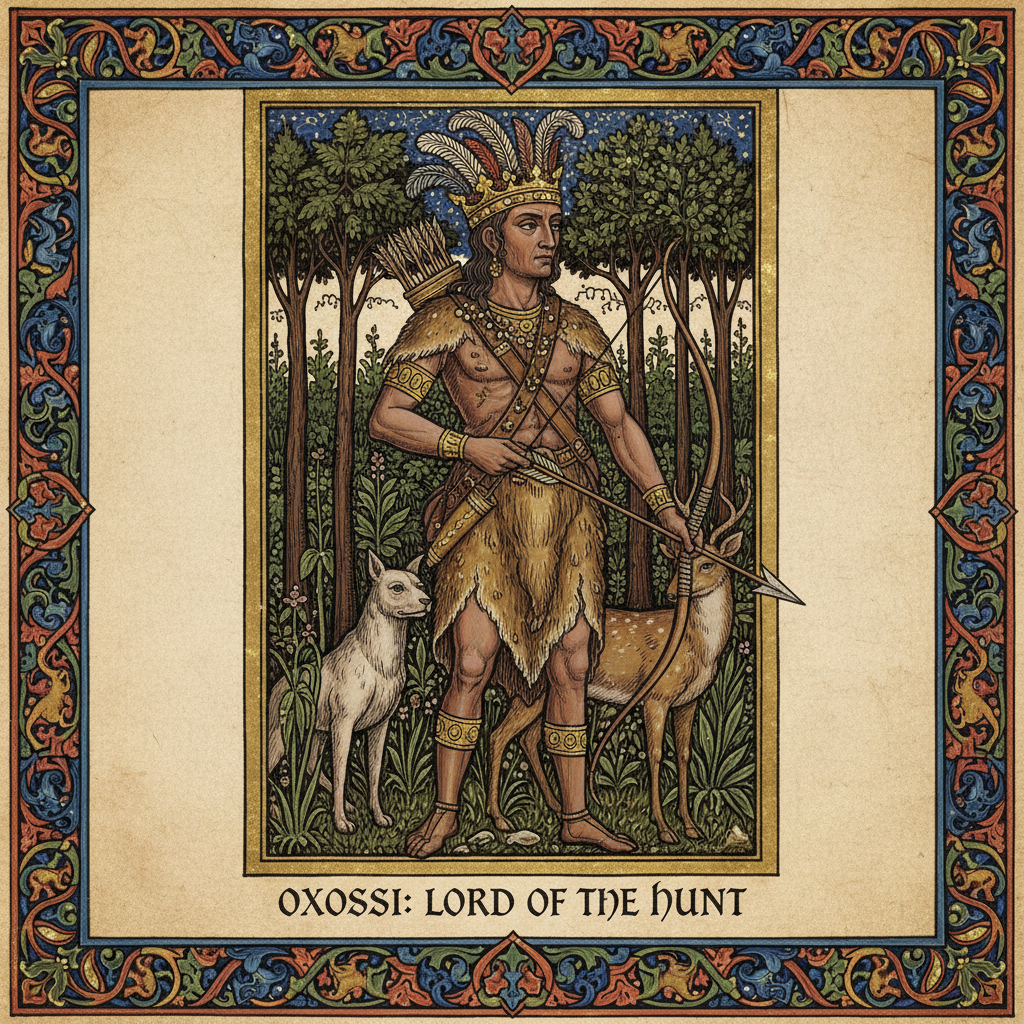
Combat Profile
Arrow of Certainty
Oxóssi fires a perfectly-aimed projectile that never misses its target, striking with the precision of a master hunter who reads the forest's whispers.
Master of the Wild
Oxóssi moves unseen through natural environments and perceives all living creatures within his domain, granting enhanced awareness and communion with the animal kingdom.
Solitude. Oxóssi is the forest, and the forest is not built for crowds. He does not fight armies -- he hunts. His precision requires patience and isolation. In the city, his power thins. In the Amazon, it is absolute
“Oxóssi releases one arrow. One is enough. The arrow finds what it seeks because Oxóssi already knows where the prey is before the arrow is released.” — Candomblé tradition
Lore: Oxóssi (Ochosi in Yoruba and Cuba) is the divine hunter — silent, precise, patient. In Yoruba tradition he is one of the Warriors, the foundational Orishas given to initiates as their first spiritual protectors. In Cuba he is associated with justice and the forest. In Brazil, he became something more expansive: the king of the forest, and the forest is the Amazon.
The theological significance of this expansion cannot be overstated. The Amazon basin is the largest tropical rainforest in the world — a cathedral of biodiversity housing an estimated 10% of all species on Earth, with ecosystem processes that influence the climate of the entire planet. For Candomblé, this is not geography. It is Oxóssi’s kingdom. When Candomblé priests speak of the forest, they mean this specific forest — the forest that was here before the Portuguese arrived, that sheltered the indigenous peoples who encountered those arrivals, that contains plants whose medicinal properties informed Candomblé healing practice, and that continues to hold the Orixá’s axé in its roots and canopy.
Oxóssi’s arrow — which never misses its target — is one of the most poetically precise symbols in the diaspora traditions. A hunter who always hits what he aims at must, by definition, always aim at what he intends to hit. Ochosi’s foundational tragedy (accidentally killing his own mother — see Yoruba.md) appears in some Brazilian lineages. Oxóssi holds this: the one who cannot miss must be especially careful about what he aims at.
Parallel: Oxóssi is Ochosi (Yoruba/Cuba) — see Yoruba.md. In his Brazilian expansion into the Amazon specifically, the closest parallel is Artemis as goddess of the wilderness — but Artemis commanded the Greek forests, which were manageable in scale. Oxóssi commands a forest larger than Western Europe. He also parallels Cernunnos (Celtic lord of the animals and the wild), Green Man traditions across European mythology, and Kaang (the Bushman creator god who maintains the balance of the natural world). None of them govern a space the scale of the Amazon. Oxóssi’s domain is, quite simply, the largest sacred forest in the history of world religion.
2 min read
Deforestation. This is not metaphor: the systematic destruction of the Amazon basin is, in Candomblé theology, the desecration of Oxóssi's domain. Some Candomblé priests have explicitly framed environmental destruction in terms of spiritual consequence -- the Orixás do not separate the sacred from the ecological
Roger Bastide, *The African Religions of Brazil* (1978); J. Lorand Matory, *Black Atlantic Religion* (2005)