Combat Profile
Maternal Tide
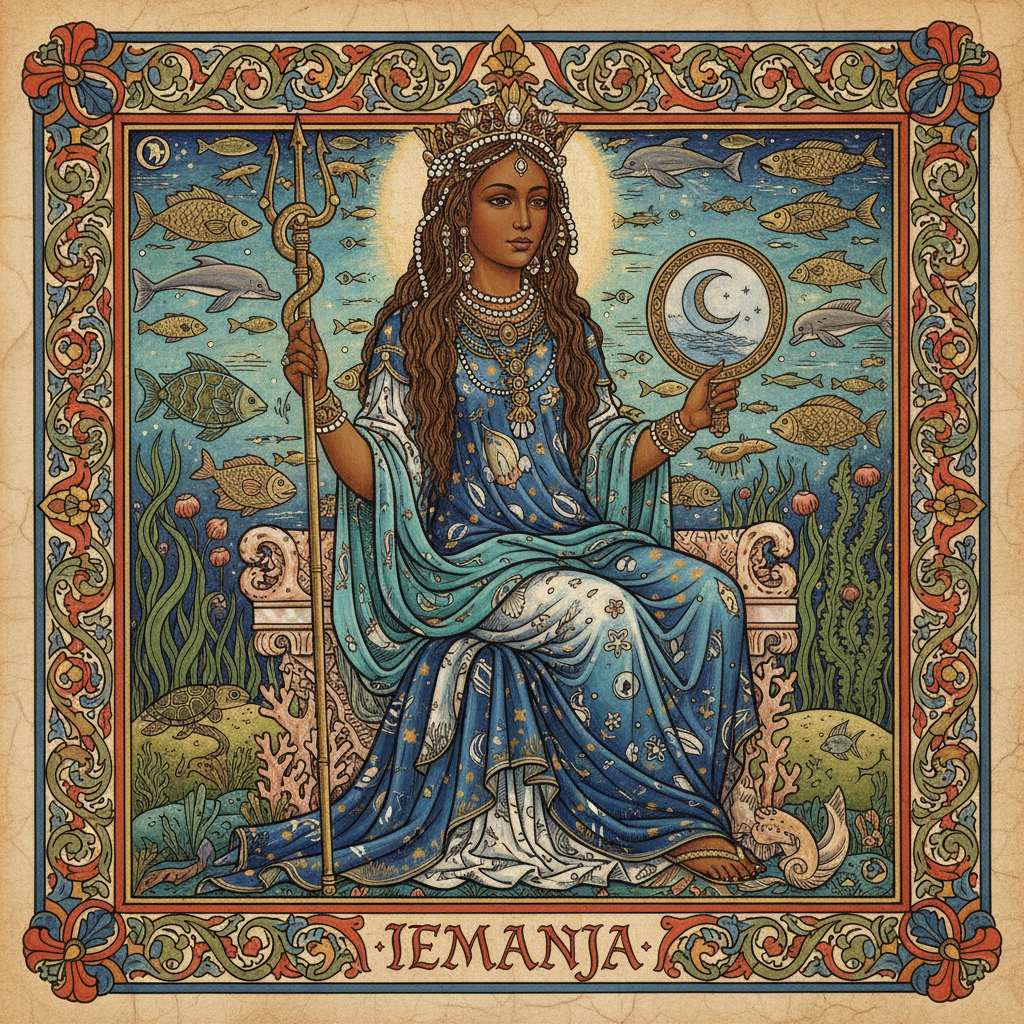
grants allies protection and renewal while drowning enemies in waves of maternal wrath if her children are threatened
Mother of All Waters
her presence brings fertility, safe passage, and dreams to those who honor her, while the moon guides her eternal protection over women and children
Her grief. The Atlantic Ocean is Iemanjá's domain, and the Atlantic was the site of the Middle Passage -- the ocean crossing that killed an estimated 2 million of her children. In Brazilian Candomblé theology, Iemanjá holds the memory of every enslaved person who died at sea. Her tears are in the salt of the ocean. She is not only the protector; she is the bereaved mother whose grief is the depth of the sea itself
“Every flower that reaches the sea is a prayer. Every prayer reaches Iemanjá. And Iemanjá answers — not always in the way you expected, but always in the way you needed.” — Candomblé tradition
Lore: Iemanjá (Yemoja in Yoruba, Yemayá in Cuba, La Sirène in Haiti) is the Orisha of the ocean, and in Brazil she has achieved something remarkable: she has become a figure of national devotion that transcends religious boundaries. The New Year’s Eve ceremony — the Festa de Iemanjá — is not primarily a religious ritual for initiated Candomblé practitioners. It is a mass popular event in which ordinary Brazilians who would not call themselves religious participate because it is simply what you do when the new year comes: you go to the sea, you thank Iemanjá for the year, you ask her blessing for the next one. The African goddess of the ocean became the patron saint of Brazil’s relationship with time itself.
The practice of reading the offerings tells you the theology in miniature. If your boat of flowers returns to shore with the tide, your wish was not accepted, or Iemanjá is calling you back to try again. If it is carried out to sea, it was accepted. The ocean decides. The mother decides. You submit your hopes to the water and wait to see if they are taken or returned. This is not magic in the consumer sense — not guaranteed outcomes for correct performance. This is petition: the humble acknowledgment that what you desire requires more power than you possess, and that the divine mother of the sea has the power to grant or withhold.
Iemanjá’s appearance in Brazil differs from her Nigerian and Cuban presentations. In Brazil, she is often depicted as a pale-skinned woman rising from the waves with long dark hair — a figure that synthesizes the African spiritual tradition with Brazilian visual culture in ways that have been debated (the European skin tone reflecting colonial aesthetics) but that also reflect the genuinely syncretic nature of the tradition. In Candomblé ceremonial contexts, she appears in blue and white, her colors, and those who receive her in trance move like the ocean — flowing, circular, their arms extended like waves.
Parallel: Iemanjá is the divine mother of waters — see the complete parallel discussion in Yoruba.md. In Brazil specifically, her New Year’s festival creates an unambiguous parallel with the ancient Roman Navigium Isidis (the Ship of Isis), the spring festival in which devotees launched flower-laden boats onto the sea to honor Isis as the protector of sailors. Iemanjá’s New Year ceremony and the Navigium Isidis are the same theological act: the human community releasing its hopes and fears to the divine mother of water at a moment of transition. The fact that they were invented independently — one in West Africa and Rome, one in Brazilian Candomblé — suggests that this is not coincidence but something universal about how humans relate to the ocean as a symbol of the divine maternal.
2 min read
Nothing counters the mother of the ocean. But Iemanjá can withdraw her protection from those who harm her children or pollute her waters. The theological warning is also an ecological one: the desecration of the ocean is the desecration of the divine
Roger Bastide, *The African Religions of Brazil* (1978); Rachel Harding, *A Refuge in Thunder: Candomblé and Alternative Spaces of Blackness* (2000); Stefania Capone, *Searching for Africa in Brazil* (2010)