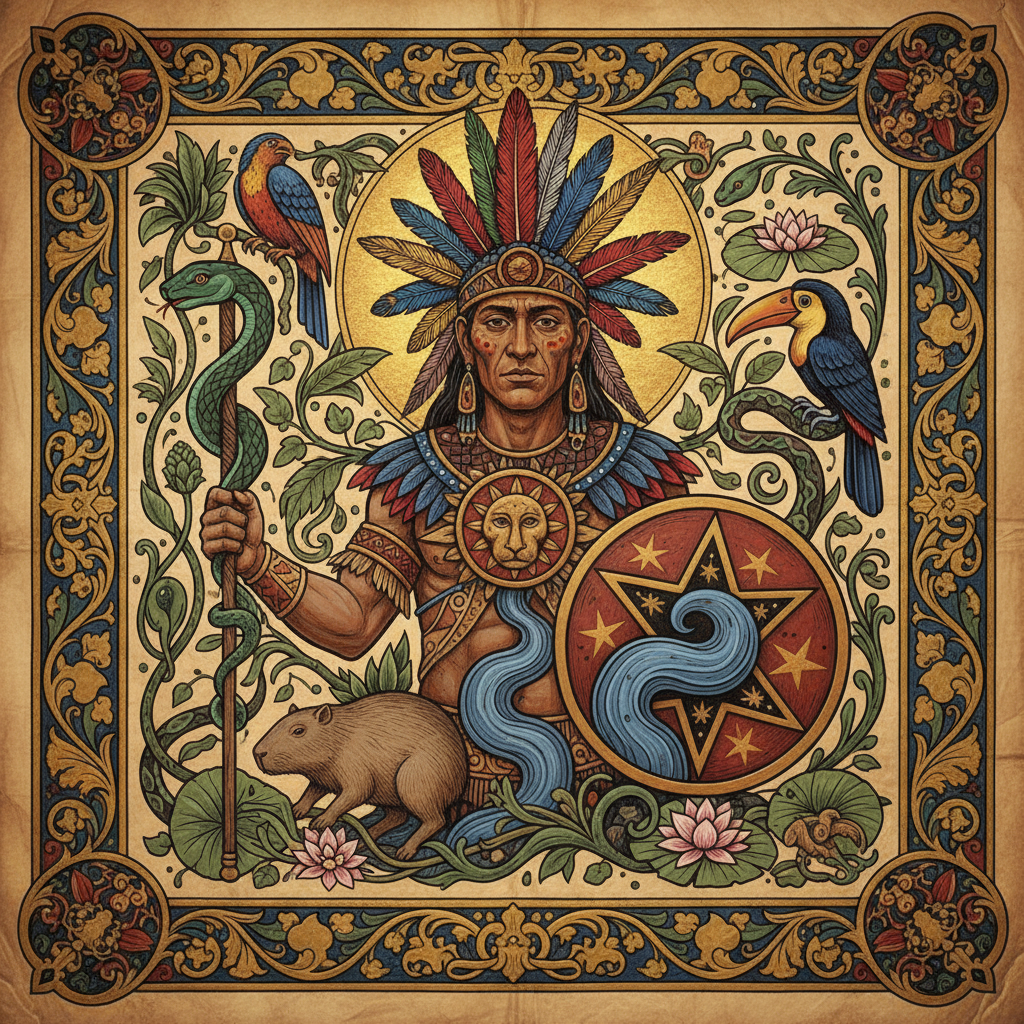
Combat Profile
Floresta Sagrada
Caboclo summons the forest itself to heal allies and entangle enemies, drawing power from the ancestral land.
Filho da Terra
Caboclo gains strength and restoration when standing on natural ground, embodying the unbroken connection between indigenous spirit and Brazilian wilderness.
Historical erasure. The Caboclos are the spirits of peoples who were exterminated in one of the most catastrophic genocides in human history: the indigenous Brazilian nations, whose population fell from an estimated 5 million at first contact to fewer than 300,000 by the 20th century. Their spirits speak from within an Umbanda tradition that is itself the product of the people who displaced them -- the African and mixed-heritage Brazilians who absorbed indigenous spiritual elements into their practice. This is complicated. The Caboclos themselves, when they speak through mediums, do not typically express anger about this. They express attachment to the land
“I have always been here. I was here before the ships came. I will be here after the last ship leaves. This is my land. I know every plant, every animal, every river. I offer you this knowledge if you can receive it.” — Caboclo speaking through a medium
Lore: The Caboclos represent a theological move that is unique in world religion: an African-derived spiritual tradition absorbing and honoring the indigenous people of the land where that tradition took root. This is not common. In most cases of displacement and conquest, the spiritual traditions of the conquerors either ignore or demonize the spiritual traditions of the conquered. Umbanda, created by African-descended Brazilians who were themselves among the conquered and oppressed, developed a different posture: it made the spirits of the indigenous Brazilians sacred intermediaries. It became the tradition that honors the people the colonizers destroyed.
This is theologically and ethically complex. The Caboclo spirits in Umbanda are not precisely the same as the actual spiritual traditions of the indigenous peoples they represent — they are mediated through the African and Spiritist framework of Umbanda. Some indigenous scholars and communities have objected to the way Umbanda uses indigenous imagery. The practice exists in a space of genuine ambiguity: it is both an act of honoring and an act of appropriation, sometimes simultaneously.
What is not ambiguous is the Caboclos’ relationship to the land. When a Caboclo speaks through a medium, they speak from a place of profound attachment to specific Brazilian ecosystems — the cerrado, the Amazon, the Atlantic Forest. They are the spirits of people who lived in intimate relation with those ecosystems for millennia before the first Portuguese ship appeared on the horizon. Their plant knowledge, encoded in Umbanda healing practice, is a fragment of the larger indigenous knowledge system that sustained millions of people for thousands of years.
Parallel: The Celtic gods and spirits absorbed into Irish Catholic practice — figures like Brigid and the fairy folk who existed in folk devotion alongside official Christianity (see Celtic.md). But the parallel the issue prompt correctly identifies is the more precise one: like the Celtic synthesis, the Caboclos represent a conquered indigenous spiritual tradition that survived by being absorbed into the tradition of another conquered people. The difference is that Ireland absorbed Celtic spiritual elements into Christianity — the tradition of the conquering empire. Brazil’s Umbanda absorbed indigenous spiritual elements into an African-derived tradition — the tradition of another conquered and enslaved people. The result is a synthesis of the oppressed, and it is theologically unlike anything else in the compendium.
2 min read
Deforestation and the destruction of indigenous territories -- the ongoing colonial project in Brazil -- is both a political and spiritual emergency in Umbanda theology. The Caboclos are the land. When the land is destroyed, their spiritual presence diminishes
Diana DeG. Brown, *Umbanda: Religion and Politics in Urban Brazil* (1994); Stefania Capone, *Searching for Africa in Brazil* (2010)