Combat Profile
Crossroads Judgment
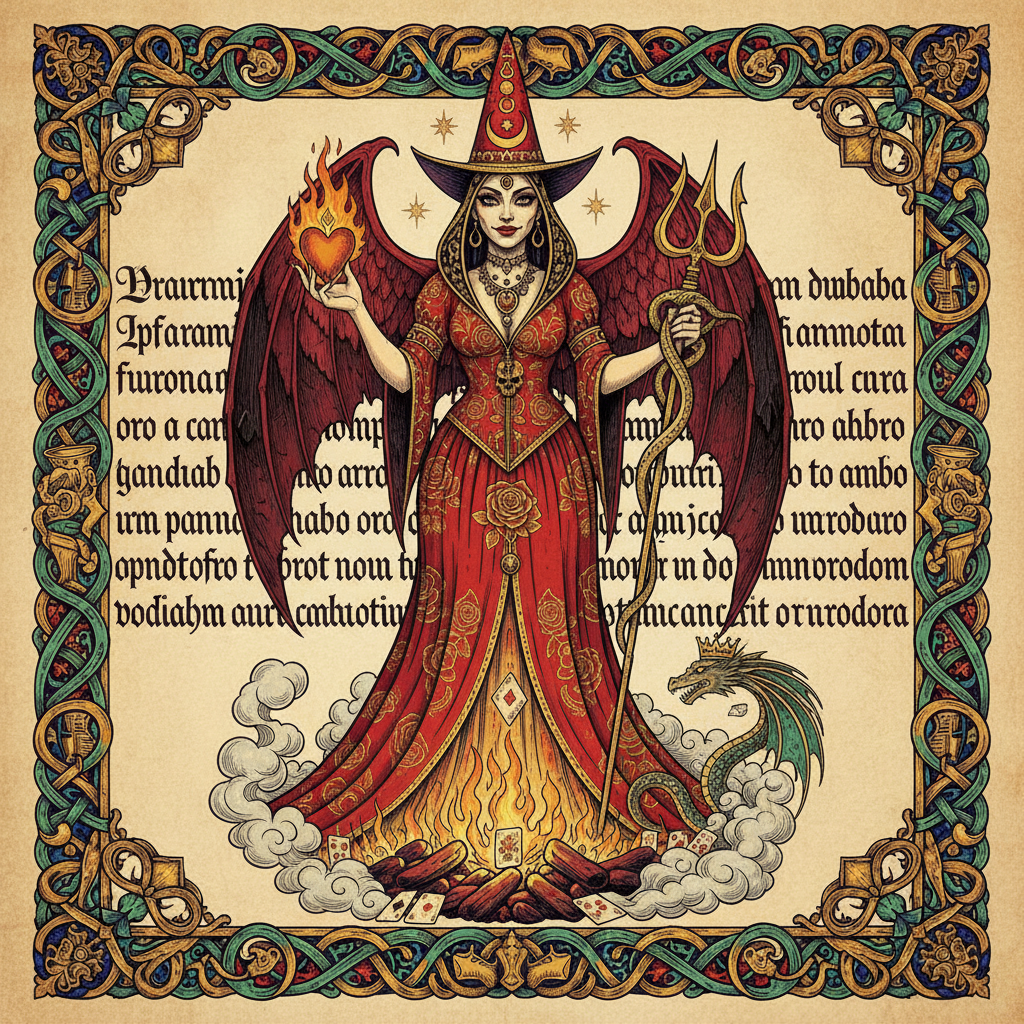
Pomba Gira manifests at liminal spaces to expose hidden truths and deliver swift justice against those who exploit or demean women.
Queen of Transgression
She embodies absolute feminine autonomy and sensual power, granting clarity to those who walk unconventional paths and protection to the marginalized.
She has been systematically misrepresented as a demon -- specifically as a spirit of prostitution and moral danger -- by the Catholic church and by some sectors of Brazilian evangelical Christianity. This is not a weakness of the spirit but of the cultural context: Pomba Gira represents feminine autonomy, and Brazilian Catholicism and evangelicalism have historically treated feminine autonomy as demonic. The misrepresentation tells us more about the accusers than about the spirit
“Pomba Gira does not walk where angels fear to tread. She dances there.” — Umbanda tradition
Lore: Pomba Gira is one of the most extraordinary figures in this entire compendium for a specific reason: she does not exist in the Yoruba tradition. She has no direct African prototype. She was born in Brazil.
The name “Pomba Gira” derives from the Bantu word “Nkumba Ngira” (spirit of the crossroads), carried to Brazil by enslaved people from Kongo and Angola — the second-largest African ethnic group in Brazil after the Yoruba. In the Bantu tradition, both male and female crossroads spirits existed. In Brazil, the female crossroads spirit developed, under the specific conditions of Brazilian society, into Pomba Gira: the feminine counterpart to Exu, the transgressive spirit who lives at the margins of respectable religion, who governs sexuality and feminine power with complete unapologetic authority.
What makes Pomba Gira theologically remarkable is what she reveals about the society that created her. She embodies everything that Catholic and evangelical Brazil has historically suppressed in women: sexual desire, independence from male authority, the willingness to speak about the erotic without shame, the assertion that feminine power is sacred rather than sinful. She drinks champagne — an aristocratic beverage — at the crossroads. She smokes cigarillos — a male leisure activity — without permission. She wears red and black — colors of passion and power — rather than the white of purity that Candomblé tradition assigns to women’s virtue. She is the spirit of the woman who refuses to perform respectability, and she is beloved.
In Umbanda ceremony, Pomba Gira’s arrival transforms the atmosphere. The medium who receives her begins to move differently — more fluid, more seductive, more direct. The questions people ask of Pomba Gira are the questions they cannot ask elsewhere: about love that has gone wrong, about desire that has no sanctioned outlet, about justice for women whose suffering is not legible within the official institutions of church and state. She answers these questions without shame and without judgment.
The parallels that the issue prompt correctly identifies: Lilith (the biblical feminine figure who refused to submit to Adam and was demonized for it — see Demons.md); Erzulie Dantó (the fierce Haitian Lwa who fights for the defenseless — see Haitian-Vodou.md). But Pomba Gira is distinct from both because she is specifically Brazilian, specifically a creature of urban crossroads religion, and specifically the spirit who presides over the intersection of African spiritual power and the transgressive feminine in a deeply Catholic patriarchal society. She is the spirit that Brazil needed and therefore created.
2 min read
Nothing effectively counters Pomba Gira within the Umbanda system. She works the spaces that other spirits consider beneath them, and her power in those spaces is absolute
Stefania Capone, *Searching for Africa in Brazil* (2010); Diana DeG. Brown, *Umbanda: Religion and Politics in Urban Brazil* (1994)