Teresa and the Golden Spear
c. 1559-1560 · Convent of the Incarnation, Ávila, Castile
Contents
A Carmelite nun in sixteenth-century Castile sees an angel beside her with a fire-tipped spear of gold, who plunges it through her heart again and again. The pain is so great she moans aloud — and the sweetness so great she would not lose it for anything in creation.
- When
- c. 1559-1560
- Where
- Convent of the Incarnation, Ávila, Castile
She is forty-five and she is exhausted.
The Convent of the Incarnation in Ávila is too large, too noisy, too full of well-born women who have come there to escape marriages they did not want and who treat the cloister like a salon. Teresa has been a nun here for twenty-five years. She has been ill for most of them — heart trouble, fainting fits, a paralysis at twenty-four that nearly killed her. She has been mediocre at prayer for two decades. She admits this in her own voice, in the autobiography her confessor will force her to write: I was one of the most wretched souls who ever practiced prayer, and yet I went on practicing it.
In her late thirties, the visions began.
Christ at her side. Christ in front of her. Christ’s hands. Christ’s eyes. Locutions she could not silence. Raptures during which her body lifted from the floor and the other nuns had to hold her down. She has examined every one of these phenomena with a Castilian skepticism that would do credit to a prosecutor. She has consulted six confessors. Two told her the visions were from the devil. She has continued to write them down anyway.
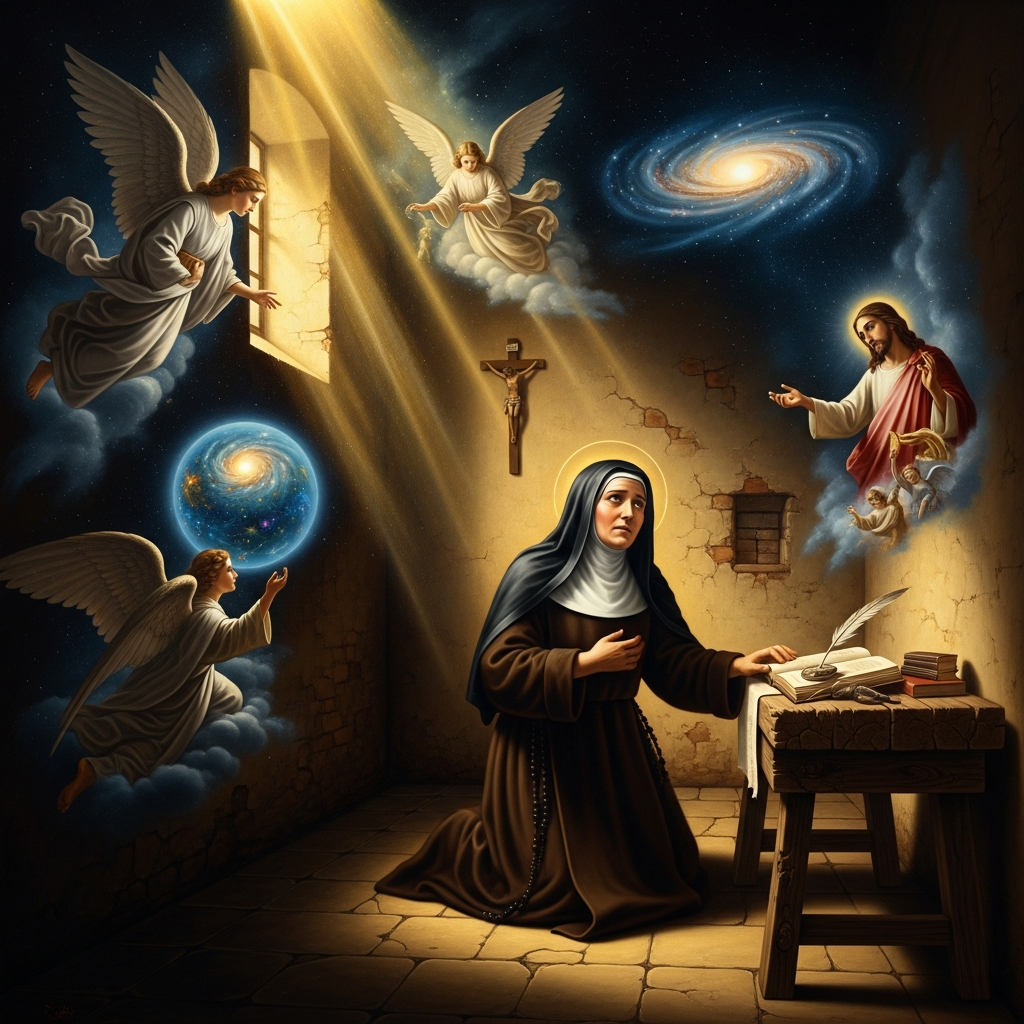
The cell is small. The window is high. The afternoon light falls on a wooden crucifix and a chest containing two habits and nothing else.
She kneels for the office. She is not expecting anything. She has learned, over the years, not to expect — expectation is the surest way to get nothing. She prays the way she breathes: without commentary, without watching herself do it.
And then, beside her, on her left, she becomes aware of a presence.
She turns her head and sees the angel.
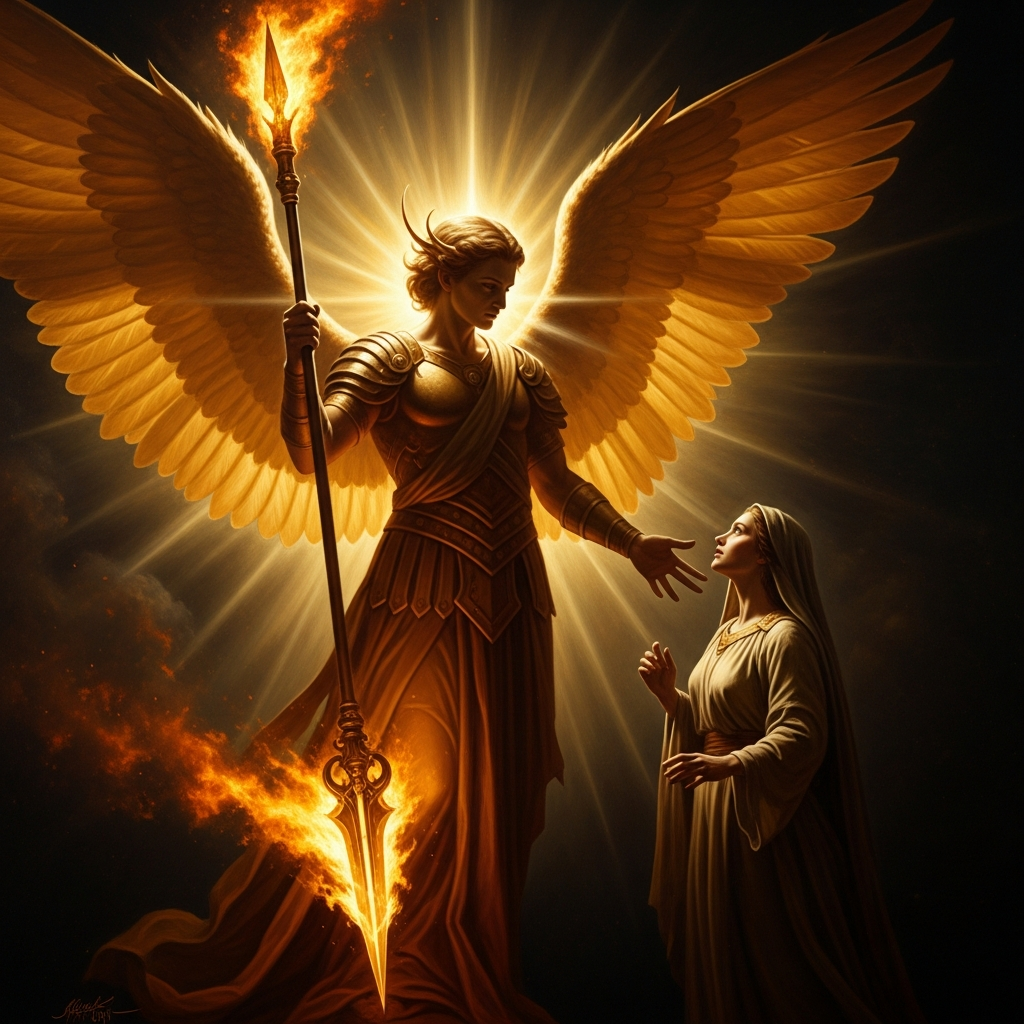
Not large. Not the towering seraph of Isaiah. A small bodily shape — corporal, though I do not usually see them so — exquisitely beautiful, his face on fire with a fire that does not consume. She thinks he is of the highest rank because he burns so much. The cherubim, perhaps. Or one of the seraphim — the ones whose name comes from the Hebrew root for to burn.
In his hands, a long dart of gold.
At the tip, a small flame.
She knows what is going to happen the way an animal knows weather. There is no time to refuse it. There is no part of her that wants to refuse it.
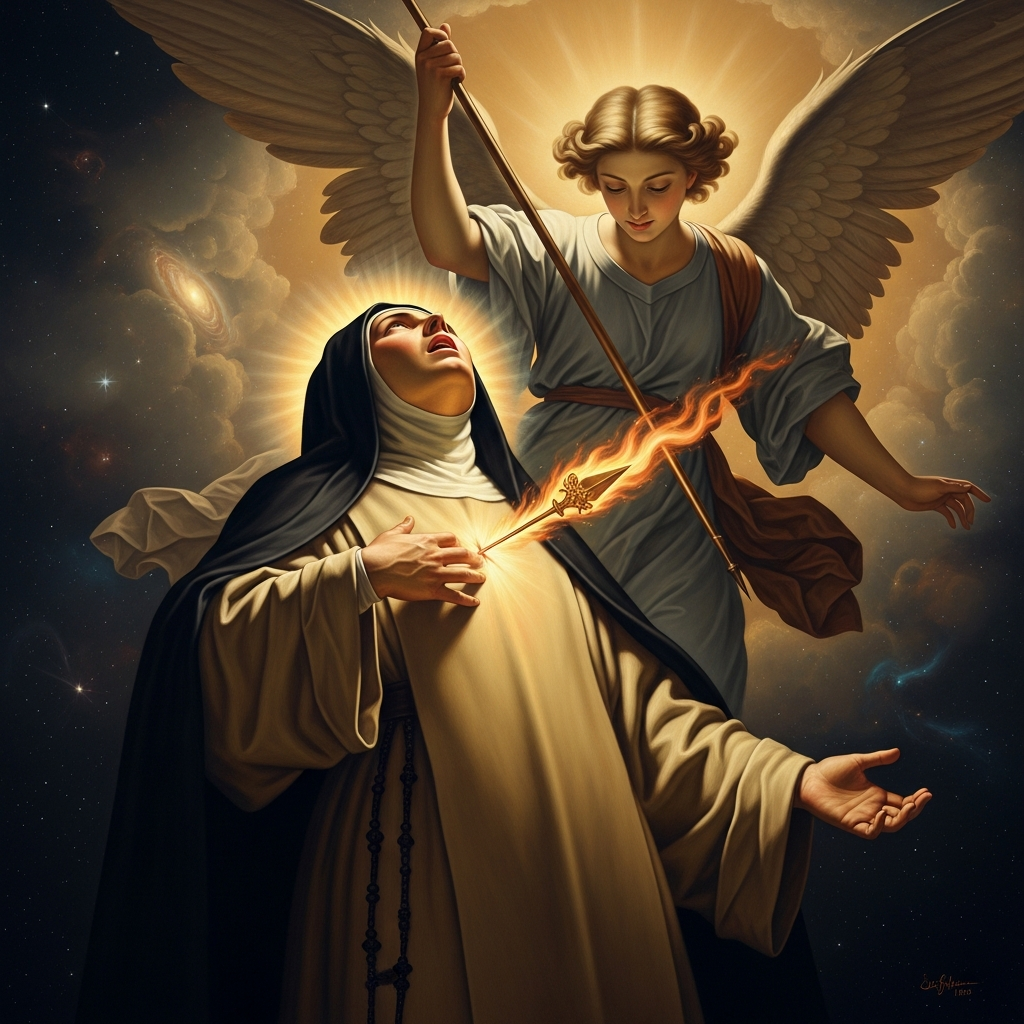
He plunges the spear into her heart.
It passes through to her entrails — she uses this word, entrañas, the Castilian word for the deepest interior, the seat of mercy and grief. He draws it out. The entrails come with it. She is left, she will write, toda abrasada — entirely on fire — en amor grande de Dios, in a great love of God.
The pain is so great that she moans. Not metaphorically. Aloud. The other nuns in the cells around her hear it and do not know what to make of it. The pain is not bodily, exactly — it is in the soul — but the body cannot help participating, and the body has its share, even a great share.
He plunges the spear again.
And again. She loses count. The dart is fire-tipped, gold-shafted, and each thrust withdraws something from her interior and leaves something else behind. The pain and the sweetness arrive together, inseparable, refusing the distinction the Castilian language has been carefully drawing between them since the Cantar de Mio Cid. She is not being wounded. She is being exchanged.
She will write, later, with the care of a woman who has read scholastic theology and knows exactly what she is risking by saying it: the pain is not bodily but spiritual, although the body has its share, and the caress between the soul and God is so sweet that I beg him in his goodness to give a taste of it to anyone who thinks I am lying.
It ends. He is gone. She is on the floor, or near it.
She lies there for some time. The fire in her entrails does not go out — for days, she will write, she could not turn her attention to anything created, her soul would not be content with anything less than God. The pain becomes a kind of permanent climate inside her. Her health, which had been broken for decades, settles into a new pattern: she will be ill the rest of her life, but the illness no longer matters in the way it had mattered.
She will see the angel again. The wound — the herida — will be probed and re-opened in subsequent ecstasies. After her death in 1582, the nuns will remove her heart and find, they will claim, a long thin scar across one of its chambers. It is preserved in a reliquary at Alba de Tormes. Pilgrims still ask to see it.
She is forty-seven when she begins the reform.
She walks out of the Incarnation and founds a smaller, stricter house — San José in Ávila, 1562. Discalced: barefoot. The nuns will own nothing. They will live in poverty, silence, and the kind of prayer that the transverberation has shown her is possible. She is opposed by her order, by the local clergy, by the Inquisition (which holds her Vida in a cell in Madrid for years), and by half the male hierarchy of the Spanish church.
She founds seventeen convents in twenty years. She walks across Castile in donkey-carts and on foot, in summer heat and winter mud, arguing with bishops and bullying landlords. She writes the Way of Perfection, the Foundations, the Interior Castle — the last of which maps the soul as a series of seven concentric mansions, with the King in the innermost room, and the transverberation at the threshold of the sixth.
She finds, in a young friar named Juan de Yepes, a co-conspirator. He will become John of the Cross. He will write poetry to match her prose. They will be imprisoned, separated, vindicated, canonized.
She dies at sixty-seven, on October 4, 1582 — the night the Gregorian calendar reform deletes ten days from European history. Her last words, by some accounts: At last, Lord, I am a daughter of the Church. By others: It is time we were on our way.
In 1622 she is canonized. In 1647 Bernini begins carving her ecstasy in marble in Rome — a swooning woman, head fallen back, mouth parted, the smiling angel above her with the golden spear, the whole tableau lit from a hidden window so the light seems to come from inside the marble itself. The sculpture has scandalized critics for four centuries. If that is divine love, Charles de Brosses sneered in 1739, I know it well.
He missed the point. So have most of her readers. So has most of Christianity. The point is that she would not have been embarrassed by the comparison.
Teresa is the saint who refused to apologize for the body’s participation in prayer. She found a vocabulary — borrowing from the Song of Songs, from Castilian erotic poetry, from her own spectacular honesty — to describe what happens when the soul is taken seriously enough that the flesh has to participate.
The Sufis had been doing this for five hundred years. The Hindu bhaktas had been doing it for a thousand. The Greek lyric poets had done it before any of them. Teresa is the one who did it inside the Counter-Reformation, in a Spain run by the Inquisition, in a Church that was burning women like her in other towns the same year.
She got away with it because she was funny, because she was Castilian, because she could out-argue any inquisitor in the room, and because the visions kept coming whether the Church approved or not.
The angel still has the spear. The fire is still on its tip. The wound has been open for four hundred and seventy years.
Scenes
The convent cell at the Incarnation — visions, locutions, the exhausting honesty of her self-examination
 Generating art…
 The seraph appearing beside her with the great golden spear, fire at its tip
 Generating art…
 The transverberation — the spear plunged into her heart, the moaning, the unbearable sweetness
 Generating art…
 Echoes Across Traditions
Entities
- Teresa of Ávila
- the Seraph
- John of the Cross
- Christ
Sources
- Teresa of Ávila, *El Libro de la Vida* (1565), especially ch. 29
- Teresa, *Las Moradas* / *The Interior Castle* (1577)
- Rowan Williams, *Teresa of Avila* (1991)
- Cathleen Medwick, *Teresa of Avila: The Progress of a Soul* (1999)
- Bernini, *Ecstasy of Saint Teresa* (sculpture, 1647-1652, Santa Maria della Vittoria, Rome)