The New Jerusalem at Münster
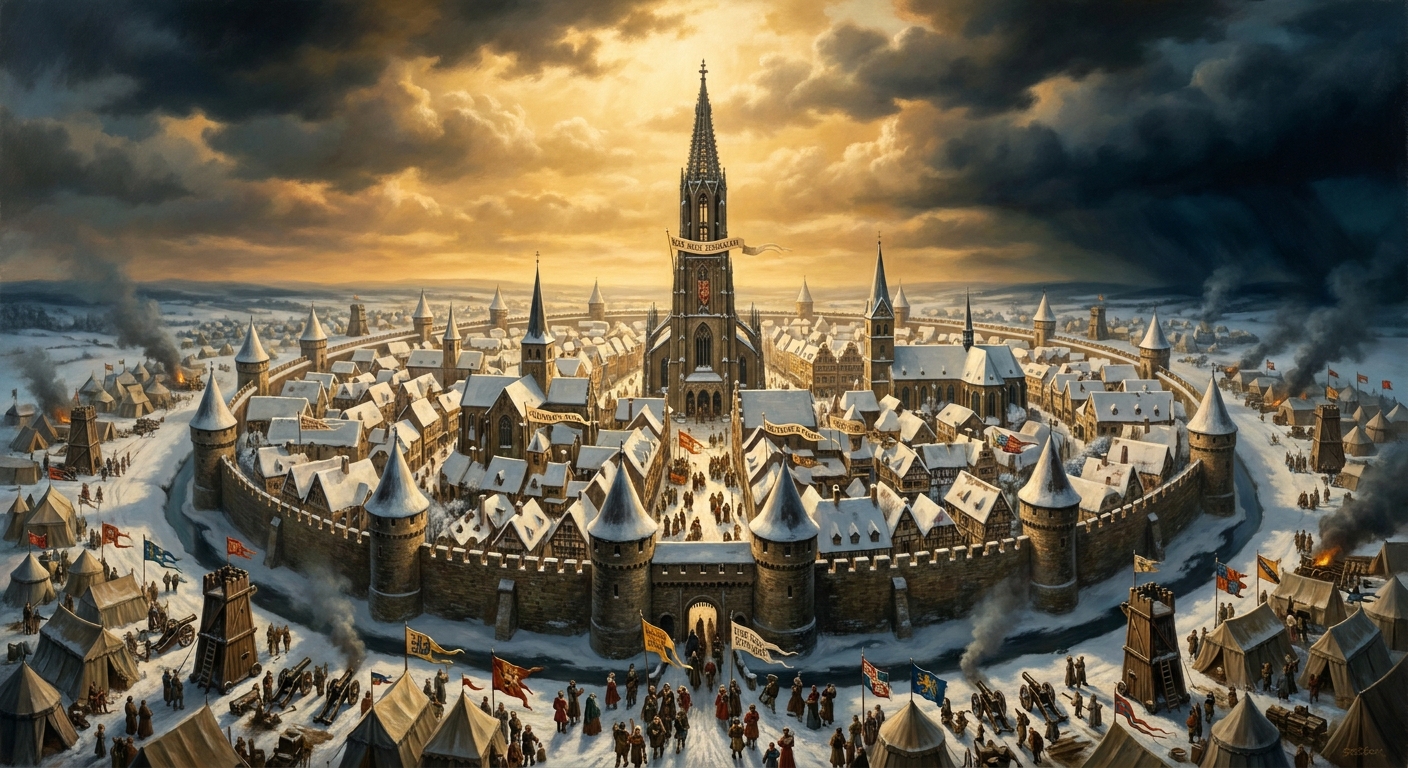
February 1534 → June 25, 1535 · Münster, Westphalia · The walled city of Münster in the Prince-Bishopric of Westphalia — declared the New Jerusalem by its Anabaptist rulers; surrounded for sixteen months by combined Catholic and Lutheran armies
Contents
Anabaptist millennialists seize the Westphalian city of Münster, abolish private property, institute polygamy, and crown Jan van Leiden king of the New Zion — until a sixteen-month siege ends with the leaders' bodies hung in iron cages from the tower of St. Lambert's, where the cages still hang today.
- When
- February 1534 → June 25, 1535 · Münster, Westphalia
- Where
- The walled city of Münster in the Prince-Bishopric of Westphalia — declared the New Jerusalem by its Anabaptist rulers; surrounded for sixteen months by combined Catholic and Lutheran armies
The city falls to them in February.
The Catholic bishop, Franz von Waldeck, has been losing the doctrinal argument inside Münster’s walls for two years. Lutheran preachers replaced Catholic ones. Anabaptist preachers — Bernhard Rothmann from the pulpit of St. Lambert’s, drawing crowds who weep and rebaptize themselves in tubs in the square — have replaced the Lutherans. By February 1534, the elections produce an Anabaptist majority on the council. The bishop’s garrison withdraws.
Pamphlets go out across the Netherlands and the Rhineland: Come to Münster. The New Jerusalem is rising. Bring weapons, bring tools, bring your families. Christ is coming back here.
Refugees pour through the gates. By the time the bishop’s mercenaries close the ring around the walls in late February, there are perhaps fifteen thousand believers inside, and Jan Matthys, a Haarlem baker who claims to be Enoch returned, is in charge.
Matthys’s first acts are administrative.
Catholics and Lutherans who refuse rebaptism are given a choice: convert, leave, or die. Most leave through the gates with what they can carry; the bishop’s troops let the refugees pass and search them for valuables. Inside the city, all coin and gold is gathered and pooled. Locks are removed from doors. Houses are opened to anyone who needs shelter. Account books are publicly burned.
The communism is not metaphor. It is enforcement.
Books, too, except the Bible, are burned in the cathedral square. Not Luther, not Erasmus, not the church fathers — all of it. The New Jerusalem will not need a library. The Spirit speaks fresh.
On Easter Sunday, 1534, Matthys announces a vision: he will ride out alone against the besieging army, and God will scatter them. He rides out with twelve companions. The mercenaries catch them in the open ground and cut them to pieces in under an hour. Matthys’s head is struck off and mounted on a pike where the city can see it from the walls. His genitals are nailed to the city gate.
The city looks at the gate and falls silent.
Then a twenty-five-year-old Dutch tailor named Jan van Leiden steps forward and announces that the kingdom continues, and that he is now its king.
The coronation is in September.
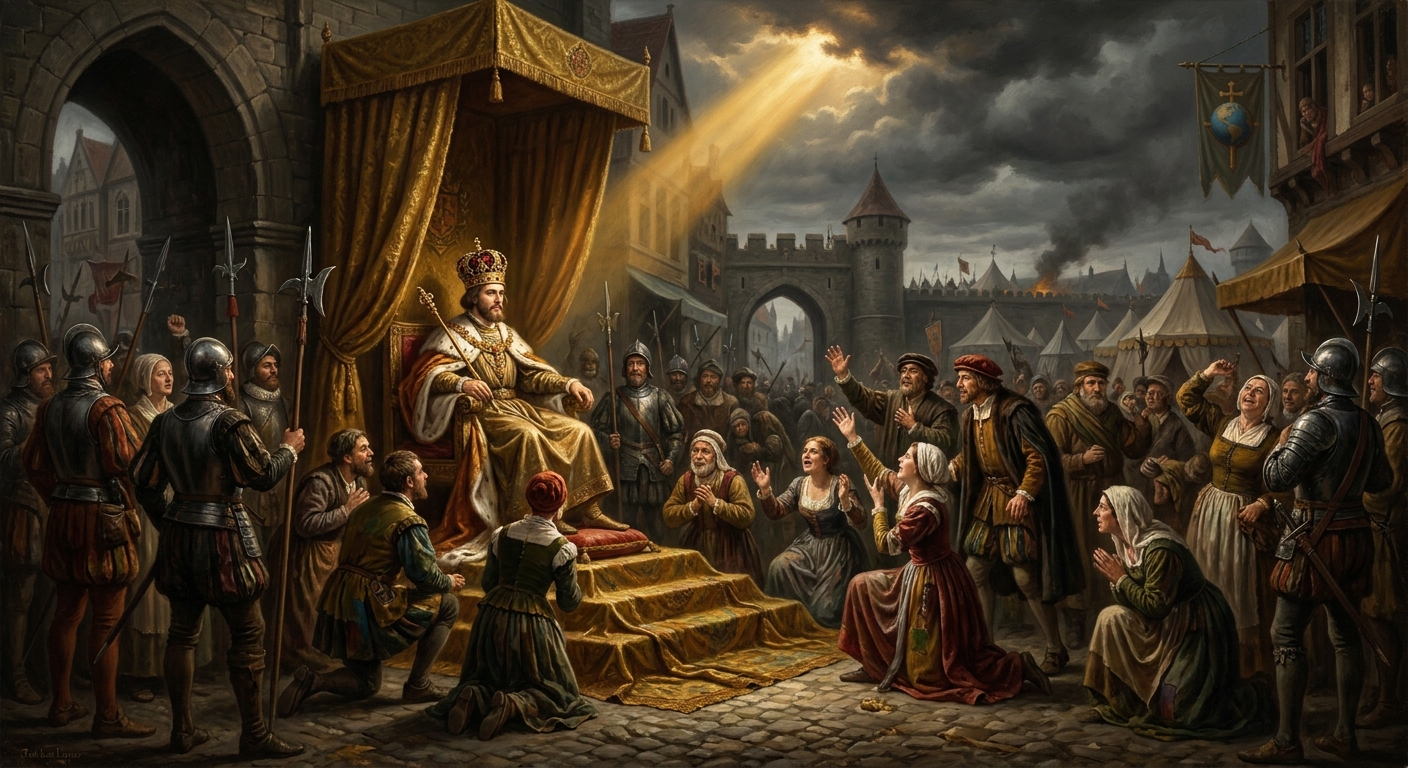
A goldsmith named Dusentschur has had a vision: Jan is to be crowned king of the New Zion, the new David, the king of righteousness, until Christ himself comes to take the throne. Jan accepts. The city’s confiscated gold is melted into a globe topped with two crossed swords, which he holds at his enthronement in the cathedral square. Twelve elders sit at his side as judges of the twelve tribes.
Polygamy is authorized for all believing men. The justification is biblical: Abraham, Jacob, David, Solomon. The practical occasion is demographic: the women in the city outnumber the men by perhaps three to one, after the executions and the desertions, and Jan rules that no woman of marriageable age may remain unmarried. He takes sixteen wives himself, including Divara, the widow of Jan Matthys.
Dissent is now treason. Public executions in the cathedral square — beheadings, mostly, by Jan’s own hand or the hand of Knipperdolling, his executioner-mayor — become weekly. One of his own wives, Elisabeth Wandscherer, asks permission to leave the city. He kills her in the marketplace himself and dances around her body singing a psalm.
The siege walls outside grow thicker. The food inside grows thinner.
By spring 1535, the city is starving.
Dogs, cats, rats, leather belts, the moss between the cathedral stones. Children with distended bellies in the streets. Jan continues to preach that deliverance is imminent — that on Easter, on Pentecost, on this saint’s day, on that one, Christ will appear above the city and the besiegers will be destroyed by fire from heaven.
None of the days arrive.
Outside the walls, the bishop’s army has been reinforced — at last — by Catholic and Lutheran troops, by Hessian and imperial regiments, by money from Philip of Hesse, even by quiet diplomatic encouragement from Wittenberg. The Reformation and the Counter-Reformation, who agree on almost nothing, agree on this: Münster cannot be allowed to win the argument about what scripture-alone might license.
On the night of June 24-25, 1535, two deserters guide the besiegers through a poorly-watched gate. The mercenaries pour into the streets in the dark.
The fighting is house-to-house through dawn. Six hundred defenders die. The remainder surrender at the cathedral square. Jan, Knipperdolling, and Bernhard Krechting are taken alive.
They keep the three of them in cages for six months while a punishment is designed.
On January 22, 1536, in front of an enormous crowd in the Münster marketplace, the executioner uses red-hot iron tongs on each of them in turn — six locations, each, on the body — for an hour. They are then stabbed in the heart with a dagger.
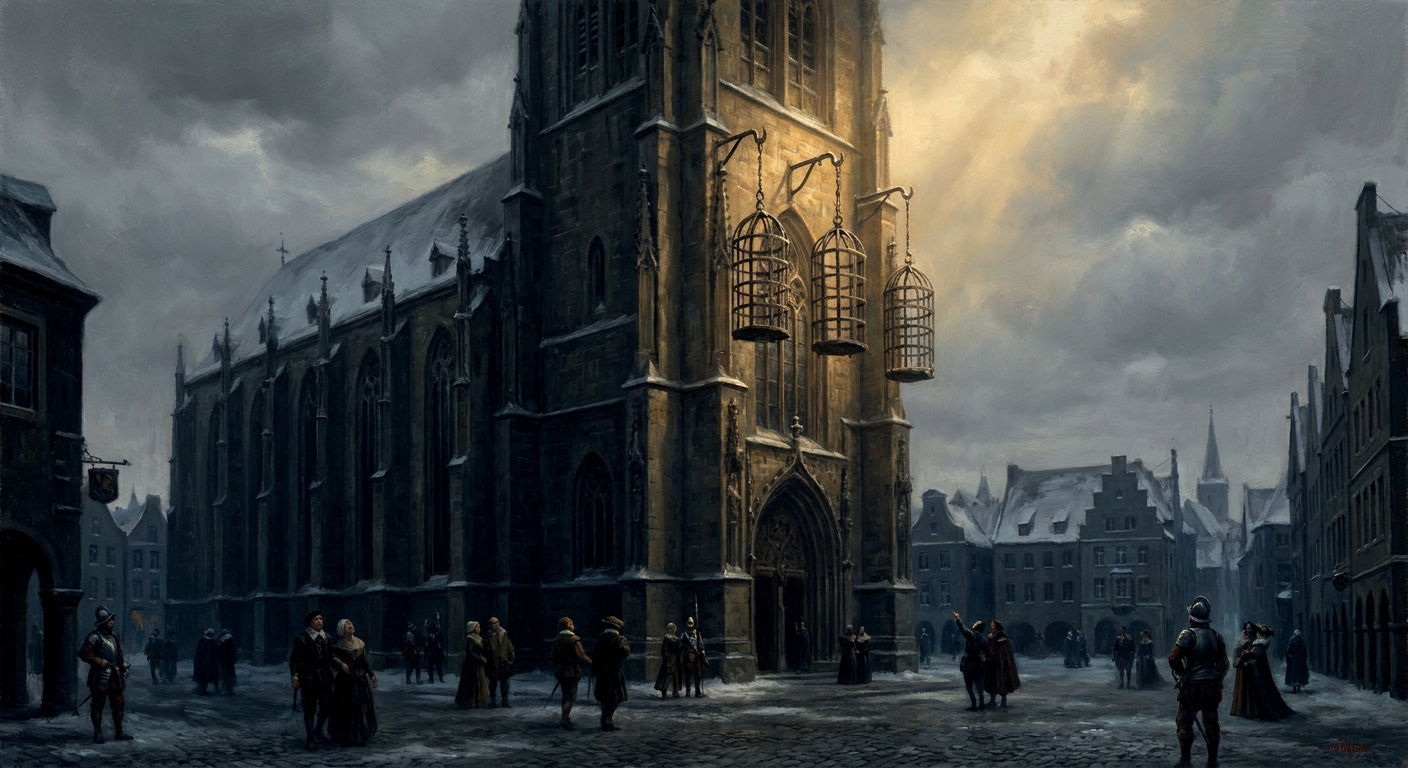
The bodies are placed in three iron cages — wrought to fit a torso each, with bars wide enough to see the corpses inside — and hoisted by chain to the tower of St. Lambert’s church, sixty meters above the cathedral square.
The bones remain inside the cages for fifty years. Birds and weather strip them eventually. The cages themselves, however, are never taken down.
They hang from the tower today. You can stand in the Münster Hauptmarkt in 2026 and look up at them: three empty iron baskets, four hundred and ninety years old, swaying very slightly in a Westphalian wind.
Münster is the Reformation’s nightmare and the Reformation’s confession. It demonstrates what happens when sola scriptura, sola fide, and an apocalyptic clock are placed in the hands of charismatic men inside a fortified city: communism, polygamy, executions, a king with a crown of melted ducats, and finally a slaughter to which both confessions consent.
Every later Anabaptist tradition — Mennonite, Amish, Hutterite — defines itself by the renunciation of Münster: pacifism instead of the sword, withdrawal instead of theocracy, simple living instead of the New Zion. The tailor-king is the dark twin every peaceable Anabaptist has had to disavow.
The cages remain. They are the only honest monument the Reformation built to itself: a public, permanent, and indefensible reminder that the radical reformation also burned, also tortured, also crowned its own kings, and was crushed by the same Christendom it had hoped to replace.
Scenes
February 1534
 Generating art…
 September 1534
 Generating art…
 January 1536
 Generating art…
 Echoes Across Traditions
Entities
- Jan van Leiden
- Bernhard Rothmann
- Jan Matthys
- Bishop Franz von Waldeck
- Knipperdolling
Sources
- James M. Stayer, *The German Peasants' War and Anabaptist Community of Goods* (Montreal, 1991)
- Anthony Arthur, *The Tailor-King: The Rise and Fall of the Anabaptist Kingdom of Münster* (1999)
- Hermann von Kerssenbroick, *Anabaptistici furoris monasterium inclitam Westphaliae metropolim evertentis historica narratio* (1573)
- Norman Cohn, *The Pursuit of the Millennium* (1957)