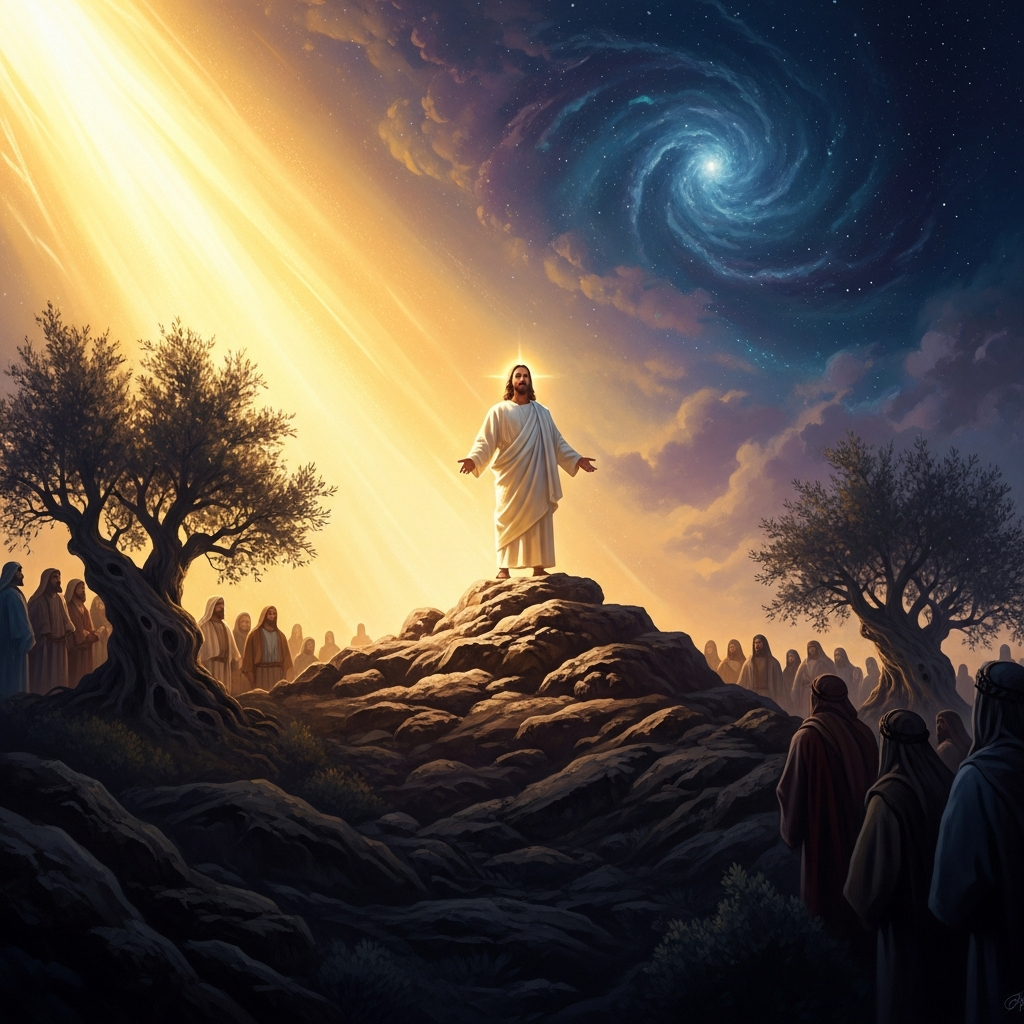
Lord, Open the King of England's Eyes
October 6, 1536 · Vilvoorde Castle, Brabant · The castle yard at Vilvoorde, eight miles north of Brussels — the imperial prison where Tyndale was held for sixteen months
Contents
William Tyndale, betrayed at Antwerp and imprisoned at Vilvoorde, is strangled and burned for translating the Bible into English — three years before Henry VIII authorizes the Great Bible, largely from Tyndale's own text.
- When
- October 6, 1536 · Vilvoorde Castle, Brabant
- Where
- The castle yard at Vilvoorde, eight miles north of Brussels — the imperial prison where Tyndale was held for sixteen months
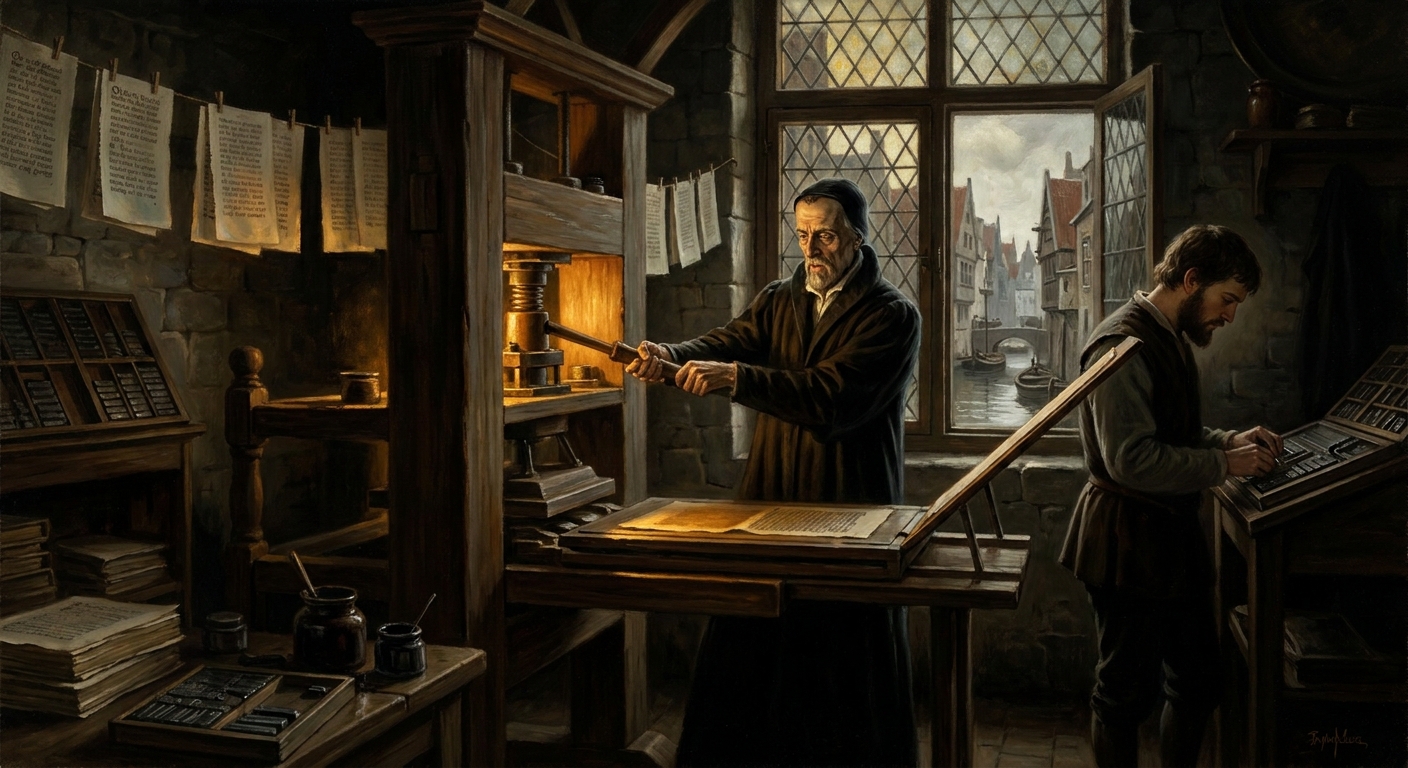
He works by candle in a back room in Antwerp.
The English merchants’ house on the Kammenstraat shelters him; the city’s printers do the rest. The New Testament is already done — 1526, octavo, pocket-sized, smuggled into England in bales of cloth and barrels of flour. Bishop Tunstall of London buys whole shipments and burns them at Paul’s Cross; the merchants take the bishop’s coin back to Antwerp and pay for a second, larger printing. Tyndale is grateful for the bishop’s patronage.
Now he is on the Pentateuch. He has taught himself Hebrew — there is no chair of Hebrew at Oxford or Cambridge, so he has learned it from rabbis in Worms and Hamburg, in cities where a fugitive Englishman can find a Jewish teacher who will trade Genesis for bread.
Genesis 1:3 comes out under his hand: Let there be light, and there was light.
He does not know yet that the sentence will outlive empires.
Henry Phillips arrives in Antwerp in the spring of 1535.
He is well-dressed, well-spoken, well-funded — too well-funded, given that he has gambled away his inheritance and is living on credit. Someone in England has paid him. Probably the bishops. Possibly Thomas More’s circle, though More himself is by now in the Tower awaiting his own execution. The transaction is never traced.
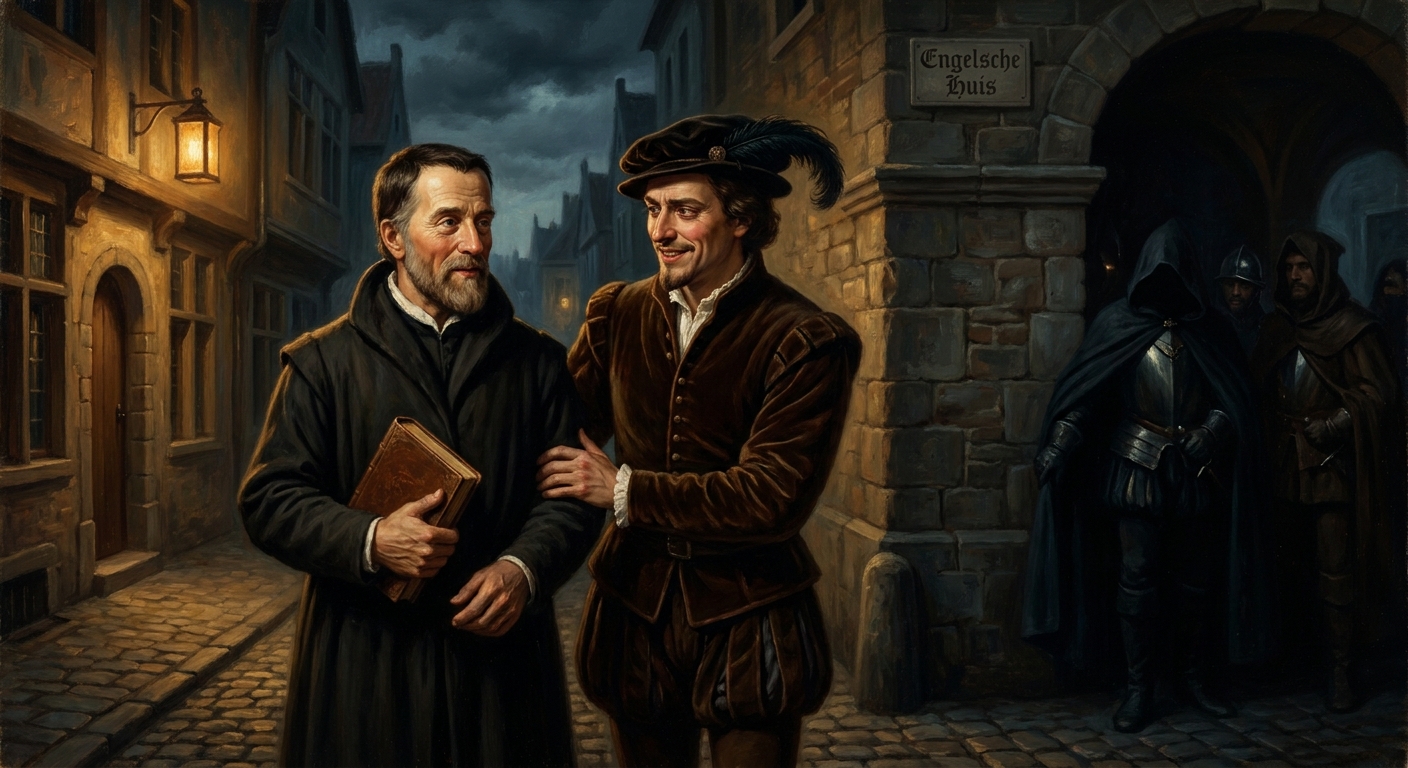
Phillips ingratiates himself. He attends Tyndale’s table. He borrows money. He compliments the translation work. Tyndale — who has been on the run for a decade, who has survived Tunstall, Wolsey, More, and the imperial spies of Charles V — somehow trusts him.
On a May afternoon, Phillips walks Tyndale to dinner through a narrow Antwerp lane. At the end of the lane, imperial officers step out of a doorway. Phillips points. That is the man. He is paid in full and disappears from history.
The cell at Vilvoorde is cold, stone, and almost dark.
He writes one letter that survives. It is addressed to the governor of the castle. He asks — the request is so modest it breaks the heart — for a warmer cap, because his head suffers in the cold; for a warmer coat, because the one he has is very thin; for a candle, because the evenings are tedious in the dark; and most of all, he writes, I beg your lordship to permit me to have my Hebrew Bible, my Hebrew grammar, and my Hebrew dictionary, that I may continue with my work.
We do not know if he received the cap or the coat. We know he received the books. The Old Testament translation continues in the prison through the winter of 1535 and into 1536. Joshua, Judges, Ruth, the books of Samuel, the books of Kings — all of them surface, two years later, in the English Bible Miles Coverdale will publish, which is to say in the Bible Henry VIII will eventually authorize, which is to say in every English Bible thereafter.
He is translating in his cell while the procurator-general of Brabant builds the case to burn him.
The trial is procedural and brief. The charges are heresy, sacramentarianism, denial of papal authority, advocacy of justification by faith. The verdict is a foregone conclusion — Vilvoorde is an imperial prison, Charles V is the most Catholic prince in Europe, and the inquisitor has not summoned a defendant in five years to acquit him.
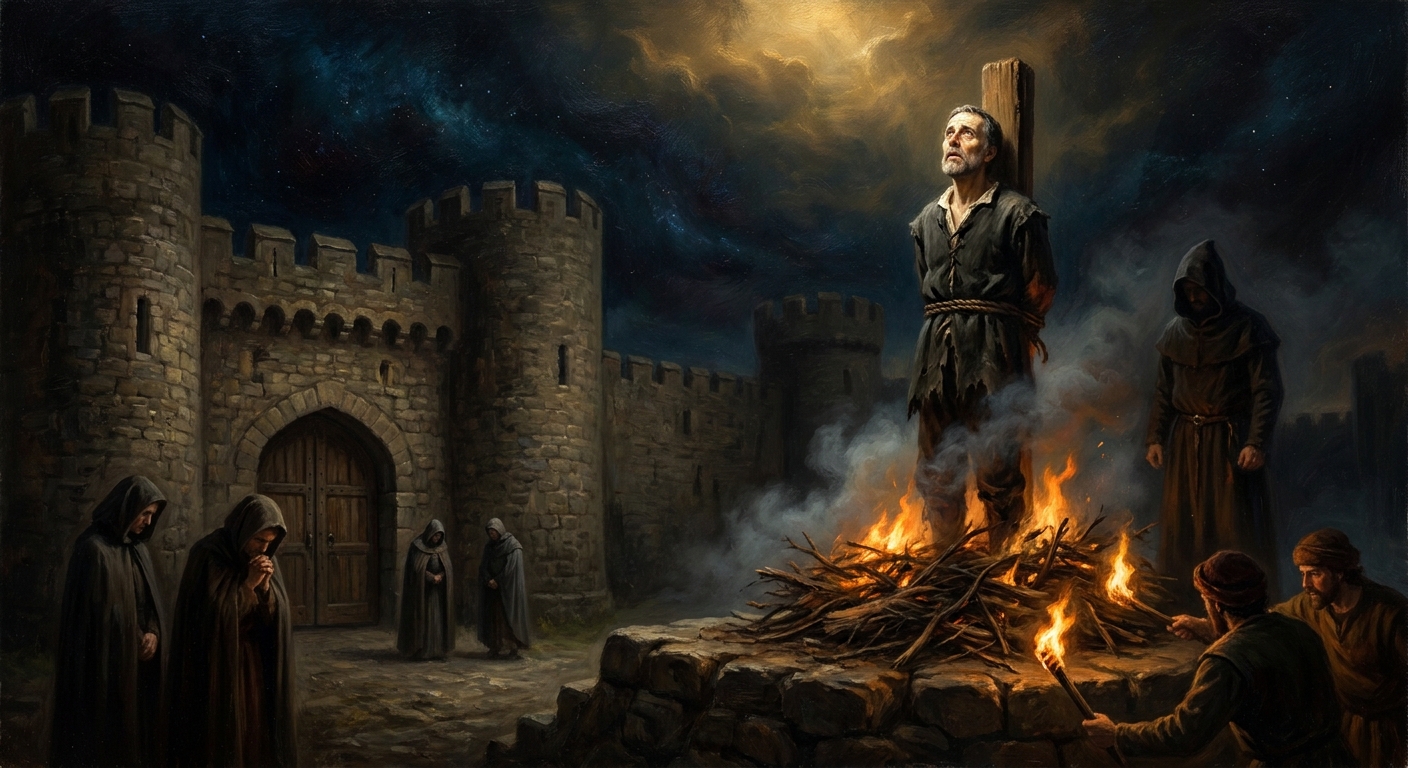
On October 6, 1536, they bring him out into the castle yard at dawn.
A crowd has gathered along the walls. The stake stands in the middle of the yard with faggots stacked around its base. They tie him to the stake with a chain at the throat and ropes at the wrists.
The executioner, behind him, holds a noose.
This is the small mercy of the day: in Brabant, heretics are strangled before they burn. The fire is for the body, not the man. The executioner waits for the signal.
Tyndale, his eyes lifted toward England across the water, says it loud enough for the crowd to hear: Lord — open the King of England’s eyes.
The noose tightens. He goes still.
The torch is brought.
The fire burns down through the morning.
Three years later — three years, almost to the month — Henry VIII signs the injunction requiring an English Bible to be placed in every parish church in the kingdom. It is the Great Bible, edited by Miles Coverdale, who has worked from Tyndale’s manuscripts. The king, who once paid agents to track Tyndale through Flanders, now stands at the front of his volume in a portrait, handing out the Word of God to his bishops and nobles.
The text is Tyndale’s. The cadence is Tyndale’s. Let there be light. The Lord is my shepherd. Our Father which art in heaven. The phrases that will be read over English coffins for the next four hundred years are the phrases of the man burned at Vilvoorde.
When the King James commissioners gather in 1604 to make the version that will define English itself, they do not start over. They start from Tyndale, edit him lightly, and call the result theirs. The English-speaking world will read Tyndale every Sunday for centuries without knowing his name.
The translator is the most dangerous heretic, because the translator is unanswerable. Once the words exist in the mother tongue, no inquisitor can put them back in Latin. The cap, the coat, the candle, the Hebrew dictionary — these were the tools Tyndale needed. They were the tools the empire could not, in the end, deny him.
Phillips disappears. The bishops who paid him die. Henry dies. Charles V abdicates. The Holy Roman Empire eventually ceases to exist. Tyndale’s English keeps going.
He prayed that the king’s eyes would open. They did. Whether the prayer caused the opening or only described what was inevitable is, like most questions about prayer, undecidable. What is certain is that the man in the cell with the dictionary won the argument.
Scenes
Antwerp, 1526
 Generating art…
 May 1535
 Generating art…
 October 6, 1536
 Generating art…
 Echoes Across Traditions
Entities
- William Tyndale
- Henry VIII
- Thomas More
- Henry Phillips
- Miles Coverdale
Sources
- David Daniell, *William Tyndale: A Biography* (Yale, 1994)
- John Foxe, *Acts and Monuments* (1563) — Foxe's *Book of Martyrs*
- Brian Moynahan, *God's Bestseller: William Tyndale, Thomas More, and the Writing of the English Bible* (2002)
- William Tyndale, *The Obedience of a Christian Man* (1528); *Practice of Prelates* (1530)