Contents
John Calvin remakes Geneva into a theological experiment: the Consistory, sumptuary laws, and total discipline of morals. In 1553, the Spanish physician Michael Servetus arrives in Geneva, attends a Calvin sermon, is recognized, arrested, and burned at the stake for denying the Trinity. Calvin later expresses regret only about the method, not the execution.
- When
- 1541–1564 (Servetus trial: 1553)
- Where
- Geneva, Switzerland
The Consistory meets every Thursday.
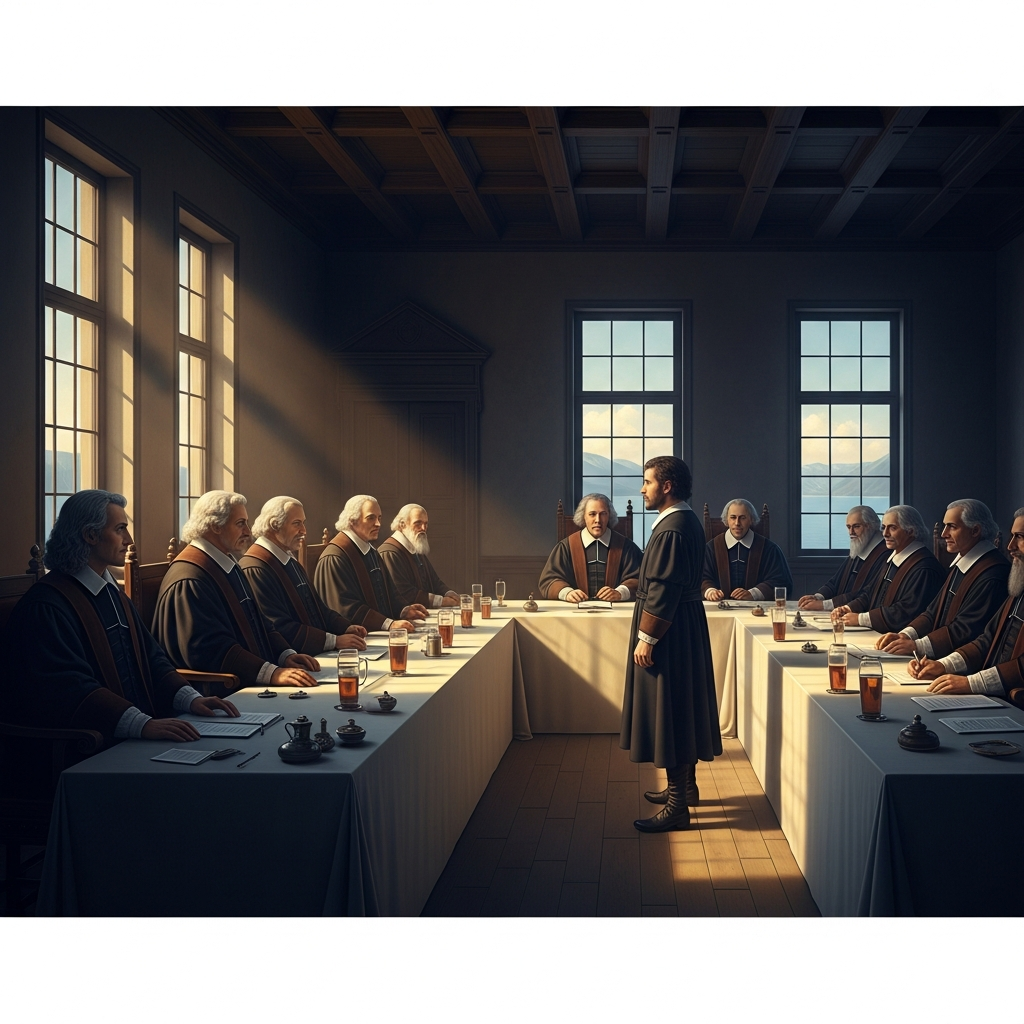
It is composed of twelve lay elders and the pastors of the city’s churches, and it has authority over the morals of every resident of Geneva. It summons citizens who have been reported for dancing, for playing cards, for working on Sunday, for saying something slanderous about a neighbor, for missing church without cause, for singing profane songs, for wearing clothing too elaborate for their station, for fornication, for failing to know the Lord’s Prayer. The elders who sit at the table are not sadists — they are, by the standards of their time, measured and procedural. They offer pastoral counsel before they issue censure. They refer the worst cases to the civil authorities. They keep meticulous records.
John Calvin is forty-two years old in 1551 and already sick with the first of the diseases that will kill him — gout, migraines, hemorrhoids, kidney stones, pleurisy, a cough that blood appears in. He is small and dark and intensely focused and not, by the accounts of those who know him well, comfortable with casual human warmth. He corresponds with Melanchthon in Wittenberg, with Cranmer in England, with Reformed leaders across Europe. He preaches twice on Sundays and once most weekdays. He writes continuously. He is, by any measure, the most influential systematic theologian of the Protestant Reformation, and he is also the de facto governor of a city of thirteen thousand people who did not, in most cases, ask to be governed by him.
He came to Geneva the first time in 1536 and was expelled in 1538 for insisting on a level of ecclesiastical discipline the city council was not prepared to enforce. He spent three years in Strasbourg, happily. Then Guillaume Farel, who had recruited him to Geneva the first time, wrote him a letter that amounted to a demand that he return, and Calvin returned in 1541, and the Consistory was established within months of his arrival, and Geneva became the laboratory he intended it to be.
The theology behind the laboratory is rigorous and internally consistent.
Calvin has read Augustine more carefully than anyone since Aquinas, and Augustine has convinced him that the human will, corrupted by the Fall, is incapable of choosing God or good without prior divine action. Grace is not a response to human effort or merit. It is God’s unconditional election of those whom God has chosen to save, from before the foundation of the world. The reprobate — those not chosen — are destined for damnation not because of their particular sins but because God has not chosen them. This is the doctrine of double predestination, and Calvin does not flinch from it. He calls it horrible, because it is horrible by human standards of justice, and he calls it true, because the scriptures require it, and he calls it consoling, because it means that the salvation of the elect is not contingent on anything they could do or fail to do.
From this theology he builds an ethic. Because the elect are saved not by works but by grace, they cannot be complacent about their behavior — the visible fruits of election are evidence (though not cause) of one’s status, and a man who behaves as though he is not elect is living a lie about himself. The discipline of the Consistory is not a means of earning salvation. It is a means of keeping the city in conformity with the life that the elect are called to live, so that the city itself can be a witness to the world of what a community redeemed by grace looks like.
It is a beautiful argument. It is also an argument that gives the theologically confident enormous authority over the theologically uncertain, and Geneva in the 1550s has no shortage of theologically confident men.
Michael Servetus arrives in Geneva in August 1553.
He is a Spanish physician — brilliant, restless, the man who first correctly described pulmonary circulation, the man who has spent twenty years corresponding with Calvin on theological questions and has been, from Calvin’s perspective, both intellectually interesting and dangerously wrong. Servetus denies the Trinity. He has published Christianismi Restitutio — the Restitution of Christianity — arguing that the orthodox doctrine of three persons in one God is a corruption introduced by Greek philosophy into the originally simpler monotheism of the New Testament. This is not a safe position anywhere in sixteenth-century Europe. The Catholic Inquisition has already condemned him in absentia and burned his effigy at Vienne.
He comes to Geneva by choice. Perhaps he thinks Calvin will protect him from the Inquisition. Perhaps he thinks their long correspondence has established a relationship that will allow him to argue his case in person. Perhaps he is simply incautious. He attends a Sunday sermon in the church of Saint-Pierre, where Calvin is preaching, and someone in the congregation recognizes him and tells the city authorities.
Calvin knows about the recognition by Sunday evening. He provides the prosecution with the letters Servetus has written him over the years, which are damning. Servetus is arrested on August 14 and confined in the Maison de Ville.
The trial takes three months. It is conducted according to the procedures of Geneva’s civil courts, with Calvin testifying as a theological expert rather than as a prosecutor, though the distinction is subtle. The Genevan council solicits opinions from the Reformed churches of Bern, Basel, Zurich, and Schaffhausen. All four condemn Servetus’s theology and recommend punishment; none specifies the method. On October 26, the council sentences Servetus to death by fire.
Calvin petitions for beheading.
This is the form that his later regret takes — a letter to Farel noting that he has asked for the execution to be by the sword rather than by fire. The petition is denied. The city council burns Servetus.
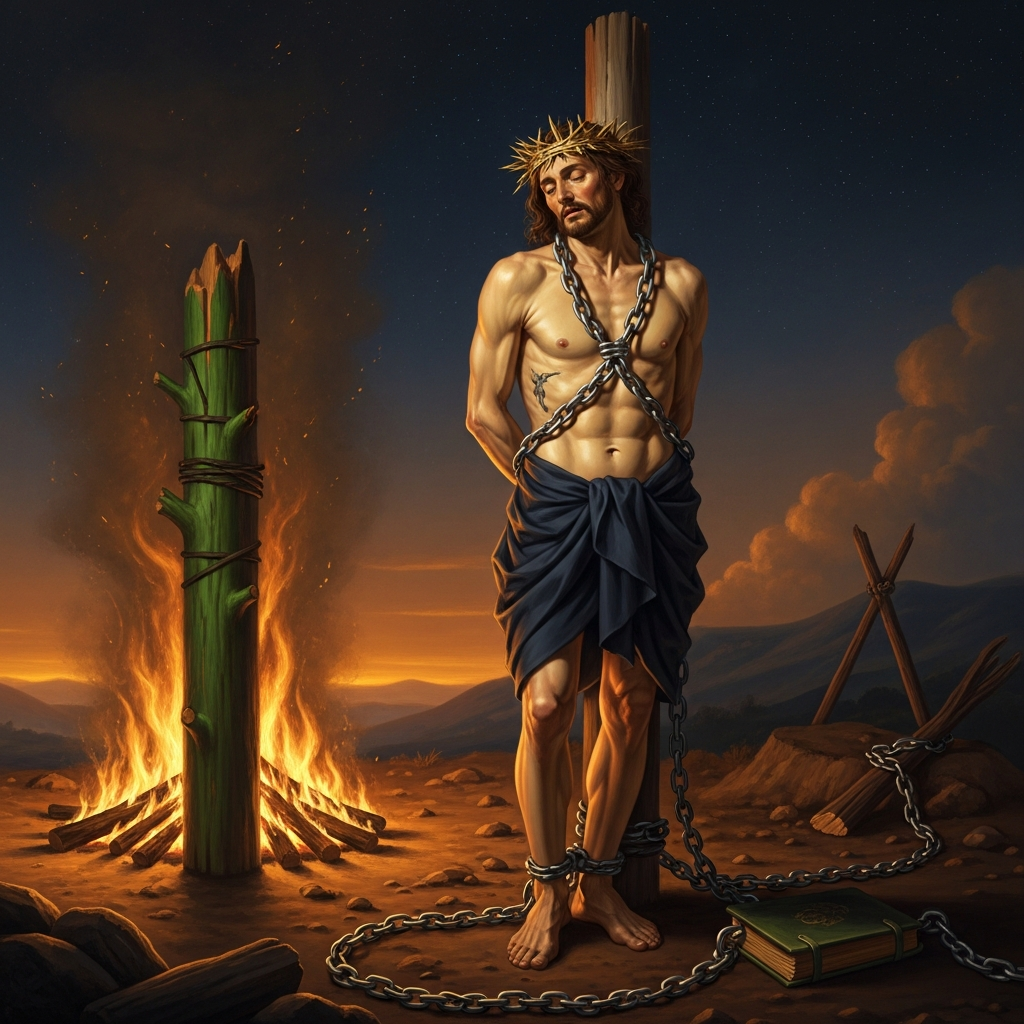
The hill of Champel, on the morning of October 27, 1553, is wet from an autumn rain and the green wood that has been stacked around the stake is slow to catch. Servetus burns for approximately half an hour. His book, Christianismi Restitutio, is chained to his leg. He is reported to have cried out: O Jesus, Son of the eternal God, have pity on me. The witnesses note the phrasing: he calls Jesus the Son of the eternal God, not the eternal Son of God. He maintains his theological position in the last minutes of his life.
Sebastian Castellio, a humanist scholar who has previously quarreled with Calvin over biblical interpretation, publishes his response the following year: Concerning Heretics and Whether They Should Be Persecuted, arguing that killing a man over a theological opinion is not a defense of Christianity but a murder. Calvin publishes his defense of the execution. The argument between them is the sixteenth century’s version of the argument that every subsequent era has had to have again.
The Geneva experiment produces descendants across the Protestant world.
John Knox, who spends several years in Geneva as a refugee from Catholic Scotland, calls Geneva the most perfect school of Christ since the apostles. He brings the model to Scotland, where it becomes Presbyterianism. The Puritans who sail to Massachusetts in the 1630s carry Calvin’s Institutes in their luggage and attempt a New England version of the godly city. The Reformed tradition spreads through the Netherlands, Hungary, Bohemia, and France, shaping political thought and moral culture in ways that persist long after the specific discipline of the Consistory has been abandoned.
Calvin dies in 1564, at fifty-four, worn out by illness and overwork. He has preached thousands of sermons, written thousands of letters, produced commentaries on most of the Bible, and revised the Institutes four times into a systematic theology of approximately a million words. He asks to be buried in an unmarked grave — he has been explicit, throughout his ministry, that veneration of any kind directed toward a human being is a form of idolatry — and he is. The grave’s location in Geneva is known but unmarked, a plain stone with only the initials J.C.
What he built in Geneva survives him: not the Consistory, not the sumptuary laws, not the particular discipline that made Geneva simultaneously admired and feared across Protestant Europe, but the theological system, the insistence on the sovereignty of God, the shape of a worship stripped of ceremony, the trained conscience as the seat of religious authority. These travel in books, and books travel everywhere.
Servetus’s Christianismi Restitutio survives in three copies. Two of them were saved from the Champel fire by individuals who retrieved pages from the edges of the pyre. One is now in the Bibliotheque Nationale in Paris. The other is in the National Library of Edinburgh, in the country that John Knox made Reformed.
The question that Castellio asked in 1554 — whether killing a man for his theology is ever a defense of truth — remained the most important question in Western religious thought for the next century and a half, and produced, eventually, the modern theory of religious tolerance. Locke cites Castellio. Voltaire cites Castellio. The argument that began at Champel on October 27, 1553 is still being made.
Calvin would not have been surprised. He would have disagreed.
Scenes
The Consistory chamber in Geneva — twelve lay elders seated at a long table, Calvin at the head, a citizen standing before them accused of dancing at a wedding
 Generating art…
 The hill of Champel above Geneva, October 27, 1553 — a green-wood fire burning slowly around a stake, Servetus bound with iron chains and a crown of straw and sulfur on his head, his book chained to his leg
 Generating art…
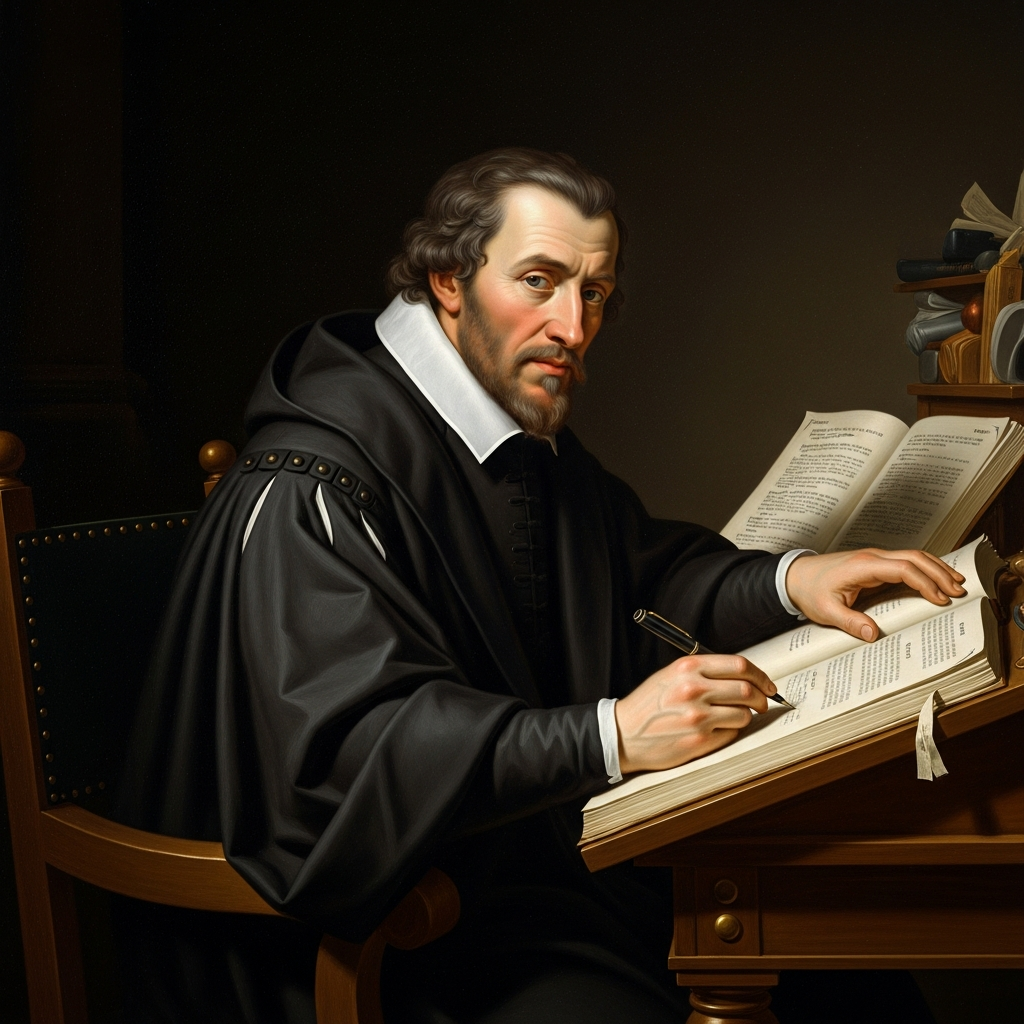
 Calvin at his writing desk in Geneva, his Institutes of the Christian Religion open beside him, his pen moving steadily across the page
 Generating art…
 Echoes Across Traditions
Entities
- John Calvin
- Michael Servetus
- the Consistory
- Guillaume Farel
Sources
- William Bouwsma, *John Calvin: A Sixteenth-Century Portrait* (Oxford University Press, 1988)
- Diarmaid MacCulloch, *The Reformation: A History* (Viking, 2003)
- Bruce Gordon, *Calvin* (Yale University Press, 2009)
- Roland Bainton, *Hunted Heretic: The Life and Death of Michael Servetus* (Beacon Press, 1953)
- Stefan Zweig, *The Right to Heresy: Castellio Against Calvin* (Viking, 1936)