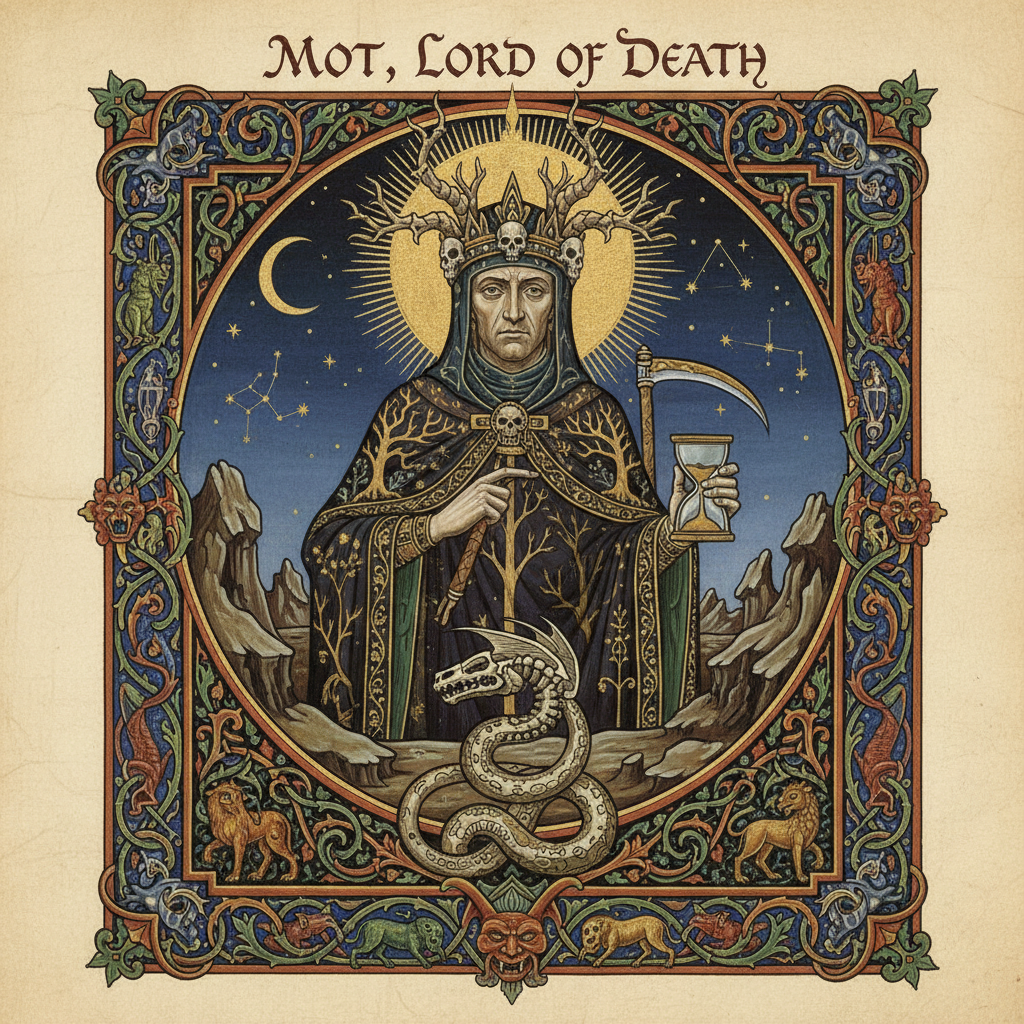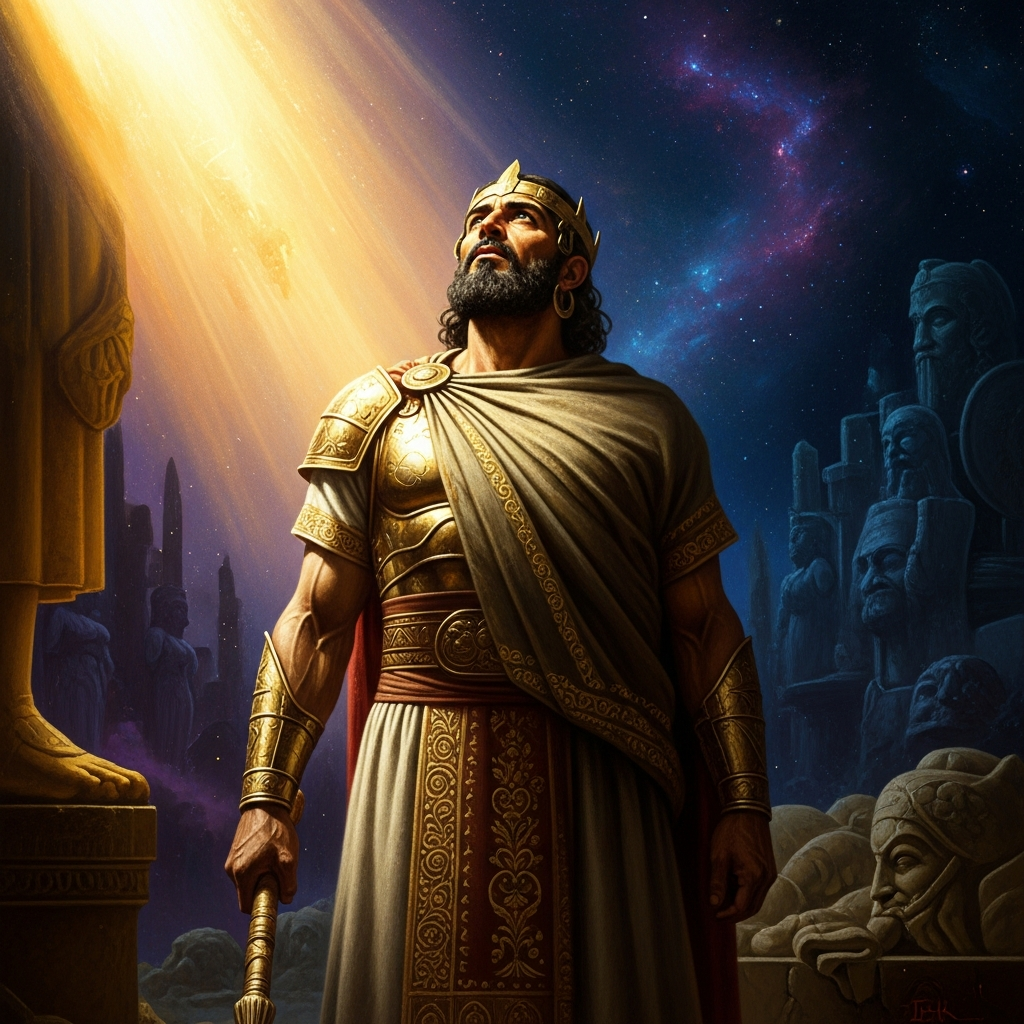
The Epic of Kirta
Mythic Time · tablets recorded ~1350 BCE, Ugarit; set in Bronze Age Canaan · Ugarit — the court of Kirta, and the long road to Udum
Contents
King Kirta has lost everything — seven wives, his heirs, his future. El appears in a dream and gives him a plan: march your army to the court of King Pabil of Udum, demand his daughter Hurray, and promise a golden offering to Asherah. Kirta succeeds, marries Hurray, fathers eight children. Then he forgets the vow. Then he falls ill to death. His kingdom waits.
- When
- Mythic Time · tablets recorded ~1350 BCE, Ugarit; set in Bronze Age Canaan
- Where
- Ugarit — the court of Kirta, and the long road to Udum
He sits in his room and counts what he has lost.
It is not a short count. Kirta, king of Khubur, son of El — the tablets name him as the son of the patriarch of the gods, a half-divine king at the head of a dynasty — has lost seven wives. To pestilence, one. To desertion, another. To sickness, a third. The fourth killed by enemies, the fifth by a dream, the sixth by a flood. The seventh came to him fresh and strong and was taken by war. Seven wives, each one a line of heirs that will not now happen, each one a kingdom that will end with him.
He has no children.
He sits in his room and weeps until he falls asleep in his tears, and in the sleep El comes.
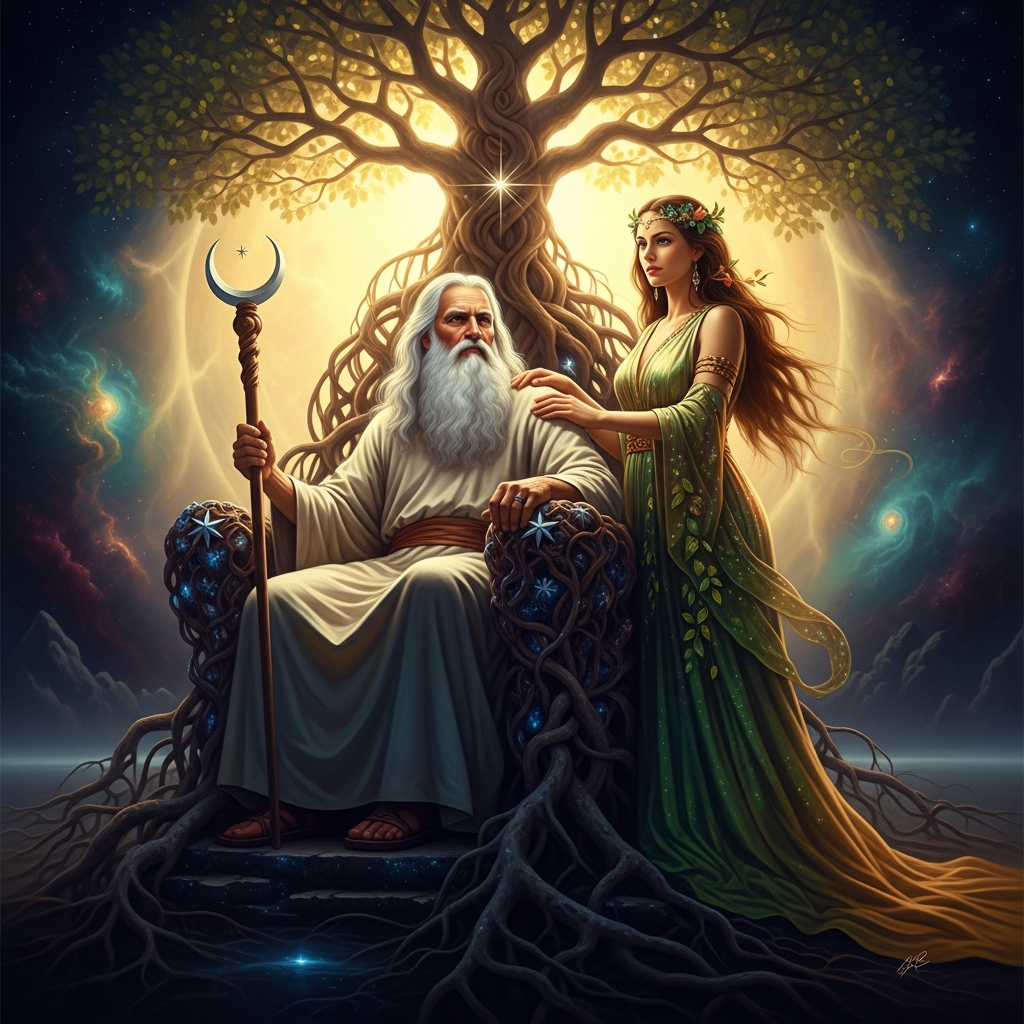
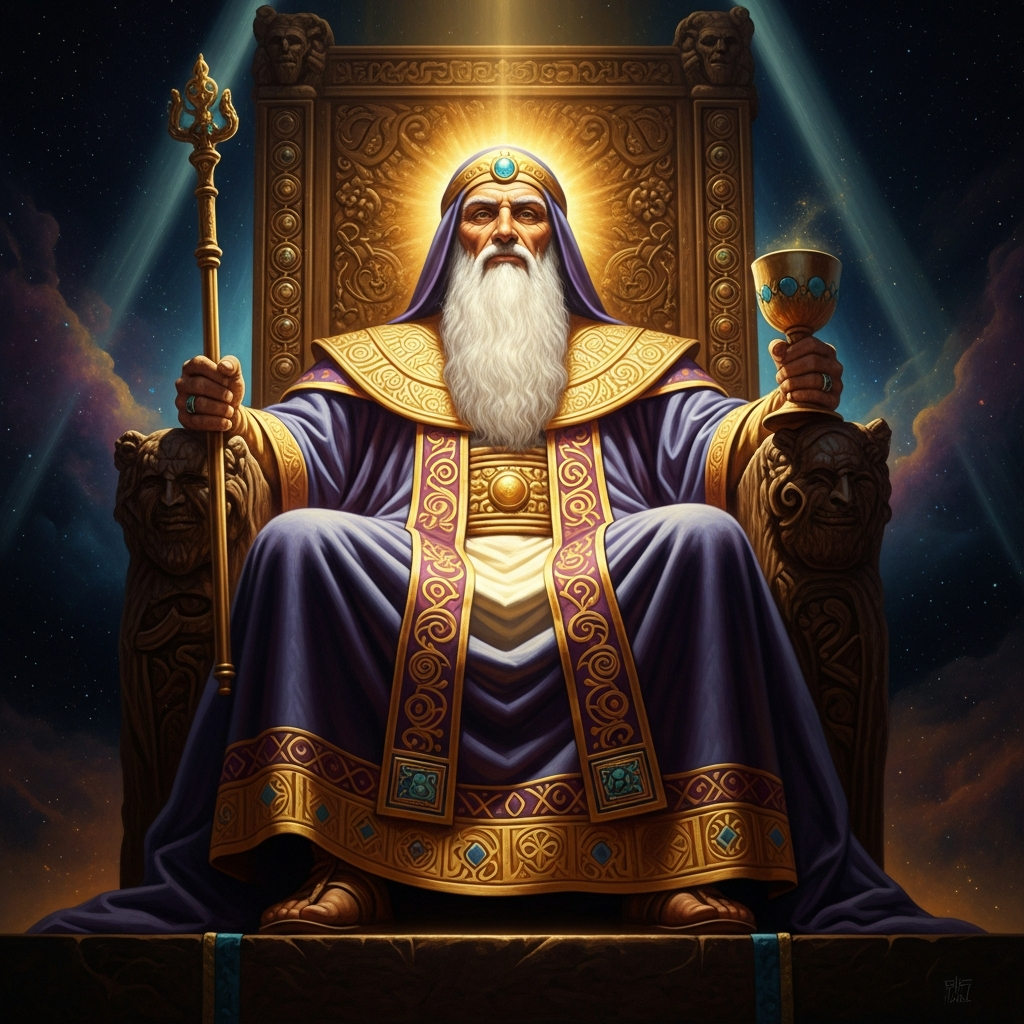
El does not come in fire or in wind. The patriarch of the gods appears in Kirta’s dream the way a grandfather appears to a grieving grandson — quietly, with the unhurried patience of someone who has been watching this unfold and has finally decided it is time to intervene. He sits beside the weeping king. He asks the question that contains its own answer: What ails Kirta that he weeps? What is wrong with the Gracious One, the lad of El?
Kirta tells him what he has lost. El already knows. El asks anyway, because the loss needs to be spoken before the remedy can be prescribed.
Then El gives instructions with the brisk efficiency of a general who has already thought through the logistics:
Rise in the morning. Wash your face. Open your hands to heaven and sacrifice to your father the Bull, your god. Then go down into your stores: one jar of wine for each five of your men. Muster your army — six hundred thousand soldiers, ten thousand groups — march three days into the wilderness, three days more, and on the seventh day come to Udum the Great, the city of Pabil the king. Camp before the city. Do not attack. Wait. Make no noise except the noise of your presence.
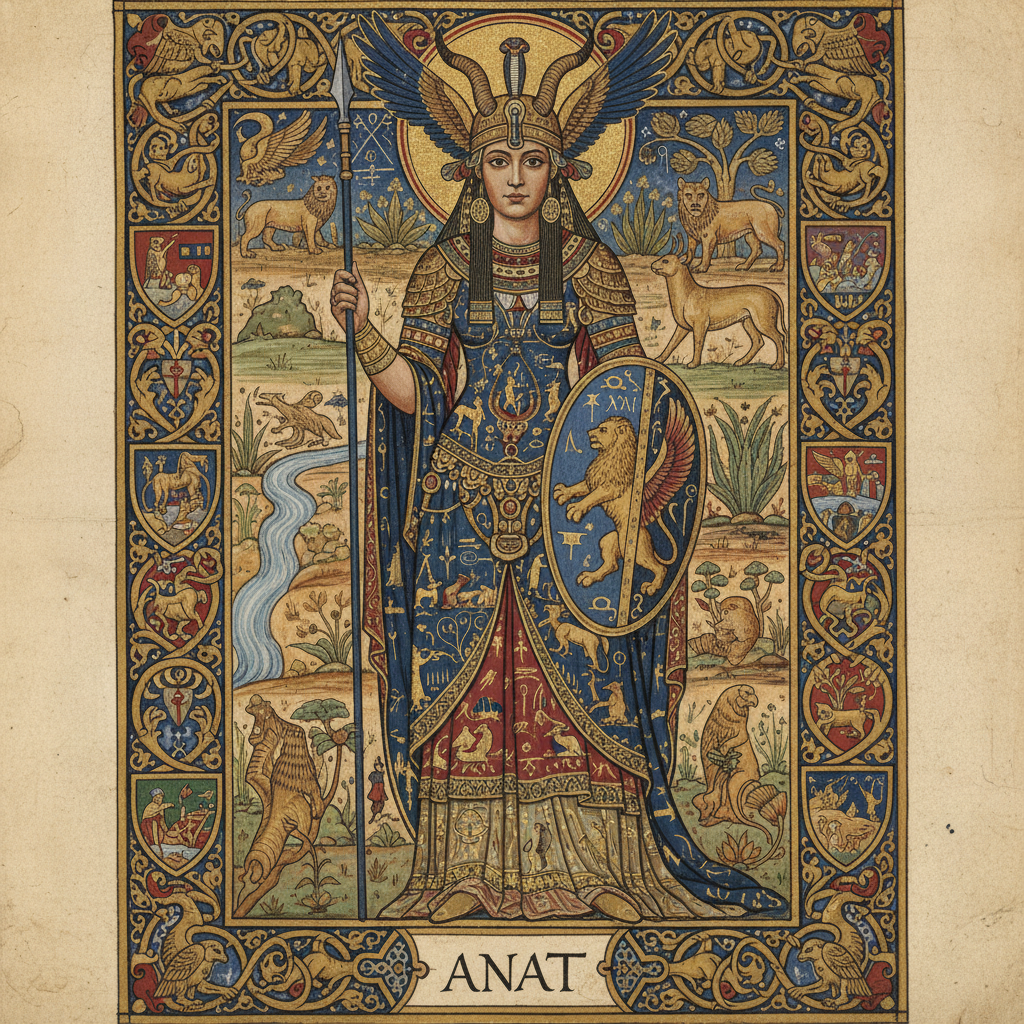
Pabil will send gifts. Refuse them. He will send silver and gold. Refuse. He will offer horses and chariots. Refuse. Tell him: the one thing you want is his daughter Hurray, the fairest of the firstborn of men, whose graciousness is the graciousness of Asherah and whose beauty is Anat’s beauty. Ask for Hurray.
And then: On the road, stop at the shrine of Asherah at Tyre. Vow to her. Promise her a golden weight — twice her height in gold, three times in silver — if Hurray comes to your house. If Hurray comes to your bed.
El describes Hurray in language that makes a king reach for a stylus: she will bear Kirta seven sons and an eighth, a daughter. The youngest son will be nursed on Asherah’s knee. She names him among the gods.
Kirta wakes. He executes the instructions with military precision. He musters. He marches. He stops at Asherah’s shrine. He makes the vow. He continues to Udum.
Pabil is unmoved by the army camped at his gates.
He tries gold. He tries silver. He offers horses and chariots, and Kirta refuses them all with the patience of a man who knows exactly what he came for and has received divine instructions specific enough to quote. The siege does not require assault — it requires presence, the massed weight of an army that is not going away, that has rations for months, that will simply continue to exist outside the gates until Pabil understands that the thing being demanded is the only coin that will buy their departure.
Pabil sends his daughter Hurray.
She is everything El promised in the dream. The tablets praise her the way Bronze Age epics praise the worth of a woman: her eyes are the lapis of heaven, her brows are the arc of the rainbow, her beauty is the beauty of Anat. She comes with her retinue and Kirta receives her and the army turns and marches home.
The vow to Asherah goes unpaid.
The tablets do not record a deliberate decision to forget. Kirta returns home. He marries Hurray. The years pass with the normal erosion of memory that success produces: when a man has what he wanted, the desperation that drove the wanting becomes hard to reconstruct. He has his wife. She is giving him his children — the seven sons El promised, the eighth child, the daughter. The kingdom is full. The halls are loud with heirs.
Asherah’s golden weight sits unpaid.
The goddess notices. She is the Lady of the Sea. She is the one who interceded with El for Baal’s palace. She is the mother of seventy gods and the intercessor of the divine assembly. She does not forget debts.
She strikes Kirta.
The illness the tablets describe is not named with any precision — the tablets here are damaged, lacunae eating the specific terms — but the effect is clear. Kirta stops eating. Kirta stops drinking. Kirta lies in his bed while the court stands around him and understands the math: if the king dies without formally designating an heir, every one of the seven sons will have a claim to the throne. The succession is not settled. The kingdom is a body with a failing heart.
El convenes the divine assembly.
The patriarch of the gods asks the question he has asked before, in other forms: who among you can drive away the illness? Who can defeat the disease? The gods are silent. None of them can.
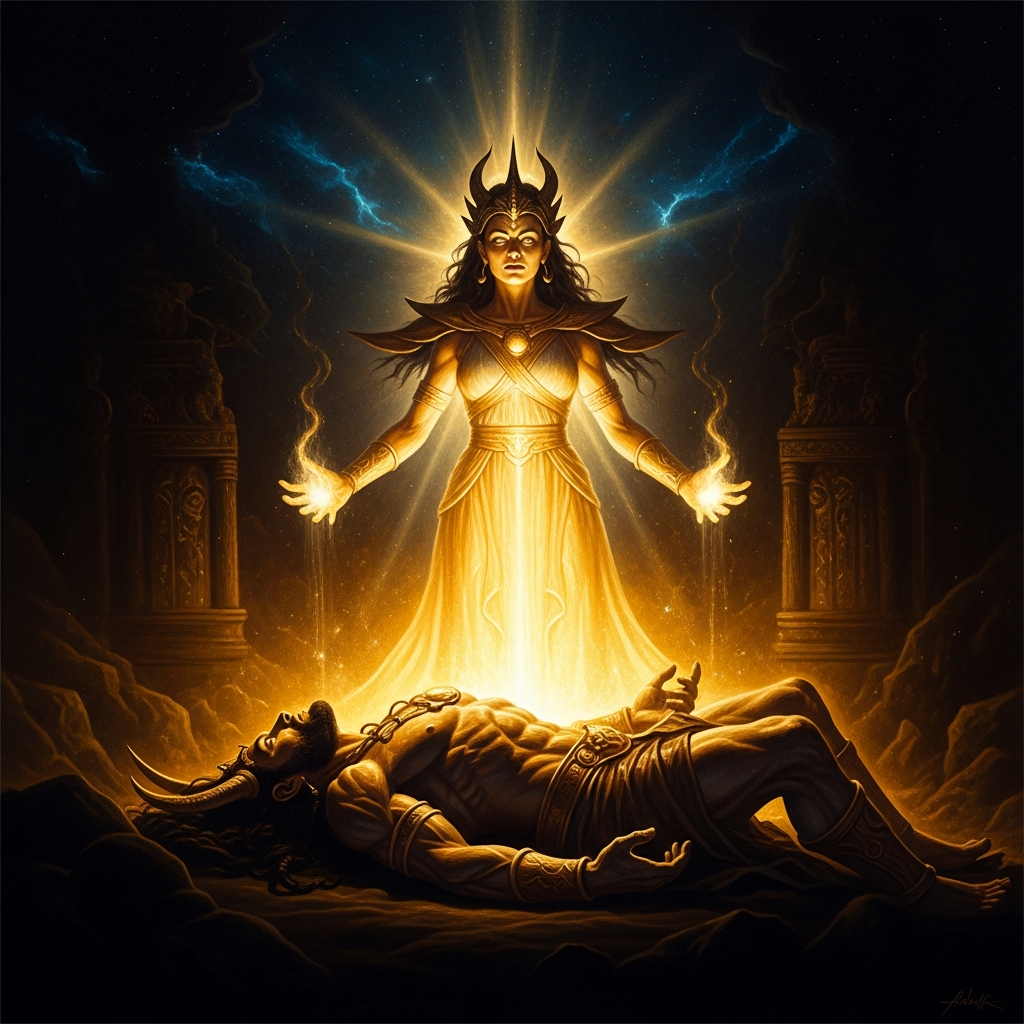
El does it himself. He fashions a woman — the tablets call her Sha’tiqat, she who causes the evil to pass — and he sends her to Kirta’s bedside with instructions to take the illness away. She goes through Kirta’s body the way a skilled physician goes through a patient — systematically, finding the thing that should not be there, removing it. The fever breaks. The king eats again. The king drinks again. The king comes back from whatever edge he had been standing at.
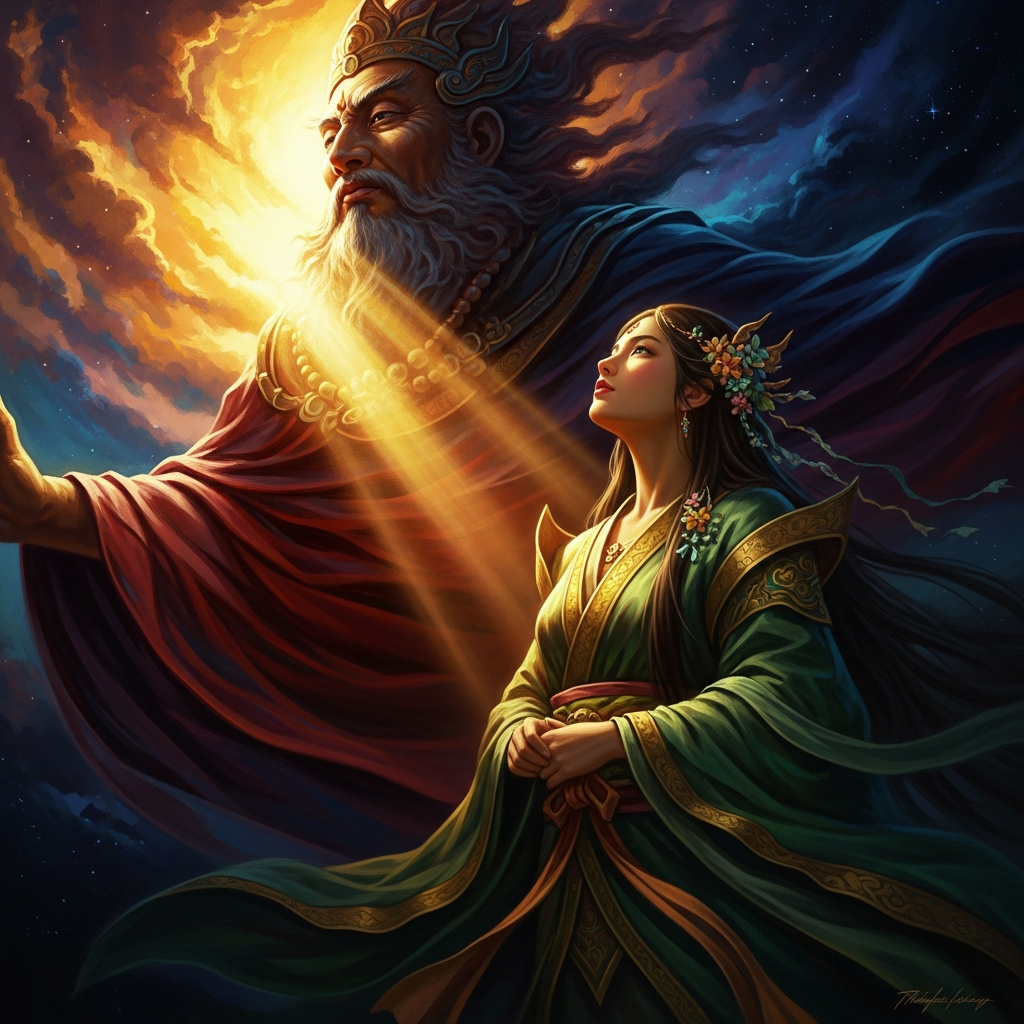
But it is Thitmanit who sits with him.
Kirta’s daughter — one of the eight children Hurray bore — is at her father’s bedside through the illness with the particular stubbornness of a daughter who has watched her father’s line nearly extinguish itself twice and will not permit a third occasion. The tablets give her the emotional weight of the story’s resolution: she is the one who maintains vigil, who applies the cures, who stays when others have gone to consider the succession. She is the human agent of the healing that El has ordained, the hands that carry the divine remedy into the sickroom.
The kingdom recovers.
The connection between the king’s body and the land’s body is not metaphor in Bronze Age theology — it is physiology. Ugarit’s crops and Ugarit’s rains and Ugarit’s trade routes are all implicated in the health of the king on his throne. A sick king is a sick land. When Kirta’s fever breaks, the tablets imply, the land breathes again. The succession question resolves. The dynasty continues.
But the eldest son Yassib has drawn his own conclusions from the illness. He comes to his father — recovered now, seated on his throne — and makes the case that a king who has been brought to death’s edge by a forgotten divine vow has perhaps demonstrated that he is no longer fit to rule. He is prepared to take the crown. He says this with the reasonableness of a son who believes he is acting in the kingdom’s interest.
Kirta curses him.
The recovered king has not forgiven his illness into generosity. He invokes El’s name against his son with the force of a man who has just been on the other side of divine judgment and knows exactly how it feels. Yassib withdraws. The succession remains with Kirta.
The message of the tablets is not subtle.
Divine vows, once made, must be honored. The desperation that produced them does not expire when the desperation passes. Asherah does not forget. El does not forget. The gods of Ugarit do not maintain a separate accounting for the promises made in crisis and the behavior practiced in comfort. A vow is a contract with a divine party who is still watching after the emergency is over, and the failure to pay it is not a theological error — it is a debt, and debts collect interest.
Kirta’s illness is not punishment in the vindictive sense. It is the debt coming due. The missing golden weight takes its value out of his body because the body is the most available collateral. The king and the kingdom are the same organism, and the organism owes a payment it has not made.
This theology migrates intact into the Hebrew Bible. Jephthah vows and his daughter pays. Saul makes a rash oath and Jonathan nearly dies for eating honey. David’s census costs seventy thousand lives. The king’s covenant obligations — to God, to the divine economy — are not private matters. They are the condition on which the land’s health depends, and the land pays when the king defaults.
The tablets of the Kirta Epic were found at Ras Shamra among the same cache as the Baal Cycle, written by the same scribal school, in the same cuneiform alphabet. They have been damaged more severely — significant lacunae break the text at its most critical moments, including the exact nature of Sha’tiqat’s cure and the resolution of Yassib’s challenge. What survives is enough to reconstruct the theological architecture.
What the tablets demonstrate about Ugaritic society is this: kingship is a theological office, not merely a political one. The king’s obligations to the gods are not separate from his obligations to his people — they are the same obligation, because the gods’ goodwill is the mechanism by which the people are fed, watered, defended, and governed. A king who makes a vow to Asherah in crisis and ignores it in prosperity is not merely being ungrateful. He is introducing a structural fault into the organism of the kingdom that will express itself as illness, drought, military defeat, or dynastic collapse.
The gods of Ugarit are patient. They are not lenient.
El appears in dreams. He gives specific instructions. He makes his expectations clear. The rest is the king’s responsibility — and if the king forgets the vow in the ordinary business of his prosperity, the gods have their own accounting methods, and they apply them to the one resource the king cannot misplace.
His own body.
Scenes
El appears in Kirta's dream — the patriarch of the gods bending over the weeping king, his voice gentle as water over stone, his instructions precise as a battle plan
 Generating art…
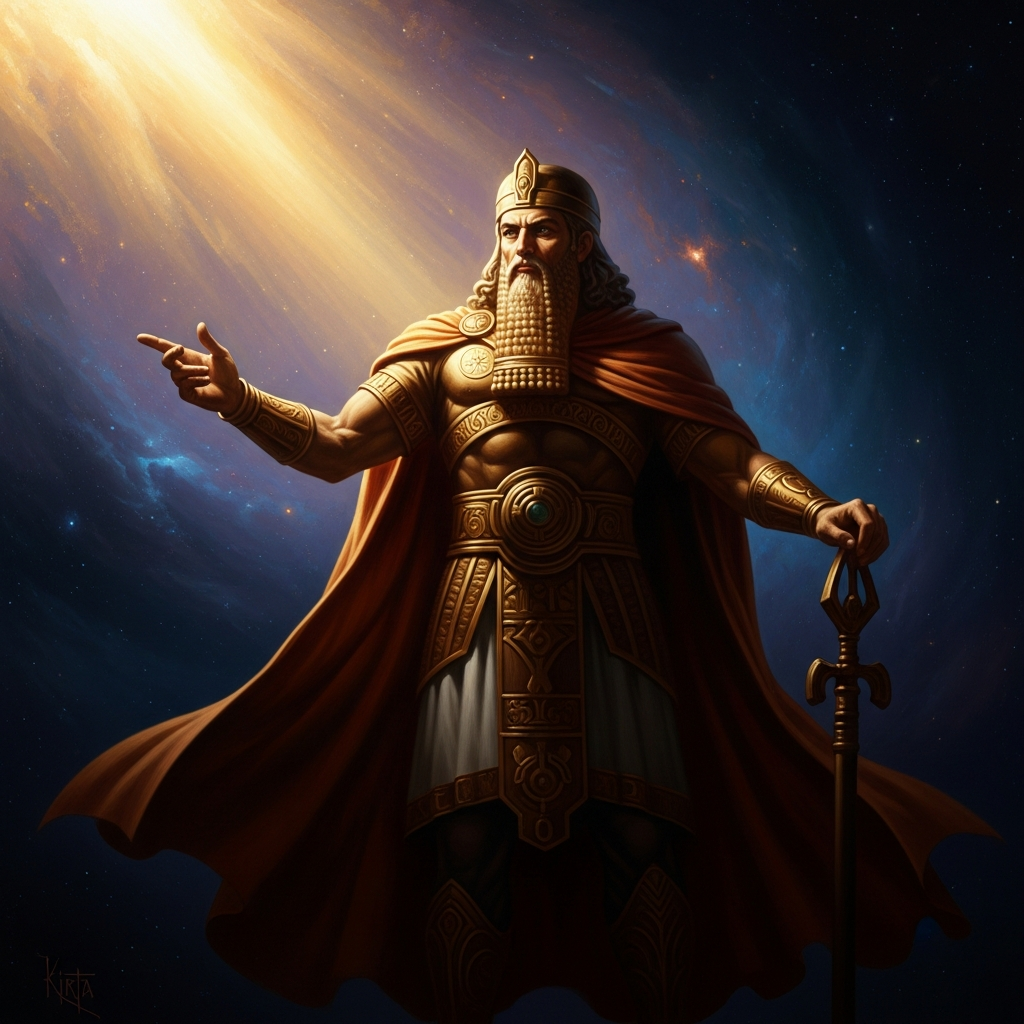
 Kirta's army on the road to Udum: ten thousand soldiers in the bronze-age dust, the king at their head, the vow to Asherah still fresh in his memory, the golden offering already promised
 Generating art…
 Thitmanit at her father's bedside: the daughter who will not lose another family member, her hands moving over the king's fever with the calm of someone who knows the cure and is applying it
 Generating art…
 Echoes Across Traditions
Entities


Sources
- *Epic of Kirta* (KTU 1.14–1.16, cuneiform tablets, Ugarit, ~1350 BCE)
- John C. L. Gibson, *Canaanite Myths and Legends* (T&T Clark, 1977)
- Michael D. Coogan & Mark S. Smith, *Stories from Ancient Canaan* (Westminster John Knox, 2012)
- Mark S. Smith, *The Ugaritic Baal Cycle*, vol. I (Brill, 1994)
- Simon Parker (ed.), *Ugaritic Narrative Poetry* (Scholars Press, 1997)