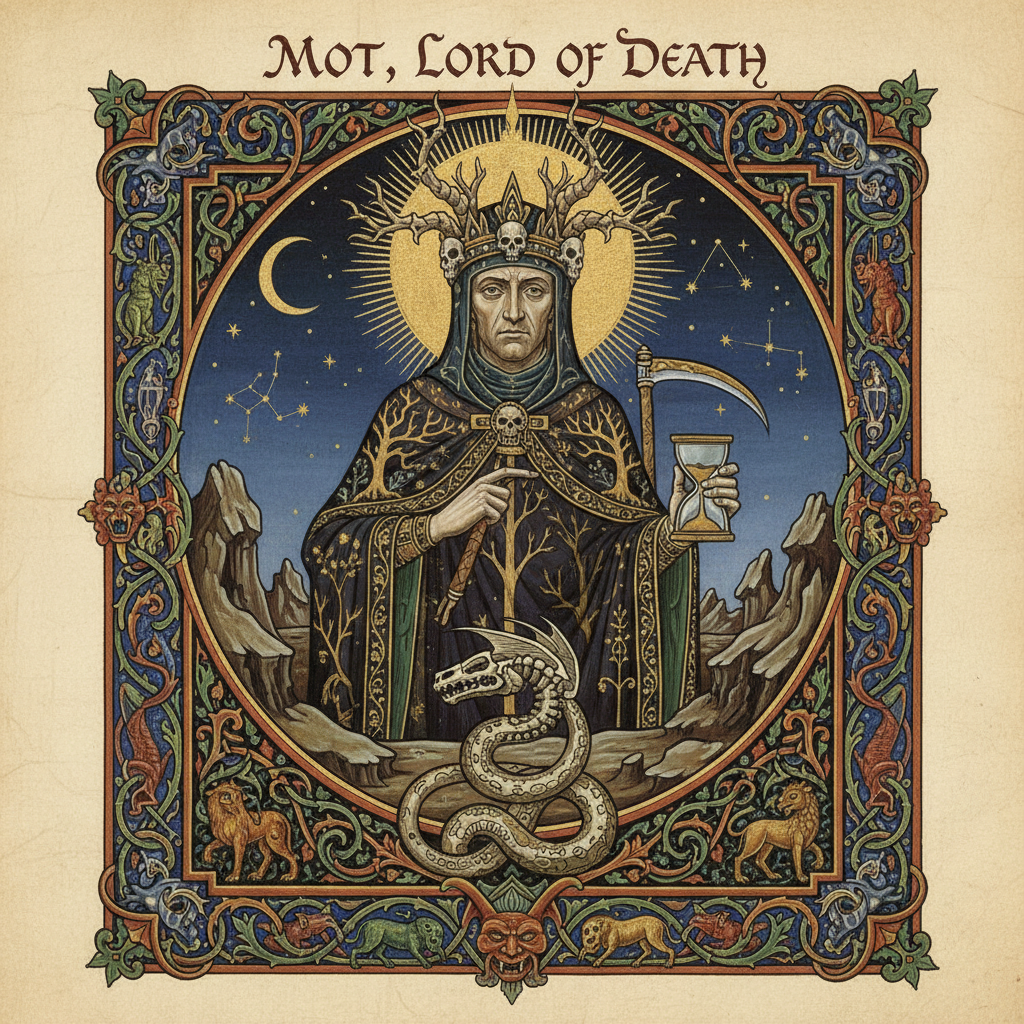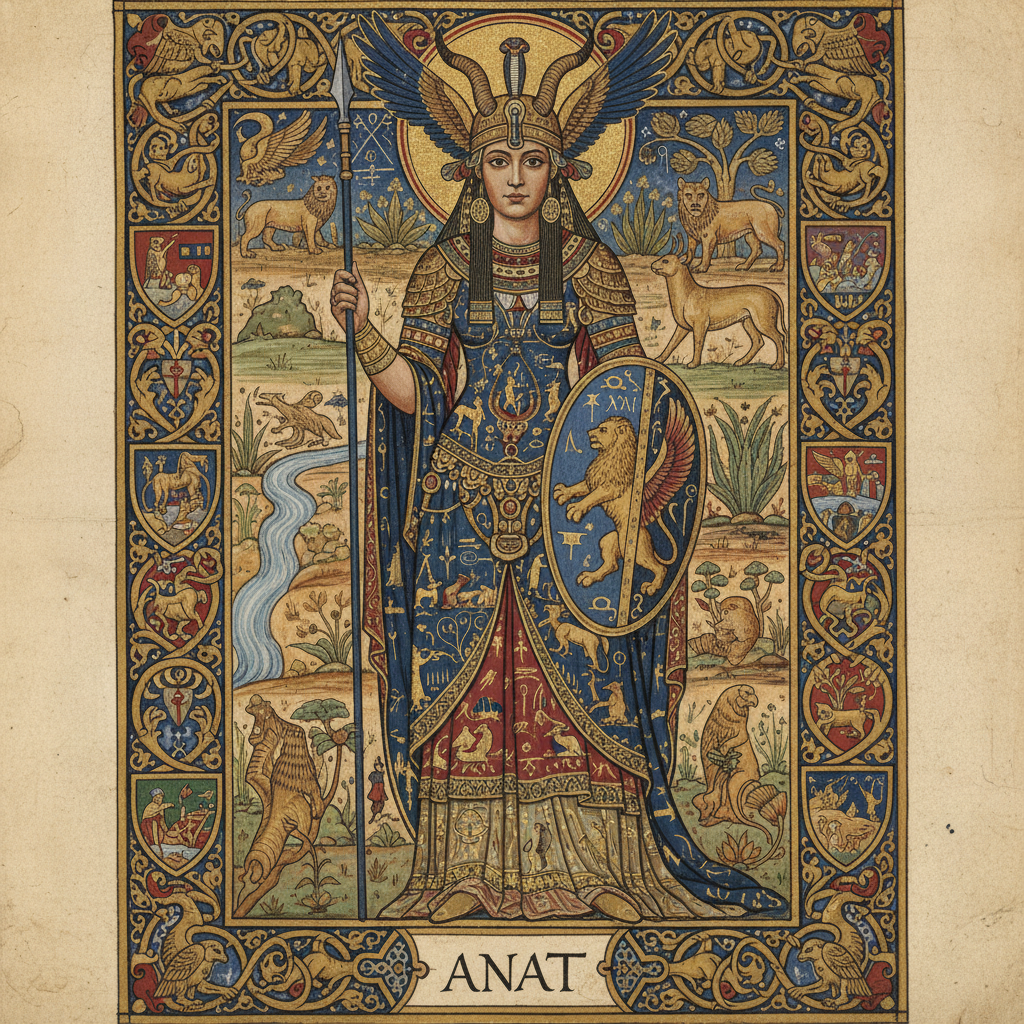
Anat Threshes the Dead
Mythic Time · tablets recorded ~1350 BCE, Ugarit · The wilderness between the living world and the underworld, and the threshing floors below Zaphon
Contents
Baal's sister Anat, the warrior-goddess, takes revenge on Mot for her brother's death: she seizes him, splits him with a sword, fans him, burns him, grinds him in a mill, and scatters him across the fields. The most extreme violence in ancient Near Eastern mythology as a theology of natural cycles.
- When
- Mythic Time · tablets recorded ~1350 BCE, Ugarit
- Where
- The wilderness between the living world and the underworld, and the threshing floors below Zaphon
Seven years.
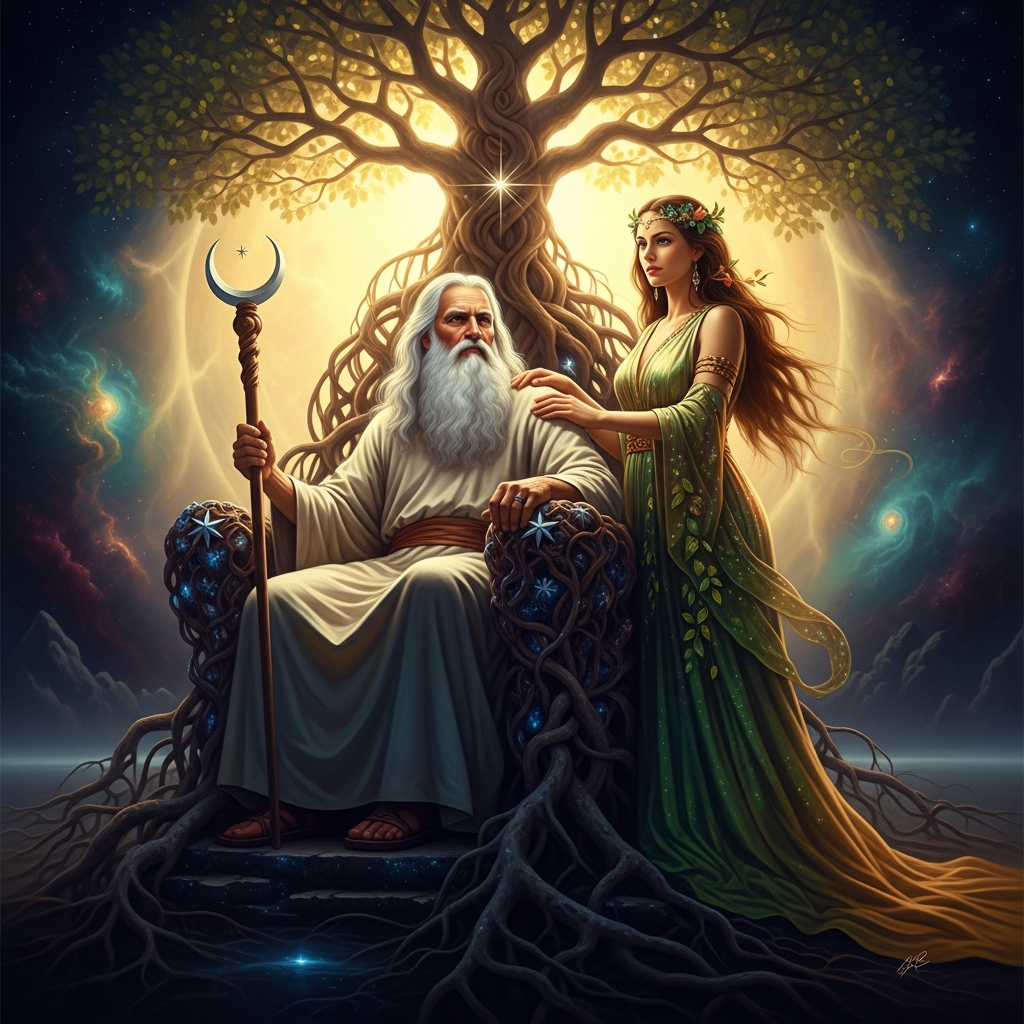
The earth has been dry for seven years. Not a poor harvest — a stopped sky, a closed heaven, the god of rain in the ground and the storm-apparatus dark. Shapsh, the sun-goddess, has been traveling her daily arc over a landscape that does not renew itself. The grain in the terraced hillsides of Canaan has not risen properly. The cisterns in the valley cities are at their winter levels and staying there. El is still in ash, because El processes his grief slowly and thoroughly, descending from footstool to floor at the pace of a patriarch who has time for everything except speed.
Anat is still moving.
She has been moving since Gupn and Ugar told her what happened. She buried Baal — she found him at the margin of Mot’s domain, took him on her shoulder, carried him to Zaphon, slaughtered the animals of his funeral rites, put him in the ground of the holy mountain herself. She did what the warrior-goddess does when there is a body to tend: she tended it. Then she turned toward Mot.
The search takes seven years, or the search takes whatever time the dry season takes, because the myth is not measuring in human years but in seasons, and the season that is drought is however long Mot holds his claim on Baal.
She finds him.
The wilderness where she finds him is not a named place.
The tablets do not give Anat a map. They give her the quality of the space between the living world and the dead one — the margin that is neither the highland valleys of Canaan nor the underworld city Mot calls Hamriya. It is the place you find a god who occupies both realms: Mot is simultaneously below the earth and distributed through everything that dies, which means he is also here, in the dry field, in the cracked wadi, in the absence of rain that is his presence.
He is not expecting her in the form she arrives in. Or perhaps he is, the way death is always expecting the next thing — with patience, with the certainty of a lord who has never lost a claim. She is the warrior-goddess who bathes in human blood before she eats. He is the god who just swallowed the mightiest storm-lord in the Canaanite pantheon. They assess each other in whatever light the margin has.
Anat does not speak diplomatic words. She does not send messengers ahead.
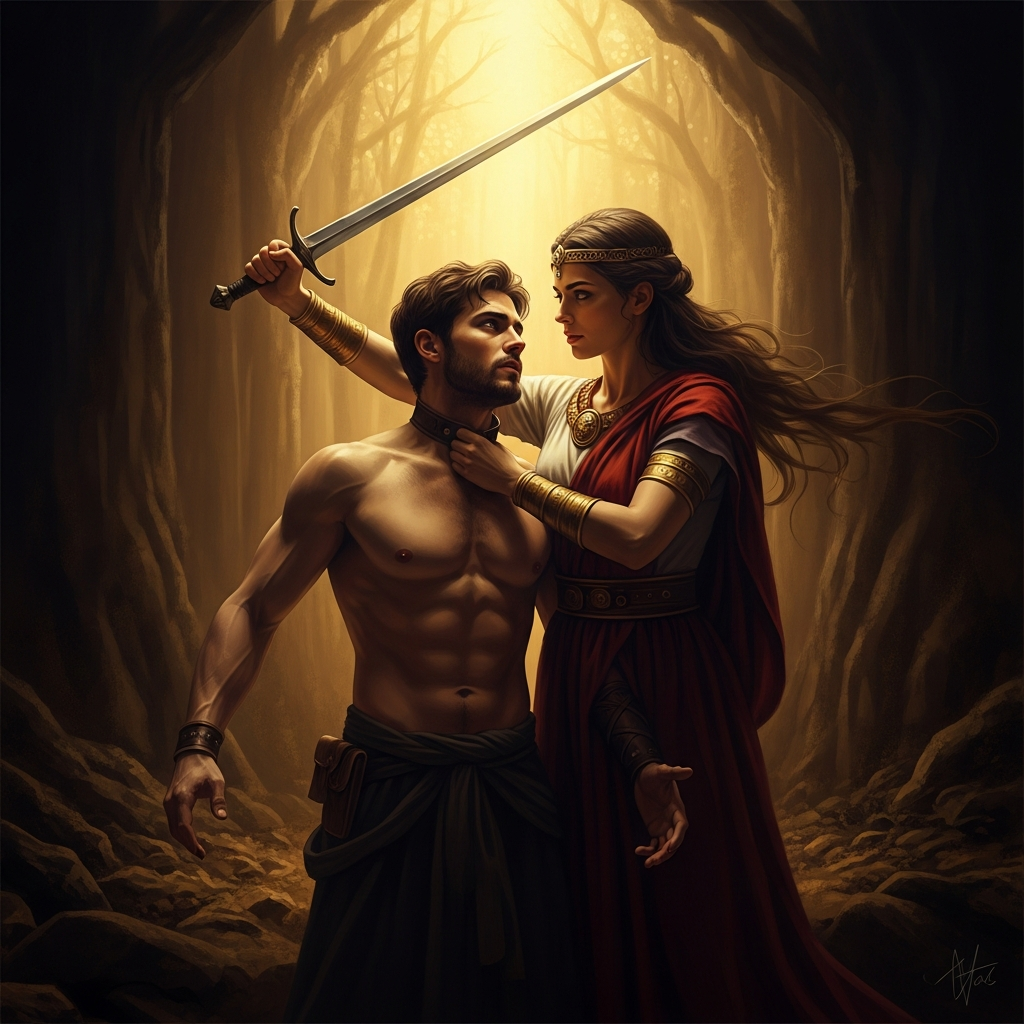
She seizes him.
Then she does to him what farmers do to grain.
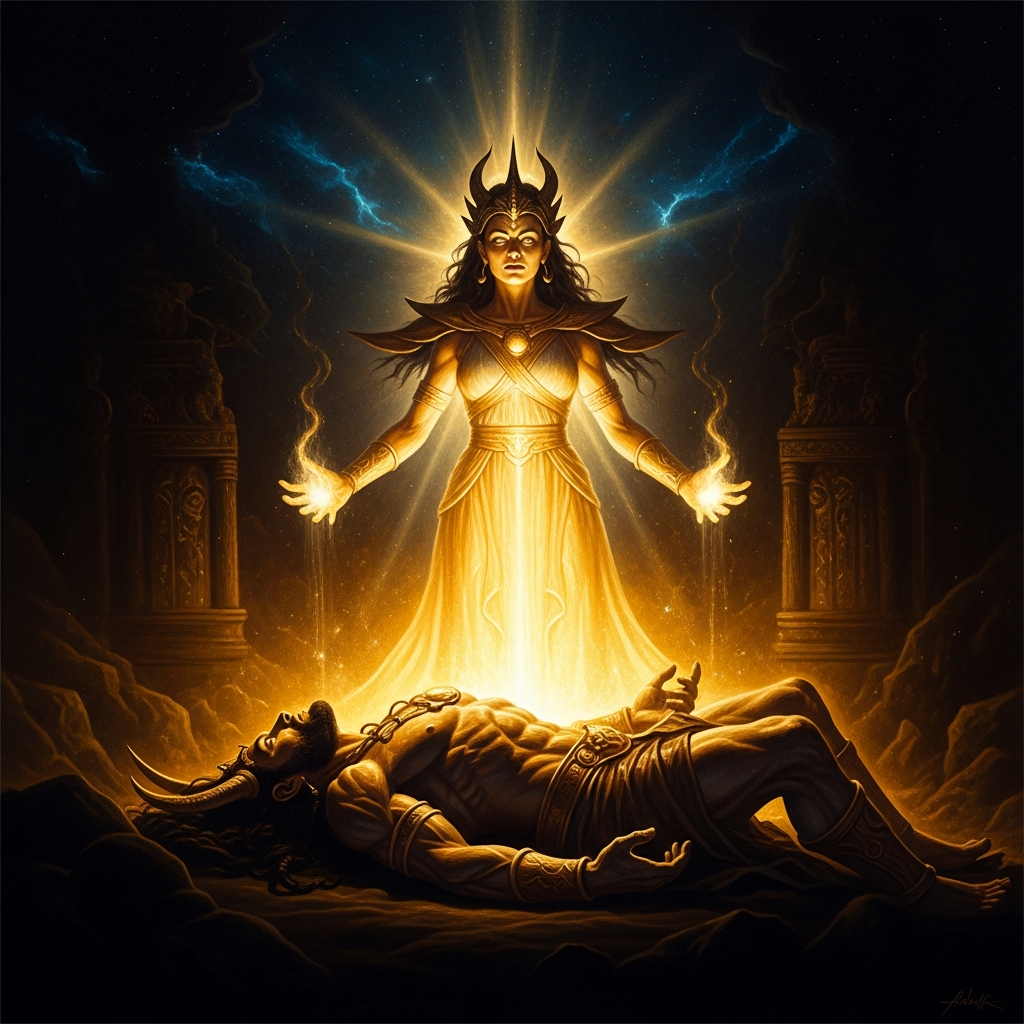
The tablets record it in the language of the harvest, and the language is exact and methodical and violent in the way that agricultural work is violent: essential, purposeful, and completely without ceremony. She seizes Mot with her sword and cleaves him — cuts him the way grain is cut at the stalk, the first necessary blow. She takes a fan and winnows him — lifts the cut Mot into the wind that separates what is useful from what is not, the way the farmer on the threshing floor holds up the sheaves and lets the breeze carry off the chaff. She takes fire and burns what remains. She takes millstones — the heavy grinding stones of every household in Canaan, the stones that make grain into flour and flour into bread — and she grinds what Mot has become between them. She takes what comes out of the stones and scatters it in the fields.
She plants Death like seed.
This is the moment where the myth and the agricultural cycle become the same thing, where the ritual on the threshing floor in September and the cosmic event that restores the rain are identical. Anat is not performing a metaphor for the harvest. She is doing the thing that the harvest does when the harvest does it to the grain, and the harvest is the thing that does to grain what Anat does to Mot. The logic is reversible and it runs in both directions and the Canaanite farmer who worked the threshing floor knew both directions by heart.
Death becomes seed. Seed is the only form in which the thing that was cut and ground and burned can become, again, the thing that rises.
El dreams.
In the dream, the fat of the earth runs. The heavens rain with oil and the wadis run with honey. These are the images of a land that is working — the olive trees fruiting, the bees in the flowers, the water in the channels — and El, who is old enough to recognize a true dream when one comes to him in his ash and sackcloth, wakes and knows without being told what the dream means.
Baal is alive, he says. The Mighty One is alive. The Prince, Lord of the Earth, exists.
He calls for Shapsh. The sun-goddess is still on her arc, still traveling her daily route over the dry land. He gives her a task: go down through the wilderness, find where Anat scattered Mot, and look for what is growing. Shapsh goes. What she finds the tablets do not fully preserve — the clay is damaged at this line, the wedge-marks blurred by three thousand years and the fire that burned Ugarit — but the report comes back: Baal is found, Baal rises, Baal returns to his seat on Zaphon.
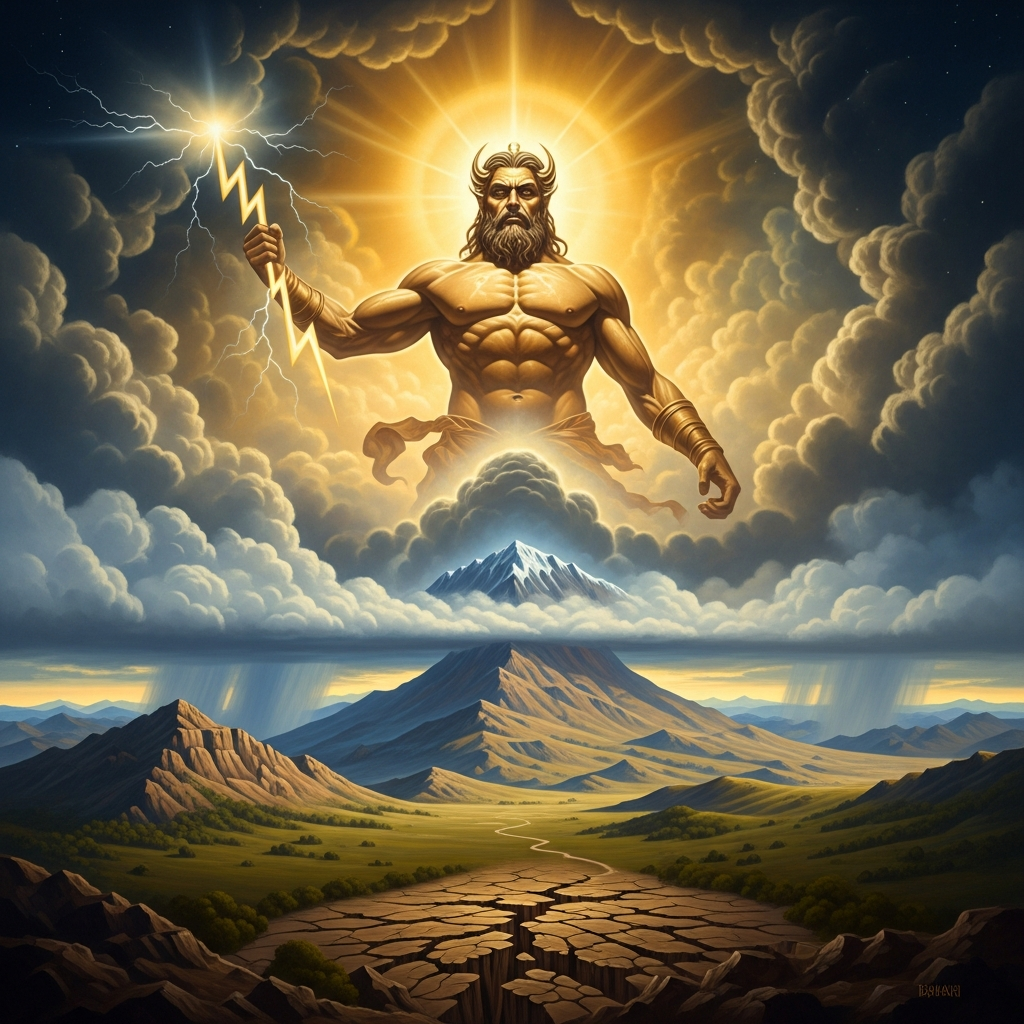
The clouds that have been absent for seven years begin to gather above the holy mountain. Not immediately — the storm-god returning to his palace is not the same as the first rain falling — but the physics of what Baal is begin to reassert themselves: clouds form where the storm-god stands. Rain follows clouds. The western winds carry the moisture in from the sea. The hillsides above the valley that has been waiting for seven years feel the first drops.
The rains return.
The world does not celebrate with speeches. The world celebrates the way it always celebrates a returning god: it grows. Barley comes up green in the terraced fields. The olive trees set fruit. The vineyards that have been bare through seven dry summers load with clusters that the harvest will do to in the autumn exactly what Anat did to Mot in the wilderness: cut, winnow, press, scatter.
The threshing floor is a ritual site. It always was. The tools that process the harvest are the tools that process Death. The farmer who swings the flail in September is performing, without necessarily knowing the full shape of what he performs, the act that Anat performed in the wilderness at the end of the seventh year. He is doing what needs to be done so that the seed can go back into the ground. The ground is Mot. The seed is what Mot becomes when the goddess who loves the storm-god does not accept that the drought is permanent.
But Mot is not destroyed.
This is what the myth will not let you miss.
Anat ground Mot in a millstone and scattered him in the fields. Seven years later — the tablets jump forward without explaining the arithmetic, because the arithmetic is seasonal, not calendrical — Mot reconstitutes himself. He approaches Baal on Zaphon. He is furious. He has a grievance that is legitimate in the way that death’s grievances are always legitimate: the gods intervened. Baal won through Anat’s violence, and this is not over.
They fight. Properly this time, two gods on the heights of Zaphon, goring each other like wild bulls until the sun-goddess Shapsh intervenes. She tells Mot: El has empowered Baal. El stands behind the storm-god. Your brothers support him. Step back.
Mot hears it. He hears the weight of the divine order behind it — El, whose verdict naming Yam king was the original mistake, whose mourning in ash was the original grief, whose dream of the fat earth was the signal of restoration — and he retreats to his underworld throne. He is not destroyed. He never was, not really, even when Anat had him in the millstone. He is contained. He is seasonal. He will return again at the end of the rains and the beginning of the dry summer, and Baal will descend again, and Anat will do what needs doing again.
The cycle does not end. It repeats. The violence is not a solution. It is the mechanism.
What Anat demonstrates that no other goddess in the ancient Near East demonstrates quite so clearly is the difference between mourning and action. Isis mourns and reassembles. Demeter mourns and negotiates. Inanna herself, when she returns from the underworld, requires a substitute — Dumuzi — to take her place in the dark. Anat mourns and then she picks up a sword.
She finds the enemy and she destroys it, and the fact that the enemy is Death itself — the most fundamental condition of all living things, the god who claimed her brother by an appetite Baal could not argue against — does not slow her down. She identifies the right tool: not the combat weapons she used in her battlefield rampages, but the agricultural tools of the threshing floor. The scythe. The fan. The fire. The millstone.
Death must be processed the way grain is processed. Cut, winnow, burn, grind, scatter. Then it becomes seed. Then it goes back into the ground. Then something grows from it.
The theology is not comfortable. It is not meant to be. The restoration of the rains in Canaanite mythology does not come from divine mercy, from cosmic law automatically correcting itself, or from the defeated power releasing its claim. It comes from a goddess who loved her brother enough to go into the wilderness and thresh Death like a farmer threshes barley in September.
Anat went. The millstone turned. The rain followed.
Scenes
Anat seizes Mot in the wilderness margin between the living world and the dead — one hand in his collar, the sword already raised, the full resolve of what she is about to do organized in her face like a plan
 Generating art…
 The millstones turn on the threshing floor as Mot is ground between them — the god of death becoming grain flour, scattered on the wind, sown in the fields that he has spent seven years starving
 Generating art…
 Baal rises above Mount Zaphon as the first clouds gather over the hills of Canaan — the rain breaking after seven years of closed sky, the earth below opening its mouth to receive what it is owed
 Generating art…
 Echoes Across Traditions
Entities


Sources
- Mark S. Smith, *The Ugaritic Baal Cycle*, vol. I (Brill, 1994)
- Nicolas Wyatt, *Religious Texts from Ugarit* (Sheffield Academic Press, 2002)
- John Day, *God's Conflict with the Dragon and the Sea* (Cambridge University Press, 1985)
- Frank Moore Cross, *Canaanite Myth and Hebrew Epic* (Harvard University Press, 1973)
- Michael D. Coogan & Mark S. Smith, *Stories from Ancient Canaan* (Westminster John Knox, 2012)