Combat Profile
Divine Decree
El's absolute word reshapes the cosmic order and binds all lesser deities to his supreme will.
Father of All
El's presence grants wisdom and compassion to his domain, while his authority over the divine council makes him immune to mortal or divine coercion.
Passive to the point of irrelevance; younger gods act while he deliberates
“El, the kindly one, the compassionate, the Bull, the father of years.”
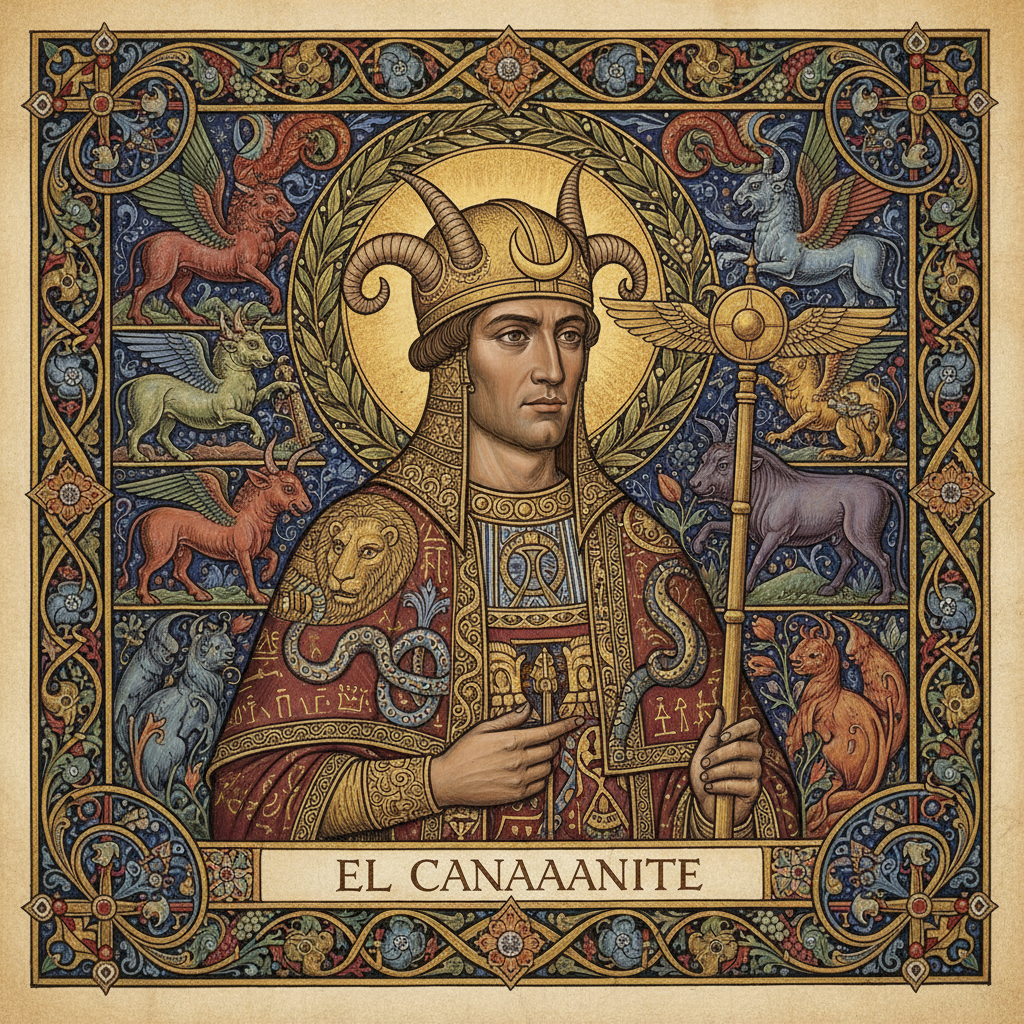
Lore: El is the supreme god of the Canaanite pantheon — aged, wise, bearded, seated at the source of the cosmic rivers where the two deeps meet. He is “the Bull” (a title of virility and authority), “Father of Years,” “the Kindly One.” He presides over the divine assembly (phr ilm) where the gods make decisions. In the Baal Cycle, he is the ultimate authority who grants Baal permission to build his palace and mourns when Baal is swallowed by Mot. Compassionate but distant — a god who rules by consent and seniority rather than force.
The critical point: “El” is literally the generic Hebrew word for “god.” El Shaddai (God Almighty), El Elyon (God Most High), Elohim (Gods/God) — all originally Canaanite El titles absorbed into YHWH worship. Deuteronomy 32:8-9 (Dead Sea Scrolls version) preserves what appears to be an older theology: “When Elyon divided the nations, he set the boundaries according to the number of the sons of El. YHWH’s portion was his people Jacob.” (Deuteronomy 32:8-9, DSS version). In this reading, YHWH was originally one of El’s sons, assigned Israel as territory. Later tradition merged El and YHWH into a single deity (Mark S. Smith, The Early History of God). The seams still show.
Parallel: El maps onto the “distant supreme god” archetype found across traditions: Anu (Mesopotamian), Ouranos/Kronos (Greek), Brahma (Hindu) — ancient, authoritative, but displaced from active power by a younger storm god (Baal, Marduk, Zeus, Indra). The transition from El-worship to YHWH-worship mirrors the Mesopotamian transition from Enlil to Marduk as supreme deity.
1 min read
None -- unchallenged but increasingly sidelined by Baal
Ugaritic texts (KTU 1.1-1.6); Mark S. Smith, *The Early History of God*