Combat Profile
Asherah's Blessing
grants allied mortals and divine children fertility of crops, flocks, and bloodlines while weaving protection into the fabric of family bonds
Mother of Multitudes
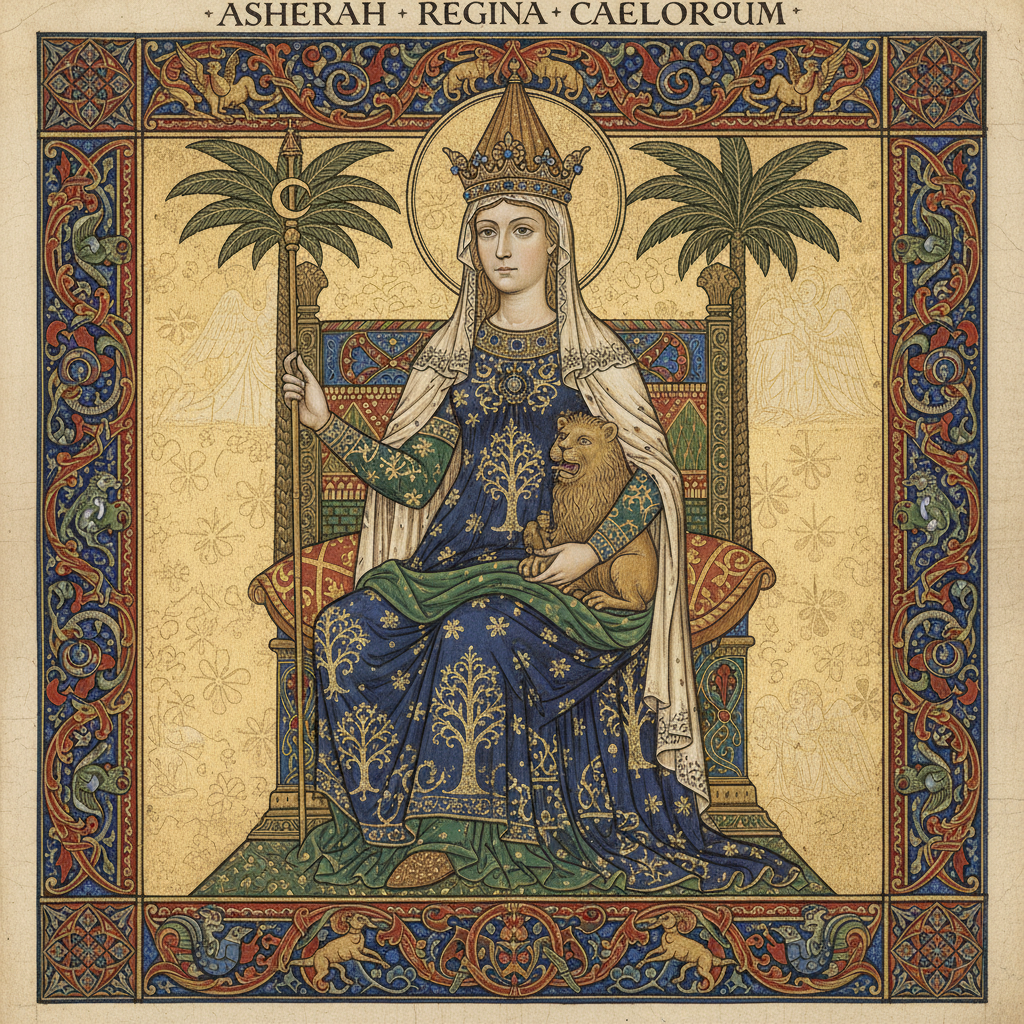
Asherah's presence manifests through sacred trees, waters, and maternal bloodlines, blessing lineages and ensuring cyclical renewal across mortal and divine realms
Her worship was systematically erased by the Deuteronomistic reforms
“YHWH of Samaria and his Asherah.” — Kuntillet Ajrud inscription, c. 800 BCE
Lore: Asherah (Athirat in Ugaritic) is El’s wife, “Lady Who Treads on the Sea,” mother of the seventy gods. In the Baal Cycle (KTU 1.4) she is the intercessor: when Baal needs permission to build his palace, Asherah persuades El. She is tied to sacred trees and carved wooden poles (asherim) that stood at Israelite cult sites — and, per 2 Kings 21:7, inside Solomon’s Temple itself. King Manasseh placed her image in the Temple. King Josiah ripped it out during his reforms (2 Kings 23:6) and burned it in the Kidron Valley.
The most explosive find in modern biblical archaeology is the Kuntillet Ajrud inscription (c. 800 BCE): “YHWH of Samaria and his Asherah.” A similar inscription at Khirbet el-Qom reads: “Blessed be Uriyahu by YHWH… and by his Asherah.” These inscriptions (Kuntillet Ajrud and Khirbet el-Qom epigraphs) suggest that for ordinary Israelites — not the prophetic elite, but villagers — YHWH had a wife, and her name was Asherah. The prophets raged. The Deuteronomists rewrote history. The inscriptions survived. Whether “his Asherah” means the goddess or merely a cult object (an asherah pole) is still debated (William Dever, Did God Have a Wife?), but the implication shook biblical scholarship to its foundations.
Parallel: Asherah maps onto the “supreme mother goddess” archetype: Isis (Egyptian), Frigg (Norse), Hera (Greek), Parvati (Hindu). Like Hera, she is the consort of the sky father. Like Isis, her worship was eventually suppressed by a newer religious order. The erasure of the divine feminine from Israelite religion is one of the most consequential theological decisions in Western history.
1 min read
Josiah's reforms (2 Kings 23); prophetic monotheism
KTU 1.4; 2 Kings 21:7, 23:4-7; Kuntillet Ajrud inscriptions; Judith Hadley, *The Cult of Asherah in Ancient Israel and Judah*