Combat Profile
Divine Forging
Imbues weapons and structures with supernatural durability and magical properties that mortals cannot replicate.
Master Craftsman
All creations under his influence gain enhanced resilience and hidden enchantments that reveal themselves in times of need.
A servant-god; creates for others, never rules himself
“Kothar-wa-Khasis, the Skillful and Wise, went to his bellows. In his hands he took the tongs. He cast silver, he poured gold.”
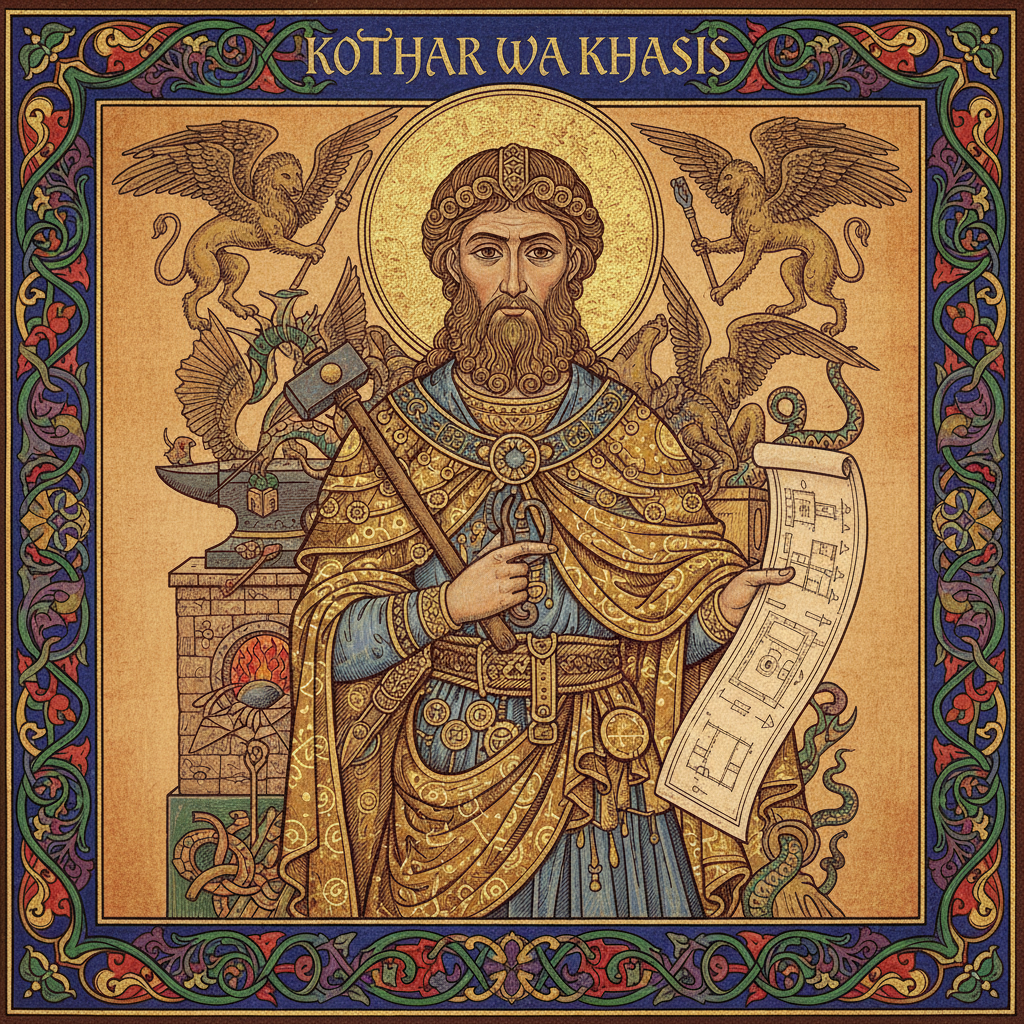
Lore: Kothar-wa-Khasis (“Skillful-and-Wise”) is the divine craftsman of the Canaanite pantheon, the god who makes the things that make divine action possible. When Baal needs weapons to fight Yam, Kothar forges two divine maces (KTU 1.1-1.4) — Yagrush (“Driver”) and Ayamur (“Expeller”) — and names them with incantations that guarantee their effectiveness. When Baal earns the right to a palace, Kothar designs and builds it, including a controversial window that Baal initially refuses (fearing Mot will enter). His workshop sits in Memphis, Egypt, or on Caphtor (Crete) — linking him to both Egyptian and Aegean craft traditions.
Kothar embodies the divine principle of techne — craft, skill, and technology as sacred. Without his maces, Baal cannot defeat Yam. Without his palace, Baal cannot rule. The craftsman god is no mere servant; he is the enabler of cosmic order. His dual name (“Skillful AND Wise”) emphasizes that craft without wisdom is mere labor, wisdom without craft mere thought — the combination is divine power.
Parallel: Kothar maps onto the universal “divine smith” archetype with remarkable precision: Hephaestus (Greek — forges Zeus’s thunderbolts, as Kothar forges Baal’s maces), Ptah (Egyptian — the creator-craftsman god, and notably Kothar’s workshop is in Memphis, Ptah’s city), Ilmarinen (Finnish — forges the Sampo in the Kalevala), Ogun (Yoruba — the orisha of iron and technology), Goibniu (Celtic — the divine smith of the Tuatha De Danann), Wayland (Norse/Germanic). The divine smith is one of the most consistent archetypes in world mythology, reflecting humanity’s recognition that metalworking — the transformation of raw earth into weapons and tools — is something close to magic.
1 min read
None -- universally valued by all factions
KTU 1.1-1.4; Helene Danthine, *Le palmier-dattier et les arbres sacres*