Sinai and the Two Tablets
~1280 BCE · three months after the Exodus · Mount Sinai
Contents
Three months after the Exodus, Israel reaches Sinai. Moses ascends into fire and cloud. Forty days. The people build a golden calf. Moses descends, sees the calf, smashes the tablets. He grinds the calf to powder and makes Israel drink it. Then he climbs again. The Law is given twice — the second time, after betrayal.
- When
- ~1280 BCE · three months after the Exodus
- Where
- Mount Sinai
The mountain is on fire.
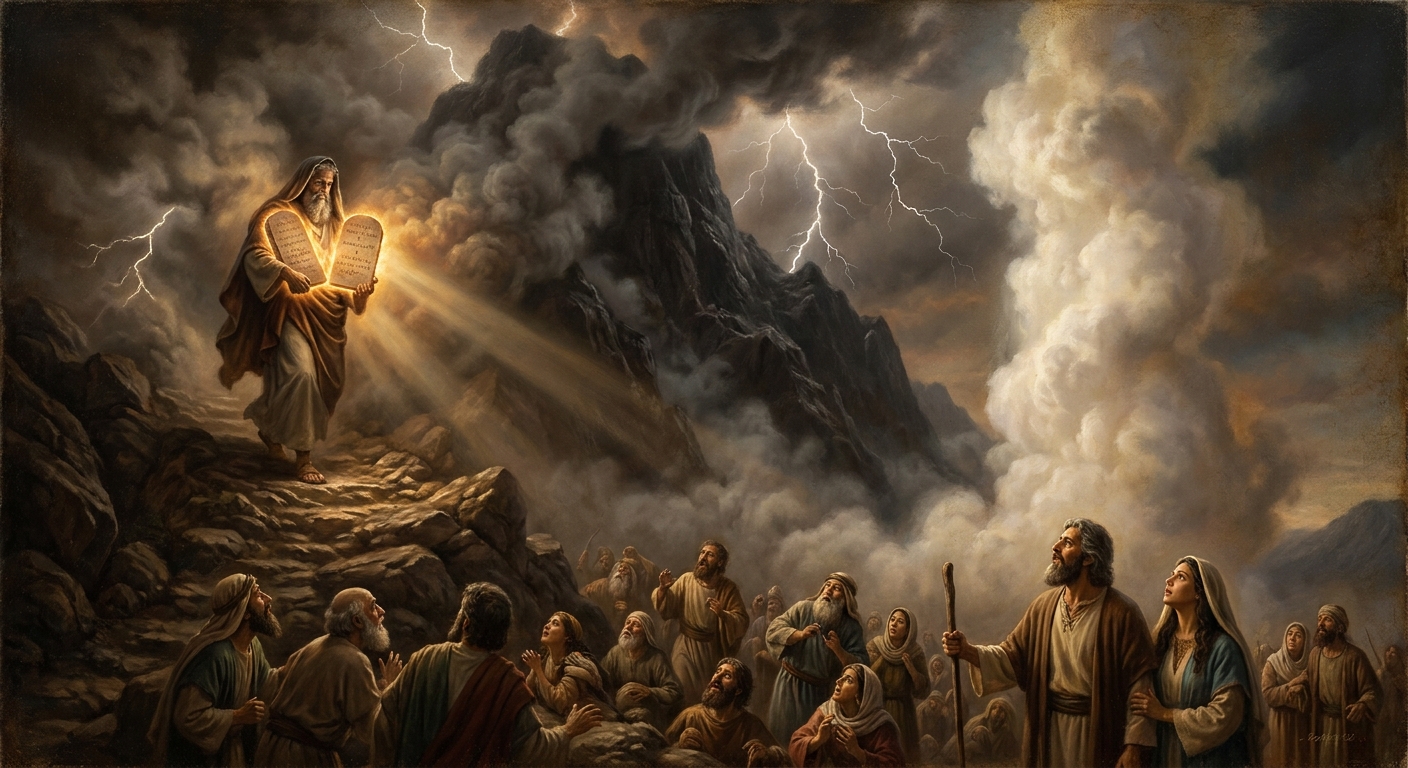
Not metaphor. Not vision. The text says smoke, the text says lightning, the text says the whole summit trembles as though the stone itself cannot hold what is standing on it. Three months ago these people were slaves in Egypt. Now they camp in the wilderness of Sinai, and the mountain at the edge of their camp is doing something that no mountain has done before.
YHWH descends on it in fire.
Moses has been in conversation with this fire since the burning bush in Midian — since the voice came out of the desert and told a fugitive shepherd that he was going to walk back into Egypt and take his people home. He is accustomed to the voice. He is not accustomed to this. The whole community of Israel is standing at the base of the mountain with their eyes up, and the word comes down to him: Come up.
He goes up alone. Joshua waits partway. The cloud takes Moses.
Forty days.
Below, the camp waits. The first days are discipline. The second week is routine. Somewhere in the third week the anxiety shifts into something else. Moses has been gone too long. The fire and smoke continue, but they are no longer signs of a god who is near — they are signs of a god who has taken their leader and not returned him.
The people go to Aaron.
Aaron is everything Moses is not: sociable, priestly, smooth. He has been Moses’ voice before Pharaoh, his spokesman, his translator to the crowd. He is also, as Exodus will not say politely but will say plainly, a man who folds under pressure. The people say: Make us a god we can see. This Moses, we don’t know what has become of him.
Aaron does not argue. He does not call for patience. He says: Give me your gold earrings.
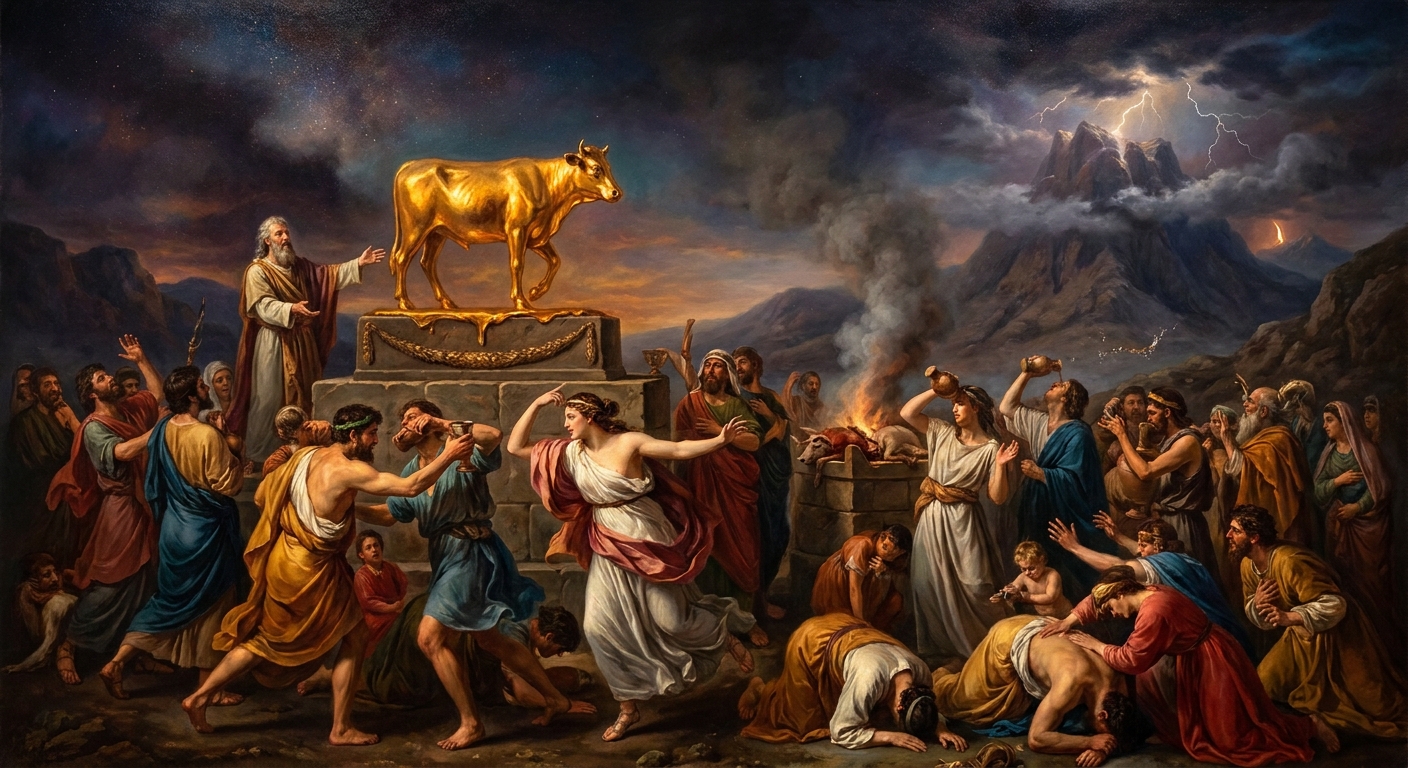
They give them. He melts them. He casts them into a mold, and what comes out of the fire is a calf.
He builds an altar in front of it. He announces a festival to YHWH. The people rise early the next morning, sacrifice burnt offerings, sit down to eat and drink, and then rise up to play. The word the text uses — letzachek — carries freight: revelry, dancing, possibly something more disordered than the text says directly. The camp is not praying. It is celebrating.
The calf stands in the smoke and does not move.
On the mountain, YHWH speaks before Moses can descend.
Go down. Your people, whom you brought out of Egypt, have corrupted themselves.
Not: my people. Your people. The sentence is a test of the man. What follows is one of the most extraordinary moments in any religious text: Moses argues with God. YHWH says he will destroy Israel and start over with Moses as the founding father of a new nation. Moses says no. He tells YHWH to remember Abraham, Isaac, and Israel — the promises are not Moses’ to break, they were made to the ancestors. He reminds YHWH that Egypt is watching. He talks the fire down.
And YHWH relented from the disaster he had spoken of bringing on his people.
Moses carries the two tablets. Stone written on both sides. The writing is the writing of God. He comes down the mountain, and Joshua is waiting partway and hears the noise from the camp and says it sounds like war. Moses says no: not the sound of victory, not the sound of defeat. The sound of singing.
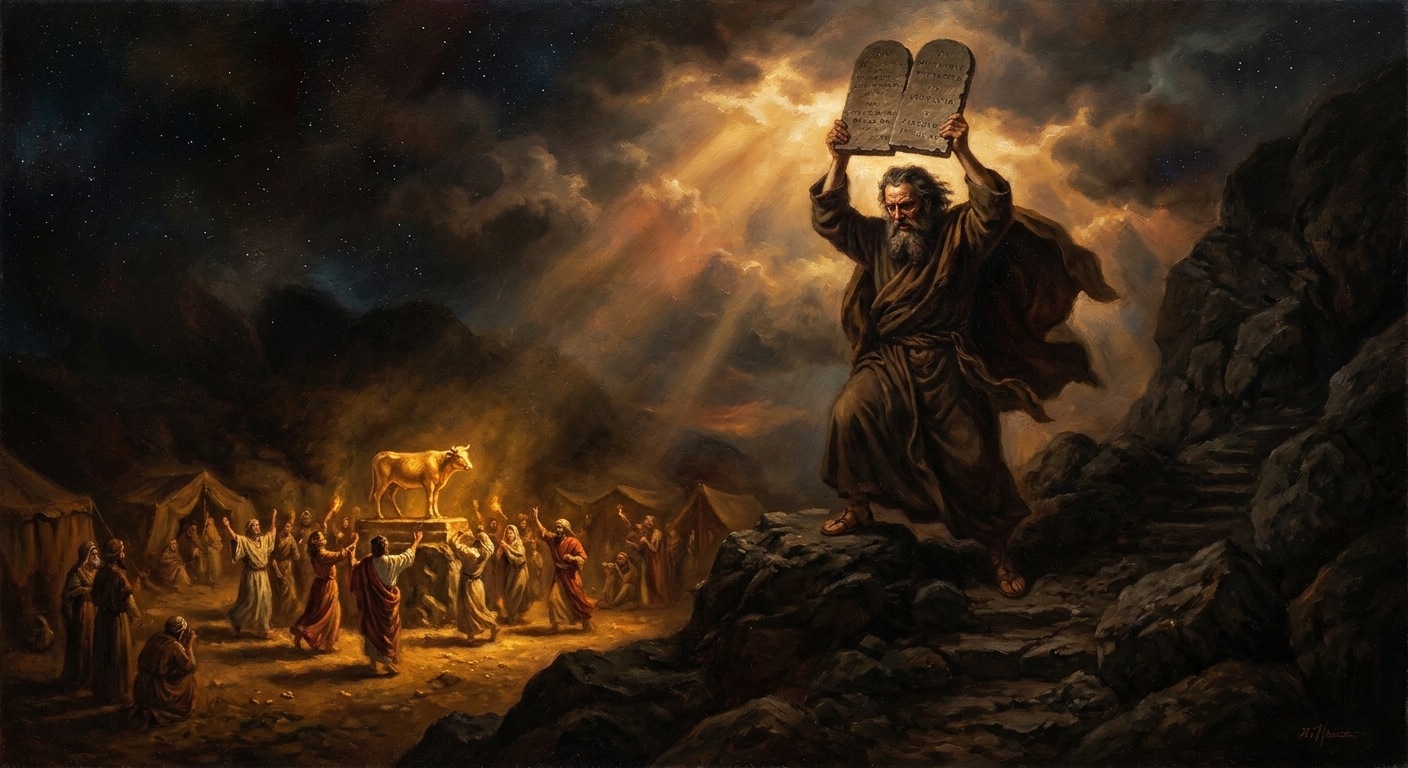
He rounds the bottom of the mountain and sees the calf. He sees the dancing.
He throws the tablets down. They shatter at the foot of Sinai.
What he does next is deliberate and precise and terrible.
He takes the calf and burns it in fire. He grinds it to powder. He scatters the powder on water. He makes the children of Israel drink it.
This is not the act of a man who has lost control. This is the act of a man who is choosing a punishment that is exact: you wanted to swallow this god, you will swallow this god. The calf goes back into the people who built it. The metal they melted from their own jewelry passes through them.
He goes to Aaron. Aaron’s explanation is the most famous piece of cowardice in the Torah: I threw the gold into the fire, and out came this calf. Moses does not argue. There are twenty-three thousand people who have died in what follows the worship — Levites with swords going through the camp at Moses’ word, killing brothers and neighbors and friends, the price of the idolatry extracted in blood. Aaron will live. Aaron will be high priest. The text does not explain this fully. It rarely does.
Then Moses climbs again.
Now, if you will only forgive their sin — but if not, blot me out of the book that you have written.
This is Moses’ second bargain, the one he makes for the people after the slaughter rather than before. YHWH does not accept the trade. But he accepts Moses. He passes his glory before Moses — goodness, the Hebrew says, tov — and covers Moses’ face in the cleft of the rock while it passes, because a human being cannot see the face of YHWH and live. Moses sees the back. He hears the name spoken over him in the dark: YHWH, YHWH, a God compassionate and gracious, slow to anger, abounding in steadfast love and faithfulness.
The covenant is renewed.
New tablets. Moses carves them himself this time — in the first giving, God writes; in the second, Moses cuts the stone and God fills it. The distinction is not accidental. After betrayal, the human being does more of the work.
He comes down the second time and his face is shining. He doesn’t know it. The people see it and they’re afraid to come near him. He has to call them twice before they approach. He gives them everything YHWH has spoken. Then he puts a veil over his face, because the light is too much for them to look at while he is just talking.
When he goes back in to speak with YHWH, he takes the veil off. Two modes: covered among the people, uncovered before the fire.
The Law given twice. The tablets broken and recarved. The first giving before Israel has failed; the second giving after. The second covenant is the real one — the one made not with a people who have never sinned but with a people who have sinned and been held anyway. Robert Alter calls this the central tension of the whole Torah: YHWH’s anger and YHWH’s love are both real, and the text will not resolve them into something easier.
The Law is not punishment. The covenant is not conditional on perfection. The tablets do not stay broken.
What the mountain keeps insisting on, across every covenant in Tanakh, is not that the people will be faithful. It is that when they are not — and they will not be — there is a procedure for what comes next. Moses grinds the failure to powder and makes Israel drink it. Then he climbs the mountain again. This is the shape of every covenant that follows: broken, remade, carried forward into the wilderness by people who are not up to it.
That is precisely the point. The Law was never given to the worthy.
Scenes
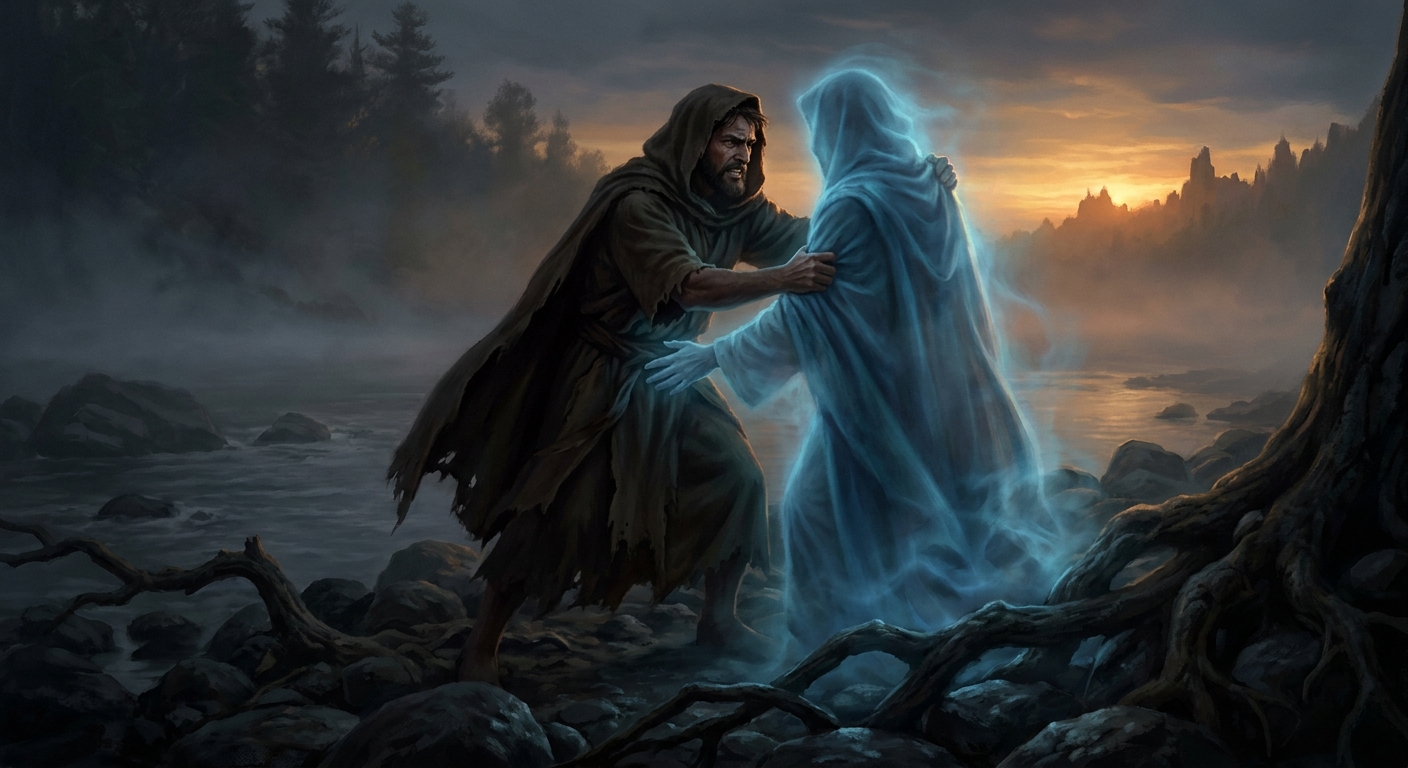
Moses descends from Sinai carrying the two stone tablets — his face shining so brightly the people cannot look at him (Exodus 34:29-30)
Generating art… Aaron melts the people's gold earrings and casts the calf
 Generating art…
 Moses, still burning with the fire of the mountain, sees the calf and the dancing
 Generating art…
 Echoes Across Traditions
Entities
- Moses
- Aaron
- Miriam
- YHWH
- Joshua

Sources
- Exodus 19–20, 32–34
- Deuteronomy 5
- *Mekhilta de-Rabbi Ishmael*
- Robert Alter (trans.), *The Five Books of Moses* (2004)
- Aaron Wildavsky, *Moses as Political Leader* (1984)