Moses Parts the Sea
~1280 BCE traditional date · Exodus composed ~6th-5th century BCE · The Yam Suph — the Reed Sea, the Red Sea
Contents
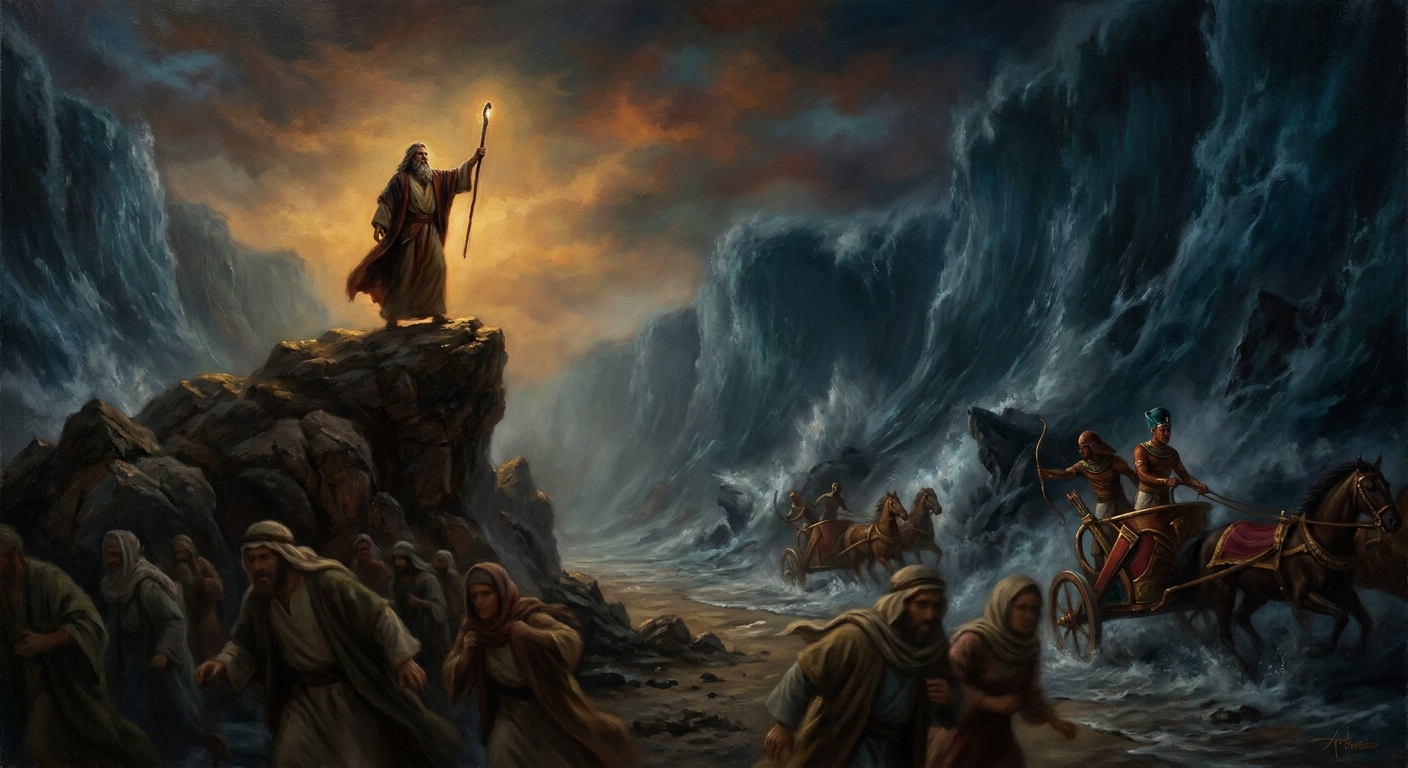
Moses raises his staff before the Egyptian chariots. The sea splits into two walls, revealing a corridor of dry ground. The Israelites cross. Behind them, the waters collapse, drowning Pharaoh's army.
- When
- ~1280 BCE traditional date · Exodus composed ~6th-5th century BCE
- Where
- The Yam Suph — the Reed Sea, the Red Sea
The dust reaches the shore before the sound.
Pharaoh’s chariots — six hundred of them, bronze wheels and black horses, linen-clad archers with obsidian-tipped arrows — rise behind Israel like a second sun. The slaves-turned-refugees have nowhere left to run. The sea blocks them. The chariots close in. The trap springs.
Moses does not run.
He stands at the water’s edge, two million people behind him (or so the tradition counts — the historians will argue forever), with Aaron beside him and Miriam standing further back, her tamburine hanging from her wrist like a prayer waiting to be sung. The old man raises his staff. Not in desperation. In simple recognition of what must happen.
The Bible will say it clearly: “The Lord said to Moses, ‘Why are you crying out to me? Tell the Israelites to move forward. Raise your staff and stretch out your hand over the sea to divide the water so that the Israelites can go through the sea on dry ground’” (Exodus 14:15-16).
This is not passive. This is not waiting.
The staff rises. The hand extends.
What happens next defies the neat categories of the possible.
The sea does not part gently, like a curtain drawn back from a window. It breaks. The rabbis will later imagine it in the Mekhilta, the exegetical midrash: the water splits not into two walls but twelve channels — one for each tribe, so no tribe walks through another’s spray, so the people maintain their integrity even in the crossing. It is a detail that reveals the tradition’s hunger for order, for justice even in miracle.
But the Exodus text is simpler and stranger. It says the sea divided, and the waters became a wall on their right hand and on their left. Not spray. Not mist. Walls. Vertical. Solid. The seafloor revealed in a moment — not drying as the hours pass, but dry — sand packed hard enough to walk on without sinking, without the sucking pull of wet earth.
For a modern reader, the question is immediate: How?
A tsunami? The word does not exist in Exodus, but scholars have speculated about tidal bores, about storm surge, about the geological features of the Reed Sea that might make this physically possible under extraordinary conditions. Richard Friedman notes that yam suph — the Reed Sea — is not necessarily the Red Sea as post-Biblical mapmakers imagined it, but perhaps one of the northern lakes, the Bitter Lakes, a body of water where seasonal wind, underwater geography, and the movement of sand might conspire to create a passage. Possible. Documented in rare cases.
But that is not how the text reads it. The text reads it as pure act. The hand raises. The sea obeys. There is no mechanism. There is only will and submission.
The crossing is terror and order at once.
Imagine it: two million people — the young, the old, the sick, the slowest — moving across a corridor of sand between two cliffs of water. The walls do not splash. They do not lean in. They stand. But they stand because they are held. The weight of the sea presses down on them. The people feel it. They smell the salt. They hear the susurration of water held at bay by a force that has no visible engine.
Aaron moves among them. Move. Keep walking. Do not look back.
Miriam does not sing yet. Not yet. The music comes after.
The horses are fast. The chariots are closing.
What happens next is inevitable the moment the first Israelite touches the far shore.
The staff descends.
The walls do not collapse gently. They return. The sea reasserts itself. The rabbis later debated whether Pharaoh himself was drowned, or whether he escaped, or whether he was present at all in this moment. The text is clear: “The Lord swept the sea back over them; all the horsemen and chariots of Pharaoh, his entire army” (Exodus 14:28). Not some. All.
Six hundred chariots. Thousands of horses. Tens of thousands of soldiers.
The sea does not negotiate.
Then, in the silence after the drowning — in that moment when the Israelites stand on the eastern shore, breathing hard, newly orphaned into freedom, the shattered remains of Pharaoh’s army washing up in pieces — Miriam lifts her tamburine.
The text says: “The prophetess Miriam, Aaron’s sister, took a tamburine in her hand, and all the women went out after her in dance with tamburines” (Exodus 15:20).
Not prayer. Dance.
“Sing to the Lord, for he is highly exalted. The horse and its rider he has hurled into the sea” (Exodus 15:1).
The oldest liturgy in the Bible — the Song of the Sea, the Shirat ha-Yam — is not a lament for the drowned. It is a shout of defiance and recognition. This is what it looks like when the sacred acts. This is what liberation sounds like.
The crossing establishes everything that follows.
Israel is not a kingdom yet. It is not a nation-state. It is a people held together by having witnessed the same divine action. Every Jew since who eats matzah at Passover repeats the same declaration: “I myself came out of Egypt” (Mishnah Pesachim 10:5). Not my ancestors. I. The ritual erases the distance between past and present. The crossing happened once at the sea, and it happens again every spring.
The theologians will spend centuries debating what happened at the Red Sea. Did it happen as described? Partially? Was it composed as a meditation on divine power centuries later? The scholars will gesture at tidal bores and land bridges and the peculiarities of Egyptian geography.
But the tradition says something simpler: When the sacred acts, water obeys.
And the echo travels forward. Christ walks on water — the same mastery over chaos. Krishna lifts a mountain — the same held force. Gilgamesh crosses the dark waters — the same ferry to the other side. Every liberation narrative since, from every tradition, carries the shadow of Moses and the parted sea. The moment when running becomes possible. When the impossible becomes the only way forward.
The crossing is not a spectacle. It is a birth. The first free Israelites are not the ones who left Egypt — they are the ones who cross the sea. Everything before was slavery remembered. Everything after is freedom enacted.
The waters part because they must. The sea obeys because obedience to the sacred is the only ordering principle in a cosmos that would otherwise be chaos. That is the Jewish claim. It was the Norse claim too, in different words. The runes did not yield to Odin until he fell low enough to seize them. The sea does not part until the people are ready to walk through.
Both stories say the same thing: the sacred is not sentimental. It is not kind. But it does move. It does act. And it moves for those who have nowhere else to go.
Echoes Across Traditions
Entities


Sources
- Exodus 14:5-31
- *Mekhilta de-Rabbi Ishmael* (Tannaitic midrash on Exodus)
- Richard Elliott Friedman, *The Bible With Sources Revealed* (2003)
- Brevard S. Childs, *The Book of Exodus* (1974)