Vivekananda at the Parliament
September 11, 1893 · Chicago, the World's Parliament of Religions
Contents
A thirty-year-old monk from Calcutta walks into the Art Institute of Chicago and says 'Sisters and brothers of America.' The room stands. The West has never been the same since.
- When
- September 11, 1893
- Where
- Chicago, the World's Parliament of Religions
He stands at the back of the hall and waits for his turn.
He has no official organization. He has no letter of introduction from a university or a bishop or a recognized body. He has a saffron robe, a turban the color of turmeric, and the memory of a dead master’s voice telling him to go. The Parliament organizers have almost turned him away twice. He speaks eighth, ninth, tenth on a program crowded with bishops and deans and men whose denominations have printed programs. The room is not waiting for him.
Then he opens his mouth.
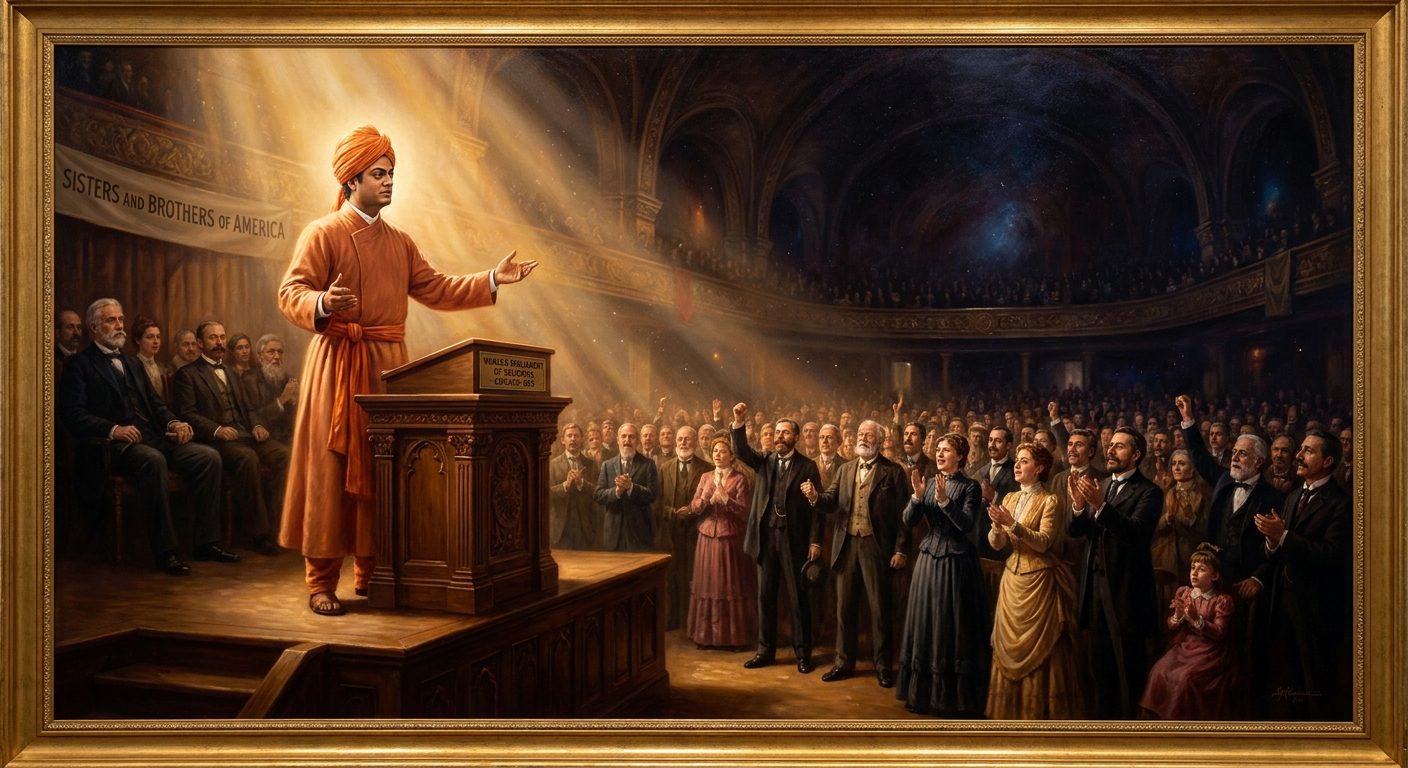
“Sisters and brothers of America.”
Seven thousand people are on their feet before he has spoken a second sentence. The applause lasts two minutes. He stands in it with the stillness of a man who has sat for years in meditation and knows that a storm, like a thought, passes if you do not run from it.
He is thirty years old. He has come from Calcutta with almost no money, traveled to Chicago by way of Vancouver and the Canadian railways, slept in a freight car on the floor, begged breakfast from a woman in a Chicago alley who turned out to be a Quaker willing to listen. He has been in America six weeks. He does not yet have a winter coat.
What he says, once the room sits down, is not what they expected.
The Parliament has been organized on an implicit premise: that the world’s religions would gather, compare notes, and recognize in Christianity their common destination. The other traditions would testify. Christianity would receive the testimony. This is not triumphalism exactly — many of the organizers are genuinely curious, genuinely liberal — but the architecture of the event encodes it. There is a host tradition. There are guests.
Vivekananda does not behave like a guest.
He speaks of the Vedanta — the Upanishadic philosophy at the root of the Hindu tradition — not as a regional belief system but as a description of reality. He speaks of Brahman, the absolute consciousness underlying all appearance, and he speaks of it as something every religion has been pointing toward without using that word. The river metaphors — all streams to the same sea — are his. The phrase “as different rivers… all mingle their water in the sea, so, O Lord, the different paths which men take… all lead to Thee” is his, drawn from the Shiva Mahimna Stotram. He is not translating Hinduism into Christian categories for polite consumption. He is offering the Vedanta as a philosophical framework large enough to contain Christianity rather than the other way around.
The room is astonished. Some of it is the voice — deep, modulated, a trained singer’s control over breath and pitch. Some of it is the image: the saffron and the calm, the stillness in the face of seven thousand strangers. But most of it is the argument, which is genuinely new to them. They have heard that other religions exist. They have not heard, from inside one of those religions, a coherent account of why the existence of many traditions is not a problem to be managed but a truth to be understood.
He speaks again the next day. And the next. Each time the crowds grow.
Behind Chicago is Ramakrishna.
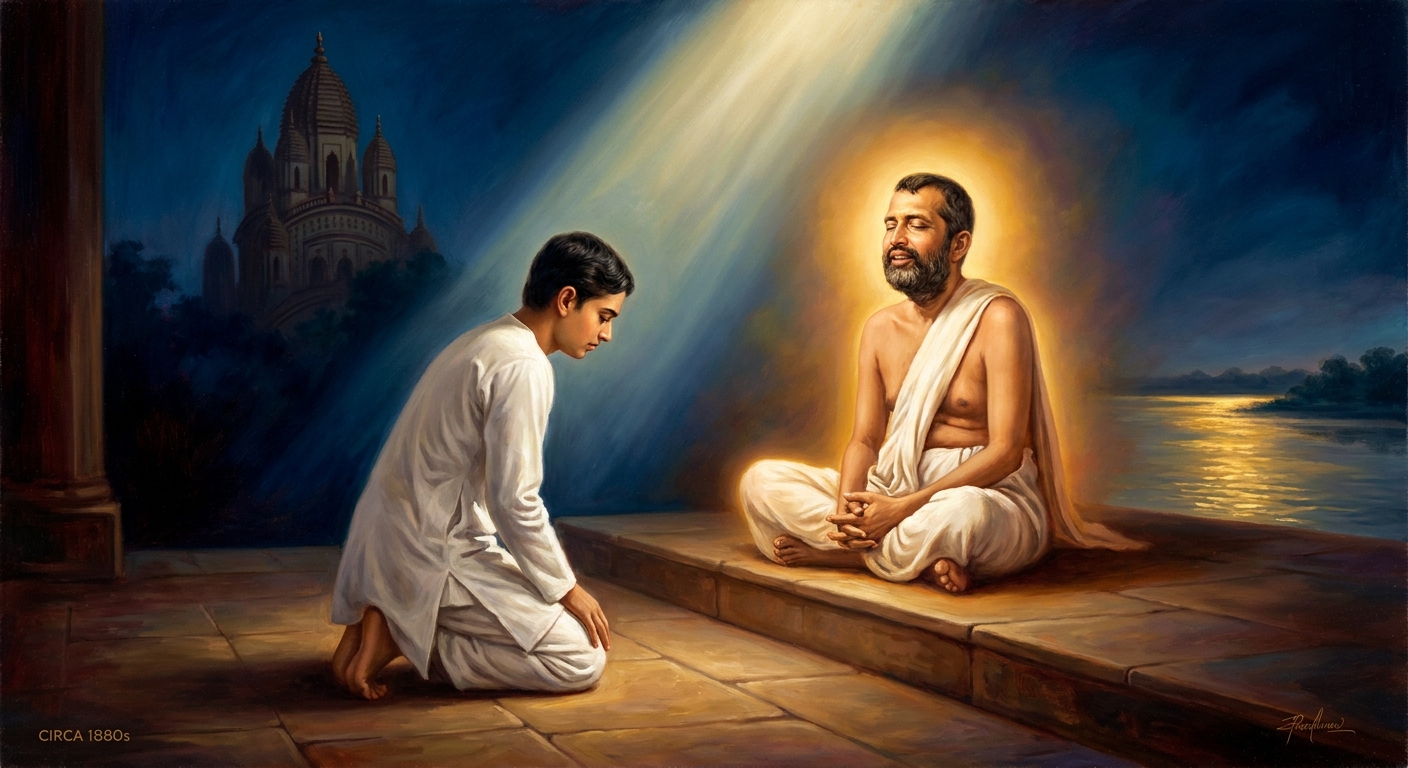
Narendra Nath Datta — the name Vivekananda was born with — met the priest of Dakshineswar at nineteen, already a skeptic and a rationalist who had been reading John Stuart Mill and Herbert Spencer. He went to test a holy man and came back shaken. Not because Ramakrishna had arguments: he had none. He had darshan — the direct transmission of a state. He touched Narendra’s chest with his foot and the visions came, uninvited, a flooding of the nervous system that the boy could not explain and could not dismiss. He spent years fighting it, returning to Dakshineswar, leaving, returning. When Ramakrishna was dying of throat cancer in 1886, Narendra stayed.
What Ramakrishna poured into him was a particular claim: that all religious paths are real, that the divine puts on different faces for different seekers, that kali and krishna and allah and jesus are masks of the same reality worn for different eyes. This was not tolerance in the liberal sense — not the polite suspension of disbelief about someone else’s tradition. It was a metaphysical position: the diversity of forms is built into the nature of the absolute, because the absolute is too large to be seen whole.
That is the argument Vivekananda carries to Chicago. He has not invented it. He has received it, tested it, survived it, and translated it into the vocabulary a Western audience could hold.
He stays for years.
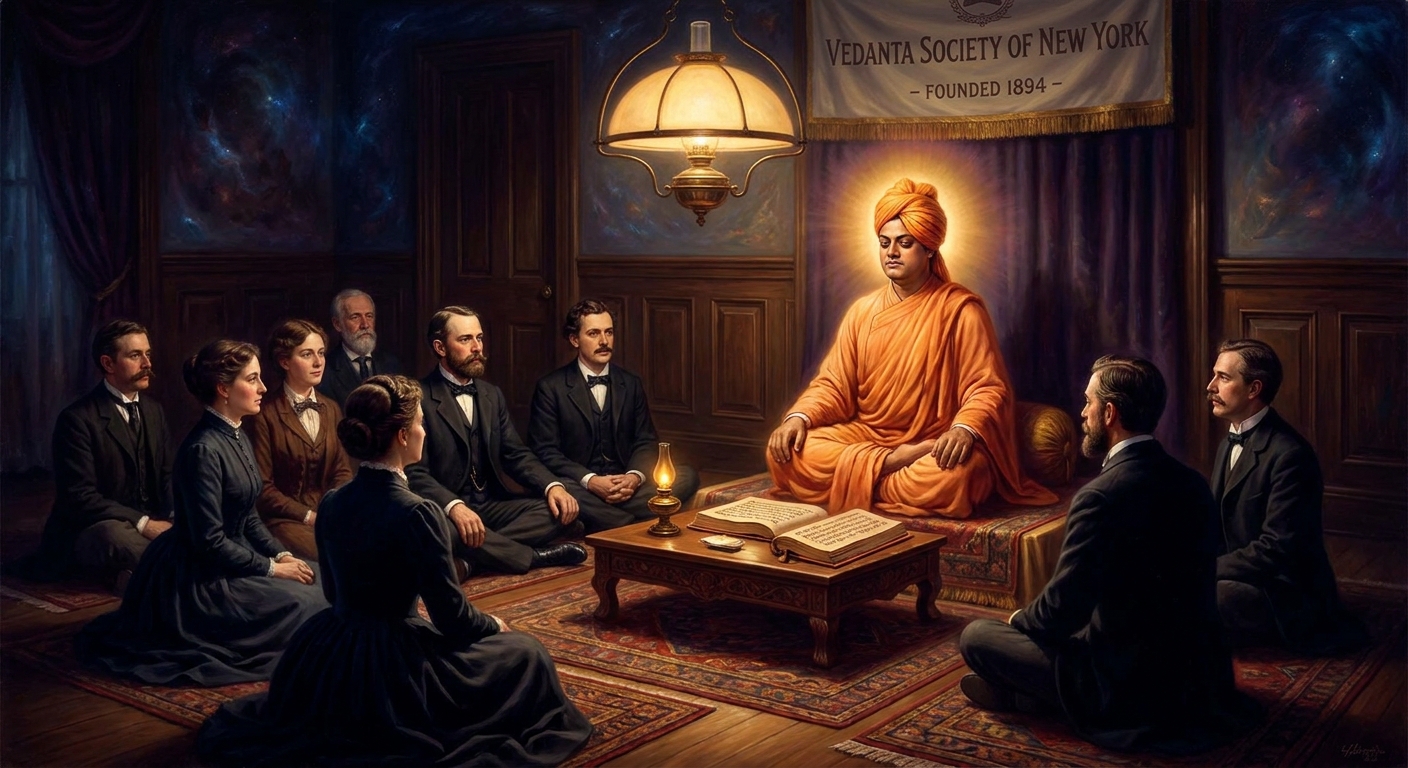
He lectures in Boston drawing rooms where Brahmin New Englanders — the American kind, the Harvard kind — take careful notes. He speaks in Detroit and Memphis and New York. He draws the curious and the hungry: Sara Bull, the Norwegian-American widow who becomes his most steadfast American patron and funds the Vedanta Society’s early years; Christine Greenstidel, who will eventually become a monastic. He gives interviews to journalists who are not sure how to file the copy. He writes letters home to his brother monks in Belur that read like dispatches from a strange war: “The Americans are a great people… but they have no philosophy, no religion, just a little Jesus-Christ-business.”
He is not without frustration. The celebrity creates its own distortions. Women in Boston want the exotic monk; what he wants to give them is the Upanishads. He navigates the attention with varying success. He is homesick in a way that surprises him, having imagined himself past attachment. He misses the Ganges. He misses the taste of certain foods. He misses the ease of being in a place where the categories are already understood.
But the work is real. The Vedanta Society he founds in New York in 1894 is still operating. The classes he teaches on Raja Yoga and Jnana Yoga become books. The books get translated. The translations get read by people who will teach others who will teach others, and the line from Vivekananda’s Chicago lecture to the yoga studio on the corner of your city is not metaphorical — it is a continuous transmission with traceable links.
He returns to India in 1897 to enormous crowds. He has done what he went to do: he has demonstrated that the tradition can stand on a Western stage and hold its own, not as a curiosity, not as a dying civilization’s remnant, but as a living philosophy with something to say to modernity. For a country under British rule, for a culture that has been told for a century that its thought is primitive and its gods are superstition, this matters in a way that is hard to overstate.
He founds the Ramakrishna Math and Mission. He works himself to the edge of collapse. He dies in 1902, at thirty-nine, his body simply used up.
He predicted this. He told his monks he would not live forty years. He did not say it as a lament. He said it the way a man says it who has calculated the exchange and decided it is fair.
What he planted in Chicago was the category itself. Before 1893, “world religions” was not a stable intellectual concept in the West — there was Christianity, and there were the traditions of lesser-developed peoples awaiting conversion. After Vivekananda, the comparative religion field exists. After Vivekananda, Hinduism is something you can choose, study, practice, or reject on its merits. After Vivekananda, the East is a direction wisdom can travel in.
The yoga mat in your gym. The word “meditation” in your hospital’s chronic pain literature. The academic department of religious studies in your university. The assumption that a serious person might draw from more than one tradition. These are not inevitable. They have parents. One of them stood in Chicago in a saffron robe and said “Sisters and brothers of America” to a room that had not yet learned to be that.
Scenes
September 11, 1893
Generating art… In Dakshineswar, years before Chicago, Ramakrishna places his foot on a young Narendra's chest and the visions begin
 Generating art…
 New York, 1894
 Generating art…
 Echoes Across Traditions
Entities
- Swami Vivekananda
- Ramakrishna
- Sara Bull
Sources
- *The Complete Works of Swami Vivekananda* (Advaita Ashrama, 1907-1922)
- Romain Rolland, *The Life of Vivekananda and the Universal Gospel* (1931)
- Carl T. Jackson, *Vedanta for the West* (1994)
- *Barrows, John Henry (ed.), The World's Parliament of Religions* (1894)