The Hill That Is Shiva's Body
Mythological time; 1896 CE · Tiruvannamalai, Tamil Nadu, India
Contents
Brahma and Vishnu argue over cosmic supremacy. Shiva interrupts the argument by manifesting as an infinite pillar of fire — a jyotirlinga without beginning or end. Brahma flies upward for a thousand years and cannot find the top; Vishnu dives downward for a thousand years and cannot find the bottom. Both concede. The pillar does not vanish: it becomes the hill of Arunachala in Tamil Nadu, where it waits as stone. In 1896 a sixteen-year-old from Madurai named Venkataraman arrives at the hill and never leaves.
- When
- Mythological time; 1896 CE
- Where
- Tiruvannamalai, Tamil Nadu, India
In the beginning of the argument, neither Brahma nor Vishnu is unreasonable.
Brahma has created the world. He has produced from his own body the fourteen realms, the four Vedas, the orders of beings, the first human pair. He sits on his lotus throne above the primordial waters and his case is solid: without creation there is nothing for preservation to preserve. Creation precedes. The creator is therefore prior, and priority confers supremacy.
Vishnu has maintained the world through every catastrophe. He has descended as fish, tortoise, boar, half-man half-lion, dwarf, axe-wielding brahmin, king, cowherd, hero, and will descend again. He has held the order of things together through floods and demon-kings and the periodic dissolution that threatens to end everything permanently. Preservation requires continuous active effort; creation is a single event. The preserver is therefore more essential.
The argument has been going on for a very long time. The realms are beginning to shake.
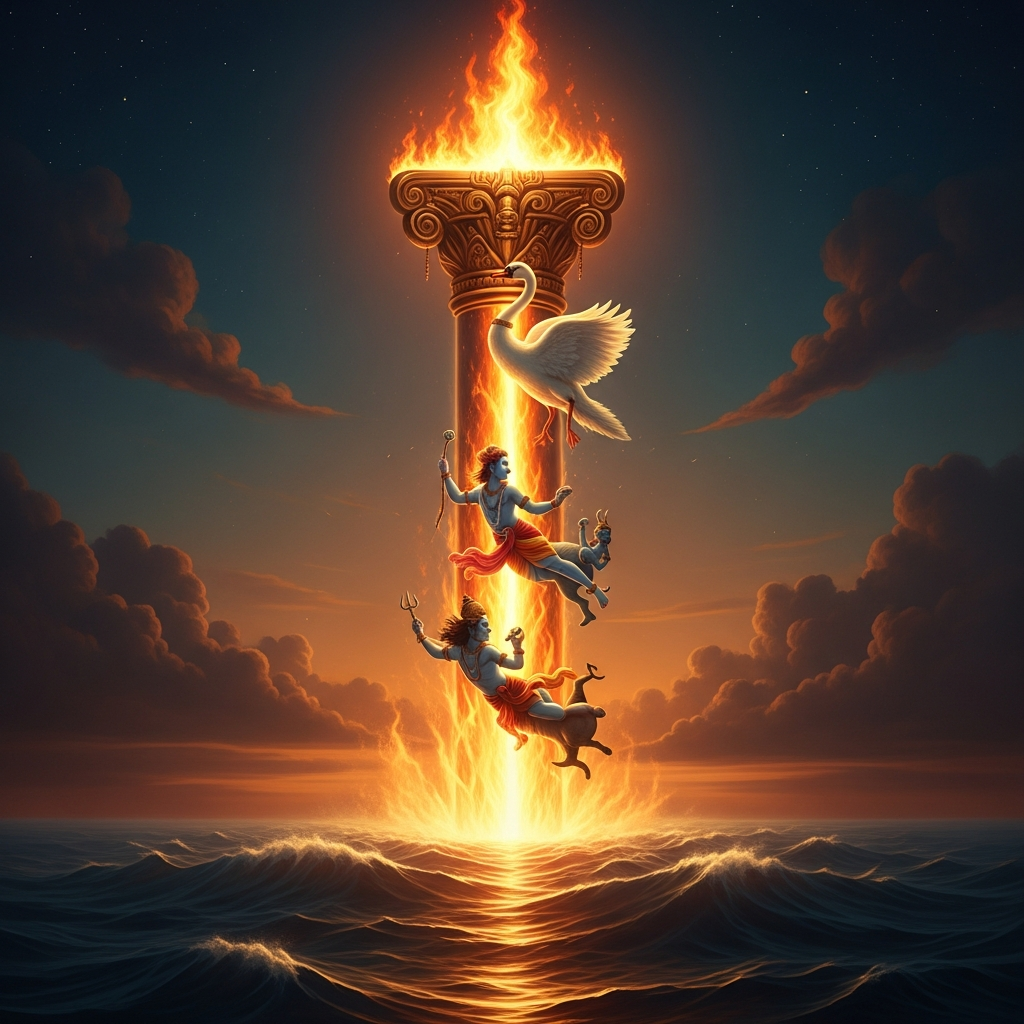
The pillar appears between them without warning.
It has no beginning in the space below. It has no end in the space above. It is fire, but it is not the fire of burning, not the fire of warmth or destruction or illumination in any ordinary sense. It is the fire that was before the elements were separate, before Brahma separated fire from water from air from earth and gave each its character. This fire contains all of them without being any of them. It has no sound. It has no heat. It is the most present thing in creation and it is also completely outside creation.
Brahma and Vishnu stop arguing because the argument has become, suddenly, irrelevant.
Vishnu speaks first, which is characteristic: he is the pragmatic one, the preserver who deals with the world as it is. He says that he does not know what this is, and that they should find out before they resume their discussion of which of them is greater. Brahma agrees. They decide: Brahma will take his swan form and fly upward along the pillar to find its top; Vishnu will take his Varaha form — the cosmic boar — and dive downward along it to find its bottom. Whoever finds an end will have demonstrated, by that discovery, the finitude that defines the cosmos rather than what is beyond the cosmos.
They go.
Brahma flies for a thousand years.
The number is not a metaphor for a long time; in the mythological cosmos, a thousand divine years is a genuine duration, the kind of time across which entire civilizations rise and fall in the world below. He flies upward in his swan form — white wings, cold air, the pillar always beside him and always the same: the same fire, neither growing nor diminishing, neither beginning nor approaching an end. At some point in the first hundred years he realizes he is not going to reach the top. He continues anyway, because the alternative is to turn back and admit that the pillar exceeds him.
He does not find the top.
He almost admits this when he returns. What he does instead — and this is the detail the myth preserves with a specificity that suggests it is important — is encounter a ketaki flower falling downward along the pillar. He stops the flower. He asks it where it has come from. The flower says it has been falling for a thousand years from the top of the pillar where it was placed at Shiva’s crown. Brahma takes the flower and descends and tells Vishnu that he has reached the top and the flower is his proof.
Vishnu, who has also not found the bottom, says simply: I did not find the bottom. He says this without elaborating.
The pillar resolves itself into the form of Shiva, who has been the pillar all along, and the cosmic order shifts in the way it shifts when something that has been uncertain is settled: Brahma lied; Vishnu did not; the ketaki flower is cursed never to be used in Shiva’s worship; Brahma loses one of his five heads — some versions say Shiva cuts it off in his anger, some say it was always an excess, a pride-head that needed removing. What does not change is the pillar.
The pillar remains.
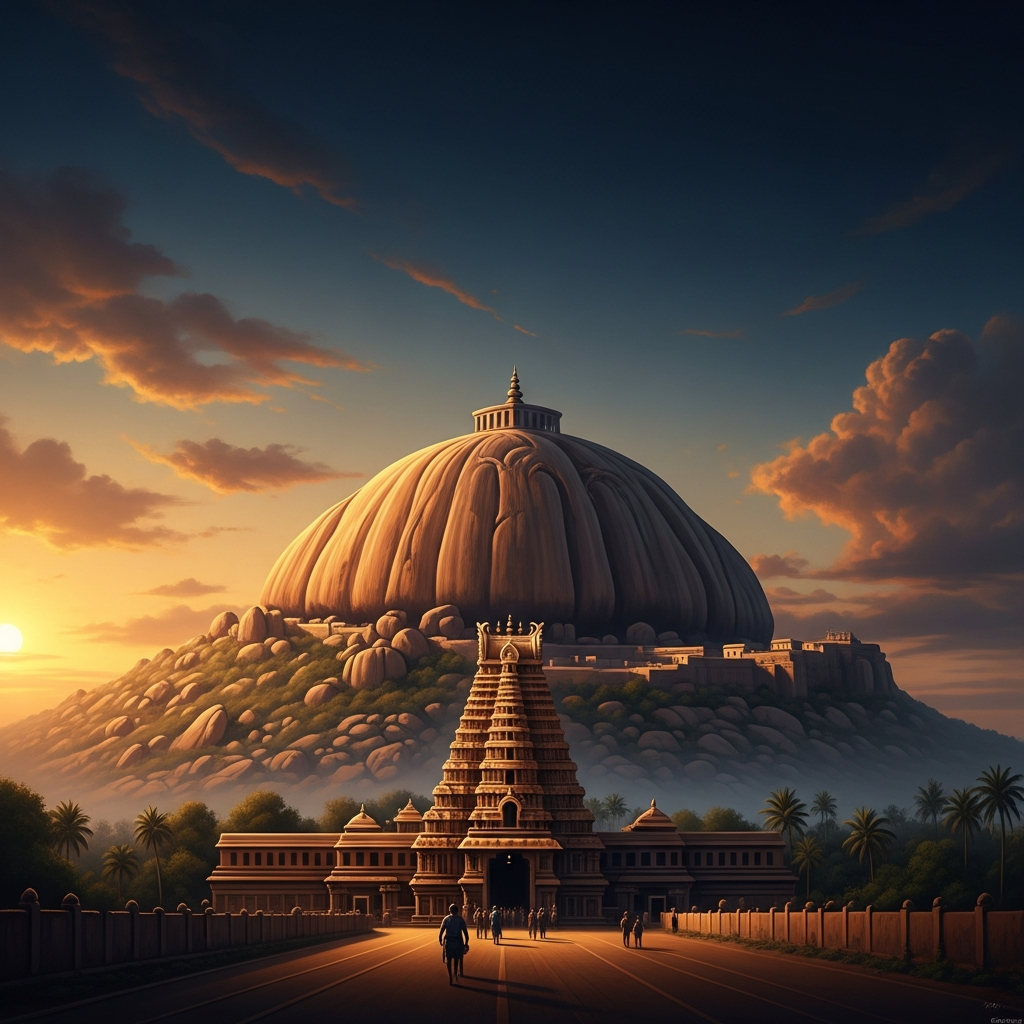
It becomes stone somewhere in the Tamil country, which is very old country, country that has been sacred in ways the Sanskrit tradition absorbed rather than created. The mountain that is the pillar made permanent stands at 2,682 feet above the plain of Tiruvannamalai — not impressive by Himalayan standards, not even impressive by the standards of the Western Ghats visible on the horizon. It is a small granite dome, red and ancient, with a temple complex at its southern foot whose gopuram towers mark it for anyone approaching across the flat paddy fields. The mountain is called Arunachala: the red hill, the hill of the rising sun, the hill that is fire made terrestrial.
The Shaiva texts of the Tamil tradition, the Tevaram and the Tiruvachakam, describe it as the place where Shiva is most directly himself — not wearing the ascetic’s form, not wearing the dancer’s form, not clothed in the guises the deity takes to make himself comprehensible to human minds. Here he is the light itself, the jyotirlinga, materialized in stone because stone is the closest material-world analog for something that does not change.
Pilgrims have been walking the pradakshina — the circumambulation of the hill’s base, fourteen kilometers of it — for as long as there have been pilgrims in the Tamil country. They walk it in the early morning when the stone is cool. They walk it on full moon nights when the hill is visible by moonlight against a dark sky. They walk it at Karthigai Deepam, the festival when a fire is lit at the hill’s summit and seen from forty kilometers away, enacting in ritual fire the pillar that preceded the stone.
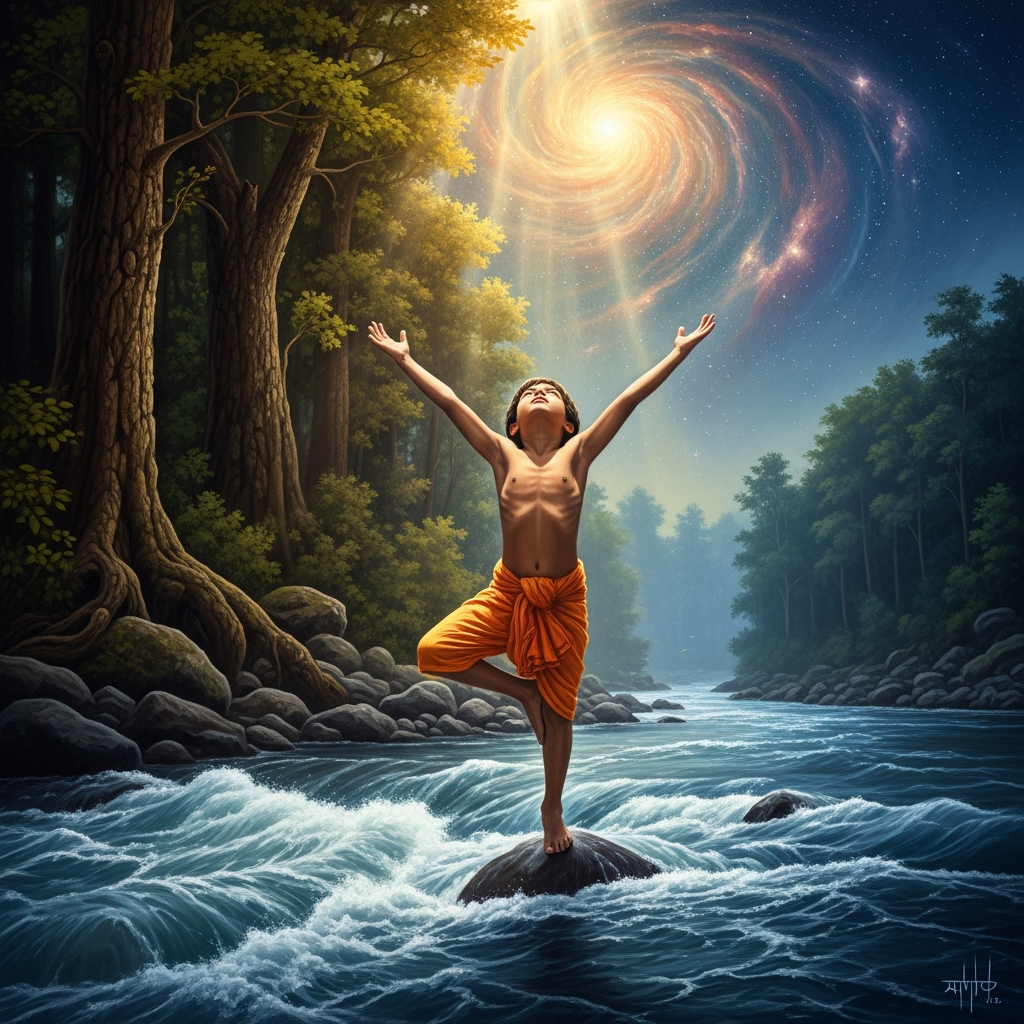
In September 1896 a sixteen-year-old boy in Madurai has what he will later describe as a death experience. He is alone in his uncle’s house. He lies down on the floor and holds very still, convinced that he is about to die, and investigates what it feels like to die. What he discovers is that the thing doing the dying is not what he thought he was. There is something watching the dying — something that does not itself die, that observes the end of the body’s narrative with a detachment that is not coldness but recognition.
He gets up. He is no longer interested in Madurai.
He knows about Tiruvannamalai from the Tamil tradition he grew up in. He knows Arunachala is Shiva. He takes the train — or walks when the money runs out — and arrives at the hill and goes directly to the temple. He sits in the Thousand Pillar Hall. He sits so still that boys from the town find him and put stones on his legs to see if he will move. He does not move. He moves to a water tank where the water and insects damage his skin. He is cared for intermittently by a saint named Seshadri Swamigal who keeps the more aggressive pilgrims from harassing him.
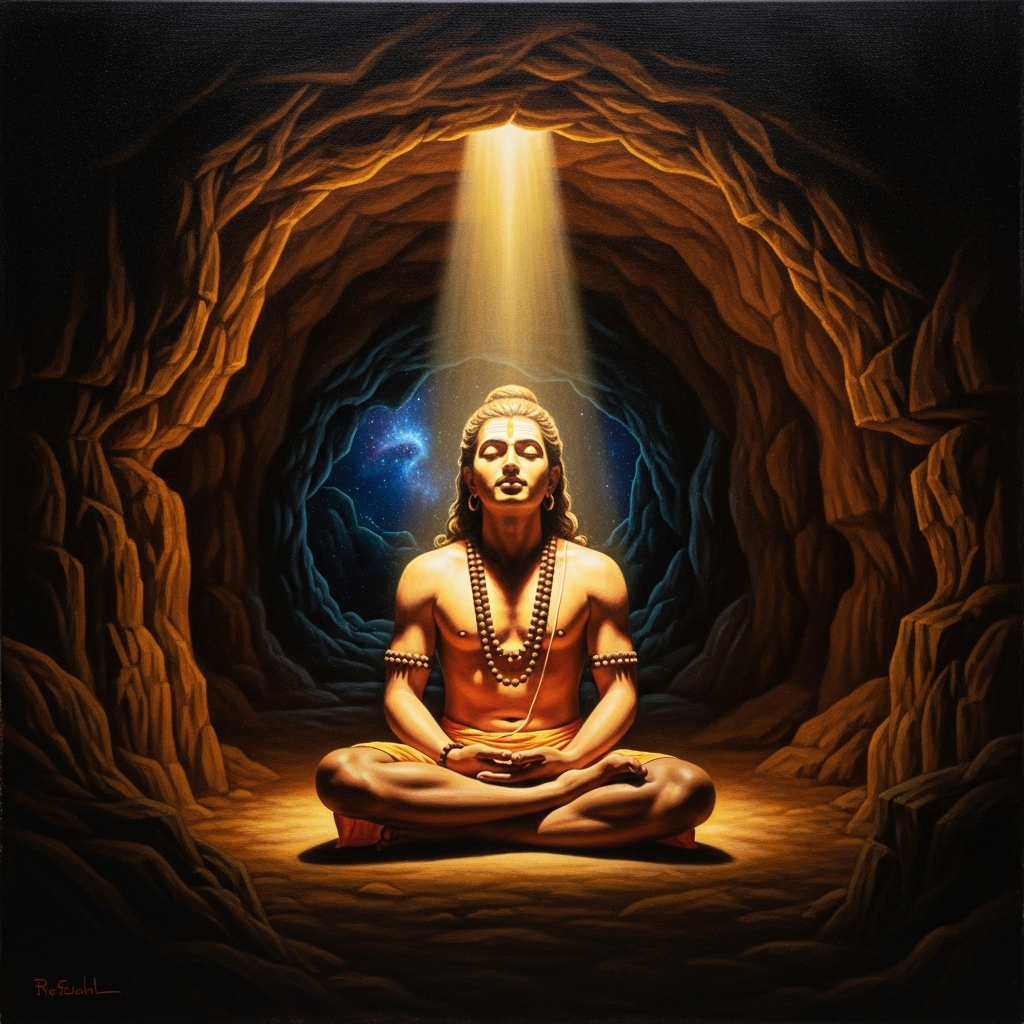
He moves up the hill. He lives in the Virupaksha cave. He stays.
He stays for fifty-four years. He dies in 1950, at the hill, surrounded by devotees who report that a falling star crossed the sky at the moment of his death and moved toward the hill’s summit.
He teaches — when he teaches at all, which is less often than most teachers — by pointing at the hill. He says: the hill is the guru. The hill is Shiva. The hill is the teaching. He says this not as metaphor but as literal description: the fire that Brahma could not top and Vishnu could not bottom is still there, still infinite, still the thing that ends all arguments about precedence and supremacy, and it is made of granite now only because granite is what fire looks like when it agrees to hold still long enough to be visited.
His other teaching is a question: Who am I? Not as a philosophical inquiry to be answered discursively but as a meditative process, a turning of attention back on the attention itself. The questioner investigates the questioner. What is found, he says, is what the pillar is made of.
The hill alone abides, he writes, in Tamil, in a poem to the mountain, one of the few things he ever commits to paper. What is born will die. What is not born cannot die. Arunachala is not born.
The jyotirlinga myth is told in twelve locations across India, each a site where Shiva manifested as the column of fire — at Somnath, at Varanasi, at Ujjain, at the others. But Tiruvannamalai is different from the others in a specific way that the tradition itself acknowledges: here, the pillar did not vanish when Shiva’s point had been made. Here it stayed. The argument between Brahma and Vishnu was not just about their relative status. It was about whether the fundamental nature of things can be located, bounded, measured, claimed as territory by the one who reaches its limits first.
The pillar is the answer no. You cannot find the top. You cannot find the bottom. The hill is the teaching that this is not a failure of effort but a description of what the thing actually is.
The boy from Madurai, arriving in 1896, walked to the base of the pillar and sat down and stopped moving. Everything else, the fifty-four years of teaching and the lineage and the thousands of pilgrims and the international attention and the books written in his name, followed from that stopping.
Scenes
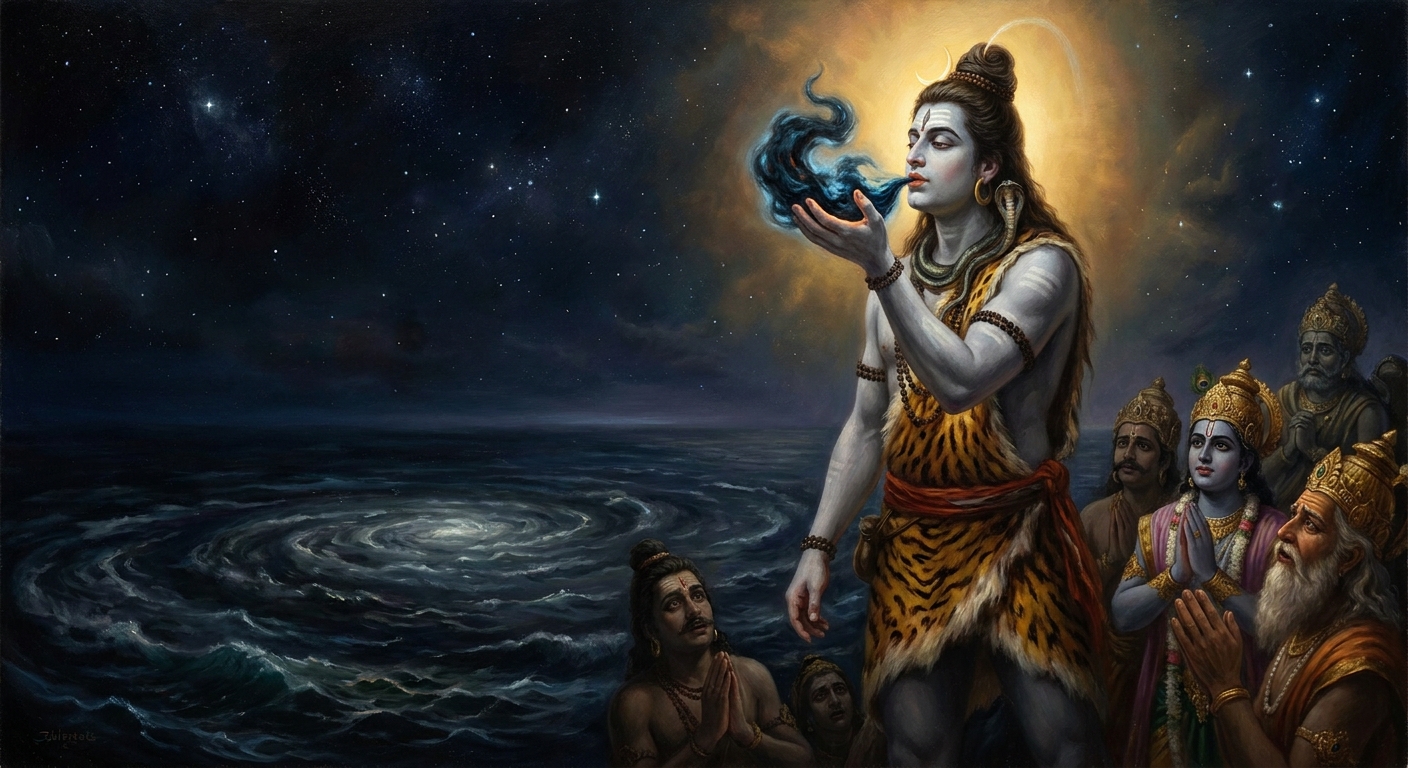
A column of fire rises from the ocean of dissolution and pierces the sky without limit — Brahma as a swan climbing its right side, Vishnu as a boar diving along its left
 Generating art…
 The hill of Arunachala at sunrise, its granite dome rising above the Tamil plain in a silence that is not empty but full
 Generating art…
 A young man sits in the Virupaksha cave on the hill's slope, absolutely still, eyes open without focus
 Generating art…
 Echoes Across Traditions
Entities


Sources
- David Godman, *Be As You Are: The Teachings of Sri Ramana Maharshi* (Arkana, 1985)
- Stella Kramrisch, *The Presence of Shiva* (Princeton University Press, 1981)
- Diana Eck, *India: A Sacred Geography* (Harmony Books, 2012)
- Ramana Maharshi, *The Collected Works of Sri Ramana Maharshi* (Sri Ramanasramam, 1969)
- T.M.P. Mahadevan, *Ramana Maharshi: The Sage of Arunachala* (George Allen and Unwin, 1977)