Mirabai Walks Out of the Palace
c. 1498-1547 CE · Rajputana, Gujarat; historical figure with biographical tradition assembled in the 16th-17th centuries · Merta and Chittorgarh in Rajputana (modern Rajasthan), and the Krishna temple at Dwarka in Gujarat
Contents
Mirabai (c. 1498-1547), Rajput princess and bride of Krishna, is married off to a prince but refuses the marriage bed — she already belongs to the god. Her in-laws try to kill her three times. The poison becomes nectar. The cobras become garlands. The bed of nails holds no nails for her. She walks out of the palace, joins the wandering devotees, and sings until her body dissolves into the image of Krishna at Dwarka. Her bhajans are sung across India today.
- When
- c. 1498-1547 CE · Rajputana, Gujarat; historical figure with biographical tradition assembled in the 16th-17th centuries
- Where
- Merta and Chittorgarh in Rajputana (modern Rajasthan), and the Krishna temple at Dwarka in Gujarat
She knew him before she could speak.
The story goes like this: Mirabai is a small child in Merta, in the Rajput kingdom of Mewar, when a wedding procession passes below her window. She watches the bridegroom ride past on his decorated horse — the garlands, the drums, the relatives weeping with happiness — and she turns to her mother and asks: Who is my bridegroom?
Her mother says this lightly, as one says such things to children: Your bridegroom? Krishna, little one. Krishna is your husband.
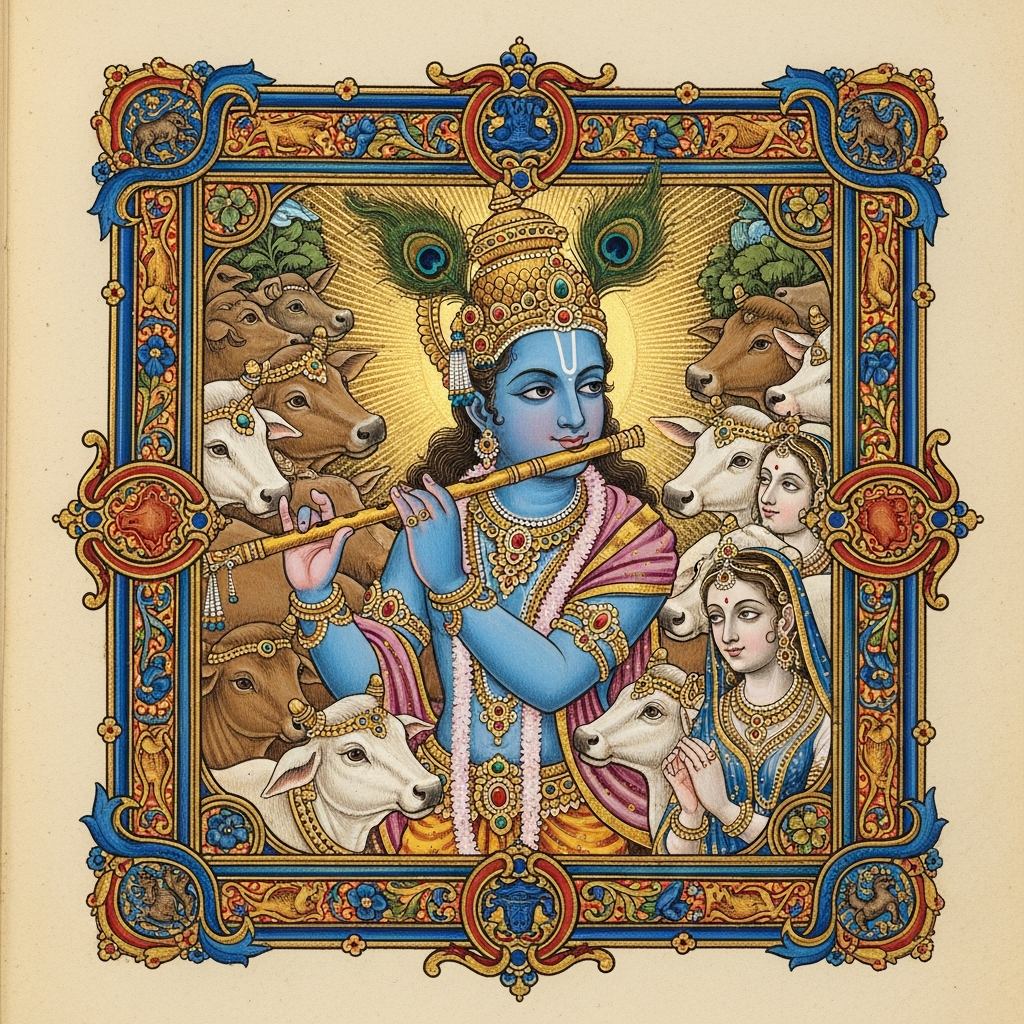
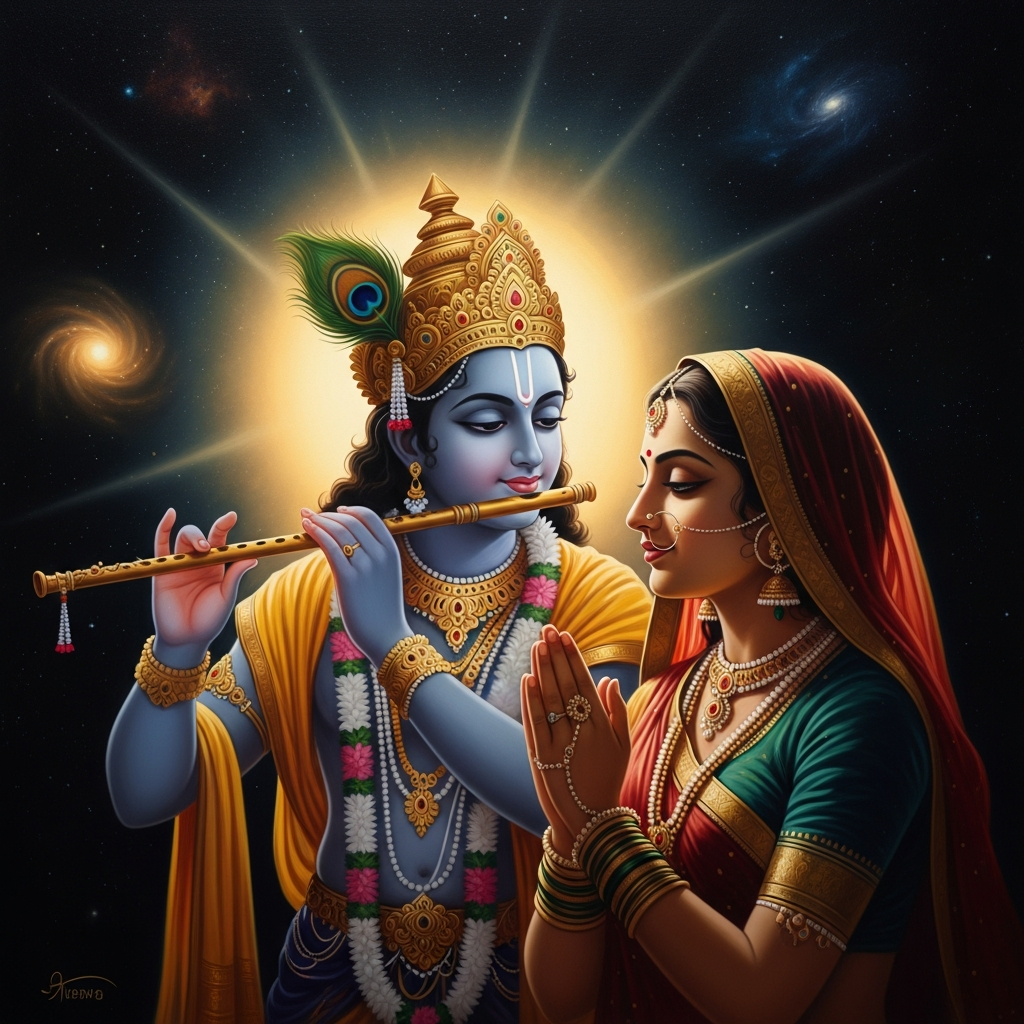
Mirabai takes this with the absolute literalness of a child who has not yet learned which answers are meant seriously. She goes to the household shrine. She looks at the image of the dark-blue god — flute at his lips, peacock feather in his crown, feet crossed in the eternal dance. She recognizes him. The mother’s joke has landed in a place in the child that has been waiting for exactly this information.
She is, from this moment, a married woman. She is five years old. She knows who she belongs to.
The family has other plans.
Mirabai’s family are Rathore Rajputs. Her father Ratan Singh is a nobleman of standing, and a girl of her lineage has a destiny that involves alliance and land and the careful accounting of dynastic advantage. When she is of age, negotiations are conducted, arrangements are made, and she is married to Rana Bhojraj, heir to the Rana of Chittorgarh — a match that consolidates Rajput alliances and is considered a substantial success.
The wedding is elaborate. Mirabai is clothed and jeweled and processed and wed. At every stage of the ceremony, she participates correctly. She is not difficult. She says what is said. She goes where she is taken.
In her trunk, wrapped in silk, she carries a small image of Krishna.
On her wedding night, she goes to the image of Krishna. She tells her husband, clearly and without hostility: I am sorry. I already have a husband. I have always had a husband. His name is Giridhari — the one who lifts the mountain. I belong to him.
Rana Bhojraj is not a bad man, by the historical accounts. He is bewildered. He is a Rajput prince who has been told he has a wife and now the wife is telling him she does not have a husband who is him. He does not know what to do with this information and, for a while, he does not force the question.
He dies young, in battle. Mirabai is a widow. A Rajput widow is expected to commit sati — to burn with her husband. Mirabai refuses. I cannot be a widow, she says. My husband is still alive. He is always alive. He will never die.
Her in-laws do not find this charming.
The Rana’s household has a new head now — Vikramaditya, Bhojraj’s younger brother, who does not have his brother’s tolerance for the Krishna-devoted woman in the women’s quarters who refuses to be a widow and goes to the temple to sing and dance in front of the god and lets holy men and wandering devotees into the women’s court to sing with her.
The scandal is considerable. A Rajput widow has specific social duties. She does not dance. She does not sing in public. She does not receive men who are not her kin. She does not wear the bright colors Mirabai wears — red and yellow and saffron — she wears white, the color of mourning, and she stays out of sight.
Mirabai does none of these things. She wears what she wears. She sings what she sings. The temple door is always open to her and she goes through it.
Vikramaditya sends a cup.
The cup contains poison — real poison, strong enough to kill. The servant who delivers it tells her it is prasad, the sacred food offered to and returned from the god. She takes it with both hands. She raises it toward the image on the wall. She prays. She drinks.
She is fine.
The poison has no report of her. It arrives in her body and finds no wound to inhabit. She sets the cup down. She goes back to her song.
Vikramaditya sends a basket.
The basket is delivered to her room at night, wrapped in cloth, with a note that says it contains a flower garland, a gift from the household. The servants who carry it set it down quickly and leave. Inside the basket are cobras — the kind that kill in the first hour.
Mirabai opens the basket. She reaches in.
She pulls out a garland of flowers.
This is what the devotional tradition records, and the exact mechanism is not explained because the tradition is not interested in explaining it. The theological claim is simpler: when the heart is entirely given to Krishna, the world that would harm you cannot find the you it is aimed at. The poison found no wound. The snakes found no fear.
She wears the garland to the temple. She sings until the lamps burn down.
The third attempt is a bed of nails — the kind of ascetic instrument that tears ordinary skin. She sleeps on it. She rises without marks.
Vikramaditya comes to understand that the ordinary instruments of disposal do not work on a woman for whom the ordinary world has become secondary. He escalates. The persecution becomes public — the humiliation, the restrictions, the attempts to confine her to the women’s quarters and silence the singing.
Mirabai writes a letter.
She writes to Tulsidas, the great poet-saint of Varanasi, author of the Ramcharitmanas, the most beloved retelling of the Ramayana. She asks him what she should do. She is a Rajput wife and a devotee of Krishna and a widow who refuses widowhood and a woman whose in-laws want her dead, and she is also, she writes, incapable of abandoning the god she has loved since she was five years old.
Tulsidas writes back. His answer is preserved in the devotional literature. He says: Abandon anyone who makes you abandon Ram (God). Even if that person is Brahma, Vishnu, or Shiva himself.
She reads the letter once. She puts down the cup she is holding. She walks out of the women’s quarters, through the palace gate, out into the road.
She is gone for the rest of her life.
She joins the wandering bhaktas — the devotees who travel from temple to temple, living on what is given, singing at every shrine. She goes to Vrindavan, the forest where Krishna played as a child, where the gopis danced with him in the moonlight, where every stone is said to remember the god’s footstep. She goes to Mathura where he was born. She goes to the pilgrimage roads that move in their slow circuits through the holy geography of the north.
She sings. The songs are the bhajans that Indians still sing today — direct addresses to Krishna in the voice of a woman who loves without concealment, who names what she feels with the precision of someone who has decided that nothing is more important than accuracy about this. O my king, I have taken the unbreakable vow. I have given myself to you. / I have drunk the poison of love and I am not dead. / Where are you, dark one? Why do you make me wait?
The bhajans do not use the philosophical vocabulary of the Vedanta. They do not argue positions. They are dispatches from inside an experience — the specific bewilderment of a person who has been completely captured by love and is too honest to pretend it feels like peace.
She comes at last to Dwarka.
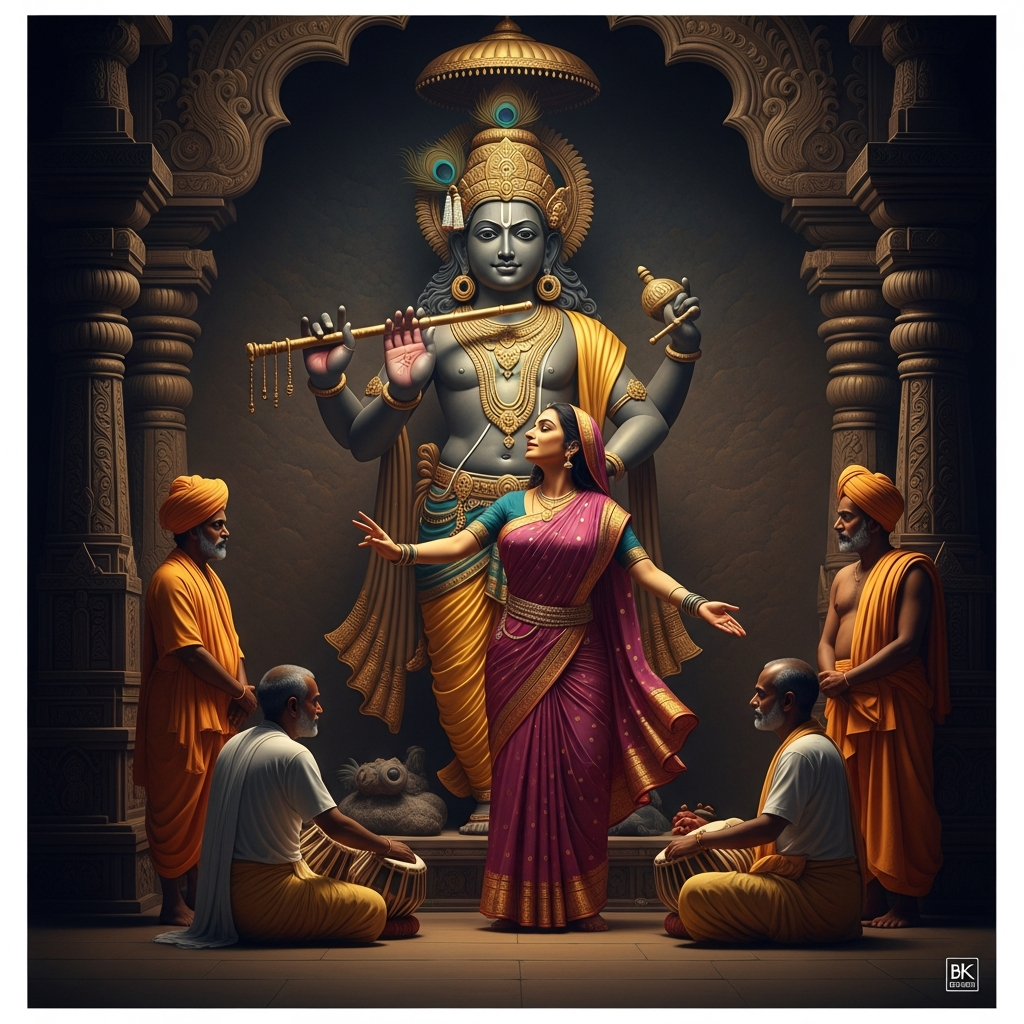
Dwarka is the city on the western coast of Gujarat where Krishna retired after the war — the golden city he built on the sea, the city the ocean swallowed after his death. The temple there is called Dwarkadhish, lord of Dwarka, and it houses the form of Krishna called Ranchhodrai — the one who fled the battlefield. The name is not an insult; it names the god’s willingness to choose what is necessary over what is glorious.
Mirabai dances in the temple for days. She dances the way the gopis danced in the forest, without self-consciousness, without an audience in view. She has been dancing for Krishna since she was five years old and she has never stopped, and here in his last city, in the temple of the god who chose the long way over the quick one, the dance has been going on for so long that the distance between the dancer and the god has become very thin.
The priests close the temple for the night. In the morning, when they open the gates, the inner sanctum holds the image of Ranchhodrai and nothing else. Mirabai’s sari is pressed into the stone of the image’s base, the fabric fused with the surface where she was standing.
She is not there. She is there.
The historical Mirabai is partly recoverable from the devotional mythology. She was born c. 1498 in Merta, in what is now Rajasthan. She was married into the Sisodia Rajput family of Mewar. She was a Krishna devotee from childhood and a poet in the Braj Bhasha dialect. She faced genuine opposition from her in-laws. She eventually left for Vrindavan and Dwarka. The dates and details of her death are uncertain.
The theological Mirabai is entirely recoverable from her songs. She is the paradigm case of viraha bhakti — devotion through separation, the spiritual discipline of longing, the practice of keeping the wound of love open because the wound is the doorway. Her theology is: I am incomplete without him, I know I am incomplete, the incompleteness is holy, I will not pretend to be complete.
Her in-laws tried three times to kill a woman whose crime was loving God too completely to have anything left for the political arrangements love was supposed to be subordinated to. The poison, the cobras, the nails — each failed because what they were aimed at had already been given away. You cannot poison someone who has no self left to be poisoned.
The sari pressed into the stone at Dwarka is the last image. She walked out of the palace and walked into the god. The song she was singing when it happened is not recorded. She had been singing it her whole life.
Scenes
The bridal chamber is prepared
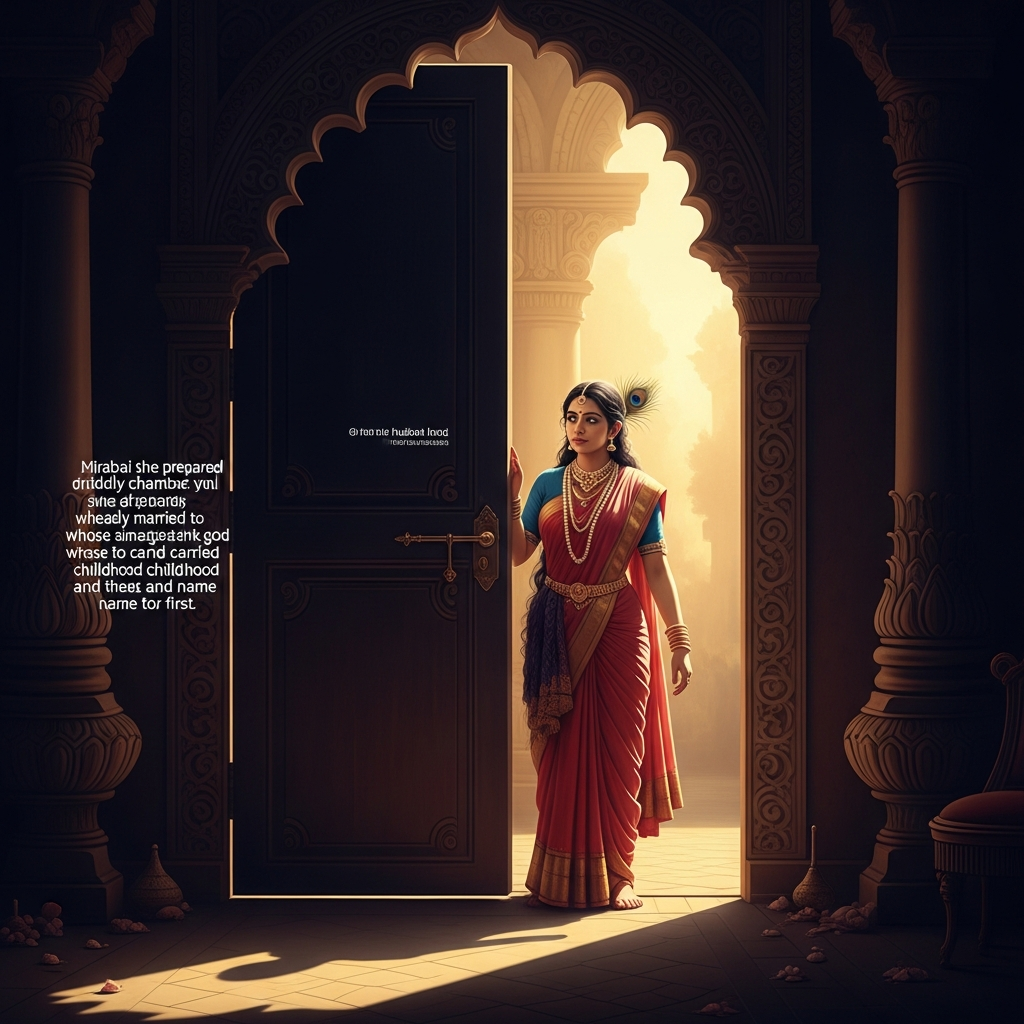 Generating art…
 Her brother-in-law's servant sets the cup before her
 Generating art…
 At the Dwarkadhish temple in Dwarka, Mirabai dances before the image of Ranchhodrai — Krishna the one who fled the battlefield to build the city of gold
 Generating art…
 Echoes Across Traditions
Entities
- Mirabai
- Krishna
- Rana Bhojraj
- Vikramaditya
- Tulsidas

Sources
- John Stratton Hawley and Mark Juergensmeyer (trans.), *Songs of the Saints of India* (1988)
- A.J. Alston (trans.), *The Devotional Poems of Mirabai* (1980)
- Parita Mukta, *Upholding the Common Life: The Community of Mirabai* (1994)
- Kumkum Sangari, 'Mirabai and the Spiritual Economy of Bhakti,' *Economic and Political Weekly* (1990)
- Winand Callewaert and Mukund Lath, *The Hindi Padavali of Namdev* (1989)