Moses de León and the Ancient Book
Christian Spain · c. 1280–1305 CE — the late thirteenth century, the last great century of Iberian Jewish creativity before the 1391 pogroms and the 1492 expulsion · Guadalajara, Valladolid, and Ávila — the small Castilian towns where the *Zohar* manuscripts begin circulating; later, in the sixteenth century, the Galilean hill town of Safed, where the *Zohar* is naturalized as ancient
Contents
In Castile in 1280, a scholar of modest reputation begins selling manuscripts of an Aramaic mystical text he claims to have copied from a thirteen-hundred-year-old original. He dies insisting it is ancient. His widow, when asked, tells the truth.
- When
- Christian Spain · c. 1280–1305 CE — the late thirteenth century, the last great century of Iberian Jewish creativity before the 1391 pogroms and the 1492 expulsion
- Where
- Guadalajara, Valladolid, and Ávila — the small Castilian towns where the *Zohar* manuscripts begin circulating; later, in the sixteenth century, the Galilean hill town of Safed, where the *Zohar* is naturalized as ancient
The first manuscripts begin to circulate in Guadalajara in the early 1280s.
They are written in Aramaic — the daily language of Jewish Mesopotamia in the centuries when the Talmud was being assembled, but a language no Jew in thirteenth-century Castile speaks. The Aramaic is unusual: idiomatic in places, awkward in others, occasionally betraying Spanish-Hebrew word order in the way that gives away a translator who has not heard the language spoken aloud. Anyone who can read it carefully will notice the strangeness. Most readers cannot read it carefully. Aramaic in late-medieval Castile is what Latin is for the Christian public — a language of authority whose very difficulty serves as authentication.
The man circulating the manuscripts is Moses ben Shem-Tov de León, a kabbalist in his thirties or forties with a small reputation as a writer of philosophical Hebrew prose and a chronic shortage of money. He says he is making copies of an ancient text that has survived in a single original — a text written in the second century by Rabbi Simeon bar Yochai (Rashbi), the disciple of Akiva who hid in a cave with his son for thirteen years and emerged with the deepest secrets of Torah. The original, de León says, has been guarded by an unbroken chain of teachers for over a thousand years. He has been granted access. He is making copies for the worthy.
The copies are expensive. He sells them for what they will fetch.
The text itself is unlike anything in the Jewish library.
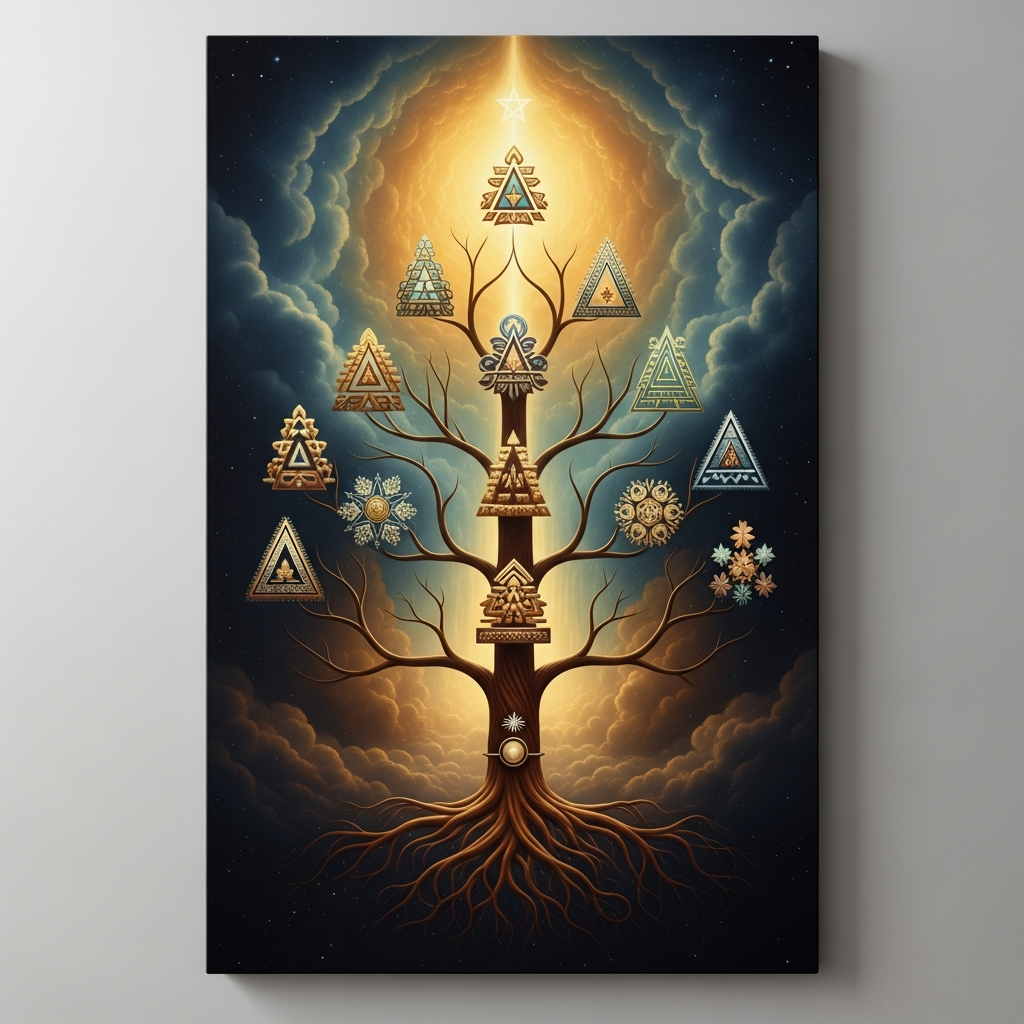
It is structured as a commentary on the Torah, but the structure is loose and visionary rather than systematic. A line from Genesis triggers a forty-page meditation on the inner architecture of God. A phrase from Leviticus opens into a vision of the cosmic feminine. The patriarchs walk along Galilean roads in the second century, having conversations that shimmer with revelations of the sefirot — the ten divine emanations, ordered as a Tree, ranging from Keter (Crown) at the unutterable summit through Hokhmah (Wisdom) and Binah (Understanding) and the six middle attributes to Malkhut (Kingship) at the root, which is also the Shekhinah, the feminine indwelling, the divine presence in exile.
The Zohar’s great insight, repeated in a thousand variations, is that creation is a drama of separation and reunion within God himself. The Shekhinah has been separated from her Bridegroom by the brokenness of the cosmos. The work of the human being — the meaning of every commandment, every prayer, every act of righteousness — is yichud, unification: the reuniting of the divine masculine and the divine feminine. The exile of the Jewish people in history is the visible sign of the exile of the Shekhinah in the divine. When Israel returns from exile, the Shekhinah returns from her exile. The cosmos and the people are isomorphic.
This is not in the Talmud.
It is also not, as far as the historical record can determine, in any second-century text. There are mystical strains in early rabbinic literature — the Hekhalot mysticism of the heavenly palaces, the Maaseh Bereshit speculations on Genesis 1, the throne-vision tradition of Ezekiel — but the systematic sefirot doctrine, the gendered cosmology, the Shekhinah as feminine bride, the entire architecture: this is twelfth-century material, the development of the Provençal and Catalan kabbalists of the previous hundred years. The Bahir, written or compiled in southern France around 1180, is the proximate predecessor. The Zohar is the Bahir’s system in full flower, dressed in second-century Aramaic.
But it presents itself as second-century. It walks the Galilean roads of Rashbi and his Companions. It speaks Aramaic. It cites no medieval authority by name. It reads like the missing book that should always have been there.
Isaac ben Samuel of Acre, a kabbalist who has lived in the Land of Israel and knows the Galilee personally, is suspicious from the start.
Isaac is a serious scholar. He has spent time in the Galilee. He knows what second-century Aramaic looks like — there are still Aramaic inscriptions on synagogue mosaics he has read. The language of the Zohar does not match. The phrasing is wrong. The vocabulary is medieval. He is also disturbed by the absence of the manuscript: when he asks to see the ancient original from which de León is allegedly copying, no one can produce it. There is always another copy. There is never the source.
In 1305, Moses de León dies on a journey, having sold a fresh batch of Zohar manuscripts in Valladolid. He never reaches home. The widow is in Ávila with a daughter and substantial debts.
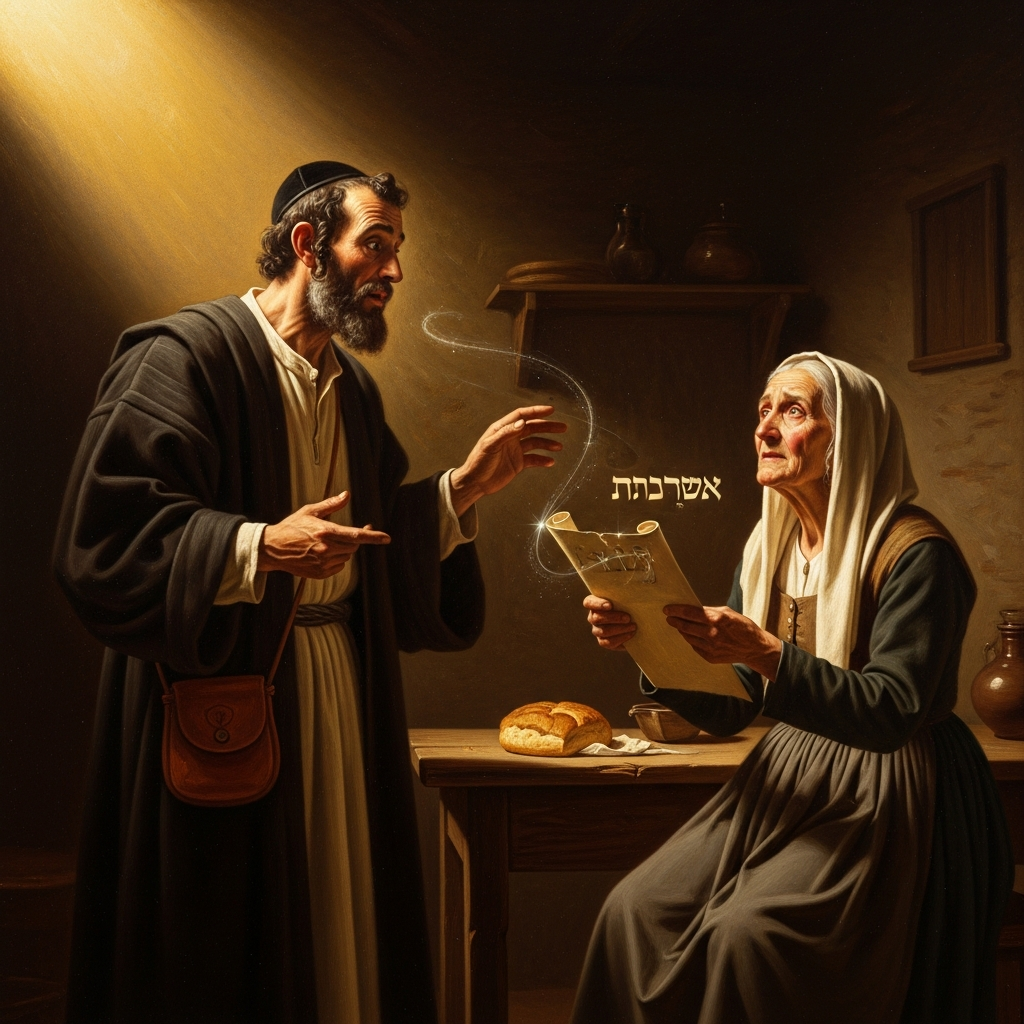
Isaac of Acre travels to Ávila to interview her. He brings money — substantial money — and an offer: if she will surrender the original manuscript, the ancient one, he will see that she is provided for. He has heard there are debts. He has heard there is a daughter who needs a dowry.
The widow tells him the truth.
There is no ancient manuscript. Her husband wrote it. He worked at it for years, late into the nights, in Aramaic he had taught himself from old liturgical texts and rabbinic citations. She watched him do it. He invented the Galilean conversations. He composed the vision of the sefirot. He produced the marriage of Tiferet and Malkhut and the long meditation on the Shema. When she asked him why he attached his work to Rashbi instead of publishing it under his own name, he answered her — Isaac records the answer in his diary — If I sign my own name, no one will pay ten coins for a sheet. If I sign Rashbi’s name, they line up to buy.
He needed bread. He believed the teachings were true. He sold them under the only name that would buy them.
Or so the widow says.
The conversation is recorded in Isaac of Acre’s notebook (preserved in the Sefer Yuhasin of Abraham Zacuto). The notebook is a single source. Some scholars have wondered whether the conversation happened as Isaac records it, or whether Isaac is producing a piece of polemic — whether the widow’s confession is itself a kind of pseudepigraphy, a story about the Zohar’s falsity that traveled because it was useful to those who suspected the work. The kabbalists who treasured the Zohar simply ignored the report. They did not investigate it; they did not refute it; they treated it the way one treats a rumor about a sacred book — as the kind of thing one does not entertain in serious company.
Within a generation, the Zohar is being cited in Spain as if it were Talmudic. Within two generations, the question of its dating has become heretical to ask. By the fifteenth century the great kabbalists of Safed — Moses Cordovero, Isaac Luria, Hayim Vital — are building cosmological systems out of Zohar materials with the same confidence with which earlier rabbis built halakhic rulings out of Mishnaic ones. The Zohar has been canonized. Its origin no longer matters.
When Gershom Scholem, in his Hebrew University lectures of the late 1930s and the great book that grew from them, demonstrates with philological certainty that the bulk of the Zohar was composed in late thirteenth-century Castile, almost certainly by Moses de León — when Scholem produces the linguistic evidence, the doctrinal anachronisms, the unmistakable echoes of Maimonidean and Spanish-philosophical vocabulary — the demonstration is not, in the end, scandalous. The Zohar’s authority does not rest on its dating. It rests on what it does to the people who read it.
What it does is reorganize the cosmos.
After the Zohar, the Jewish God is no longer the unitary, philosophically simple deity of Maimonides — whose existence is identical with His essence — but a vast inner drama: ten attributes, masculine and feminine sides, a Crown and a Kingdom, a Hidden and a Revealed, a Light and the Vessel that the Light pours through. The cosmos is a marriage interrupted. History is the marriage being repaired. The Jew at his prayer at dawn is performing the cosmic surgery — putting the divine attributes back into the proper relation, drawing the Shekhinah up from her exile, healing what creation broke.
This vision survives the catastrophes that the next centuries deliver. When the Jews are expelled from Spain in 1492 — when Moses de León’s own Castile becomes uninhabitable for the people of Moses de León — the Zohar travels in their packs, and the kabbalists of Safed in the sixteenth century read the expulsion through the Zohar’s grammar: the people are in exile because the Shekhinah is in exile; the suffering of history is the visible side of the wound in the divine; the work of the human is to suffer with intention, pray with intention, study with intention, until the wound is closed and the Bridegroom and the Bride are reunited.
When Sabbatai Zvi, in the seventeenth century, declares himself the Messiah and most of the Jewish world believes him, the conviction is grounded in the Zohar’s timetable. When Hasidism, in the eighteenth, transforms Eastern European Judaism, its idiom — divine sparks scattered through everything, the human’s task being their gathering — is Zoharic. When twentieth-century Jewish renewal, in places like Boulder and Berkeley, recovers the Zohar for non-Orthodox readers, it is recovering the world’s most successful piece of pseudepigraphy.
The text outran the question of its origin. It did so because the question of its origin was not, in the end, the most interesting question about it.
The Tibetans understand this best.
Their terma tradition — the doctrine that texts and objects are hidden by an enlightened master in one century and revealed by a destined revealer in another — is a near-perfect formal parallel to what happens with the Zohar. The terma is presented as ancient. The community knows that the revealer is, in some sense, also the author. The community does not regard this as a problem. The doctrine of the terma explicitly resolves the problem: the revealer is the channel through whom the ancient teaching emerges, and whether the words were laid in the rocks of Tibet by Padmasambhava in the eighth century or composed in the mind of the tertön in the fourteenth, the truth of the teaching is not affected by the route of its arrival.
The Zohar is, in this sense, a Jewish terma. Moses de León is the tertön. The cave of Rashbi is the place where the teaching was hidden. The thirteenth-century manuscripts are the form in which it emerges.
There is one further wrinkle, the one Scholem himself emphasizes. Even granted that Moses de León wrote the bulk of the text in late thirteenth-century Castile, he did not write it from nothing. He inherited the Bahir, the writings of the Provençal kabbalists, the Catalan school of Nahmanides. Behind those, perhaps, ran a still older oral stream — a transmission of mystical teachings that may, in fact, reach back to circles that did sit at Rashbi’s feet and pass on what they had learned mouth to ear, century after century, until it surfaced in writing seven hundred years later. We cannot demonstrate this. We cannot disprove it. The pseudepigraphical frame is a thirteenth-century construction. The content may have older taproots than any of us can see.
The widow’s confession is true, and the Zohar is genuinely ancient. Both can be the case. The Jewish tradition has known how to live with this kind of layered authorship since the editing of the Pentateuch.
Moses de León dies in 1305.
The grave is unmarked. The biographical record is thin: a few responsa, a will, a handful of philosophical works he published under his own name and which no one read. He is, in the historical record, a minor scholar of his generation — less prominent than Joseph Gikatilla or Abraham Abulafia, with a modest reputation and a small posthumous literature.
He is also the man who wrote — or transmitted, or dreamed, or received — the most influential mystical book in the history of Judaism.
He sat in a small room in Guadalajara and wrote Aramaic he had taught himself, and he attached the text to the name of a second-century rabbi who had hidden in a cave because no one in his own century would buy what he had to sell, and the text became, over the next three hundred years, the second Torah of mystical Judaism. The widow said: he wrote it. The kabbalists said: Rashbi wrote it. Both said the same thing in different keys. The book is the book. The cave is the cave. What was hidden was hidden either thirteen hundred years ago or thirteen years ago, and the difference matters less than the fact that, when the time was right, the book opened — and the Shekhinah began the long climb home.
Scenes
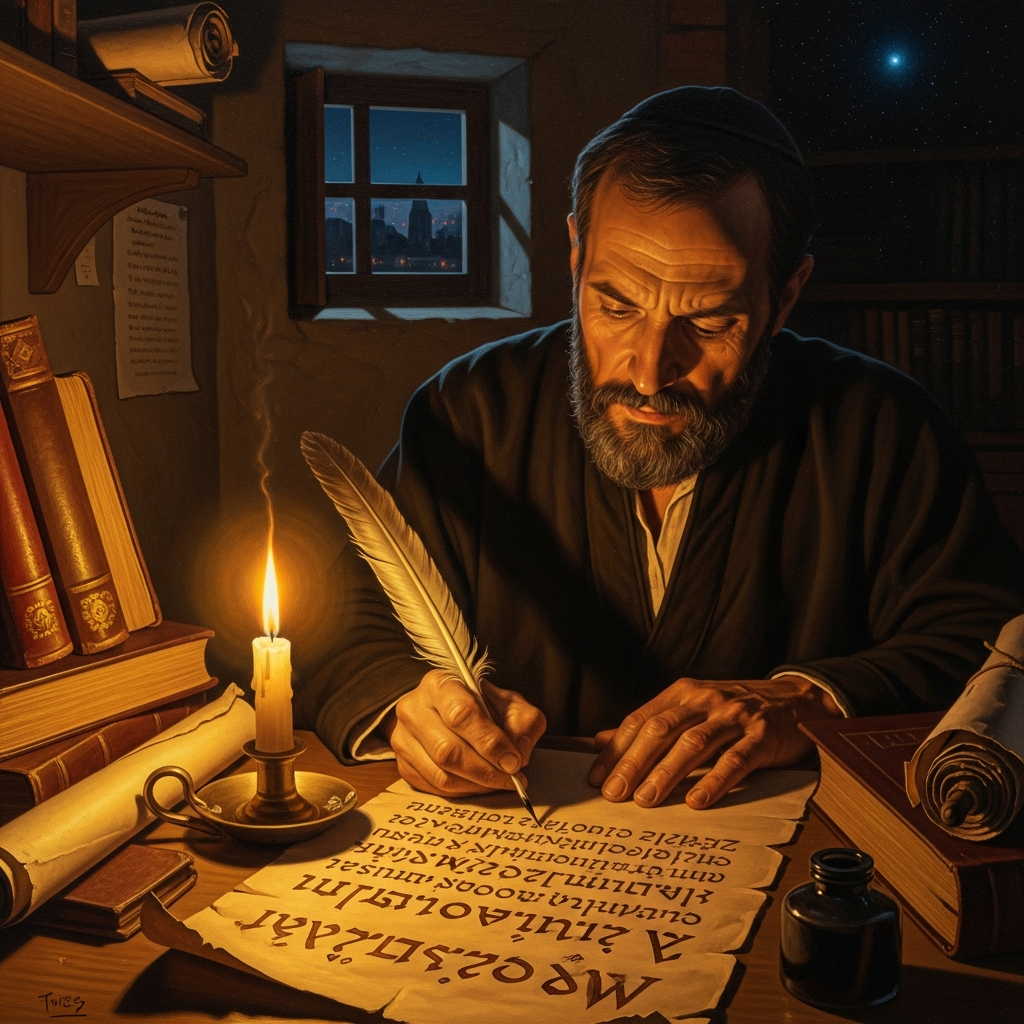
In a small upstairs room in Guadalajara, Moses de León writes Aramaic by candlelight — a language he speaks well enough to compose in but archaic enough that the text feels exhumed from the second century
Generating art… Isaac ben Samuel of Acre arrives in Ávila with money and a question
 Generating art…
 The cosmos as the *Zohar* describes it — ten *sefirot* arranged as a Tree, the divine attributes through which the hidden God engages creation: *Keter* at the crown, *Malkhut* at the root, the *Shekhinah* in exile and yearning to return
 Generating art…
 Echoes Across Traditions
Entities
- Moses de León (Moshe ben Shem-Tov)
- Simeon bar Yochai (Rashbi)
- Isaac ben Samuel of Acre
- Joseph Gikatilla
- Gershom Scholem
Sources
- Gershom Scholem, *Major Trends in Jewish Mysticism* (Schocken, 1941), Lectures 5–6 — the decisive scholarly demonstration of the *Zohar*'s medieval origin
- Gershom Scholem, *Kabbalah* (Quadrangle, 1974)
- Isaiah Tishby, *The Wisdom of the Zohar*, 3 vols., trans. David Goldstein (Littman, 1989)
- Yehuda Liebes, *Studies in the Zohar* (SUNY, 1993)
- Daniel Matt (trans.), *The Zohar: Pritzker Edition*, 12 vols. (Stanford, 2004–2017)
- Arthur Green, *A Guide to the Zohar* (Stanford, 2004)
- Hartley Lachter, *Kabbalistic Revolution: Reimagining Judaism in Medieval Spain* (Rutgers, 2014)