The Woman Who Corrected Her Scribe
c. 1285-1296 CE (visions); dictation to Fra Arnaldo c. 1292-1296 · Foligno and Assisi, Umbria, Italy
Contents
Angela of Foligno stops in the middle of a road because the Holy Spirit has begun speaking to her. She arrives at the Portiuncula chapel and loses consciousness from the force of what meets her there. Later she dictates her visions to her confessor, and then insists, again and again, that he has gotten the details wrong.
- When
- c. 1285-1296 CE (visions); dictation to Fra Arnaldo c. 1292-1296
- Where
- Foligno and Assisi, Umbria, Italy
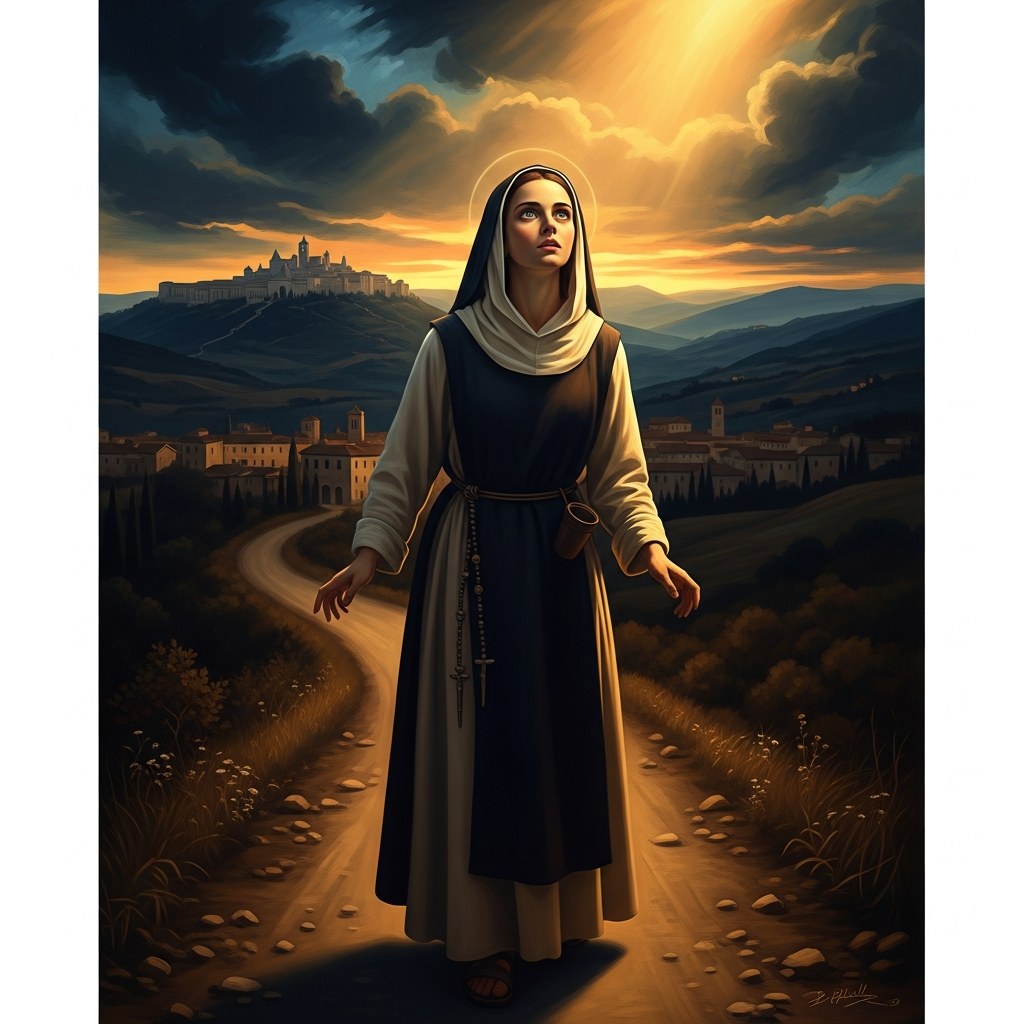
She is walking to Assisi when the voice begins.
The year is approximately 1285. She is a Franciscan tertiary from the town of Foligno — a married woman, a widow by now (her husband and her children and her mother have all died within a short span of years that she later interprets as God clearing away her attachments), who has been undergoing a spiritual transformation serious enough that she has attracted the attention of the Franciscans. She is making the pilgrimage to Assisi, to the churches of Francis’s city, accompanied by companions she does not describe further in the account. They are walking the road when the voice arrives.
She stops. The companions continue for a moment before they notice she is not moving. She is standing in the road listening.
The voice is the Holy Spirit. She will be clear about this later, when she tries to tell Arnaldo what happened, and Arnaldo tries to write it, and they argue about the words. She says: it spoke to me on the road and spoke all the way to the Portiuncula and said things that I cannot write down and things that I can. It promised that it would be with me. It promised that she would see it when she arrived.
The Portiuncula is the chapel of Santa Maria degli Angeli — the little chapel inside the larger church that is the most sacred site of the Franciscan movement, the place where Francis heard his call and where he died. Angela arrives. She enters the chapel. The voice has been speaking to her the entire road.
What meets her at the Portiuncula she will spend years trying to describe to Arnaldo, and he will spend years failing to write down to her satisfaction. What she says, in various attempts: a sweetness so great it was insupportable. A presence so full she could not stand in it. A warmth. A light. A sense of being known completely and found not wanting — not forgiven (forgiveness implies that what was found was bad and was overlooked), but found, in the finding itself, fully good.
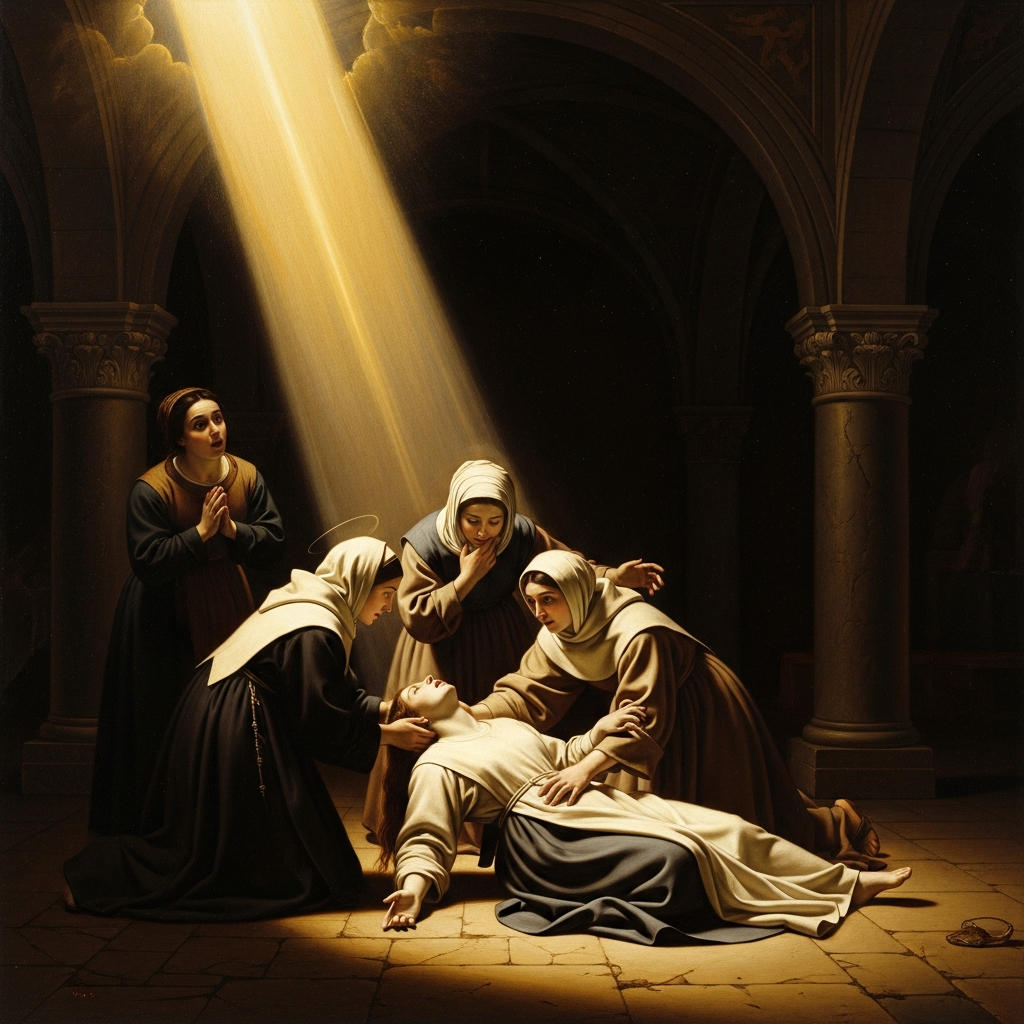
She falls down. The companions think she is dying, or having some kind of episode. She is screaming — the account is specific about this. She screams for several minutes, or possibly much longer, and the screaming is not from fear or pain. She cannot explain it afterward. The body did something with the excess that the body does when what enters it is beyond its ordinary capacity.
The companions are frightened. People gather. A relative of hers, one of the companions, sends someone for Fra Arnaldo.
Fra Arnaldo is her confessor. He is also her nephew. He is a Franciscan friar and a man of some learning — he knows Latin, he knows theology, he knows the conventions of mystical literature, he knows what a vision account should look like and what categories it should employ. He has been hearing Angela’s confessions for some time. He is not naive about her. He is also, to his credit, genuinely interested in what she is experiencing, which is more than can be said for some confessors of mystic women.
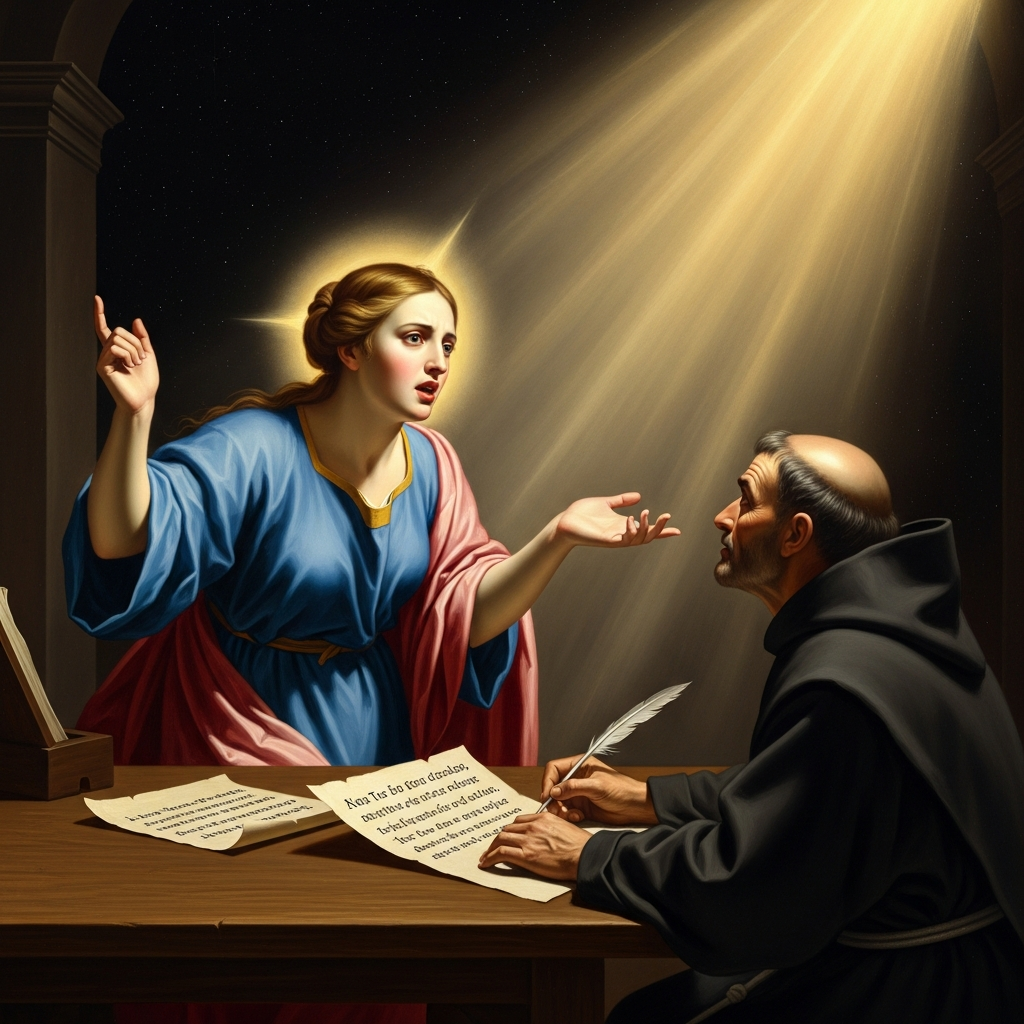
He begins writing down what she tells him. This is how her book comes into existence: she dictates, he writes, she hears it read back, she corrects.
The corrections are the most important part of the document.
She says, in the dictation, that when she speaks of God she feels a sweetness so great that if she goes on speaking she will fall. Arnaldo writes this. She reads it back and says: that is not quite right. The sweetness is not the main thing. The main thing is something she has not been able to say yet, which Arnaldo has therefore not been able to write.
She says that her experience of Christ’s body on the cross gave her a certainty about his humanity that she cannot express. Arnaldo writes this. She says: that is not it. She says: you have made it sound like a theological conviction and it was not a theological conviction, it was something else. She has not found the words for the something else. She works at it.
She says that in one vision she saw God and saw that God was seeing her and was not displeased with what God saw. Arnaldo writes this. She says: you have written the word “pleased” where I said “not displeased” and those are not the same thing. She is a precise woman. She has reason to be — the precision matters because what she experienced is not easily captured and a single word displaced from its position can tip the account toward something she did not experience, something that sounds more comfortable, more orthodox, more legible to the man with the pen.
This is the structural situation of medieval women’s mysticism.
The woman has the experience. The man has the authority to record it and the authority to declare it orthodox or heretical. The woman cannot write it herself — not always because she is illiterate (Angela may have been literate; the question is complicated), but because a woman’s account in her own hand has no institutional weight. It requires the confessor’s endorsement, the bishop’s endorsement, eventually the theological review of the order. The experience must pass through male hands to become text, and in passing through male hands it is inevitably translated into the categories those hands are equipped to hold.
Angela knows this. She works within it and against it simultaneously. She dictates — which means she controls the sequence and the content of what is said. She insists on the corrections — which means she refuses to let Arnaldo’s categories replace what she experienced with something easier to write. She reviews everything. This is not the behavior of a woman who is passive in relation to her scribe. This is a woman who understands that the text is the record that will survive, and who intends to make it accurate.
Arnaldo, for his part, is not malicious. He writes her corrections. He notes, in his own additions to the manuscript, where he feels inadequate to the task — where he says he has written what he can but suspects it falls short of what she experienced. He is, by the standards of the century, a good scribe. He is still a man with the wrong equipment writing down something that was not designed to fit his equipment.
The visions deepen over the years. Angela eventually distinguishes nineteen steps in her spiritual progress — she becomes one of the most systematic cartographers of interior experience in the medieval tradition. She describes the experience of the Trinity. She describes the experience of nothingness — a dark void that is not absence but fullness, a darkness that is not God’s distance but God’s nearness in a mode the ordinary mind cannot process. She describes moments of such certainty about the presence of God that she cannot eat, cannot sleep, can barely function. She describes being told by Christ that he loves her — not humanity in the abstract, not sinners in the category, but her, specifically, Angela of Foligno, the widow from Umbria who used to care about fine clothes and is now incapable of caring about anything that is not this.
She dictates all of this to Arnaldo. She corrects all of it.
She becomes, in her last years, the leader of a group of penitents in Foligno — men and women who gather around her for spiritual direction. She teaches. She writes letters that survive. She is asked for advice by people who have read the Memorial and recognized in it something they needed. She has become, without ordination or institutional authority, a figure of authority.
This is also structural. The medieval tradition has no way to ordain women, no way to make a woman a confessor or a preacher. It has, in practice, a way to recognize a woman whose experience is evidently real and whose counsel is evidently useful, and to allow her a de facto role that has no official name. Angela is the counselor of a community. She teaches without being a teacher. She speaks without a pulpit.
She dies in 1309. The Memorial survives in several manuscript traditions. It is a document about what happened to her and also a document about the negotiation required to turn what happened to her into something that could be preserved. You can read both things simultaneously if you know to look.
She said: the words are not right. She said it many times, about many pages. She was correct. The words were not right. But she kept trying anyway, which is the only option when what you are trying to describe is by definition beyond the best available words.
Scenes
Angela stops in the road between Foligno and Assisi — the voice has begun and she cannot move
 Generating art…
 At the Portiuncula chapel, the divine presence arrives so fully that Angela falls and cannot stand — her companions think she is dying
 Generating art…
 Angela dictates; Fra Arnaldo writes; Angela reads what he has written and says it is not right, that the words have diminished what she experienced
 Generating art…
 Echoes Across Traditions
Entities
- Angela of Foligno
- Fra Arnaldo
- Francis of Assisi

Sources
- Angela of Foligno, *Complete Works*, trans. Paul Lachance (Paulist Press, 1993)
- Paul Lachance, *The Spiritual Journey of Blessed Angela of Foligno According to the Memorial of Frater A* (Pontificium Athenaeum Antonianum, 1984)
- Catherine M. Mooney, *Gendered Voices: Medieval Saints and Their Interpreters* (University of Pennsylvania Press, 1999)
- Bernard McGinn, *The Flowering of Mysticism: Men and Women in the New Mysticism 1200-1350* (Crossroad, 1998)
- Cristina Mazzoni, *Angela of Foligno's Memorial* (D.S. Brewer, 2000)