Sango Hangs Himself and Becomes the Storm
c. 13th–15th CE · Oyo Empire · Mythic-historical period; first written by Samuel Johnson, 1897 · Oyo-Ile, royal capital of the Oyo Empire, present-day southwestern Nigeria — and the forest of Koso, where the king walks to die
Contents
The fourth Alaafin of Oyo, betrayed by his generals and abandoned by his court, walks into the forest and ties a rope to the ayan tree. The Yoruba say: the king does not hang. He ascends. The thunder you hear tonight is his answer.
- When
- c. 13th–15th CE · Oyo Empire · Mythic-historical period; first written by Samuel Johnson, 1897
- Where
- Oyo-Ile, royal capital of the Oyo Empire, present-day southwestern Nigeria — and the forest of Koso, where the king walks to die
Sango is afraid of his generals.
He is the fourth Alaafin of Oyo. He has the throne, he has the title, he has the adé okín — the crown of the kingfisher feathers — and he has the mogba, the priesthood of thunder, who teach him the secret of the herb that brings lightning down out of the dry sky. But his court is not stable. His ancestors took Oyo by violence and the city remembers it. The chiefs of the Oyo Mesi, the council of seven who can vote a king to death, watch him with cold eyes. And his two greatest generals — Timi Agbale Olofa-ina and Gbonka Ebiri — are too good. They are too loved. They are too useful. The army cheers them in the marketplace and the cheering carries up to the palace and into Sango’s sleep.
He decides to break them.
It is the oldest royal mistake. Sango summons Timi to the throne room. He praises him. He gives him a regiment and a fine house in the town of Ede, far from Oyo-Ile, with orders to defend the southern frontier. Timi knows what banishment in the mouth of a king sounds like. He goes anyway. He takes his men and his wives and he settles in Ede, and the people of Ede love him and call him Olofa-ina, the master of the arrow of fire, because he is a great archer.
Then Sango summons Gbonka.
Bring me Timi’s head, the king says.
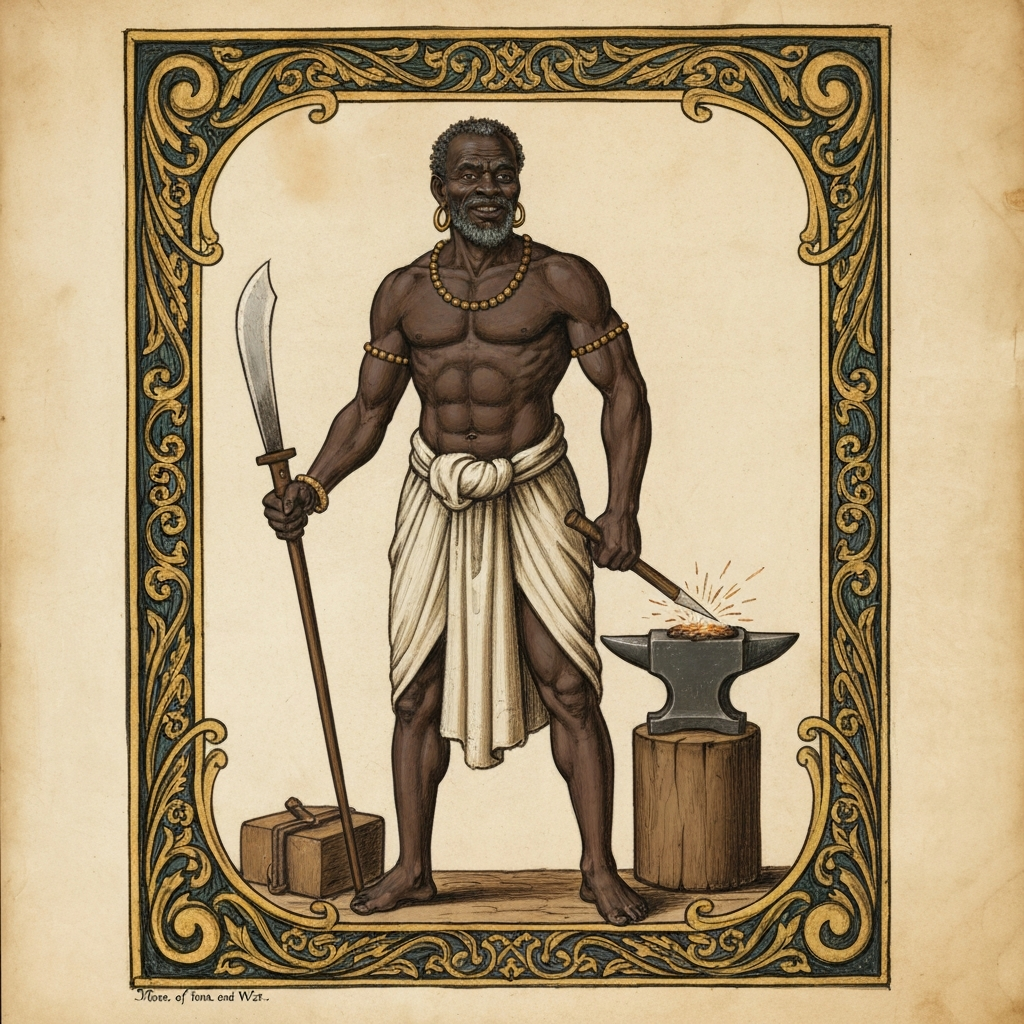
Gbonka does not hesitate visibly. Gbonka is a sorcerer. Gbonka is, in the praise-poetry of the Yoruba, the man who can disappear and reappear at will, the man whose body is a cloud, the man who can stand inside fire and not burn. He bows to the king. He goes to Ede. He kills Timi in single combat in the public square of the town and brings back the head wrapped in cloth.
Sango looks at the head. Sango looks at Gbonka.
The plan was for the two generals to destroy each other. Only one has been destroyed. The other one is standing in the throne room covered in the dust of the road and the blood of the man who used to be his counterweight. The court is silent. The chiefs of the Oyo Mesi are watching the king’s face.
Sango orders Gbonka burned at the stake.
The wood is brought. The stake is set. Gbonka is tied to it in the marketplace below the palace. The fire is lit. The whole city comes to watch. The flames climb the wood and lick at the man’s body. Gbonka closes his eyes. Gbonka opens his eyes. The fire begins to die down. Gbonka begins to laugh. He shakes the ropes off his wrists like dust. He walks out of the fire untouched, untied, his body cool, his teeth white, and he walks across the marketplace to the palace, and the palace guards back away from him because he is a thing the palace was not built to contain.
He goes up to the throne. He looks at Sango. He says:
Get out.
And then the most terrible thing happens. Sango looks at his court — the chiefs, the mogba, the captains of his guard — and he sees what has changed in their faces. They are no longer his. They have already accepted the new order. The man who walked out of the fire has the throne. The man on the throne has only a chair.
Sango leaves.
He leaves the palace. He leaves the city. He takes a few of his wives and a small retinue and he walks out of Oyo-Ile by the eastern gate at dusk, and the gate closes behind him, and the gate-keepers do not look him in the eye. He walks all night. By dawn he is in the forest. He has lost his army, his court, his throne, his city. He is the king of nothing.
But he has not lost his power.
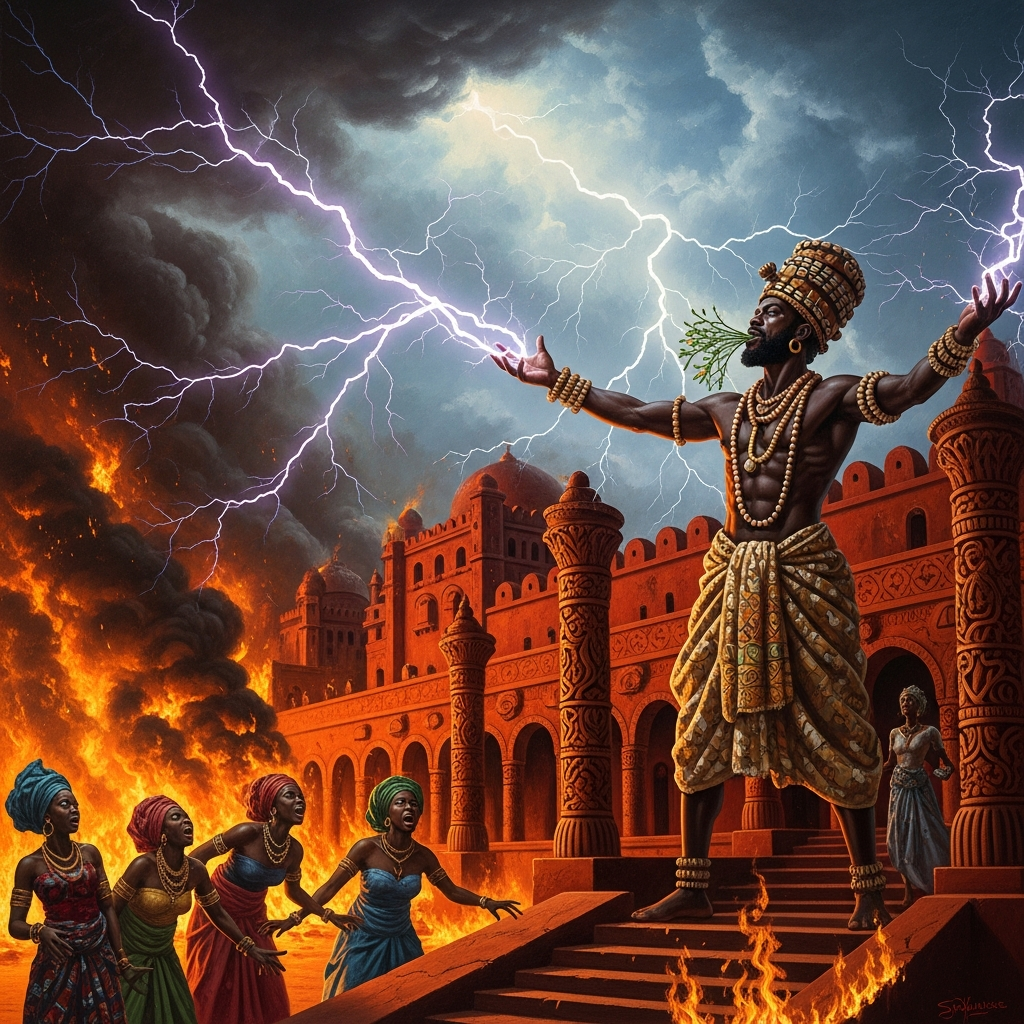
Sango stops on a rise in the forest. He turns and looks back the way he came — toward Oyo-Ile, where lights are burning in the morning, where his wives’ fires are not lit, where Gbonka is sitting on his chair. Sango chews the herb the mogba gave him long ago, the herb that opens his mouth as a door to the thunder. He raises his arms. He calls.
The lightning comes.
It comes from a sky that has been clear all night. It comes in a dozen places at once. It strikes the palace. It strikes the houses of the chiefs who voted against him. It strikes the marketplace. Half of Oyo-Ile catches fire in the space of a single breath. People run out of their homes screaming. Children burn. Wives burn. The lightning does not care; the lightning has been called by a man who has stopped caring.
And then — and this is the part of the story the Yoruba do not soften — the lightning strikes Sango’s own household. His own wives. His own children. The fire he has called down to punish his enemies is also a fire that is loose, and it eats his own family.
He stands on the rise in the forest and he watches what he has done.
He sits down.
For a long time he does not move. The smoke from Oyo-Ile rises into the sunrise and bends east. His remaining followers look at him and do not know what to say.
When he stands up, he has decided.
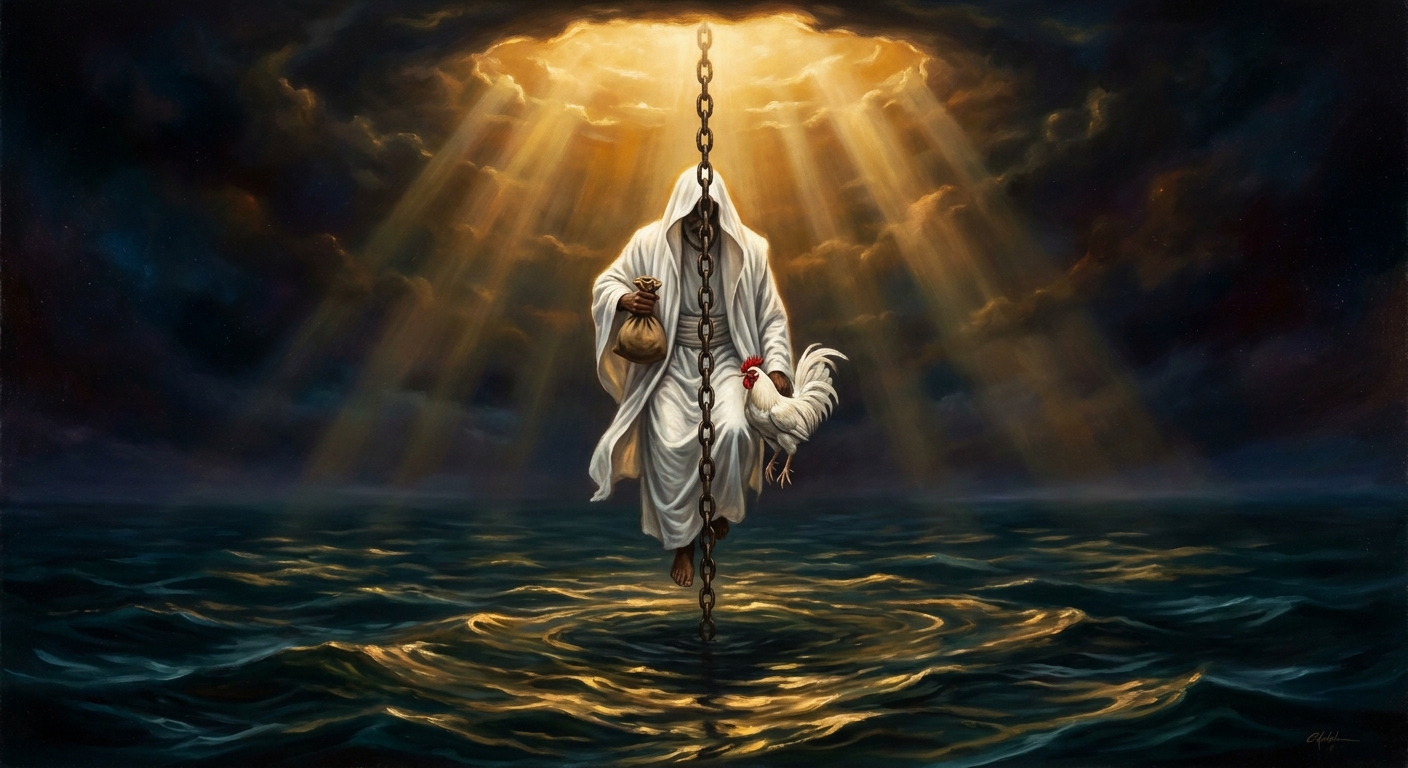
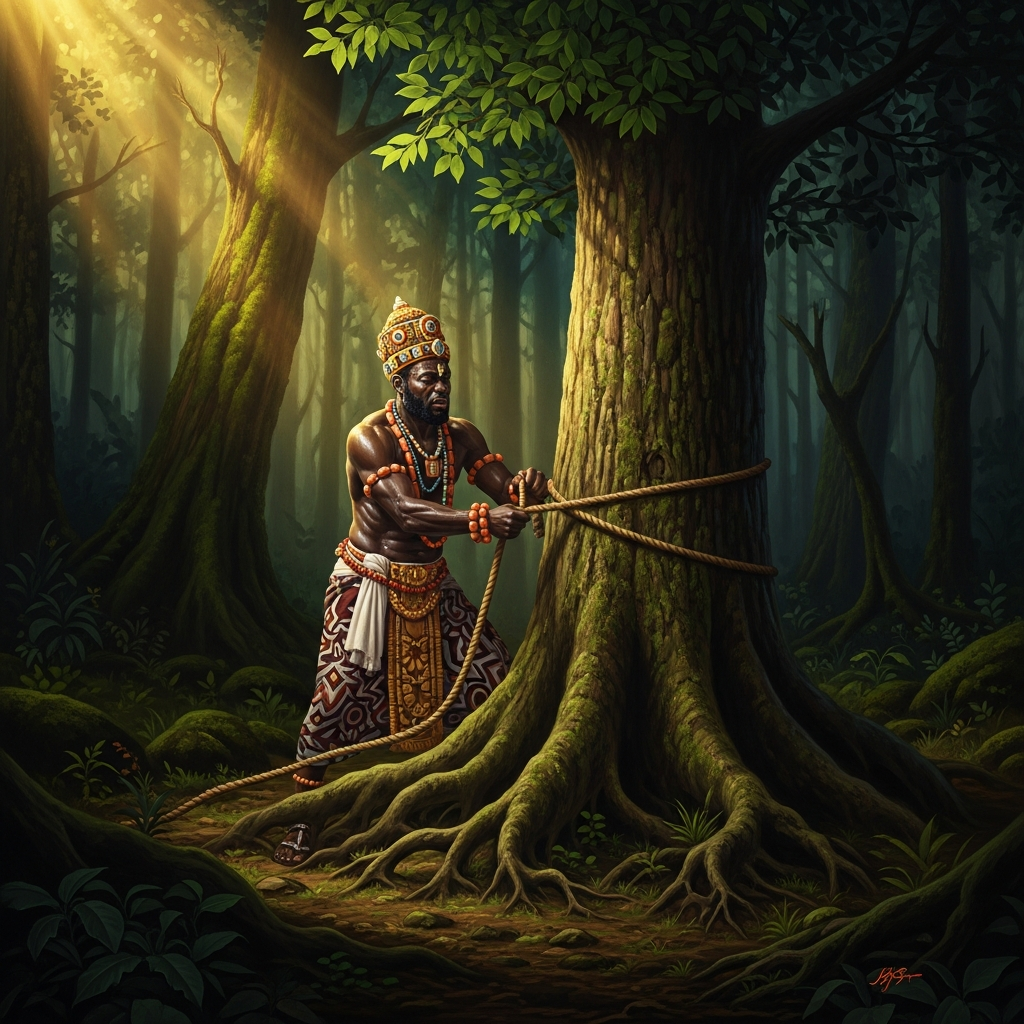
He walks deeper into the forest. He walks to the place called Koso, which means he did not hang — but the place was not called that yet. The place is called that because of what happens next. He walks until he comes to an ayan tree, the tree of thunder, the tree the mogba use to make the thunder-axes that they carry in the festival. He looks up at its branches. He takes off the cord that ties his royal robe. He throws the cord over the branch. He ties it to the trunk. He puts his head in the loop.
His remaining followers are weeping behind him. Some of them try to come closer. He waves them back without turning his head.
He steps off.
The cord pulls tight. The body falls. The followers cry out and rush forward to cut him down — and one of them, a small priest of the mogba who has loved Sango since he was a boy in the palace, falls on his knees and screams up at the tree:
Oba kò so!
The king does not hang.
The king. Does not. Hang.
The forest goes quiet.
What happens next, the Yoruba have argued for seven centuries about how to describe. Some say the body of Sango on the rope simply was not there anymore — that it dissolved upward, like smoke turning back into fire. Some say a great wind came through the forest and the tree itself bent down and laid the body on the ground softly, and when the followers approached the body, the body was empty, the spirit gone. Some say the sky cracked open above the tree the way it cracked open above Anokye’s courtyard at Kumase two centuries later, and the king walked up into it, and the rope swung empty.
What is agreed is what came next. The thunder.
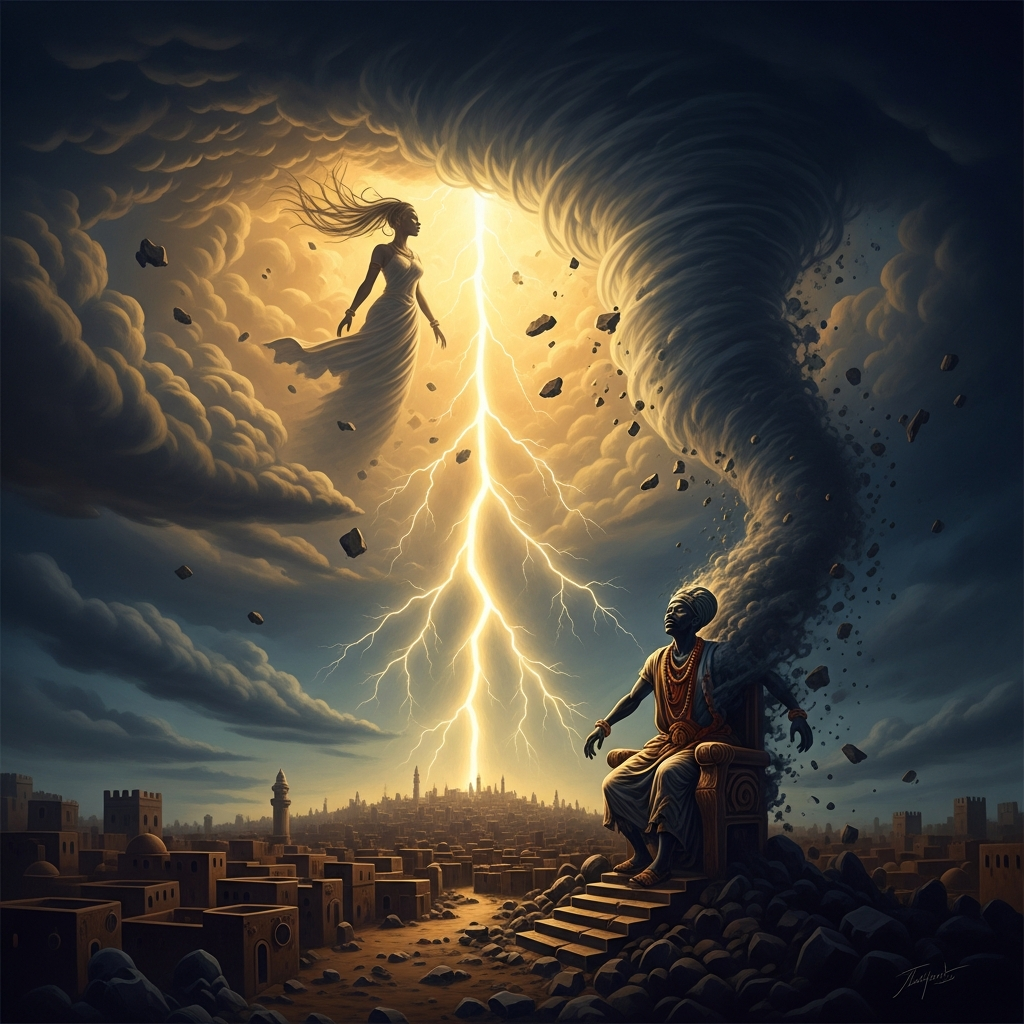
The thunder rolls in over the forest from every direction at once. It rolls across the burned palace at Oyo-Ile. It rolls down the river. It rolls into every village within five days’ walk. The lightning that has been Sango’s secret weapon — the lightning he chewed the herb to summon — comes down now without anyone calling it. It comes because Sango is it. He has stepped into his own weapon. He has become the thing he could call.
Oya comes for him.
Oya is his wife. Oya is the orisha of the Niger River, of the wind, of the storm-front that arrives before the rain. When Sango walks into the forest she follows him. She does not try to stop him; she has already understood what is happening. When the rope tightens, she becomes the wind that comes through the trees and lifts him. She is the whirlwind. She is the rotation in front of every storm that approaches Oyo for the rest of human history. The thunder is Sango. The wind that brings the thunder is Oya. They are bound together in the weather forever.
The Yoruba erect a shrine at Koso.
They erect another at Oyo-Ile, where the palace had been. They build a priesthood — the mogba, who already served him in life — to serve him in his new form. They name his weapons: the ose Sango, the double-bladed thunderaxe, which they carve in wood and in stone and which they say is the actual lightning bolt frozen in matter, the same shape as the prehistoric stone celts the farmers find in their fields and which they recognize as Sango’s thrown weapons cooled. They learn his prohibitions: red and white are his colours; dogs are his messengers; he hates lies, and to lie under his name is to invite the thunder onto your own roof.
Above all they learn his function. He is the patron of justice. He kills perjurers. He kills the man who breaks his oath. He hates corrupt judges and burns their houses down. He is the god of the public word — the king’s word, the witness’s word, the word in court — because his own word, in his life, was twisted by his fear and produced catastrophe, and his death is a kind of public penance for that twisting. He becomes, in the new dispensation, the orisha to whom you swear when you swear truly.
The shipping of the Yoruba across the Atlantic — the slave ships, the violence of the seventeenth and eighteenth centuries, the breaking of the Oyo Empire by Fulani jihad and by the slavers below — carries Sango out of West Africa and across the world. In Brazil he becomes Xangô, lord of justice, his shrines double-bladed, his colour the red of fire. In Cuba he becomes Changó, dressed in red and white, syncretized with Saint Barbara because Saint Barbara was associated with lightning in Catholic hagiography. In Trinidad they sing for him. In Haiti the Vodou loa take a different shape, but Ogou the warrior loa carries his metallic flame. In every diaspora city — in Salvador, in Havana, in Brooklyn, in Miami — the children of the Yoruba light candles to a man who once hanged himself in a forest in West Africa and refused to stay hanged.
Oba kò so.
The king does not hang.
When the storm rolls in over the West African forest tonight, when the sky turns black at four in the afternoon and the thunder begins to walk across the canopy and the lightning steps down through cloud, the mogba of the surviving Sango shrines look up and they recognize what they are seeing. They have seen it for seven hundred years. They will see it for seven hundred more.
He is still up there.
He is still hurling the ose.
He is still, in his enormous and terrible way, the king.
Scenes
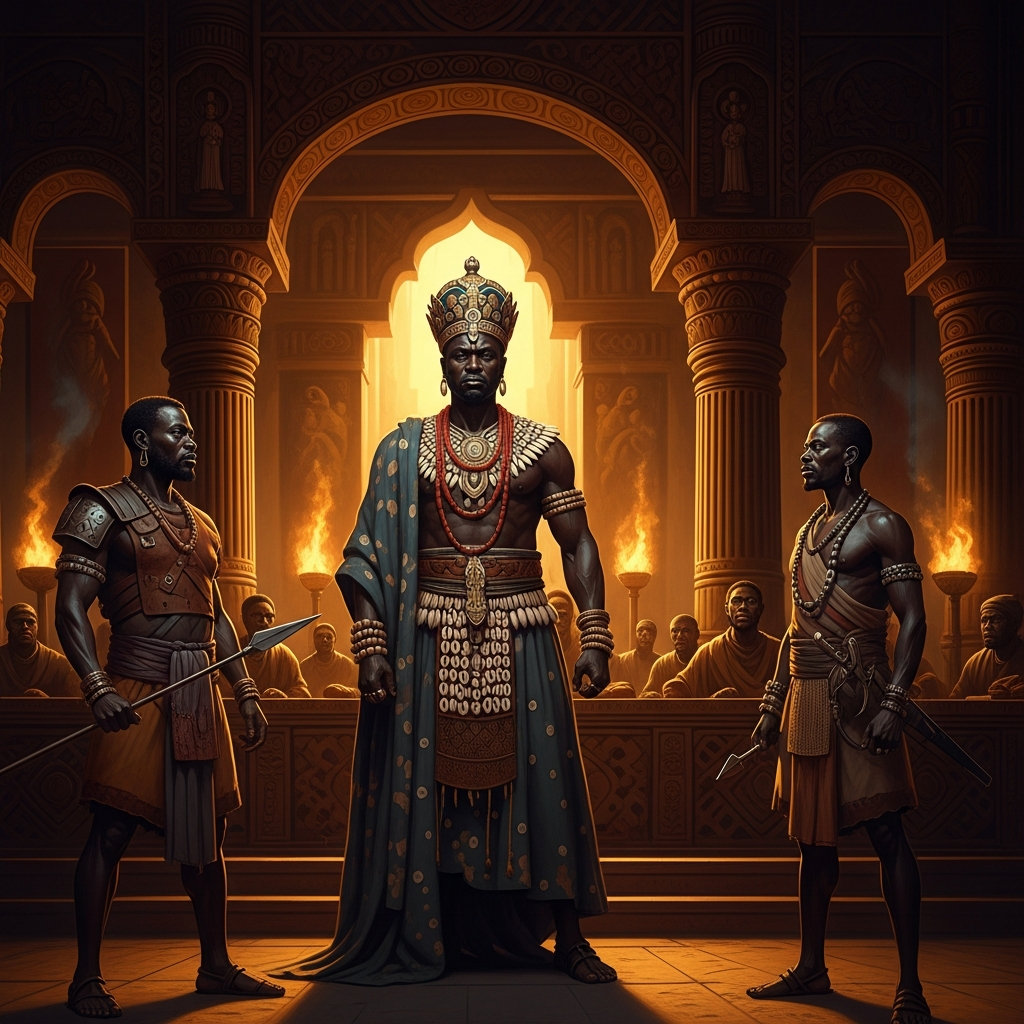
In the council of Oyo-Ile, Sango faces his two generals — Gbonka and Timi — and tries to set them against one another
 Generating art…
 Sango stands on the palace terrace, chewing the herb the priests of thunder taught him, and pulls lightning from the dry sky
Generating art… In the forest of Koso, alone, the king ties a rope to the *ayan* tree
 Generating art…
 Thunder above Oyo
 Generating art…
 Echoes Across Traditions
Entities
- Sango (Alaafin of Oyo, later orisha of thunder)
- Gbonka and Timi (his two generals)
- Oya (his wife, orisha of wind and the Niger)
- Yemoja (mother of waters, mother of orishas)
- The priests of Sango (the *mogba*) who keep the thunder cult
Sources
- Samuel Johnson, *The History of the Yorubas: From the Earliest Times to the Beginning of the British Protectorate* (1921, written c. 1897)
- J.D.Y. Peel, *Religious Encounter and the Making of the Yoruba* (2000)
- E. Bolaji Idowu, *Olódùmarè: God in Yoruba Belief* (1962)
- Robert Farris Thompson, *Flash of the Spirit: African and Afro-American Art and Philosophy* (1983)
- Karin Barber, *I Could Speak Until Tomorrow: Oríkì, Women and the Past in a Yoruba Town* (1991)