The Turn: How the Dervishes Learned to Spin
c. 1273 CE — Rumi's death and beginning of institutionalization; formalized under Sultan Walad by 1300 · Konya, Anatolia (central Turkey) — Rumi's tomb at the Mevlana Tekke and the courtyards where the sema is performed
Contents
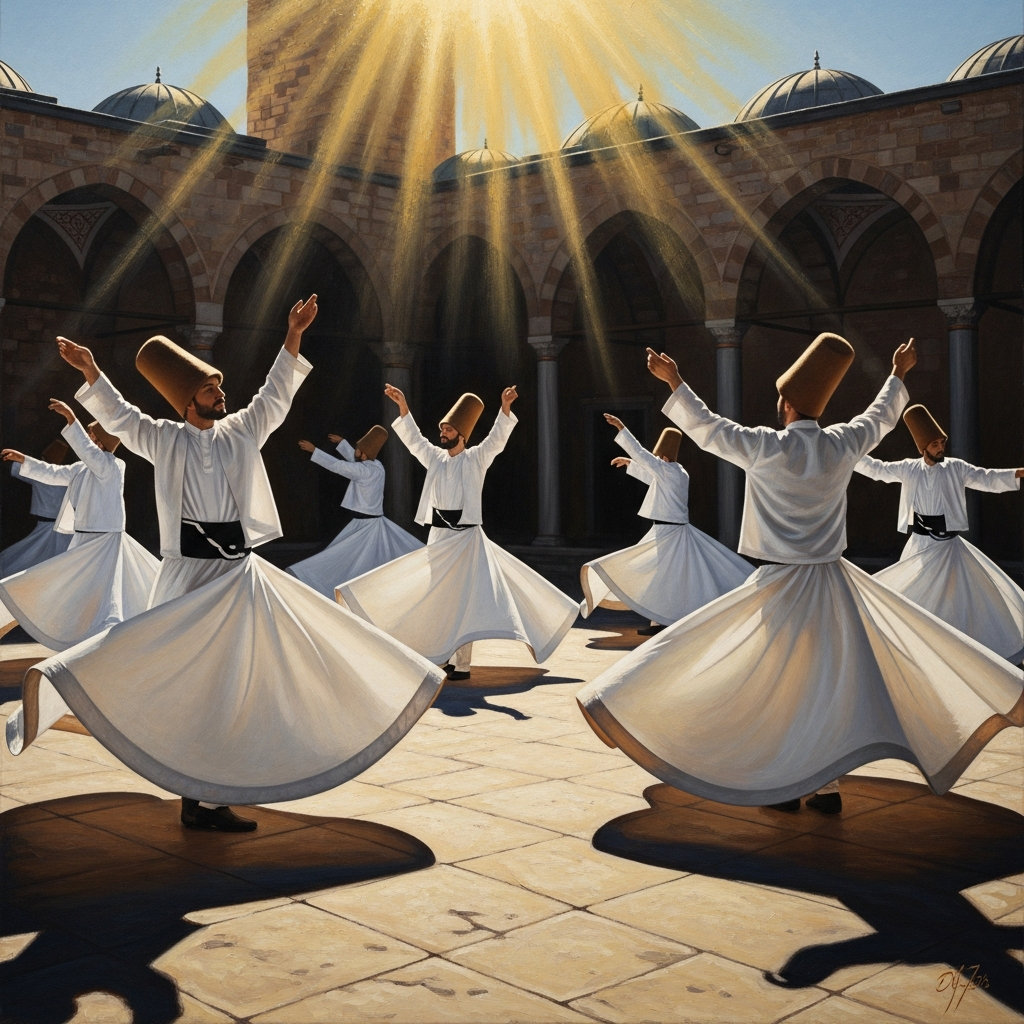
After Rumi's death in 1273, his son codifies the spinning grief his father improvised in the streets of Konya into a precise ceremony — white robes, tall felt hats, right hand to heaven, left hand to earth, the body itself as the technology of divine contact.
- When
- c. 1273 CE — Rumi's death and beginning of institutionalization; formalized under Sultan Walad by 1300
- Where
- Konya, Anatolia (central Turkey) — Rumi's tomb at the Mevlana Tekke and the courtyards where the sema is performed
The reed flute begins.
It is the first sound of every Mevlevi sema, and it is not arbitrary. The ney — the long reed flute, open at both ends, with a tone that the Persians describe as human voice with the human removed — opens the ceremony because the Masnavi, the great six-volume Persian poem of Rumi, opens with the ney. The very first lines of the Masnavi:
Bishnaw az nay chun shikayat mikunad Az judayiha hikayat mikunad —
Listen to the reed and the tale it tells, how it cries of separation.
The reed has been cut from the reed bed. It has been hollowed out. It has been pierced with seven holes. Now it is an instrument, but the instrument’s voice is the voice of the wound: the cry of something that has been removed from where it grew. This, the Masnavi says, is the soul. The soul has been cut from God. The soul is, in this world, the reed weeping for the bed it remembers.
The ney player breathes into the reed.
The dervishes are still. Their long black cloaks — khirqas — cover the white robes underneath. Their heads are bowed under the tall conical felt hats — sikkes — that the tradition calls the tombstones of the ego. Their arms are crossed against their chests, each hand on the opposite shoulder, in the posture that signifies the unity of God: the body itself becomes a single statement, La ilaha illa Allah.
The reed cries.
The dervishes do not move yet.
This ceremony did not exist while Rumi was alive.
Rumi himself, after the disappearance of his beloved friend Shams-i Tabrizi in 1248, began spinning. The accounts are scattered across the early hagiographies. He would be walking in the bazaar of Konya and a hammer would strike the goldsmith’s anvil, and the rhythm would seize him, and he would begin to turn. He would turn around the central pole of a column, around the well in the courtyard, around himself. He would spin for hours. The Persian verse would pour out of him during the turning, faster than the scribes could record it. The Diwan-i Shams-i Tabrizi — thirty-five thousand lines of love poetry addressed to the lost friend — was composed largely this way: in motion, around an absence.
The disciples watched.
The disciples occasionally joined him.
Rumi did not formalize what he was doing. He did not say: this is the ceremony. He simply spun, in grief and in something that the chroniclers, struggling for vocabulary, eventually called wajd — ecstasy, finding, the state in which the seeker discovers that what was sought has been the seeker all along.
He died in 1273. He was sixty-six. The whole city of Konya — Muslim, Christian, Jew, the dervishes and the merchants and the Sultan’s officials — joined the funeral procession. Rumi had said, in the famous lines: do not say of me that I have died — I have not died, I have moved into the dwelling of the lover. The procession was a celebration. Drums were beaten. The Christian and Jewish clergy walked alongside the imam.
After the funeral, the question became: what now?
His son was Sultan Walad.
Sultan Walad was forty-seven when his father died — already a poet in his own right, already a senior figure in the circle of disciples, already the obvious successor in the eyes of everyone except Husam al-Din Chelebi, the disciple to whom Rumi had dictated the Masnavi and to whom Rumi had given formal succession.
Husam al-Din led the order for nine years. He died in 1284. Sultan Walad took over.
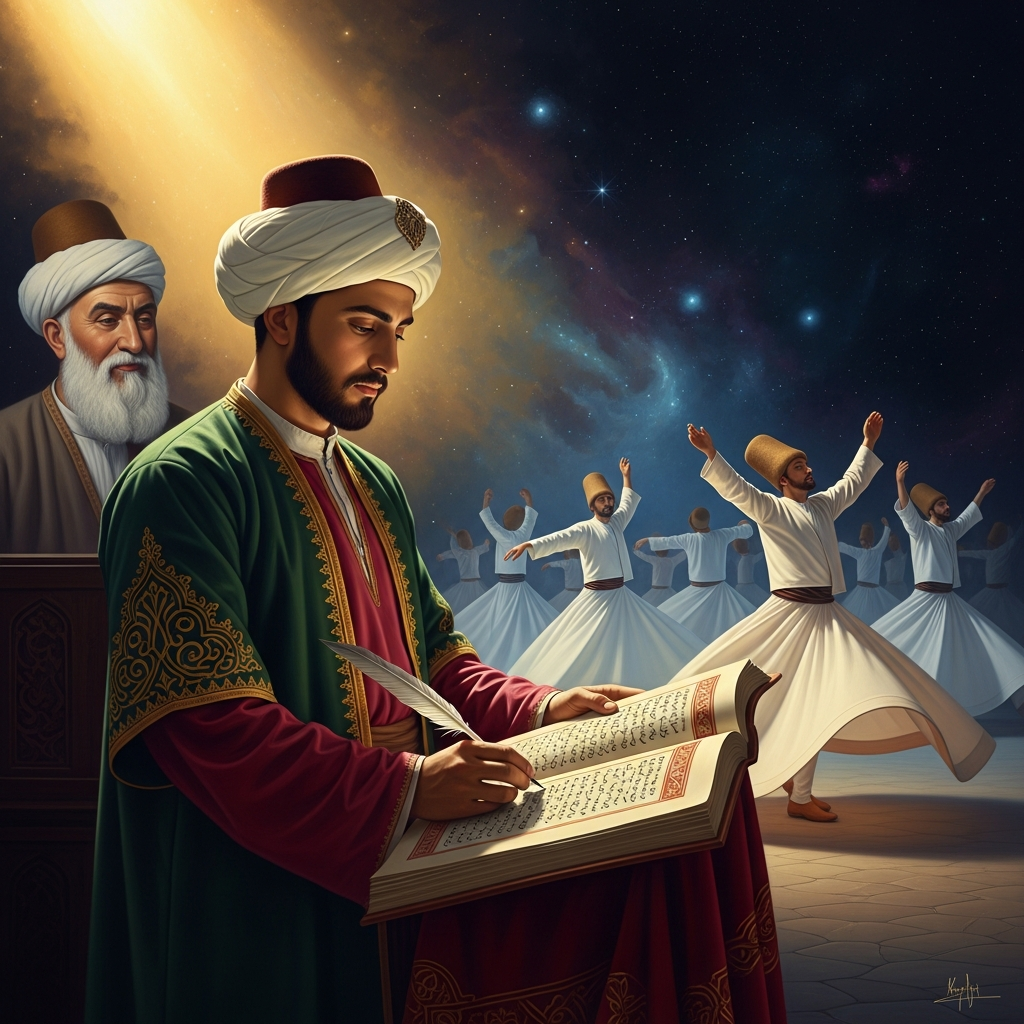
What Sultan Walad did over the next decades was the act of institutionalization that turned a charismatic master’s circle into an order. He systematized. He wrote. He built. He took the spinning that his father had done in fragments and assembled it, with the help of the senior disciples, into a precise liturgy with twelve sections and an architecture as exact as a sonata.
The architecture is this:
The ceremony opens in the semahane, the round hall built specifically for the sema. (The earliest semahanes are octagonal, eight-sided, the eight a reference to the eight gates of paradise. Later ones are circular.) The dervishes enter in a single file, hands crossed, each touching the right shoulder of the dervish ahead of him in the line of salaam — the gesture of recognizing the soul in the other.
The shaykh enters last. He sits on the red sheepskin at the head of the hall — red for the bloody sunset that, in Mevlevi color theory, is the threshold between the daylight of the body and the night of the spirit.
The opening prayer is recited. It is the naat-i sharif, the praise of the Prophet, which Rumi himself composed for use in the ceremony. The flute plays. The drum strikes.
Then the dervishes drop their black cloaks.
Underneath, the white robes — tannure — are revealed. The cloak was the body’s grave. The white robe is the shroud. The dervishes have died, in this gesture, to who they were before they entered the hall.
They begin the Sultan Veled Devri — three slow circuits of the hall, named for Sultan Walad himself, in the line behind the shaykh. Three because three is the number of the spiritual path: shari’a (the law), tariqa (the path), haqiqa (the truth). At the end of the third circuit, each dervish bows to the shaykh, and the shaykh bows back, and then —
The shaykh nods.
The dervish steps to the center of the hall.
He releases his hands from his shoulders. The right hand rises slowly, palm open, until it is above his head, fingers reaching upward. The left hand descends, palm down, until it is at his thigh, fingers angled toward the earth. He has become a vessel: receiving from the upper world, transmitting to the lower. The body is the conduit.
He begins to turn.
The turn is counterclockwise. It is around the left foot, which acts as the pivot, while the right foot pushes. The skirt of the white robe lifts and forms a circle around him. He is now a wheel within the wheel of the cosmos: the planets turn, the seasons turn, the angels turn, the molecules of the body turn, and now this small human turning at the center of the hall is doing — consciously, deliberately, with attention — what everything else is doing without attention.
There are four salams — four phases of turning, each followed by a brief pause and a change of music. The first salam is birth — the recognition of being a created thing. The second salam is witness — the recognition that all creation testifies to the unity of God. The third salam is love and ecstasy — the dissolution of the self in the divine. The fourth salam is the return: the dervish, having dissolved, returns to his place in the world to serve.
The ceremony ends with the recitation of the Fatiha and a final salaam.
The whole liturgy lasts about an hour.
The technology is what is interesting. The early Mevlevis observed — and they wrote about it explicitly, in a literature that is now being rediscovered by the contemporary neuroscientists who study altered states — that the turning, performed correctly, induces a specific change in the visual field. The room ceases to spin. The dervish, who is spinning, stops feeling that he is spinning. The point of stillness inside the motion becomes accessible. The breath slows. The thoughts thin. What the tradition calls fana fi’l-shaykh — annihilation in the master — becomes, in the experienced dervish, fana fi’l-rasul, annihilation in the Prophet, and finally fana fi’llah, annihilation in God.
It is not metaphor. The order trains for it. A novice trains for as long as a thousand and one days — the symbolic period derived from the Thousand and One Nights — before he is permitted to spin in public ceremony. The training includes specific exercises: turning slowly with one foot fixed, turning while holding a cup of water without spilling it, turning while reciting Qur’an in the mind. The body learns, by repetition, to dissociate its experience of motion from its experience of stability.
The dervish who has trained for a thousand and one days has acquired what the tradition calls çile, the discipline. He can spin for an hour without dizziness. He can turn through the entire ceremony and walk straight afterward. He has become an instrument, in the precise sense the Masnavi uses the word: a reed, hollowed out, through which the breath of God can sound.
The Mevlevi Order spread across the Ottoman Empire over the next four centuries. It established tekkes in Damascus, Cairo, Aleppo, Edirne, Sarajevo, Belgrade. It became, in the Ottoman period, the order of the cultivated elite — the order with the most patronage from the Sultan, the order whose semahanes were attached to imperial mosques. The shaykh of the central Konya tekke, the direct lineage descendant of Rumi, was one of the highest religious figures in the empire.
The order’s relationship with state power was, at the same time, ambiguous. The Mevlevis were never quite a state instrument. The poetry they read was the Masnavi — a poem in which the Sultan and the beggar are equally servants of the Beloved. The ceremony they performed was a ceremony in which the social distinctions of the Ottoman world dissolved into the white robes and tall hats that made every dervish indistinguishable from every other.
When the Ottoman Empire fell and Mustafa Kemal Atatürk built the Turkish Republic, he abolished the dervish orders. In 1925, the Law on the Closure of Dervish Lodges shut every tekke in Turkey, including the Mevlana Tekke at Konya. The shaykh’s lineage was extinguished. The ceremony was forbidden. The dervishes, formally, ceased to exist.
This lasted twenty-nine years.
In 1954, the Turkish state — having decided that the Mevlevi sema was a national cultural treasure that could be performed without religious meaning — permitted the ceremony to resume, as folk performance, in a state-sanctioned festival. The Konya tekke became a museum. The annual ceremony was billed as a cultural event for tourists.
The dervishes accepted the framework. They also did not accept it. They performed the ceremony as the state required and, internally, kept doing what they had always done. The order continues. The ney still cries the cry of the reed cut from its bed. The white robes still rise into the circle. The right hand still receives. The left hand still gives.
The turn continues.
It will, the dervishes believe, continue as long as the world turns, and one second longer.
Scenes
In the courtyard of the Mevlana Tekke, the dervishes spin in white robes — right hand to heaven, left hand to earth, axis through the heart
Generating art… The ney player opens every sema with the cry of the reed cut from its bed — the first image of the Masnavi, the soul separated from God
 Generating art…
 Sultan Walad codifies what his father improvised — the spinning grief becomes the ceremony of an order that will spread across the Ottoman world
 Generating art…
 Echoes Across Traditions
Entities
- Jalal al-Din Rumi
- Sultan Walad
- Shams-i Tabrizi
- Husam al-Din Chelebi
- the ney player who opens every sema
Sources
- Rumi, *Masnavi*, trans. Jawid Mojaddedi, 6 vols. (Oxford, 2004-2020)
- Franklin Lewis, *Rumi: Past and Present, East and West* (Oneworld, 2000)
- Seyyed Hossein Nasr, *The Garden of Truth: The Vision and Practice of Sufism* (HarperOne, 2007)
- Şefik Can, *Fundamentals of Rumi's Thought* (Tughra, 2004)
- Aflaki, *Manaqib al-'Arifin* (~1353), trans. John O'Kane as *The Feats of the Knowers of God* (Brill, 2002)