The Spark That Was Never Made
c. 1313-1327 CE, Cologne and Strasbourg · Dominican churches of Cologne, Strasbourg, and the Rhineland
Contents
A Dominican friar preaches mystical theology in the German vernacular to weavers and merchants who have never heard it. Meister Eckhart tells them there is a spark in the soul — uncreated, identical with God — and that to reach it you must own nothing, know nothing, will nothing. In 1329, the Pope condemns him. He has already died.
- When
- c. 1313-1327 CE, Cologne and Strasbourg
- Where
- Dominican churches of Cologne, Strasbourg, and the Rhineland
The church is full of people who make cloth for a living.
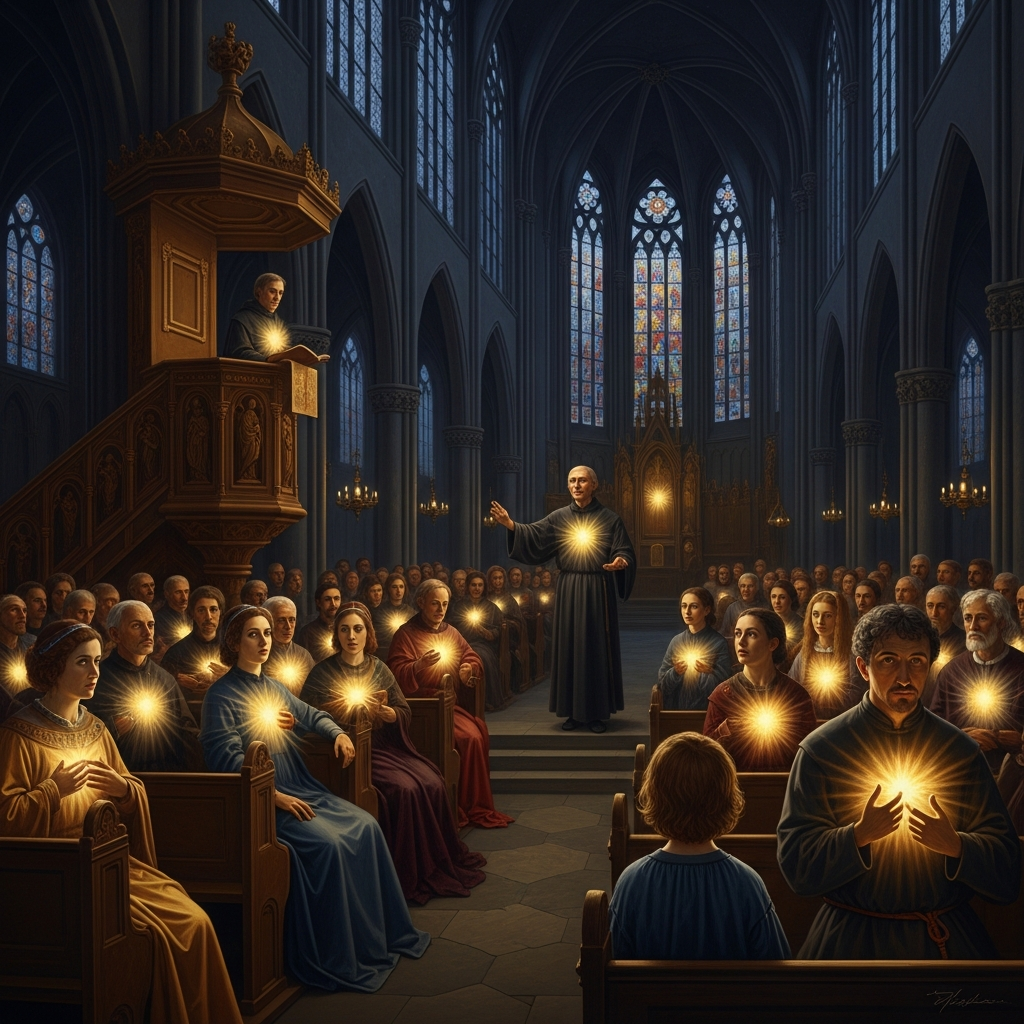
Cologne in 1313 is a city of weavers, dyers, tanners, and merchants — prosperous, literate, bored with the Latin sermon that they can follow only in fragments. The Dominican friar who has been assigned to the German Province is not boring. He is fifty and has spent twenty years in the university schools of Paris, Cologne, and Erfurt, teaching theology with enough distinction that they call him Meister — master — before his name. He stands in the pulpit of the church of Saint Gereon or the church of the Dominicans and does something no one in this building has heard before. He preaches Neoplatonism in German.
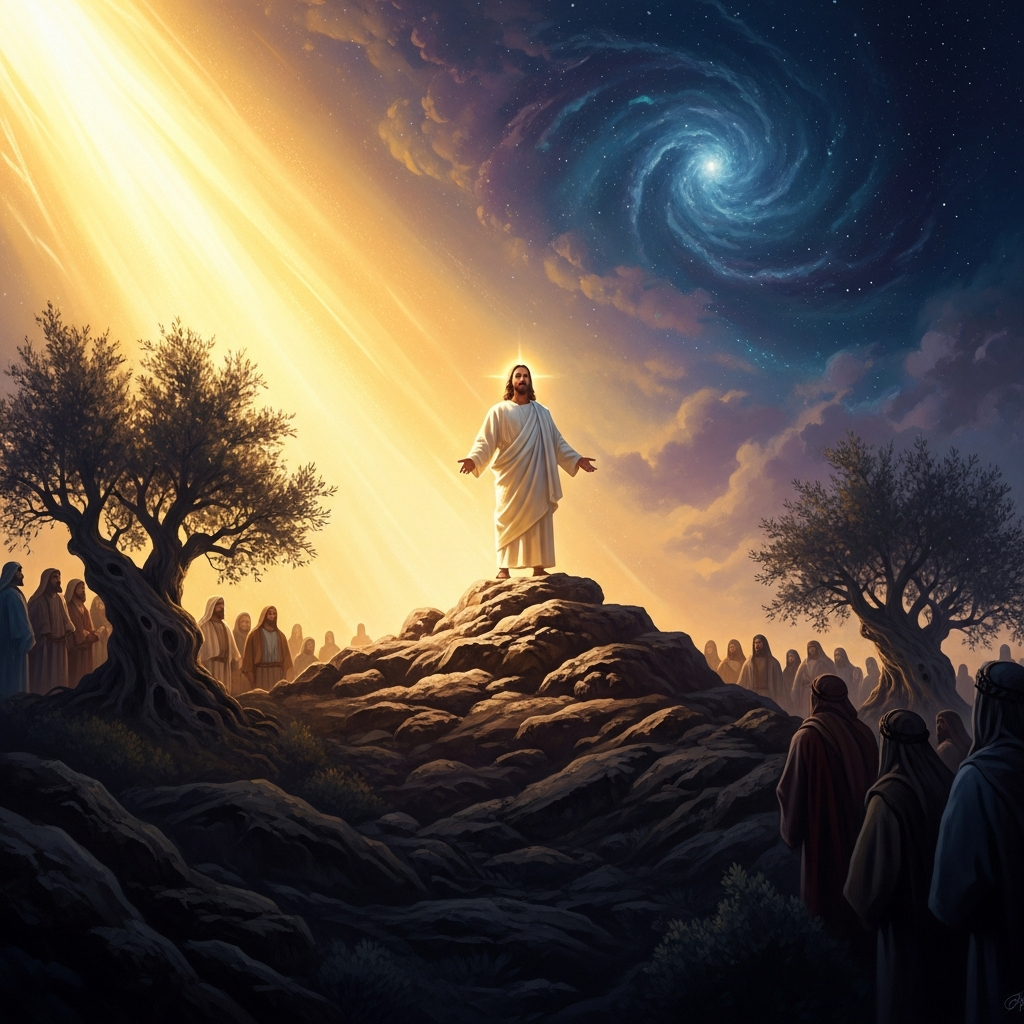
He says: there is a spark in your soul. He calls it Fünklein. He says it was never created. He says it is identical with God. He says it is watching you right now from the inside, from a place that neither sin nor time nor the noise of the city has ever reached.
He has the full attention of the weavers.
Eckhart has been developing these ideas for thirty years in the university context, where they are kept safe by their Latin and by the fact that every listener has the theological training to hold them carefully. He has written in Latin about the birth of the Word in the soul, about the return of the intellect to its source in the divine intellect, about the spark. He has said these things in the careful grammar of scholastic disputation, where every claim is immediately hedged with distinctions.
Now, standing in front of people who have no Latin and no distinctions, he says them plainly.
He says: God is not a being. God is being itself. Everything that exists participates in being. The soul, in its deepest point — the Seelengrund, the ground of the soul — touches being directly. Not through faith, not through sacrament, not through the mediation of the Church, but directly, the way the eye touches light.
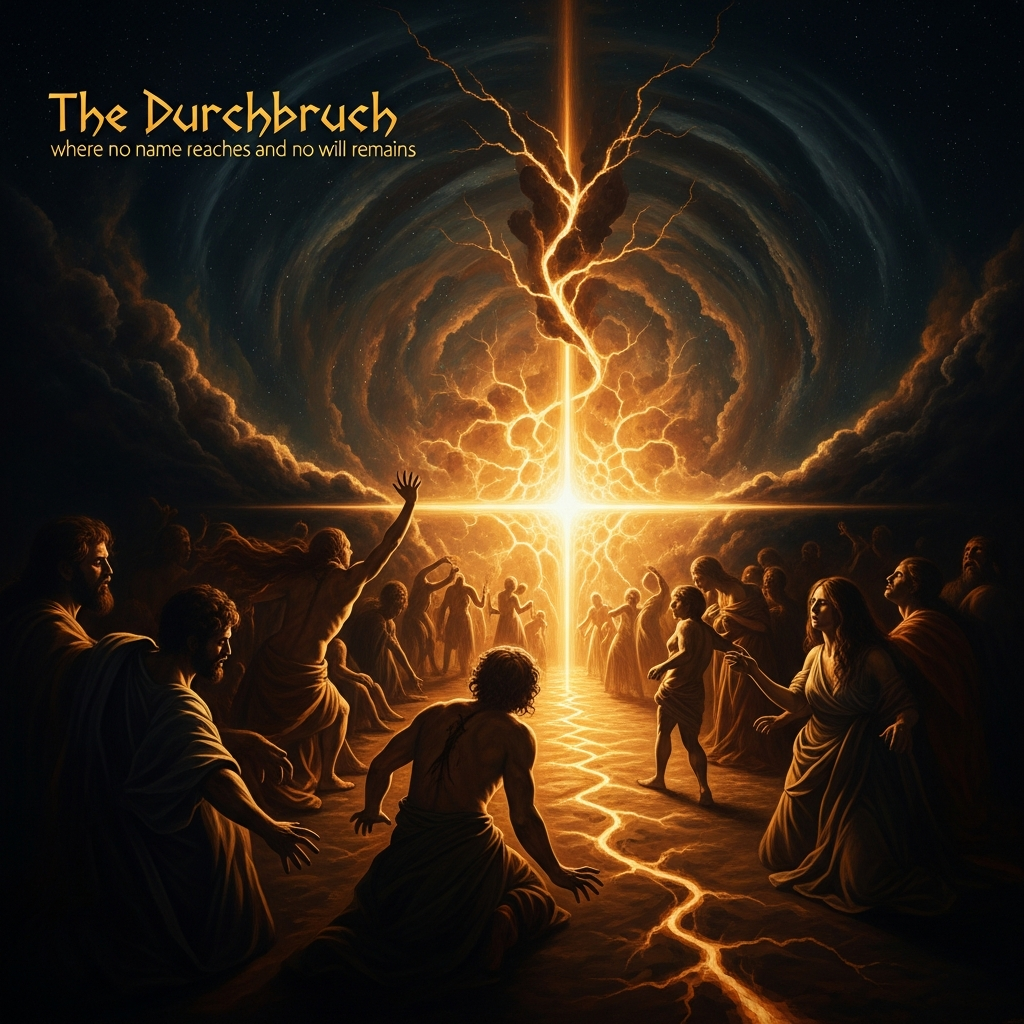
He says: the Trinity is the face God shows toward creation. But behind the Trinity is the Godhead — Gottheit, not Gott — the naked divine darkness, beyond name, beyond relation, beyond person. You can reach it. He calls the journey there the Durchbruch, the breakthrough. You break through God to the Godhead. You break through everything.
The price of the Durchbruch is what he calls poverty of spirit.
He preaches poverty in three registers, each more terrifying than the last. The first is exterior poverty — owning nothing. This is ordinary Franciscan territory; the crowd knows it. The second is interior poverty — wanting nothing. Willing nothing, not even union with God, not even salvation, not even poverty itself. The soul that wills its own poverty is still a soul with a will, and a will is an obstacle. The third is the hardest: knowing nothing. Not achieving ignorance, which would still be an achievement, but arriving at the place before knowledge, before the distinction between knower and known.
He says: if you meet God on the road to poverty, kill God. Not the Godhead — you cannot kill that. But the God who is your idea of God, the God who answers prayers and has opinions about your behavior and can be placated by ritual — that God is a construction of your needing mind, and as long as you carry it you will not reach the naked Godhead behind it.
A weaver in the third row coughs. Eckhart pauses and waits. He is not afraid of silence.
He is also not careful in the way that would have saved him.
He says, in a sermon: I am as much the Son of God as Christ is. He means: the Son is the eternal self-knowledge of the Father, and insofar as any soul achieves the ground where it is identical with God’s self-knowledge, it participates in the eternal sonship. He has a complete scholastic explanation of this. He does not always give it. The sentence goes out into the city naked.
He says: God needs me as much as I need God. He means: in the eternal now of the Godhead, the distinction between creator and creature collapses; to say God is self-sufficient and needs nothing is to say God has no relation to the world, which collapses creation. He has a complete scholastic explanation of this too. He does not always give it.
He says: the poorest person you know, if they have truly emptied their will, is as close to God as any pope.
He does not have a complete scholastic explanation of this. He means it.
In 1326 the Archbishop of Cologne, Heinrich von Virneburg, initiates heresy proceedings.
Eckhart appeals to the Pope. He travels to Avignon. He defends himself before the papal commission with a document that lists, for each condemned proposition, the orthodox interpretation he intended and the scholastic authorities that support it. He argues that his vernacular German was being heard without the technical context that makes the claims safe. He argues that he cannot be a heretic because he has always submitted to the judgment of the Church, even when he is telling people that the poorest weaver has the same access to God as the Pope.
He makes these arguments brilliantly, by all accounts. He also dies before the decision is reached, probably in late 1327 or early 1328.
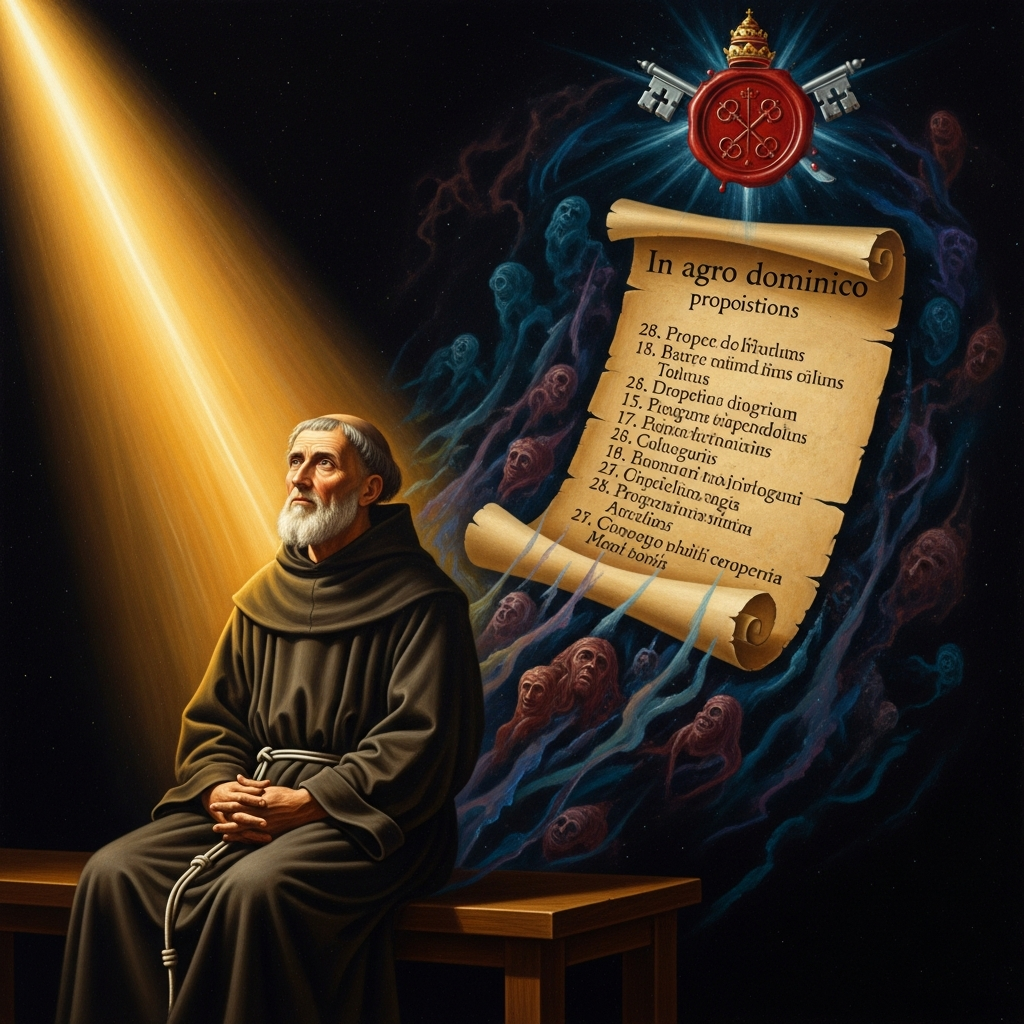
On March 27, 1329, Pope John XXII issues the bull In agro dominico. It condemns twenty-eight propositions drawn from Eckhart’s sermons and writings. Seventeen are declared heretical. Eleven are called evil-sounding, rash, and suspect of heresy. The bull notes that Eckhart recanted at the end — a claim the surviving documents do not quite support and that Eckhart’s defenders have disputed for seven centuries.
His thought does not die. It goes underground, the way fire goes underground in a peat bog.
The Rhineland mystics — Johannes Tauler, Heinrich Suso — preserve his framework in slightly more careful language. The anonymous Theologia Germanica recasts his poverty mysticism in terms orthodox enough that Luther reads it twice and publishes it, calling it, after the Bible and Augustine, the most important book he has found. The Theologia Germanica shapes Lutheran interiority for two centuries without anyone knowing Eckhart’s name is behind it.
Then, in the nineteenth century, the German philosopher Hegel begins writing about Spirit’s self-return through negation, about the dialectic that moves through destruction to higher synthesis, about the Absolute that knows itself through the finite mind. The vocabulary is Eckhart’s. Hegel has read him. He thanks him in a lecture, briefly.
Heidegger, in the twentieth century, reads Eckhart’s distinction between being and Being, between Sein and Seyn, and finds the entire problematic of his own Being and Time already sketched in a fourteenth-century Dominican’s German sermons. He says so, more than once, in his later work.
The weavers of Cologne heard something in that church that their theology professors would not have let into the classroom. They heard that the gap between the human and the divine was, at its deepest point, zero. They heard that the elaborate machinery of the medieval church — the sacraments, the hierarchy, the Latin, the indulgences — was scaffolding around an interior architecture that had been complete before any of it was built.
Eckhart does not say the machinery is useless. He says it is scaffolding. He says you need it to get inside. He also says that once you are inside, there is a room where it does not reach.
The spark was never made. It cannot be condemned. It watches from inside the skull of every Dominican, every weaver, every hereticized mystic who has ever sat in a dark room and felt, without explanation, that something in them was more at home in the dark than in the light — not because the dark was empty but because it was where the source lived.
Scenes
Eckhart preaches in a Cologne church — the *Fünklein*, the uncreated spark, blazing at the center of every soul in the room
Generating art… The *Durchbruch* — the breakthrough past the Trinity into the naked Godhead where no name reaches and no will remains
 Generating art…
 The papal bull *In agro dominico* lists twenty-eight condemned propositions
 Generating art…
 Echoes Across Traditions
Entities
- Meister Eckhart
- Pope John XXII
- the Rhineland Beguines
- the Fünklein
Sources
- Meister Eckhart, *German Sermons* (*Deutsche Predigten*), trans. Maurice O'Connell Walshe (Element Books, 1987)
- Meister Eckhart, *Latin Works* (*Opera Latina*), including *Parisian Questions* and *Commentary on John*
- Bernard McGinn, *The Mystical Thought of Meister Eckhart* (Crossroad, 2001)
- Cyprian Smith, *The Way of Paradox: Spiritual Life as Taught by Meister Eckhart* (Darton, Longman and Todd, 1987)
- Oliver Davies, *Meister Eckhart: Mystical Theologian* (SPCK, 1991)
- Pope John XXII, *In agro dominico* (Bull of condemnation, March 27, 1329)