The Heat in the Chest
c. 1318-1349 CE · Yorkshire, England — Dalton, Ainderby, and the Cistercian priory of Hampole
Contents
Richard Rolle abandons Oxford without a degree, retreats to a Yorkshire chapel, and one afternoon feels genuine physical heat spreading from his sternum. He puts his hand to his chest to check for flames. There are none. He spends the rest of his life writing about this sensation in English — becoming one of the first English-language mystics — until the Black Death reaches Hampole.
- When
- c. 1318-1349 CE
- Where
- Yorkshire, England — Dalton, Ainderby, and the Cistercian priory of Hampole
He leaves Oxford without finishing his degree.
This is not how most people leave Oxford. Most people who leave Oxford without finishing their degree leave because they have failed, or because their money has run out, or because they have been sent down for some infraction. Richard Rolle leaves because he has decided, in the summer of his late teens, that the kind of knowing Oxford offers is not the kind of knowing he is looking for. He has been at Oxford long enough to know what is on offer. He has also been reading Richard of St. Victor and Bernard of Clairvaux in the library. He goes home to Yorkshire.
What happens next is theatrical in the way that only young men who have made a dramatic decision tend to be theatrical. He borrows two of his sister’s dresses and cuts holes in them to wear as a makeshift habit, announcing to her that he is going to be a hermit. She thinks he has lost his mind and says so. He leaves anyway. He is approximately eighteen years old.
The audacity of this, he will later acknowledge, was not entirely spiritual.
He finds a patron — John de Dalton, a minor Yorkshire gentry, who gives him a cell and allows him to use the family chapel. He fasts. He prays the hours. He reads the mystics. He writes, already, in Latin — prose and verse of unusual quality, which suggests that Oxford gave him more than he acknowledged when he left. He does the work. He keeps doing the work.
Three years in, sitting in the chapel on a summer evening not long after he has finished the Te Deum, something changes.
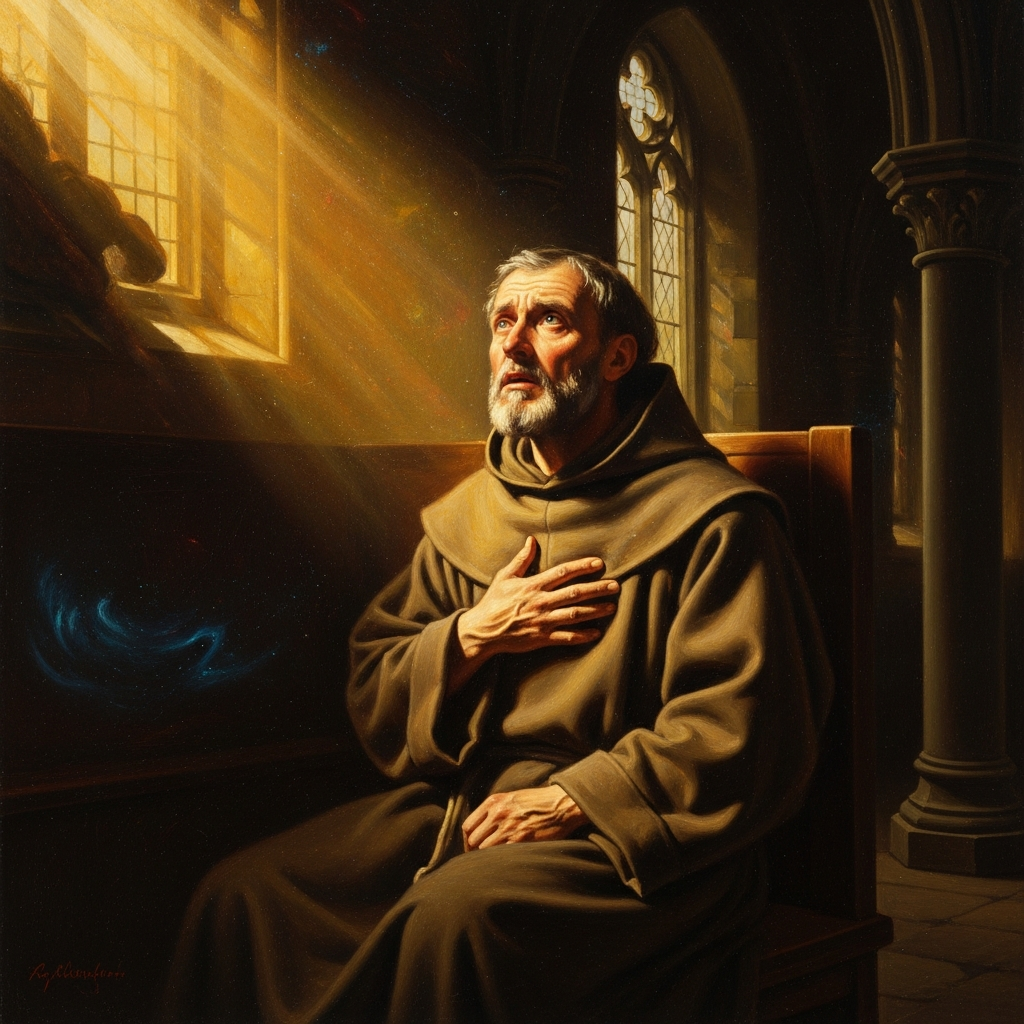
He describes it later in Incendium Amoris, the Fire of Love — the book he will write when he is older and steadier and can give the account without it sounding like the report of a man who has not slept. He says: I was sitting in a chapel and I felt in my chest a real warmth. He is specific: real warmth, not a metaphor, not an emotional sensation misinterpreted as physical. He thought it was a fire. He put his hand to his sternum to check whether he was physically on fire. He was not. The warmth was there nonetheless.
He sits with it. It does not diminish. It spreads slightly — not through his whole body, but through the region of the heart.
He decides, after a long period of sitting with the experience and testing it against everything he knows about discernment, that it is the presence of God registered physically in his body. He calls it calor — heat, warmth, the Latin word for the thing itself without any mystical freight attached. He refuses to call it something more impressive than what it is.
He also receives two other gifts, which he eventually names and which become the organizing framework of his mature mystical teaching: dulcor, sweetness — a quality of experience that accompanies the heat and resembles what he knows from Bernard’s description of the consolation of grace — and canor, song. The canor is the strangest of the three. He says: I hear, interiorly, a music that is not produced by any external instrument and not generated by my own memory or imagination. He is careful to distinguish it from the kind of interior humming that anyone can produce voluntarily. It arrives. It cannot be summoned.
He is aware that these claims are strange. He is also aware that his hesitation to make them, because they are strange, would constitute a failure of honesty. He makes them. He makes them in Latin, and later, for the women he will serve, in English. He makes them with the specificity of a man who is reporting what he actually experienced rather than a man performing mystical experience for an audience.
This is what separates him from many of his contemporaries: he does not dress the experience up. He does not reach for the theological vocabulary of Pseudo-Dionysius or the erotic vocabulary of the Song of Songs to make the calor more respectable. It was warmth. It felt like fire. He checked for fire. There was none. He reported all of this.
He moves several times in the following years — from Dalton to Ainderby, from Ainderby to other cells, the itinerant hermit’s rhythm of finding a patron, establishing a practice, moving when the situation changes. He is not always easy to be around. He is blunt about the failures of the clergy he encounters — their worldliness, their simoniacal arrangements, their lack of interior life. This makes him some enemies. He also has the reputation of a genuine holy man, which makes him patrons.
What he is doing in these years, besides the physical work of prayer and the pastoral work of counsel, is developing a theology of experience. He is working out, in his Latin prose and his English writings, what his gifts mean — not just for himself but for a general account of the Christian contemplative life. He is insisting, against the dominant scholastic tradition, that mystical experience is not primarily a matter of concepts and not primarily a matter of the will. It is a matter of the transformation of sensation — of what it actually feels like to be the kind of person who has been sufficiently emptied of self to receive what God wants to give.
He says: the fire is not achieved by effort. No amount of meditation technique or ascetic practice can produce the calor. What practice does is prepare a vessel. What arrives in the vessel comes from outside the vessel.
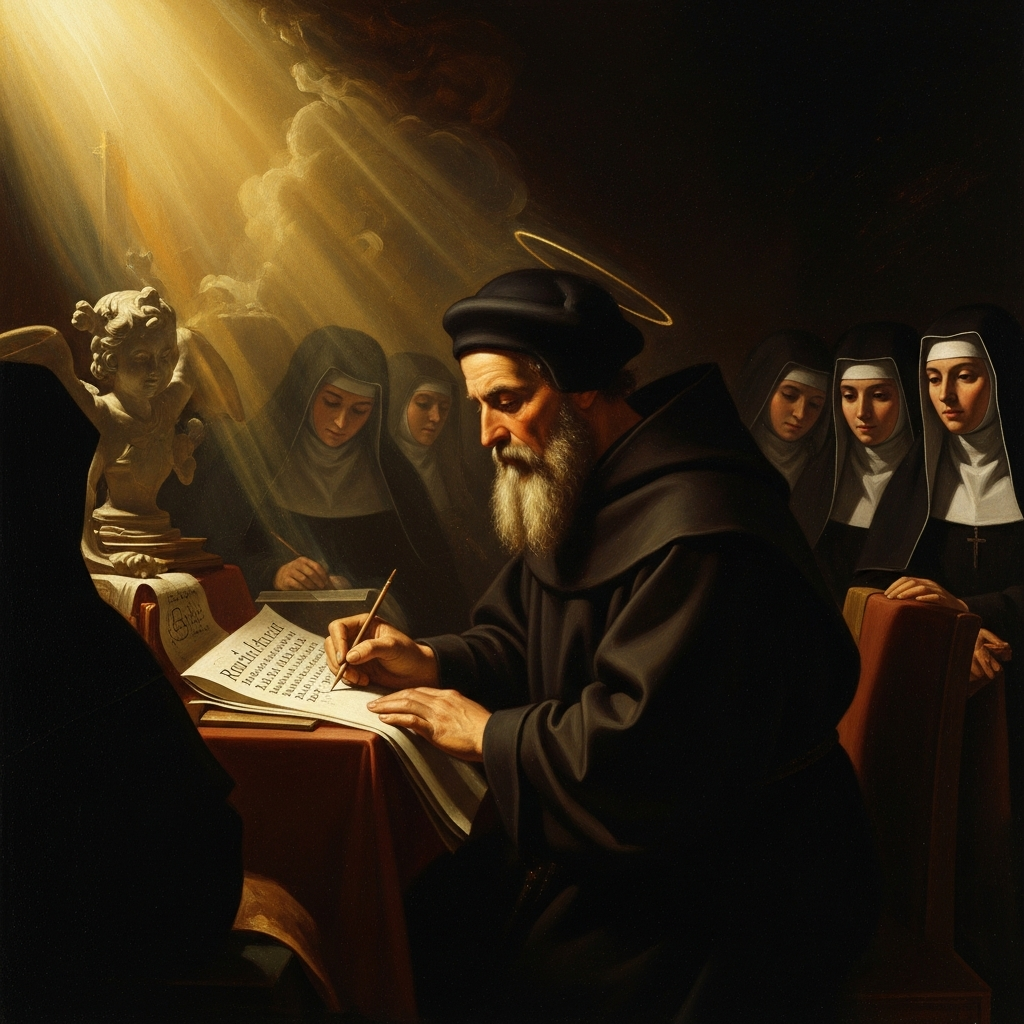
In his last years he settles near the Cistercian priory of Hampole, a community of nuns who have asked for his guidance. He writes for them in English — including the Ego Dormio, letters of spiritual direction, and the Form of Living addressed specifically to one of the nuns, Margaret Kirkby. These English writings are among the earliest examples of sustained contemplative prose in the English language. He does not write English because he cannot write Latin — his Latin is excellent. He writes English because the women he is writing for speak English, and because the subject he is writing about is not improved by the mediation of a foreign language.
The Form of Living is addressed to Margaret and begins with love. He tells her: the highest life and the most perfect is to live in love — not in austerity, not in the multiplication of devotions, not in the careful performance of the liturgy, but in love, which is the ground of everything else and without which everything else is performance. He is not dismissing the practices. He is telling her what they are for.
He tells her: you may receive what I have received. The calor, the dulcor, the canor. Not because you can produce them — you cannot — but because God gives them to those who have prepared a place for them by emptying out what was there before.
In 1349 the Black Death arrives in Yorkshire.
The plague moves through the villages of the North Riding during the summer. It reaches Hampole. Richard Rolle dies in August 1349. He is approximately forty-nine years old.
He dies at the priory, among the women he has been serving. The nuns begin, almost immediately, to gather material for a canonization cause. They compile accounts of healings at his tomb. They collect testimonies. They write an office for his feast day. The canonization never happens — the paperwork is submitted but Rome is overwhelmed with plague dead from across Europe, and the cause of an English hermit with a heterodox reputation for claiming physical contact with God is not a priority.
He remains uncanonized. He also remains read. The Fire of Love and the Form of Living circulate in English manuscripts through the rest of the fourteenth century and into the fifteenth, alongside Julian and the Cloud author and Walter Hilton — the fourteenth-century English mystical movement that happens to be the richest flowering of vernacular mystical writing in any European language of the period.
He put his hand to his chest because he wanted to know whether the warmth was real. He found no fire. He reported the warmth anyway, exactly as it was, and spent thirty years defending the report against the people who found it too physical to be spiritual — which was, he might have said, the exact confusion he was writing to correct.
Scenes
Richard Rolle sits in the chapel at Dalton and feels the warmth begin in his sternum — he puts his hand to his chest and finds no fire
 Generating art…
 The hermit's cell in Yorkshire — the physical austerity that frames the interior warmth
 Generating art…
 Rolle at Hampole, writing in English for the community of nuns — the vernacular mystic at work
 Generating art…
 Echoes Across Traditions
Entities
- Richard Rolle
- the Cistercian nuns of Hampole
- the hermit tradition
Sources
- Richard Rolle, *The Fire of Love*, trans. Clifton Wolters (Penguin, 1972)
- Richard Rolle, *Incendium Amoris*, ed. Margaret Deanesly (Manchester University Press, 1915)
- Richard Rolle, *The English Writings*, ed. Rosamund S. Allen (Paulist Press, 1988)
- Nicholas Watson, *Richard Rolle and the Invention of Authority* (Cambridge University Press, 1991)
- Hope Emily Allen, *Writings Ascribed to Richard Rolle, Hermit of Hampole* (Modern Language Association, 1927)