The Hajj That Crashed the Gold Market
1324-1325 CE (the hajj journey) · Mali Empire (Niani) → Walata → Taghaza salt mines → Tuat oasis → Cairo → Medina → Mecca → return through Cairo and across the Sahara
Contents
In 1324 CE Mansa Musa I of Mali — controller of more than half the world's gold supply — sets out for Mecca with sixty thousand people, eighty camels carrying three hundred pounds of gold dust each, and five hundred servants bearing gold staffs. He stops in Cairo. He gives away so much gold he crashes the Egyptian market and depresses the regional economy for a decade. He returns with the architect who builds the first fired-brick mosques of the Sudan. On the 1375 Catalan Atlas his crowned figure dominates Africa: 'the richest and most noble lord in all this region.'
- When
- 1324-1325 CE (the hajj journey)
- Where
- Mali Empire (Niani) → Walata → Taghaza salt mines → Tuat oasis → Cairo → Medina → Mecca → return through Cairo and across the Sahara
He has been on the throne for twelve years when he decides to make the hajj.
He is the ninth mansa — the term Mali uses for emperor — of the dynasty Sundiata Keita founded a century earlier when he defeated the sorcerer-king Sumanguru at the battle of Kirina and consolidated the Mande confederation into a single state. The empire Musa inherits in 1312 stretches from the Atlantic to the bend of the Niger, and from the southern edge of the Sahara to the gold-bearing forests of Bambuk and Buré. It contains, at its peak, perhaps thirty million people. Its standing army numbers a hundred thousand. Its capital city Niani is the seat of a court that mints its own coinage and collects tribute in gold dust by weight.
The gold is the central fact. The Buré goldfields produce, by some modern estimates, two-thirds of the world’s gold supply during Musa’s reign. Mali does not mine the gold itself — the wangara miners are a separate ethnic group with their own organization and their own taboos, and the kings of Mali have learned that the price of the gold’s continued production is to leave the miners alone — but Mali controls the trade. The gold flows north across the Sahara to Sijilmasa and Fez. From there it crosses the Mediterranean into Genoa and Venice and onward into the European money supply, where the Florentine florin and the Venetian ducat depend on West African gold for the metal of which they are struck.
Mansa Musa is the wealthiest individual the medieval world will ever produce. The modern attempts to estimate his net worth in current dollars are not serious — they cluster between $400 billion and four trillion, and there is no honest method to convert across that distance — but the contemporary record is consistent: he is, by an enormous margin, the richest king then living. The Mamluk court chroniclers describe his wealth in language they reserve for nothing else. The Florentines, hearing the news, send factors to Tripoli to investigate trade routes. The Aragonese begin compiling rumors that they will eventually translate into the Catalan Atlas.
He decides, in 1324, to perform the hajj.
The decision is religious. Musa is a devout Muslim — the Mali dynasty has been Muslim since Sundiata’s father, perhaps earlier — and the hajj is the fifth pillar, mandatory once in a lifetime for those who can afford it. Musa can afford it more than any human being then alive. Whether the obligation falls on him at all has been an interesting question for Mali’s ulema, since he is a king and his physical absence from the realm is itself a form of harm to his subjects, but the consensus has been that he should go.
The decision is also political. The Islamic world is a network of legitimation, and Mali has been at the periphery of it. The North African scholars who pass through Niani are gracious but condescending. The Andalusian theologians who occasionally arrive treat Mali as a frontier mission. The hajj will let Musa present himself in person at the center of the network. He will pray at the Kaaba. He will be received in Cairo by the most powerful sultan of the day. He will purchase scholars, books, jurists, and architects, and he will bring them home.
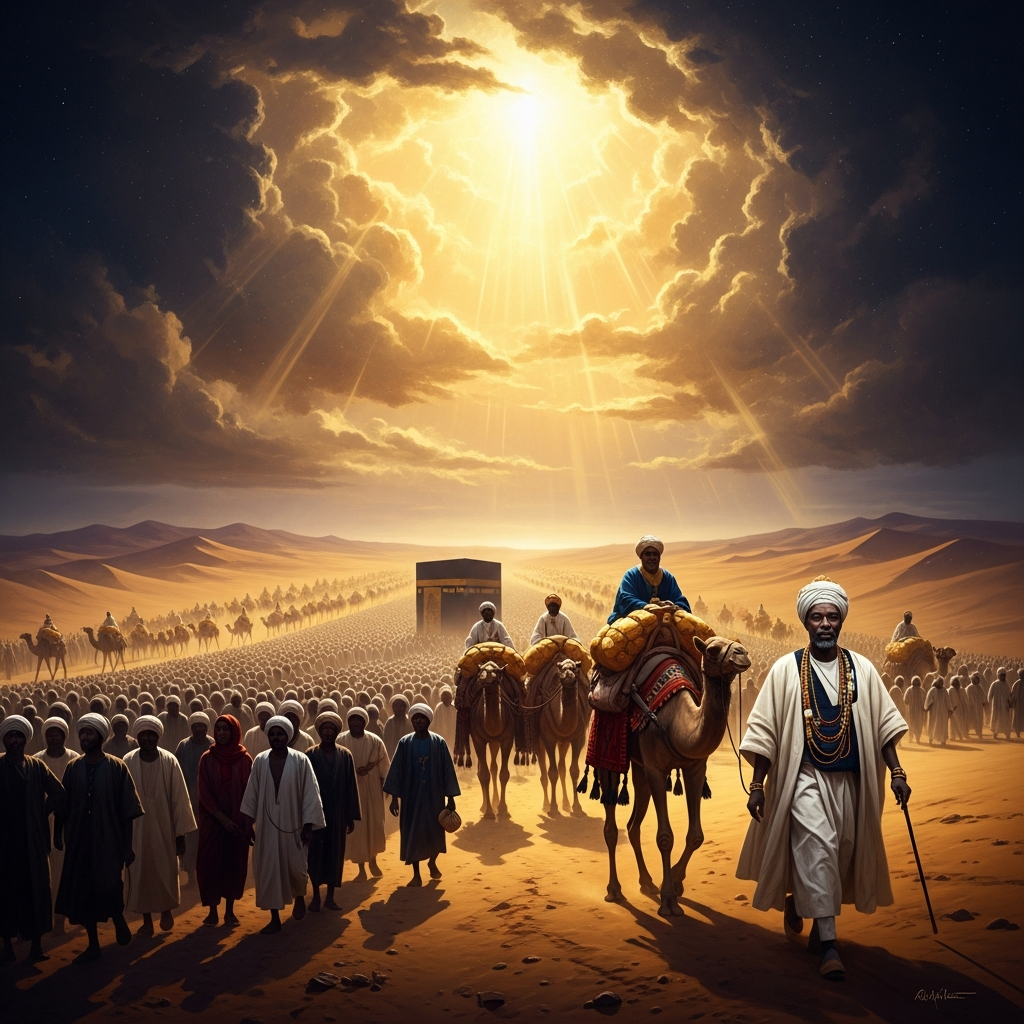
He plans for two years. He sets aside provisions, requisitions camels, organizes a royal regency under his son Maghan, and assembles a retinue that the Arab chroniclers will describe in numbers that have to be slightly compressed to be plausible: sixty thousand people; twelve thousand personal slaves attending the mansa, each carrying four pounds of gold; five hundred servants walking ahead, each with a staff of pure gold weighing six pounds; eighty camels carrying gold dust at three hundred pounds per camel.
The arithmetic produces, conservatively, eighteen tons of gold. The actual figure is impossible to verify — the chroniclers are not auditors and the mansa’s caravan kept moving — but the order of magnitude is right. Mali in 1324 has gold the way modern states have oil, and Musa is bringing his treasury with him because he intends to spend.
The caravan crosses the Sahara through the Taghaza salt mines and the Tuat oases. The journey to Cairo takes nine months. By the time he arrives, news of his approach has preceded him for half a year. Cairo’s markets have been preparing.
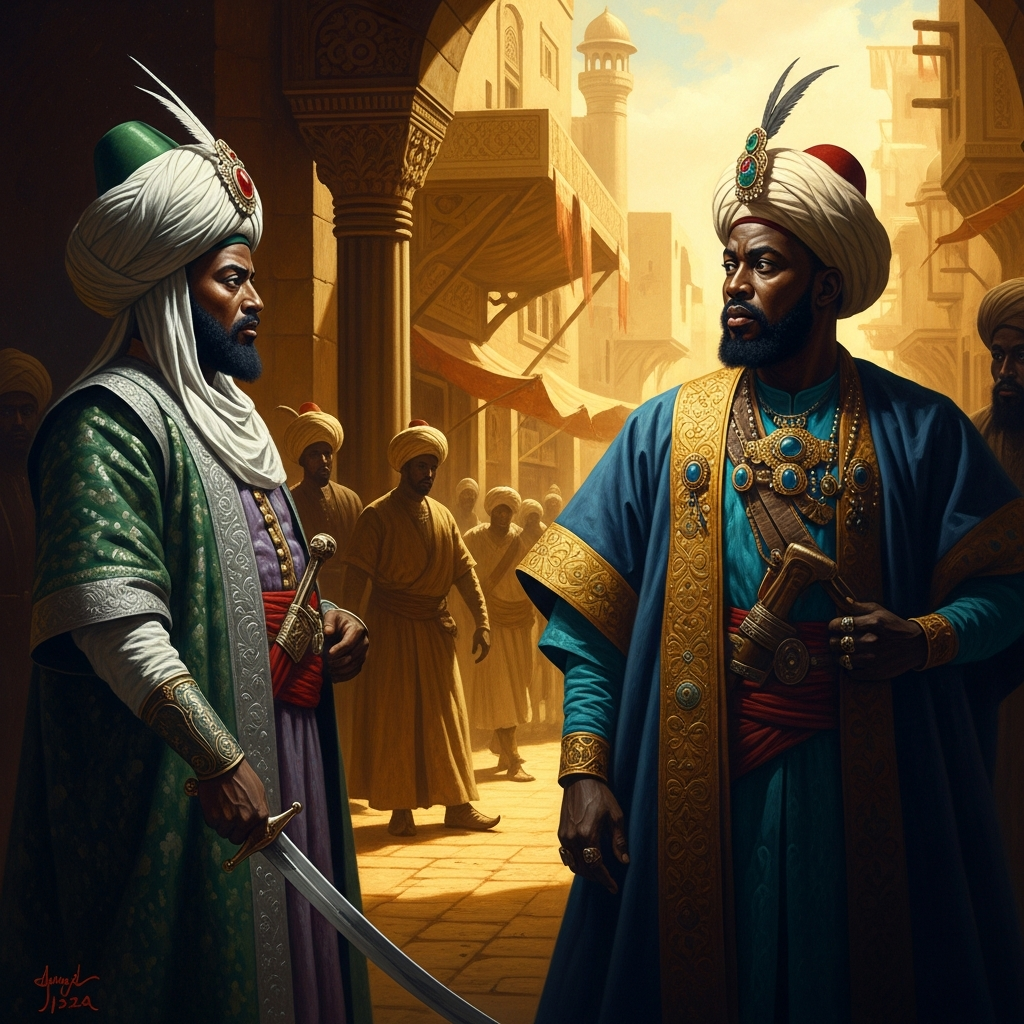
He camps at the foot of the Pyramids. He sends a delegation to the citadel to announce his presence to Sultan al-Nasir Muhammad ibn Qalawun, the Mamluk ruler of Egypt and the most powerful Muslim sovereign of the age. The protocol question is immediate and difficult. By Mamluk tradition every visiting dignitary, however senior, must kiss the ground before the sultan. Musa, as a king in his own right, refuses. He says he will kiss the ground only before God.
The negotiation continues for three days. Musa avoids the citadel. The Mamluk officials are confused — they have hosted kings before, and the protocol has never been an issue. Musa is gracious in every other respect: he sends gifts, he attends Friday prayers at al-Azhar, he visits the tombs of the saints. He just will not bow to the sultan.
The compromise is engineered by an experienced courtier named Ibn Amir Hajib, who proposes that Mansa Musa, on entering the audience hall, prostrate himself before God in the sajda — the ritual prostration of Muslim prayer — and that this prostration be accepted by the sultan as the required obeisance. Musa agrees. The two men meet. They like each other. Ibn Amir Hajib spends the following weeks interviewing Musa about Mali, and his notes will become the most detailed Arabic source on the empire’s structure, a record of which al-Umari and Ibn Khaldun will both make use.
The exchange of gifts is enormous. Musa gives the sultan fifty thousand dinars in gold on the day of the audience, and an additional unknown sum to the senior emirs, and an unknown sum again to the qadis and the imams. He buys gifts from the Cairo markets — Persian textiles, Damascene swords, Egyptian glass, Yemeni perfumes — and pays the asking price without negotiation, which causes the merchants to triple their prices and then triple them again as the news spreads.
He gives gold to every beggar at every shrine. He pays for the qiblas of three new mosques. He sponsors a feast that feeds the entire population of the al-Husayn mosque district for a week. He sends gold to the Cairo waqf foundations, to the Sufi lodges, to the schools that train the children of Mamluk officers in Qur’an. He buys books — many books — and pays scholars to compile them into a portable library.
He pays his entourage’s expenses, every day, in gold.
He is in Cairo for three months on the way to Mecca and another three months on the way back. He is, throughout, distributing gold the way a man with too much water in his hands distributes water — with a certain reckless impatience to be done with the burden.
By the time he leaves the city the price of gold in the Cairo markets has fallen to a fraction of what it was the day he arrived.
The Mamluk economy is built around gold-backed coinage. The dinar is a gold coin. Wages, taxes, contracts, debts, dowries — all of it is fixed in gold. When the supply of gold doubles in three months, the value of every gold-denominated obligation halves. The price of bread rises. The price of cloth rises. The wages of artisans, fixed in gold, no longer buy what they used to buy. Mortgages denominated in gold can be cleared at half cost; lenders are ruined. Tax receipts from the treasury, denominated in dinars, do not buy what they purchased the year before.
The Cairo economy enters an inflationary spiral. The Mamluk treasury attempts to compensate by buying gold at the new low price, hoarding it, and waiting for the supply to normalize — but the supply does not normalize. Musa’s caravan continues to spend on its way out of Cairo and on its return. The hoarded gold, when the treasury tries to release it, drives the price down again.
The chroniclers — al-Umari is most explicit — say the Cairo economy did not fully recover for ten years. Modern economic historians have tried to evaluate the claim. The data is incomplete, but the price series for Cairo grain in the years 1324-1335 are consistent with sustained inflation, and the documentary record in the waqf archives shows multiple foundations renegotiating fixed-gold endowments downward in the 1330s. The order of magnitude of the chroniclers’ claim is approximately correct. One man’s pilgrimage destabilized the most sophisticated currency system in the medieval world.
It was not done deliberately. Musa was not waging economic warfare on Cairo; he was trying to demonstrate Mali’s legitimacy by demonstrating its wealth. He learned, on the return trip, what he had done. The Cairo merchants — some of whom had been ruined — confronted him about the impact of his gift-giving. He responded by borrowing money from them at interest, taking it home to Mali, and repaying it from the next year’s gold receipts. It is the only recorded case in medieval economic history of a sovereign using a loan to manage the inflationary impact of his own previous gift-giving — a primitive but recognizable monetary intervention.
He did not do it again. Subsequent Mali pilgrimages are noticeably more restrained.
In Mecca, Musa performs the hajj. The chroniclers do not have much to say about this part — the rituals are the rituals; everyone does them — but Musa weeps at the Kaaba and gives away another quantity of gold to the Sharifs of Mecca, to the Hashemite families, to the imams of the Haram. He prays at Medina at the tomb of the Prophet. He gives more gold.
He hires scholars. He buys manuscripts — there will be a moment, twenty years later, when Timbuktu houses the largest collection of Islamic manuscripts in sub-Saharan Africa, and the foundation of that collection is what Musa carries home. He persuades, by various means including very large financial inducements, an Andalusian Granadan scholar named Abu Ishaq Ibrahim al-Sahili — known as al-Tuwayjin, the Little Saucepan, for reasons that have not survived — to come back to Mali with him.
Al-Sahili is a poet, a Maliki jurist, and an architect. The architecture is what Musa wants. Mali has built in mud and timber for centuries. There is a regional vernacular called Sudano-Sahelian architecture that produces beautiful and characteristic mosques out of compacted earth, but Musa wants something more permanent, more obviously Islamic, more closely modeled on the great mosques of the Maghrib and Andalusia. Al-Sahili agrees to come for a fee that the chroniclers report as twelve thousand mithqals of gold, which is approximately a year’s tribute from a small kingdom.
In Mali, al-Sahili builds the first fired-brick buildings in the central Sudan. He designs the audience-hall in Niani that is described by later visitors as a domed structure with stained-glass windows. He designs the great mosque at Gao. Most importantly, he designs the Djinguereber — the Great Mosque of Timbuktu — whose foundation Musa lays after his return and whose mud-brick walls (later restored repeatedly, but on the original plan) still stand.
Timbuktu, before Musa’s hajj, is a market town. After Musa’s hajj, with the new mosques and a stipend for visiting scholars, it begins the transformation that will eventually make it, by the sixteenth century, the most important center of Islamic scholarship in West Africa, with a university at the Sankoré Mosque holding twenty-five thousand students at its peak.
He returns to Niani in 1325. He reigns for another twelve years and dies in 1337.
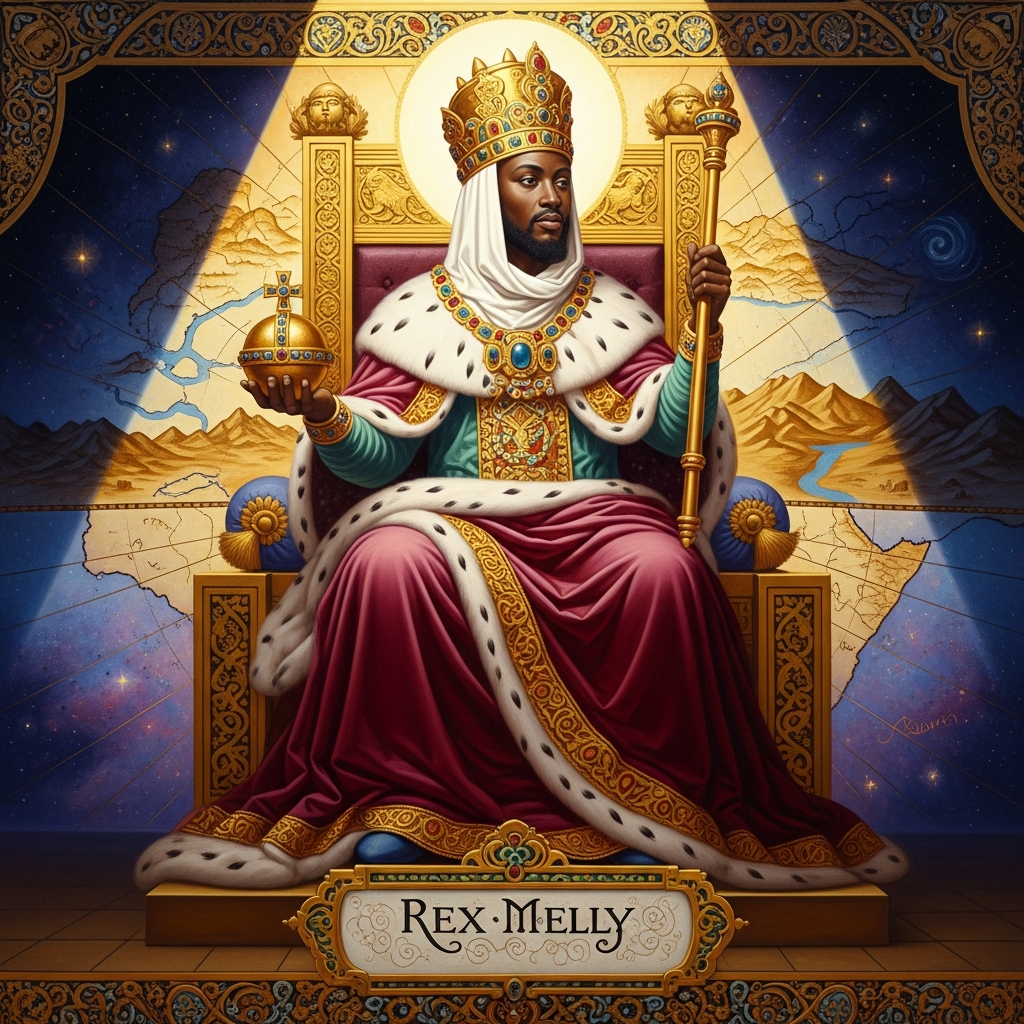
He has been visible to the world. The Cairo chroniclers have written him into the canon of Mamluk-era court history. Genoese and Florentine merchants, working off the same sources, have begun mapping Mali. In 1339 the cartographer Angelino Dulcert puts Mali on a map for the first time in European cartography. In 1375 Cresques Abraham, working in Majorca for the Crown of Aragon, produces the Catalan Atlas — the most beautiful European map of the medieval period — and at its center, in West Africa, sits a crowned figure on a throne, gold nugget in hand, dominating the southern half of the African continent.
The legend reads: This negro lord is called Musa Mali, lord of the negroes of Guinea. So abundant is the gold which is found in his country that he is the richest and most noble lord in all this region.
He has been dead for nearly forty years. The map is being copied across Europe, used to plan trade routes, hung in the halls of Castilian and Aragonese kings. Two centuries before the Portuguese round the Cape, Europe knows that there is a king in the African interior whose gold supply is essentially unlimited, and the search for the route that will bypass the Saharan caravans and reach his treasury directly is one of the principal motivations behind the Portuguese exploration of the African coast.
The hajj has done its work.
The pilgrim went to Mecca to discharge a religious obligation. He returned having put his country on the map of the world and having underwritten the first generation of mosques and madrasas that will, over the next two centuries, make Mali a recognized center of Islamic civilization.
It was not the largest hajj of the medieval period — the annual hajj caravans from Damascus and Cairo were comparable in size — but it was the most consequential. The fifth pillar, undertaken once in a lifetime, became in Mansa Musa’s hands a single instrument that simultaneously fulfilled a personal religious duty, demonstrated the legitimacy of an African Muslim empire to the rest of the umma, recruited the human capital needed to deepen Mali’s Islamic infrastructure, depressed the Egyptian economy for ten years, and inscribed sub-Saharan Africa onto the European cartographic imagination as a place of overwhelming wealth.
It was the most expensive hajj in human history. It was also the most efficient. He performed every required ritual. He kept moving. He came home.
Scenes
Spring 1324
 Generating art…
 July 1324
Generating art… 1375
 Generating art…
 Echoes Across Traditions
Entities
- Mansa Musa I (Musa Keita)
- al-Nasir Muhammad ibn Qalawun (Mamluk Sultan of Egypt)
- Abu Ishaq al-Sahili (Andalusian poet, jurist, and architect)
- the pilgrimage retinue of sixty thousand
- Ibn Amir Hajib (Mamluk court official who interviewed Musa)
Sources
- Ibn Khaldun, *al-Muqaddimah* (1377) — the most important Arabic source on Mansa Musa, recording interviews conducted in Cairo
- al-Umari, *Masalik al-Absar fi Mamalik al-Amsar* (c. 1340) — the Mamluk court chronicler who recorded eyewitness accounts of Musa's stay in Cairo
- Ibn Battuta, *Rihla* — visited Mali in 1352, eight years after Musa's death, under the reign of his brother Mansa Sulayman
- Nehemia Levtzion, *Ancient Ghana and Mali* (Methuen, 1973; Africana, 1980)
- Michael A. Gomez, *African Dominion: A New History of Empire in Early and Medieval West Africa* (Princeton, 2018)
- John Hunwick, *Timbuktu and the Songhay Empire* (Brill, 1999)
- Catalan Atlas (Cresques Abraham, 1375) — the famous map showing Mansa Musa enthroned, gold nugget in hand