The Rihla: Twenty-Nine Years and 75,000 Miles
1325-1354 CE (the journey); dictated 1355 CE in Fez · Tangier, Morocco → Mecca → Constantinople → Mali → India → China → Mali again — covering most of the 14th-century Islamic world
Contents
In 1325 CE a twenty-one-year-old judge from Tangier sets out on the hajj and does not come home for twenty-nine years. Ibn Battuta crosses the Sahara to Mali, sails to the Swahili coast, reaches India and China and the Crimea, and dictates the *Rihla* — 75,000 miles of the 14th-century Islamic world recorded by the man who could not stop traveling.
- When
- 1325-1354 CE (the journey); dictated 1355 CE in Fez
- Where
- Tangier, Morocco → Mecca → Constantinople → Mali → India → China → Mali again — covering most of the 14th-century Islamic world
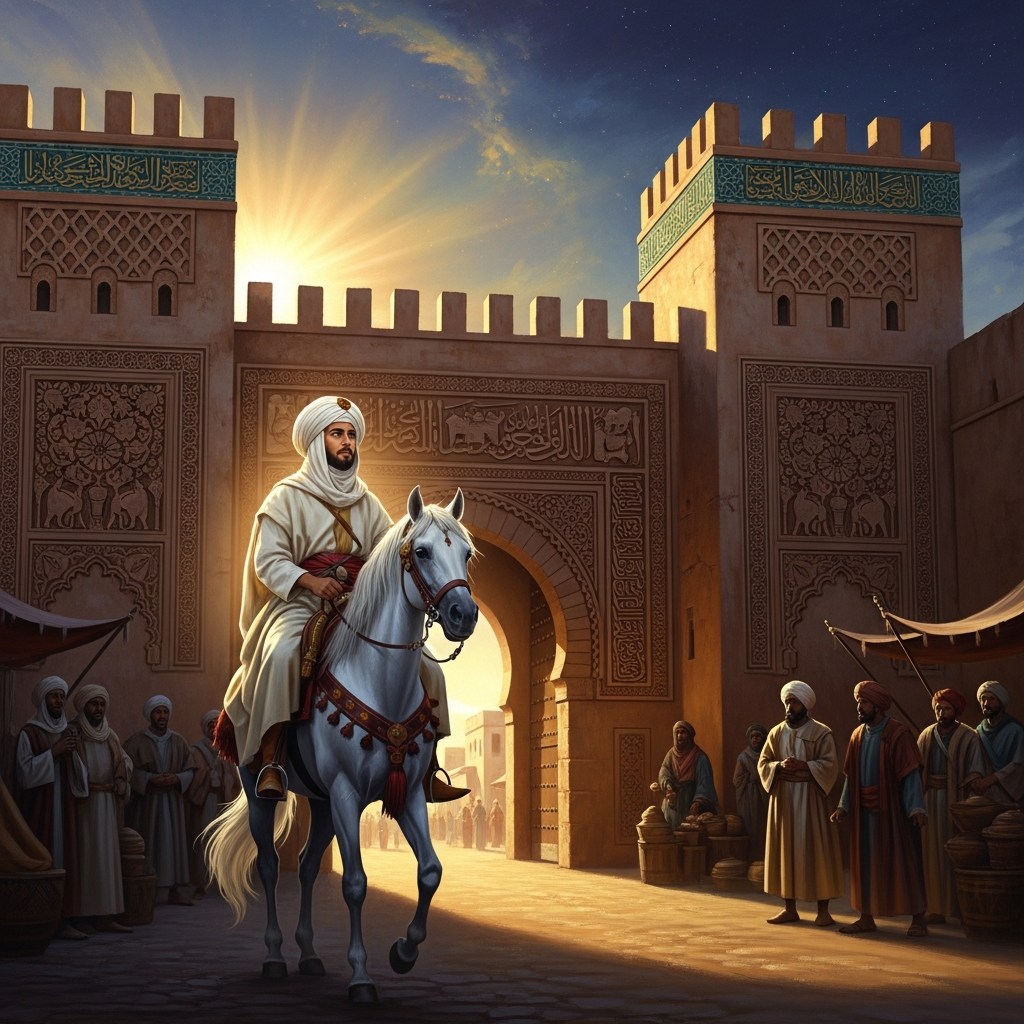
He leaves Tangier on the second of Rajab, in the year 725 of the hijra — June 1325 in the Christian calendar — and he is twenty-one years old.
He has memorized the Qur’an. He has studied the Maliki school of Islamic law. He has been raised in a family of judges, expects to become one himself, and has decided that before he settles into the life of a Moroccan magistrate he will perform the hajj. He does what every educated young Muslim of his time considers the proper preparation for adulthood: he sets out for Mecca.
He carries very little. He travels alone. He does not say goodbye to his parents, and he will write later that this is the moment he weeps — not at any subsequent danger, not at any later loss, but here, at the gate, when he realizes that he is leaving the people who raised him without their blessing on the journey.
He will not see them again. By the time he returns, both of his parents are dead.
He follows the North African coast east. Tlemcen. Algiers. Bijaya. Tunis. He joins a caravan because the road is dangerous, and the caravan is led by an old man who teaches him to ride a camel without falling off, which Ibn Battuta has not previously had occasion to learn.
In Tunis he is sick with fever and lonely enough that he weeps. A merchant takes pity on him. He continues.
By the time he reaches Alexandria he has been on the road for eight months. He has covered perhaps two thousand miles. He thinks of himself as far from home — and he is, by every measure of his Moroccan upbringing — but he has not yet understood what distance is. He is about to learn.
In Cairo he meets a holy man named Burhan al-Din the Lame, who looks at him and says: I see you love to travel through foreign lands. You will visit my brother Farid al-Din in India. You will visit my brother Rukn al-Din in Sind. You will visit my brother Burhan al-Din in China. Give them my greetings.
Ibn Battuta laughs, then stops laughing, then says: I will.
He performs the hajj at Mecca in the autumn of 1326. He could go home. The obligation is fulfilled. The journey has done what it was meant to do.
He does not go home. He stays in Mecca for a year, then goes to Iraq, then back to Mecca, then to East Africa, then to Yemen, then back to Mecca for a third pilgrimage. The hajj has converted him. Not to Islam — he was already Muslim. To the road. To the proposition that the world itself is a place he has been given a license to explore, and the license is the universal hospitality the Islamic world owes to a hajji and a scholar of the law.
He uses the license without hesitation.
In Anatolia he is taken in by an organization he has never heard of: the akhi brotherhoods, religious craftsmen’s guilds who feed and lodge any Muslim traveler who enters their town. They compete for him. Two brotherhoods nearly come to blows over which one will host him. He stays a week with each, then moves on, astonished at a culture in which the obligation to a stranger is so total that the city’s young men will fight for the privilege of paying his expenses.
He crosses the Black Sea. He visits the Crimean Khanate. He travels with the Khan’s wife — a Byzantine princess named Bayalun — back to Constantinople so she can give birth at her father’s court, and Ibn Battuta becomes briefly an attaché on a Byzantine diplomatic mission, an experience for which his legal training in Tangier has prepared him not at all.
In Constantinople he meets the Emperor Andronikos III. He sees the Hagia Sophia from the outside, declines to enter because he would have to bow to the Christian altar, and is shown the relics by a Byzantine guide who explains them with patient professionalism. He notes everything. He always notes everything.
He returns to the steppe. He crosses Central Asia. He arrives in India.
Sultan Muhammad bin Tughluq of Delhi is, in 1334, the most powerful Muslim ruler in the world and the most dangerous. He is a brilliant man with a streak of cruelty that has no bottom. He hires foreign scholars and judges by the hundred, pays them extravagantly, and executes them on a whim.
He hires Ibn Battuta.
For seven years Ibn Battuta serves as a qadi — a Maliki judge — at the Tughluq court. He grows rich. He marries. He has children. He watches the Sultan execute friend after friend, scholar after scholar, on charges that change every week. He keeps his head down. He keeps his head, period, which in Tughluq’s Delhi is an accomplishment.
In 1341 the Sultan sends him as ambassador to the Yuan court in China. The mission is a disaster — shipwrecks, mutinies, pirates, the loss of the official letters and gifts — and Ibn Battuta, separated from the embassy, decides on his own initiative to continue to China through Bengal and the Maldives.
In the Maldives he becomes a qadi again. He marries the queen’s sister. He tries to enforce Maliki law on a people who have been Muslim for two centuries but have their own way of doing things, and he is asked, politely, to leave.
He sails to Sumatra. He sails to China. He reaches Quanzhou — Marco Polo’s Zaitun — and finds the Muslim quarter, the Friday mosque, the Sufi lodges, all the institutions of the dar al-Islam operating thirteen thousand miles from Mecca. He delivers the greeting from Burhan al-Din the Lame to Burhan al-Din the brother in China. The man is real. The prophecy in Cairo, fifteen years earlier, has been fulfilled.
He turns around. He goes home.
It takes him three years.
He reaches Tangier in November 1349, in the middle of the Black Death. His mother has died of plague the month before. His father has been dead for fifteen years.
He stays a few weeks. Then he leaves again.
He crosses the Strait to Andalusia. He fights briefly in the defense of Gibraltar. Then he goes south, across the Sahara, to Mali, because he has heard about it for thirty years and has not yet seen it.
In Walata, the first Mali town across the Sahara, he is appalled. The women go unveiled. They have male friends openly. A man’s heir is his sister’s son, not his own. He scolds his hosts and is laughed at.
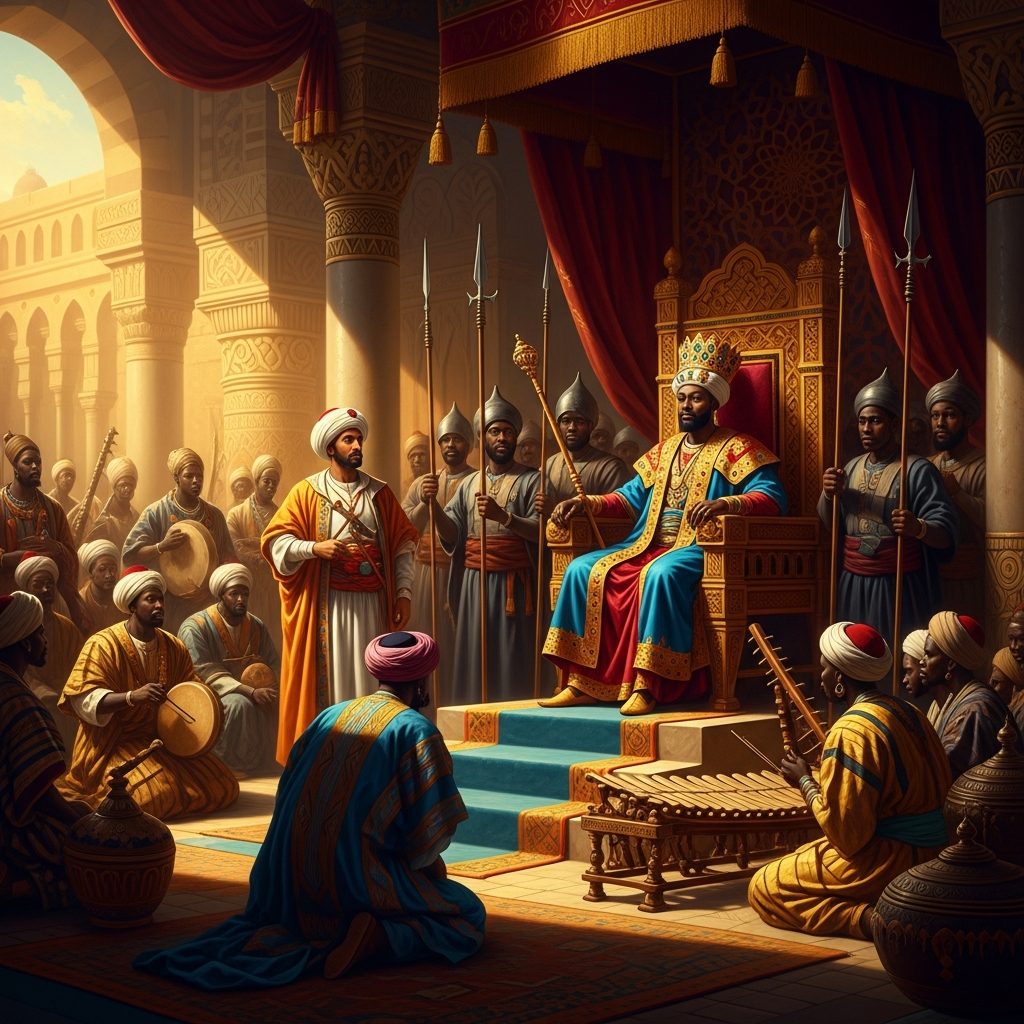
In the capital, at the court of Mansa Sulayman, he watches the king’s audience: the courtiers crawl forward and pour dust on their heads as a sign of submission. The poets perform in feathered costumes that Ibn Battuta finds undignified. The royal women are present, and the conversation is more open than anything in the Maghrib.
He notes everything. He criticizes — but precisely, in detail, with examples — and he praises also: the public security (“there is no fear of robbers in their country”), the punctuality of prayer, the diligence with which the children are made to memorize the Qur’an, the lack of injustice, the prosperity. He is the first Arab observer to document Mali from the inside, and his account is, despite every cultural complaint, fundamentally admiring.
He goes home.
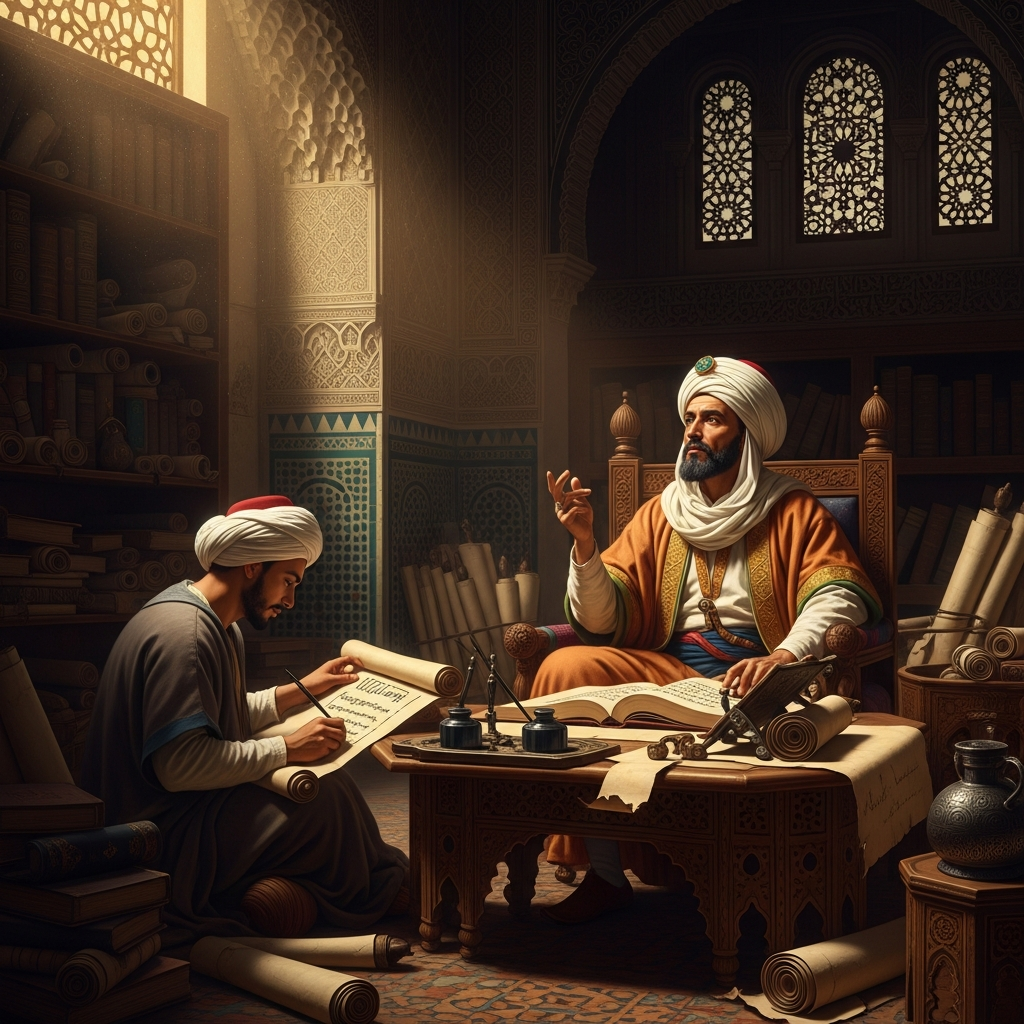
In Fez, in 1355, the Marinid sultan Abu Inan Faris commands him to dictate his travels. The sultan assigns a court secretary — Ibn Juzayy of Granada, a literary stylist who has fled the Reconquista — to take the dictation and shape it into a proper Arabic book.
Ibn Battuta talks. Ibn Juzayy writes. They work for two years.
The result is the Rihla, the Journey, formally titled A Gift to Those Who Contemplate the Wonders of Cities and the Marvels of Travelling. It runs to four volumes in modern translation. It describes some forty-four modern countries. It is the most detailed first-person account of the 14th-century world ever assembled, and it survives by accident — the original manuscript is lost, then rediscovered in fragments in Algeria during the French colonial period, reassembled, edited, translated, and finally published in full only in the twentieth century.
Ibn Battuta retires to a judgeship in a Moroccan town whose name we are not certain of. He dies, probably in 1368 or 1369, at about sixty-five.
He has covered seventy-five thousand miles. He has visited every country with a Muslim ruler in his lifetime, several of them twice. He has met sixty kings. He has performed the hajj five times. He has been married at least ten times, fathered children on three continents, and survived a shipwreck, a pirate attack, a plague, three coronations, and the homicidal whims of Muhammad bin Tughluq.
He set out for Mecca.
He kept going.
The hajj that was supposed to take a year took twenty-nine, and produced the most comprehensive map of the medieval world that any single human being has ever made — a map drawn by a man who was, until he stepped through the gate of Tangier in 1325, a perfectly ordinary young judge with no reason to be anything else.
Scenes
Ibn Battuta leaves the gates of Tangier at twenty-one, not knowing he will not return for twenty-nine years
Generating art… At the court of Mansa Sulayman in Mali, Ibn Battuta notes the formalities with diplomatic precision — the protocols of greeting, the gold dust scattered on the king's head, the women he is shocked to see going unveiled
 Generating art…
 In Fez, dictating the *Rihla* to Ibn Juzayy, Ibn Battuta reconstructs thirty years of memory into the greatest travel account in Islamic literature
 Generating art…
 Echoes Across Traditions
Entities
- Muhammad ibn Battuta
- Ibn Juzayy (the Granadan court scribe who edits the Rihla)
- Mansa Sulayman of Mali
- Sultan Muhammad bin Tughluq of Delhi
- the sultans of the Maldives and Ceylon
Sources
- Ibn Battuta, *Rihla* (*A Gift to Those Who Contemplate the Wonders of Cities and the Marvels of Travelling*), dictated to Ibn Juzayy 1355 CE — full English translation by H.A.R. Gibb and C.F. Beckingham, 4 vols. (Hakluyt Society, 1958-2000)
- Ross E. Dunn, *The Adventures of Ibn Battuta: A Muslim Traveler of the 14th Century* (University of California Press, 1989; rev. 2012)
- Tim Mackintosh-Smith, *Travels with a Tangerine: A Journey in the Footnotes of Ibn Battuta* (John Murray, 2001)
- David Waines (ed.), *Patterns of Everyday Life* — Variorum collection on Ibn Battuta's social world (Ashgate, 2002)
- Said Hamdun and Noël King, *Ibn Battuta in Black Africa* — focused translation of the Mali and Swahili sections (Markus Wiener, 1994)