The Baal Shem Tov Finds the Sparks in the Market
Podolia (present-day Ukraine), c. 1740-1760 CE · Podolia and Volhynia, Polish-Lithuanian Commonwealth (present-day Ukraine)
Contents
Israel ben Eliezer, the Baal Shem Tov — Master of the Good Name — teaches Hasidism's foundational insight: the divine sparks scattered by the shevirat ha-kelim are not waiting in the study house or the synagogue. They are in the market, in the tavern, in the drunk singing to himself in the mud. The purpose of prayer is not to ascend to God but to raise the sparks where you are already standing.
- When
- Podolia (present-day Ukraine), c. 1740-1760 CE
- Where
- Podolia and Volhynia, Polish-Lithuanian Commonwealth (present-day Ukraine)
He stops in the middle of the market.
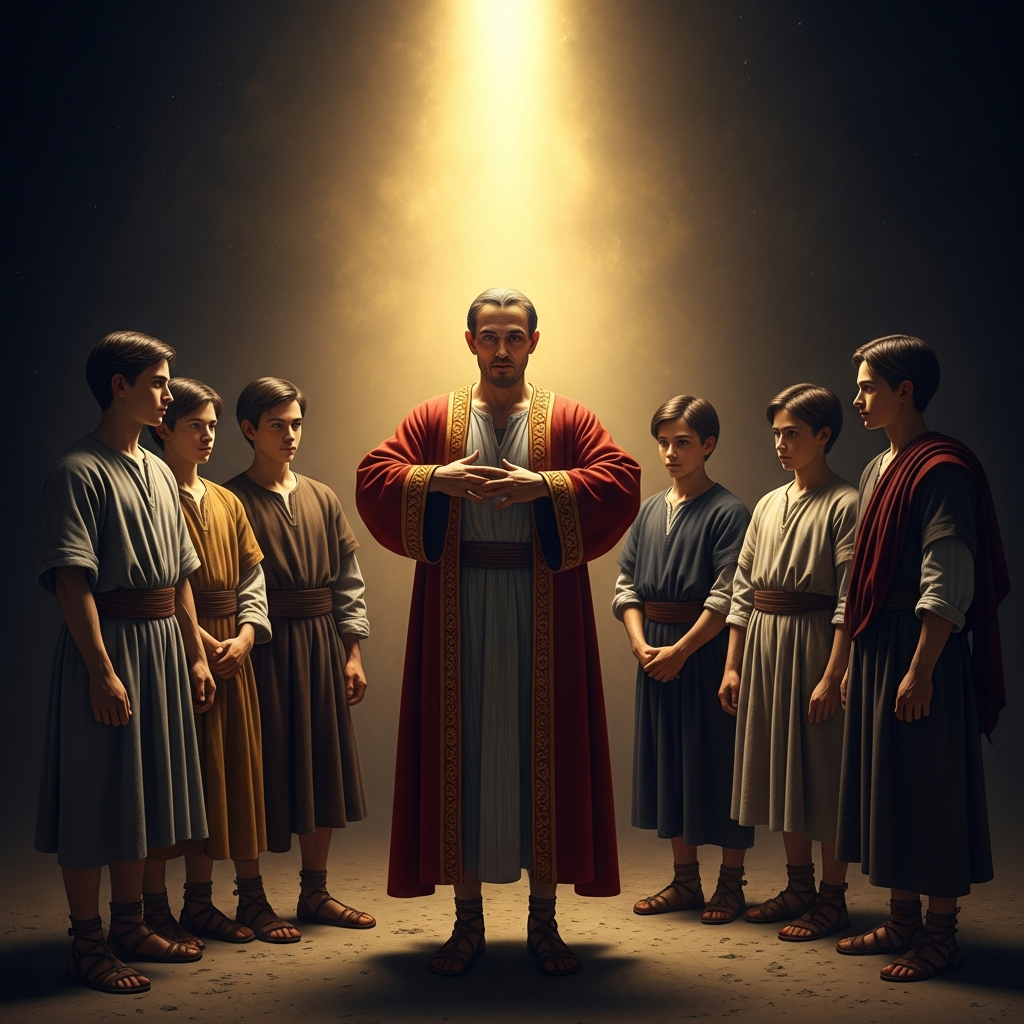
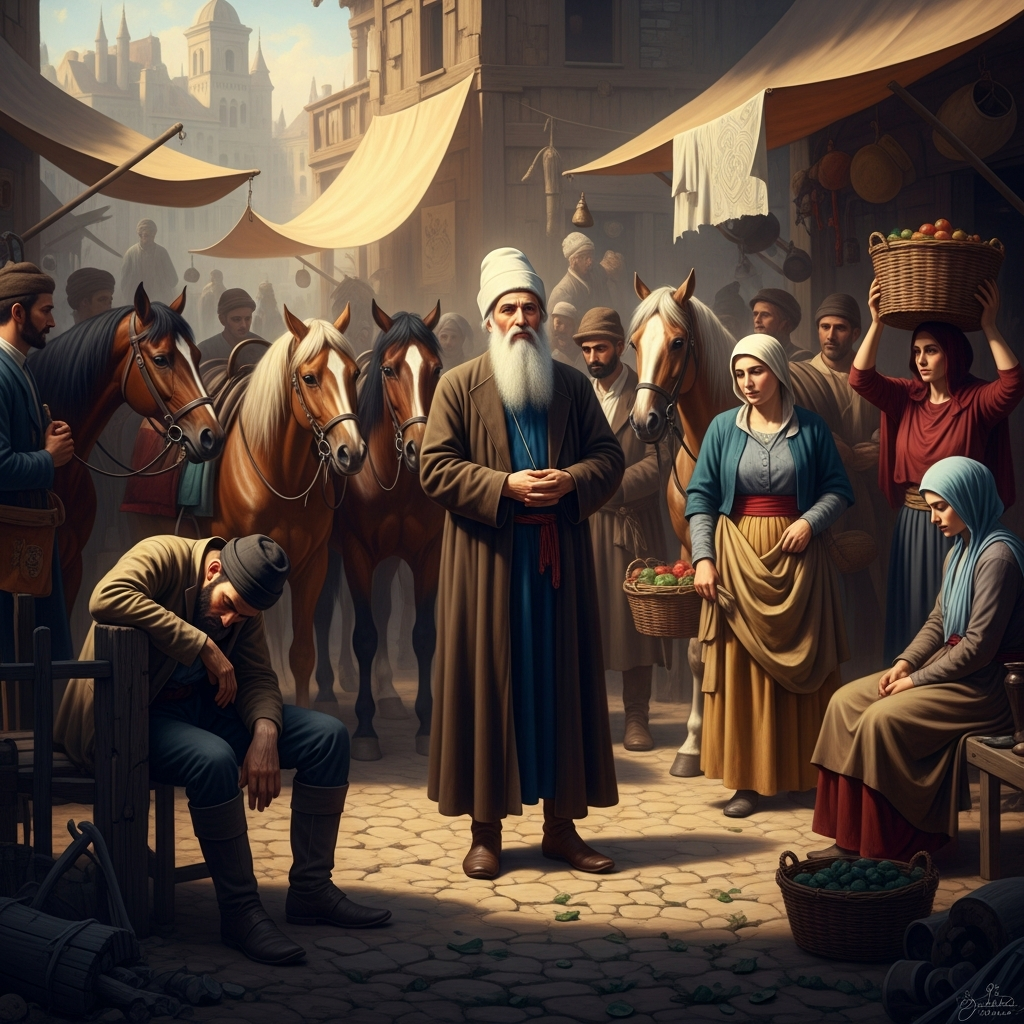
There is nothing to see here that could explain the stopping. A stall selling radishes. A cart of timber blocking the narrow lane between the buildings. Two women arguing about the price of linen. A horse that has not been fed today and knows it. The Baal Shem Tov stands in the middle of all of this with his eyes half-closed and his hands slightly open at his sides, and his disciples, who have learned not to interrupt these moments, arrange themselves in a loose circle around him to keep people from walking into him.
His disciple Yaakov Yosef of Polonnoye, who will later write the Baal Shem Tov’s teachings down, looks at the radish stall, at the cart, at the women, at the horse, and sees nothing. He makes a note to himself that he is missing something.
The Baal Shem Tov opens his eyes. He says: right there. That woman. Do you see it?
One of the women has stopped arguing. She is holding the linen up to the light to test its weave, and the light is coming through the threads in a way that is also coming through her face. She is attending to the linen with complete attention, and the complete attention is briefly identical to something else.
The Baal Shem Tov says: a spark. Every act of genuine attention lifts a spark. She does not know it. It does not matter that she does not know it.
The teaching he is giving, in the market and in the forest and in the taverns and in the study house when he is compelled to enter one, goes back to Luria and forward beyond anyone present. The Ein Sof contracted. The vessels shattered. The sparks of divine light fell into the husks of the lower world, the kelipot, and are imprisoned there, waiting. The repair, the tikkun, proceeds through human acts that free them.
But where Luria’s system had always implied that the process of liberation required expertise — the right prayers, the right intentions, the meditative techniques of the Lurianic yihudim — the Baal Shem Tov is teaching something else. The sparks are not primarily in the Torah text. They are not primarily in the synagogue. They are in the market. They are in the timber cart and the horse that has not been fed and the women arguing about linen. The husks that imprison the sparks are the surfaces of ordinary things, and the act of truly seeing those ordinary things — attending to them with genuine presence rather than moving through them in the distracted rush of the ordinary day — cracks the husks and frees what is inside.
Yaakov Yosef writes: the master teaches that a person should not say, I will go to the mountains to be close to God. For God is equally in the city and in the mountains, in the lowliest place and in the highest. The person who seeks God in only one place has already lost God in all the others.
The drunk at the tavern is a particular problem for everyone who is not the Baal Shem Tov.
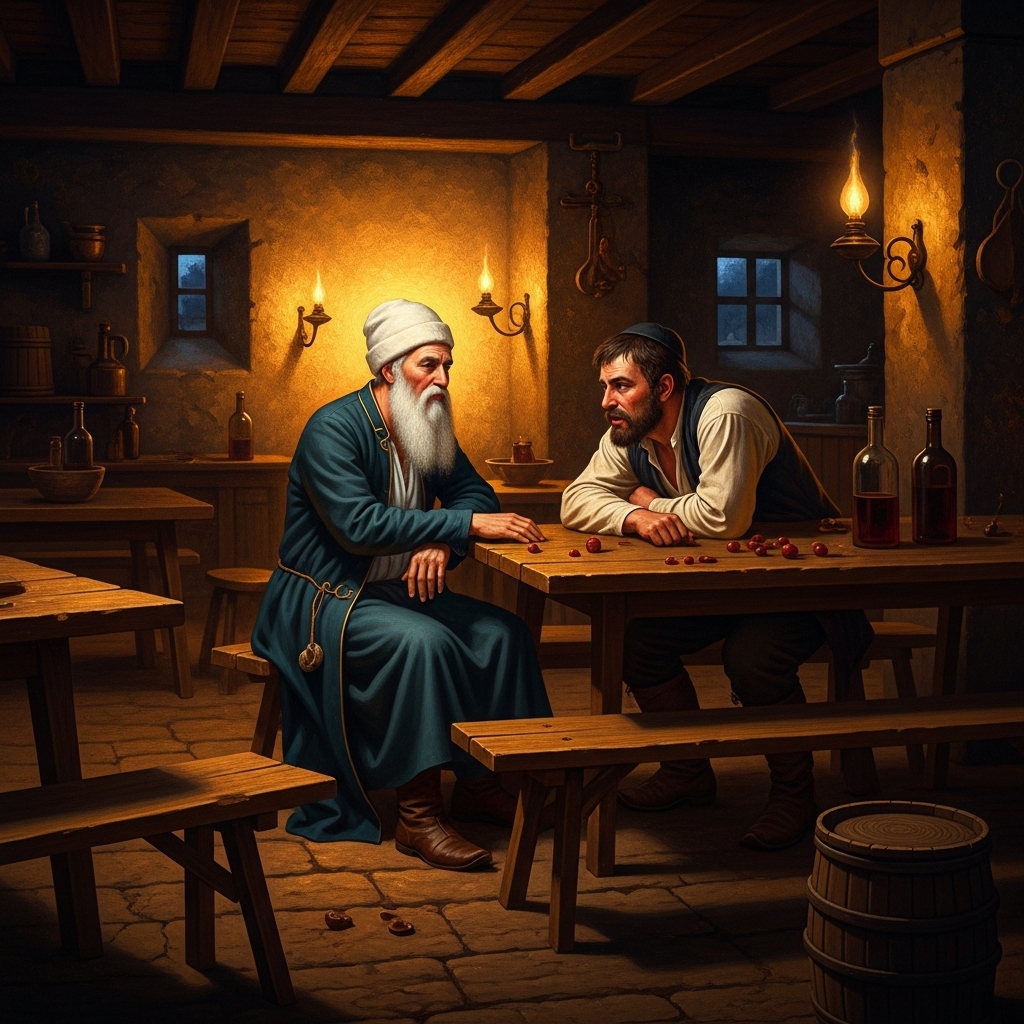
His name is Moishe or perhaps Shmuel — the disciples remember it differently — and he is sitting against the tavern wall at eleven in the morning having begun his day’s drinking at eight, and he is singing. The song is not in any language the disciples recognize. It might be a corrupted version of a Ukrainian folk melody, or it might be something he has invented, or it might be, as he himself seems to believe, a song that was given to him and that he is now returning to where it came from.
The disciples see a drunk. They see a person who is the opposite of the ascetic ideal, a person whose relationship to the Torah is so attenuated that he cannot be expected to know the basic prayers, a person who is wasting his one life on the floor of a tavern in Podolia. They see someone they would prefer the master not to speak to.
The Baal Shem Tov sits down next to him.
He does not try to sober him. He does not lecture him about the Torah. He listens to the song. After a few minutes he says: that is a beautiful song. Where did you learn it?
Moishe-or-Shmuel looks at him sideways. He says: nobody teaches you that kind of song. It just comes.
The Baal Shem Tov says: everything that comes from somewhere is still connected to where it came from. The song is still attached to its source. Do you understand?
The man clearly does not understand. He also clearly has not been spoken to with this quality of attention in a very long time. Both things are visible in his face simultaneously.
In the forest, where he goes before dawn, the Baal Shem Tov prays differently.
In the city the prayer is a matter of raising what is already present — the sparks in the faces of the women at the linen stall, the spark in the song of a drunk, the spark in the argument itself, which is a form of caring. In the forest the prayer is a matter of being raised by what is already there. The trees, which have been growing for longer than anyone in Podolia has been alive, are full of sparks that have never been imprisoned because they have never been ignored. The forest does not pretend to be what it is not. It does not rush. It does not perform.
He stands with his arms out and his face up and prays with the kind of full-body attention that his disciples will later call devekut — cleaving, the mystical adhesion to God that the tradition holds as the highest state of human consciousness — and which he teaches is available not only to the scholar in the study house but to the farmer in the field and the merchant in the market and the drunk in the tavern. Devekut is not a reward for expertise. It is what happens when you pay complete attention to the present moment and the present moment pays complete attention back.
His disciples cannot quite do what he does in the forest. They can see the quality of his attention from outside it, the way you can see someone asleep from outside their dream. But they cannot enter it.
He does not tell them they are doing anything wrong. He says: you are at the beginning. That is exactly where you should be.
The theology he is constructing, in the market and the tavern and the forest, has no systematic treatise. He does not write. He does not like writing. Writing, he believes, reduces the teaching to what can be written, and what can be written is always less than the teaching. His disciples will write everything down after he is gone, and the writing will be accurate and will miss the point and will also be essential, which is exactly what he would have predicted.
What they record is this: that the divine light is not somewhere other than where you are. That the exile of the sparks is not a cosmic accident waiting for cosmic repair. That the repair happens here, in the body, in the market, in the act of genuine attention to whatever is present. That prayer is not a ladder you climb to reach God but a quality of presence you bring to where you already stand. That God is not up or in or beyond but — here the language strains, here the disciples note that the master pauses for a long time — present in the attention itself. The light looking. The spark recognizing the spark.
The woman at the linen stall does not know she has lifted something.
The drunk does not know his song is attached to its source.
The horse, being a horse, has no relationship to the question.
The Baal Shem Tov watches all three of them with the same quality of attention and sees, in each, the same thing: the Ein Sof, which could not stop being present even when the vessels shattered, still here, scattered across the market, waiting not for the scholars to find it but for anyone paying close enough attention to look.
Israel ben Eliezer died in 1760 in Medzhibozh. His disciples numbered in the thousands. Within a generation of his death, Hasidism had spread across Eastern Europe and become the dominant form of Jewish life in Poland, Ukraine, and Galicia, transforming the practice of Judaism from the village level up.
He left no written teaching. What survives is what his disciples wrote about what they remembered. The teaching, which holds that genuine attention lifts sparks and that the divine is present in the ordinary, is itself preserved in exactly the form he would have been suspicious of: text, which can be read without attention, which can be learned without the learning changing anything.
He knew this. He taught anyway.
Scenes
The Baal Shem Tov in a Podolian market, surrounded by horses, merchants, women with baskets, a drunk asleep against a fence post
 Generating art…
 Interior of a Ukrainian tavern, lamplight on rough wooden tables
 Generating art…
 Israel ben Eliezer alone in the Carpathian forest, arms outstretched, face upturned, in the posture of ecstatic prayer
 Generating art…
 Echoes Across Traditions
Entities
- Israel ben Eliezer
- the Baal Shem Tov
- the Nitzotzot
- Devekut

Sources
- Gershom Scholem, *Major Trends in Jewish Mysticism* (Schocken Books, 1941)
- Martin Buber, *Tales of the Hasidim*, 2 vols. (Schocken Books, 1947-1948)
- Moshe Idel, *Hasidism: Between Ecstasy and Magic* (SUNY Press, 1995)
- Arthur Green, *Radical Judaism: Rethinking God and Tradition* (Yale University Press, 2010)
- Elie Wiesel, *Souls on Fire: Portraits and Legends of Hasidic Masters* (Random House, 1972)