
The Baal Shem Tov and the Sparks in Every Thing
Polish-Lithuanian Commonwealth · c. 1698–1760 CE; the public ministry primarily 1736–1760 · Medzhybizh, Podolia (present-day western Ukraine) — a market town of about two thousand Jews on the Bug River, on the contested frontier between Polish nobility, Cossack hetmanates, and the receding edge of the Ottoman Empire
Contents
In the Carpathian forests in the 1730s, a village healer named Israel ben Eliezer begins teaching that the divine sparks live in everything — in dirt, in drink, in the gesture of the hand — and that an unlettered peasant's ecstatic prayer reaches God before the rabbi's most precise grammatical parsing.
- When
- Polish-Lithuanian Commonwealth · c. 1698–1760 CE; the public ministry primarily 1736–1760
- Where
- Medzhybizh, Podolia (present-day western Ukraine) — a market town of about two thousand Jews on the Bug River, on the contested frontier between Polish nobility, Cossack hetmanates, and the receding edge of the Ottoman Empire
He is in the forest before sunrise.
This is where the story begins, in the Carpathian foothills somewhere outside the village of Okopy, in the first decades of the eighteenth century, in the practice of a young man named Israel ben Eliezer who has not yet become anybody. He is an orphan. He is poor. He is by some accounts unlearned — he can read, he knows the prayers, but he is not a Talmudic scholar of the kind the Polish-Lithuanian Jewish world recognizes as serious. He works as a melamed, a children’s teacher, and as a digger of clay, and as a ritual slaughterer, and as the assistant in a small tavern. He is the kind of person the Jewish establishment does not notice.
In the forest, before sunrise, he is doing something the establishment also does not notice. He is praying alone. Not in a synagogue, not with a quorum, not with a prayer book — alone, on the forest floor, with the firs above him and the cold ground beneath him, talking to God. The tradition will later call this hitbodedut, deliberate solitude, and identify it as a foundational practice of the new movement. At this point it is what an unschooled village healer does because he has nowhere else to go and nothing else to do.
He is, by the time he is in his thirties, claiming visitations. He says — to the tiny group of disciples who have begun to gather around him — that the soul of the prophet Ahijah the Shilonite, the same Ahijah who appeared to Jeroboam in 1 Kings, has become his teacher. That his soul ascends in the night to the heavenly academies. That he has spoken with the soul of the Messiah, who has told him that the Messiah will come when your wellsprings are spread to the outside — when what he is teaching reaches the Jews who do not yet know they need it.
This is an enormous claim. The rabbinical establishment has a name for it: messianic enthusiasm. The last Jew who made a comparable claim was Sabbatai Zvi in 1666, and Sabbatai Zvi converted to Islam under threat of execution from the Ottoman sultan, and his followers — the Sabbatean underground — are still, in the 1730s, regarded by the rabbinical establishment as the most dangerous heresy in Jewish life. To make a claim adjacent to Sabbatai Zvi’s, in the wrong room in the wrong town, is to invite excommunication.
The BeSHT makes the claim anyway. He makes it in private letters, in conversations with disciples, in remarks delivered offhandedly between stories.
The teaching, when he gives it, has the form of a story.
This is the first thing his disciples notice — the second thing being that he never quite gives the teaching the same way twice. He teaches by parables. A man who is too proud of his own learning is the king who hired a tailor and the tailor stitched the suit so beautifully that the king could no longer fit through the palace door. A man who cannot pray well is the boy with the flute in the synagogue on Yom Kippur, whose flute the father slapped down — but the gates of heaven would not open until the boy was permitted to play, because the boy’s flute was what they had been waiting for. A man who is searching desperately for God is the king’s son in the foreign country who could not remember his own language, until he heard one word of his native tongue spoken in the marketplace and ran toward it weeping.
The stories are not decorative. They are the teaching. They are the way the teaching travels — in carter’s wagons, in tavern conversations, in the recollections of disciples who do not write things down but who repeat what the master said, who repeat it to other disciples, who repeat it to their children, until the stories become the inheritance of an entire civilization.
What the stories teach, reduced to a doctrine they were not designed to be reduced to, is something like this:
God is in everything. There is no place where God is not. The divine sparks — nitzotzot, the term inherited from Lurianic Kabbalah — are scattered throughout creation, fallen into matter at the moment the divine vessels broke, waiting to be recognized and lifted back. To eat a piece of bread with attention is to lift its sparks. To drink a glass of vodka in the right spirit is to lift its sparks. To dance with full intention at a wedding is to lift sparks that the most learned scholar’s reading of Talmud cannot reach. The divine project is not the production of more learning; it is the recovery of the sparks. Every Jew, every act, every moment is a potential lifting.
Joy is not optional. Sadness, the BeSHT says — and his disciples write this down because it is the inversion of everything Eastern European Judaism has come to assume — is the gate the Adversary uses. The depressive, ascetic, fast-too-much, study-too-late, tear-your-clothes-in-mourning Judaism that has come to dominate the rabbinical academies is, in his judgment, a malfunction. Joy is the access. Singing is the access. Dancing is the access. The peasant who cannot read the prayer book but cries out to God in untutored Yiddish from the heart reaches what the scholar with his perfect grammar does not reach.
This last claim — the peasant reaches what the scholar does not — is the offense.
The Vilna Gaon hears about the BeSHT.
He hears about him through students, through letters, through the ripples that reach Vilna from Podolia six hundred miles to the south. The Vilna Gaon — Elijah ben Solomon Zalman, the greatest Talmudic mind in eighteenth-century Europe, a man who reportedly memorized the entire Talmud in his teens and who reads twenty hours a day for the rest of his life — does not approve.
The Gaon’s objection is theological and social and class-coded all at once. Theologically, he believes the BeSHT’s panentheism slides toward pantheism, which slides toward the Sabbatean heresy, which is what produced the disaster of the previous century and must not be permitted to produce another disaster. Socially, the Hasidim — the followers of the BeSHT — are creating their own prayer houses, their own ritual slaughterers, their own communal structures, parallel to and increasingly independent of the established kehillah. They are seceding. Class-coded: the Hasidim are the unlearned. They are the small-town and the village. They are the tradesmen and the carters and the wives and the children. The Gaon’s world is the academy. He is defending the academy.
In 1772, twelve years after the BeSHT’s death, the Gaon issues the first herem — formal excommunication — against the Hasidim. He issues another in 1781. The persecution is intense. Hasidic books are burned. Hasidic leaders are jailed (at one point Schneur Zalman of Liadi, the founder of Chabad, is imprisoned in St. Petersburg on charges drafted by Mitnagdim — the Opponents, as the Gaon’s faction comes to be called).
The persecution does not work. By 1800 the Hasidim outnumber the Mitnagdim in many regions of Galicia and Ukraine. By 1850 they are dominant from the Carpathians to the Black Sea. The Vilna Gaon’s last student to systematically argue against them dies in the early nineteenth century. The argument is, by the standards of any honest counting, lost.
The BeSHT himself never sees this victory.
He dies in Medzhybizh on the holiday of Shavuot, May 22, 1760. The hagiographical sources — Shivhei ha-Besht, compiled fifty years later from the recollections of his disciples — describe a death scene of full consciousness: he gathers his students around the bed, he teaches them final teachings, he describes the soul’s departure as it occurs. The accounts are stylized in the manner of all hagiography. Whether the details are accurate is impossible to know. What is known is that he died, and that the movement he founded did not.
His successor is not his son. His son, Tzvi Hirsch, takes the position briefly and yields it within a year to the man the BeSHT had been training: Dov Ber, the Maggid (preacher) of Mezeritch. Dov Ber is the systematizer. The BeSHT taught by stories; Dov Ber teaches by sermons. The BeSHT taught individuals; Dov Ber trains a generation of disciples — the holy company, dozens of them — who fan out across the Pale of Settlement and found the great Hasidic dynasties: Chabad in Belarus, Chernobyl in Ukraine, Kotzk in central Poland, Bratslav in Podolia, Ger near Warsaw. By the time Dov Ber dies in 1772, the Hasidic movement is no longer a fragile shoot in a forest clearing. It is a forest.
Each dynasty produces its own rebbe — the charismatic master, the tzaddik, the saintly figure whose authority is personal and hereditary, who functions as the mediator between his followers and God in a way no Mitnaggedic rabbi ever has. The rebbe is the BeSHT’s institutional bequest, and it is an enormous one: a structure of religious leadership that does not rely on the academy, that transmits charisma through bloodline, that survives transplantation, that carries Eastern European Hasidism intact through the catastrophes of the nineteenth and twentieth centuries — through the Pale of Settlement, through the Russian Civil War, through the Holocaust, into Brooklyn and Antwerp and Bnei Brak and Mea She’arim, where it now thrives in numbers the Vilna Gaon would have found impossible to imagine.
What he taught was not a doctrine.
It was a practice. It was: pray with your whole body. Cry out in Yiddish if the Hebrew will not come. Eat the meal as if the meal were a sacrifice and the table were the Temple. Tell stories to teach because the story holds what the proposition cannot. Find the joy because the joy is the access. The divine is in this glass of water. The divine is in this child’s laugh. The divine is in the carter’s curse if the curse is honest, and not in the scholar’s prayer if the prayer is mechanical. The unlettered woman weeping at the door of the synagogue because she could not get inside in time for the Yom Kippur service is closer to God in that moment than the rabbi who is conducting the service.
This is, in eighteenth-century Eastern European Jewish terms, a revolution. It is the relocation of religious authority from the academy to the heart, from the page to the gesture, from the head to the foot. It is the move that Francis made for Christianity in the thirteenth century and Ramakrishna will make for Hinduism a century later. It is the recurrent move that mystical traditions make when their priestly establishments have become too rigid to admit ordinary access.
It works because it is true to something the establishment had forgotten. It also works because the BeSHT, whatever his theological innovations, was a person who walked into a room and altered it. The disciples who left accounts left accounts of presence. They could not always reconstruct what he had said. They could always reconstruct what it had been like to be near him. This is the witness any movement begins with — the witness that the founder was, in person, what the doctrine claims is possible.
He prayed alone in the forest before sunrise. He told stories in taverns at night. He claimed the soul of an ancient prophet had become his teacher. He claimed the Messiah had told him to spread the wellsprings to the outside. He died at sixty-two with the wellsprings still small and local and almost completely unknown beyond Podolia. Two hundred and fifty years later the wellsprings are on every continent, and the rabbinical establishment that condemned him has been absorbed into the movement it tried to suppress, and the bonfires of joy he insisted on still burn on the festivals he taught his disciples to observe with full body and full voice.
Scenes
Before dawn in the Carpathian forest, Israel ben Eliezer prays alone among the firs — the practice that will become the Hasidic *hitbodedut*, the deliberate solitude where the divine voice can be heard
Generating art… In a Medzhybizh tavern on a winter evening, the BeSHT tells a story to a circle of carters and tailors and water-drawers — the form of the teaching is the story, and the story has more weight than the commentary
 Generating art…
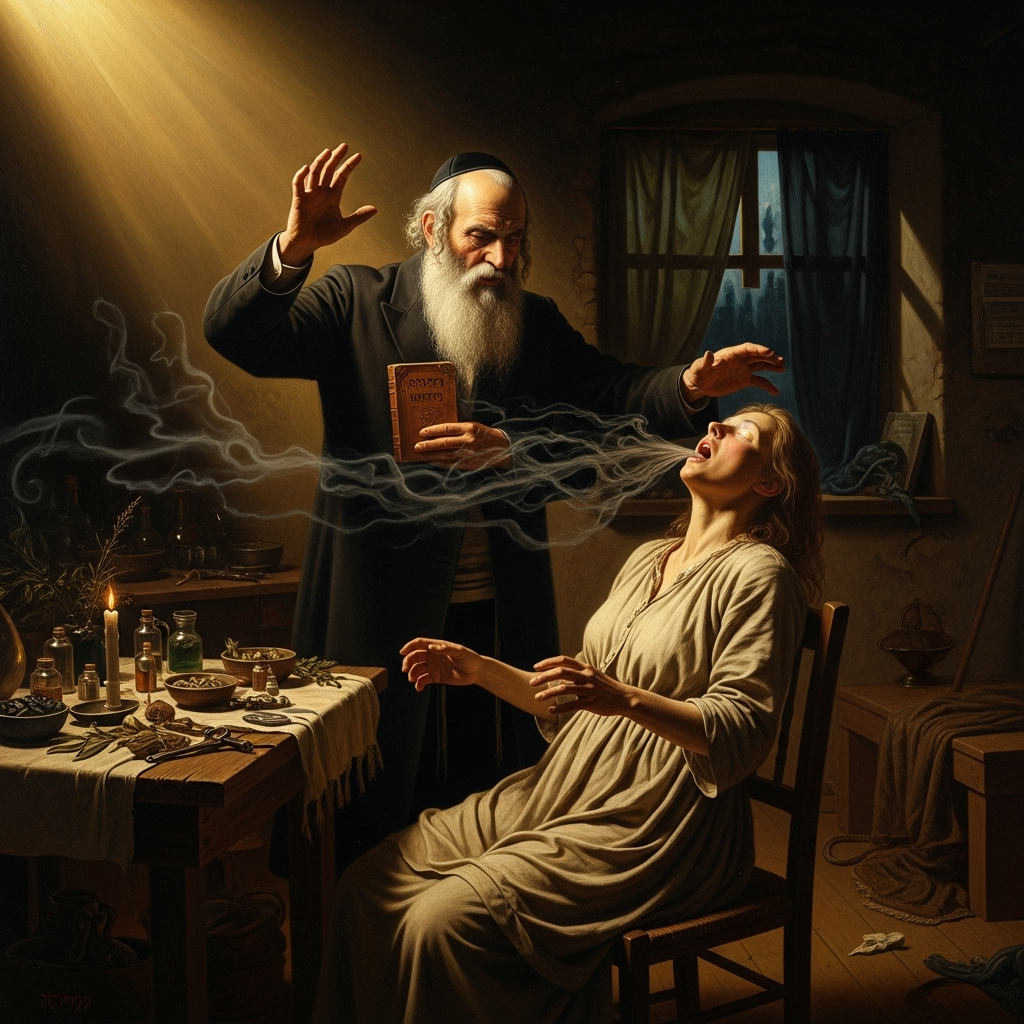
 He extracts a dybbuk from a possessed woman in a back room — the *baal shem*, the master of the divine name, doing the village healing-work that earned the title before the title became theological
 Generating art…
 Echoes Across Traditions
Entities
- Israel ben Eliezer (Baal Shem Tov, BeSHT)
- Dov Ber, the Maggid of Mezeritch
- Elijah ben Solomon Zalman (the Vilna Gaon)
- Ahijah the Shilonite (the BeSHT's claimed angelic teacher)
- The dybbuks the BeSHT exorcised
Sources
- Martin Buber, *Tales of the Hasidim*, 2 vols. (Schocken, 1947–1948)
- Moshe Rosman, *Founder of Hasidism: A Quest for the Historical Ba'al Shem Tov* (UC Press, 1996) — the decisive critical biography
- Gershom Scholem, *The Messianic Idea in Judaism* (Schocken, 1971)
- Elie Wiesel, *Souls on Fire: Portraits and Legends of Hasidic Masters* (Random House, 1972)
- *Shivhei ha-Besht* (In Praise of the Baal Shem Tov), the 1814 hagiographical compilation, ed. and trans. Dan Ben-Amos and Jerome Mintz (Indiana, 1970)
- Immanuel Etkes, *The Besht: Magician, Mystic, and Leader* (Brandeis, 2005)