Akhenaten Faces East: The Great Hymn to the Aten
c. 1353–1336 BCE — the Amarna Period · Akhetaten (modern Amarna), Middle Egypt; Thebes; the temples of Karnak
Contents
Amenhotep IV, in the fifth year of his reign, abolishes the entire Egyptian pantheon, renames himself Akhenaten, builds a new capital city on virgin ground, and declares the sun disk — the Aten — the sole god of Egypt. His Great Hymn to the Aten is the most remarkable religious text of the ancient world: the first unambiguous statement of monotheism, composed a millennium before the Hebrew prophets. Within twenty years of his death, Egypt erases him from the record as completely as it can. He is nearly lost. He is not quite lost.
- When
- c. 1353–1336 BCE — the Amarna Period
- Where
- Akhetaten (modern Amarna), Middle Egypt; Thebes; the temples of Karnak
In the fifth year of his reign, Amenhotep IV changes his name.
He has been Amenhotep — Amun is satisfied — but Amun is no longer, as far as this pharaoh is concerned, a god. Amun has been the supreme deity of the Egyptian state for nearly two centuries, his temples at Karnak richer than the palace itself, his priesthood so powerful and so wealthy that the question of whether Egypt is a theocracy or a monarchy has become genuinely difficult to answer. The pharaoh who renames himself Akhenaten — He Who Is Effective for the Aten — has decided to resolve that question.
He is closing all the other temples. He is confiscating their property. He is dispatching workers to chisel the name of Amun from every surface in Egypt — walls, obelisks, cartouches, the interiors of scarabs worn around the necks of the dead. The name will be everywhere removed. The god will cease to be.
This has never been done before. Egypt is not a tradition given to theological violence; the Egyptian gods proliferate, absorb, merge, borrow attributes from each other, tolerate contradiction the way a rich ecosystem tolerates invasive species — by incorporating rather than destroying. Akhenaten is doing something structurally new: he is saying that only one thing is divine, and everything else is either a human creation or an error.
The god he has chosen is the Aten: the solar disk, the physical light of the sun, the warmth that falls on the skin and makes crops grow and the world visible. Not Ra — Ra is a figure, a narrative, a god with a head and a barque and a daily journey through the underworld. The Aten is what the disk does. The Aten is the radiant energy itself, stripped of mythology, stripped of narrative, stripped of everything except the brute fact of light touching the world.
This is remarkable. Every major religion eventually has to deal with the problem of divine anthropomorphism — the tendency of worshippers to make gods in the image of persons. Akhenaten’s solution is extreme: he removes narrative entirely. The Aten does not have adventures. It does not have children. It does not get tricked by Thoth or seduced by earthly lovers or threatened by serpents in the underworld. It rises. It shines. It sets. It returns. This is all it does, and this is enough.
He builds a city to honor it.
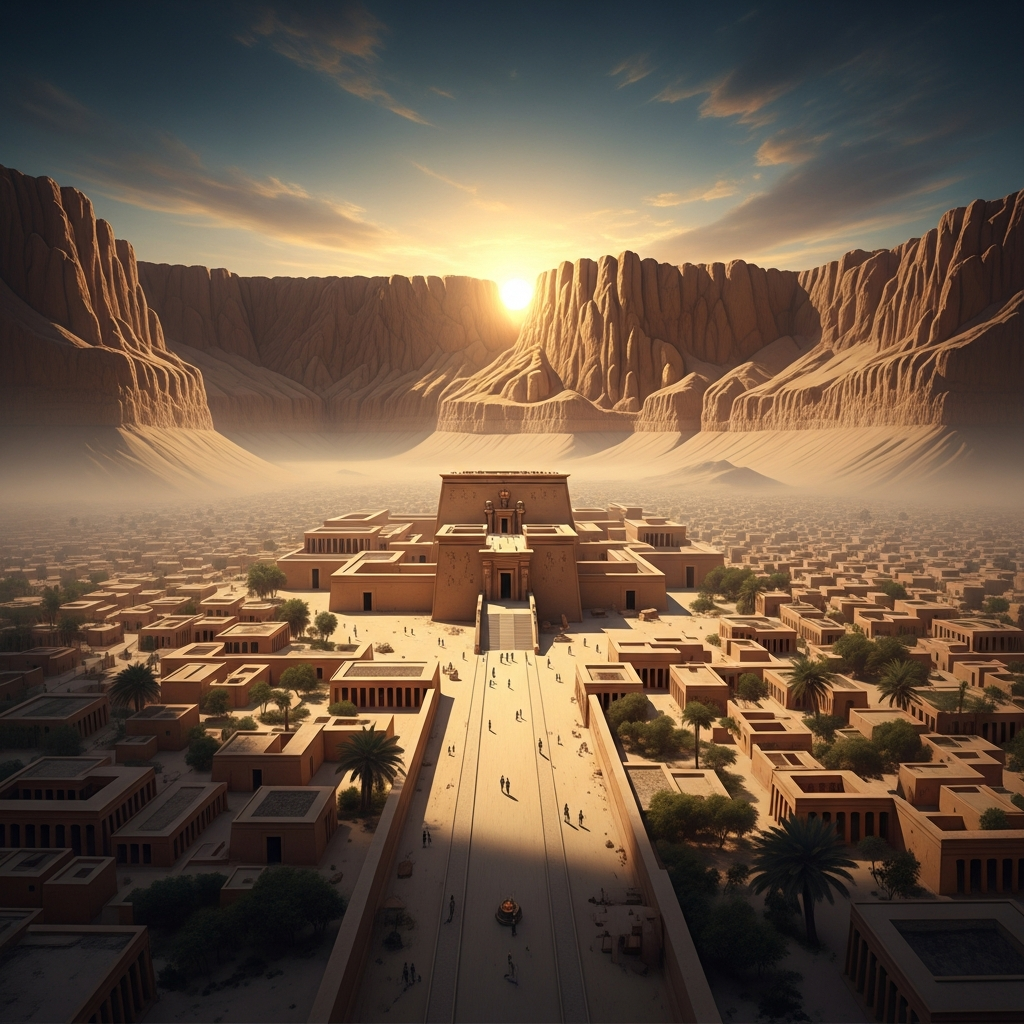
The city is called Akhetaten — Horizon of the Aten — on a stretch of limestone cliffs in Middle Egypt that has never been settled, has no prior owner, no prior cult, no prior claim. He marks the boundaries with boundary stelae carved into the rock face: he has chosen this place because the cliffs form a natural akhet, the hieroglyph for horizon, the symbol of the place where the sun rises between two mountains. The Aten rises here, in a landscape shaped like its own symbol.
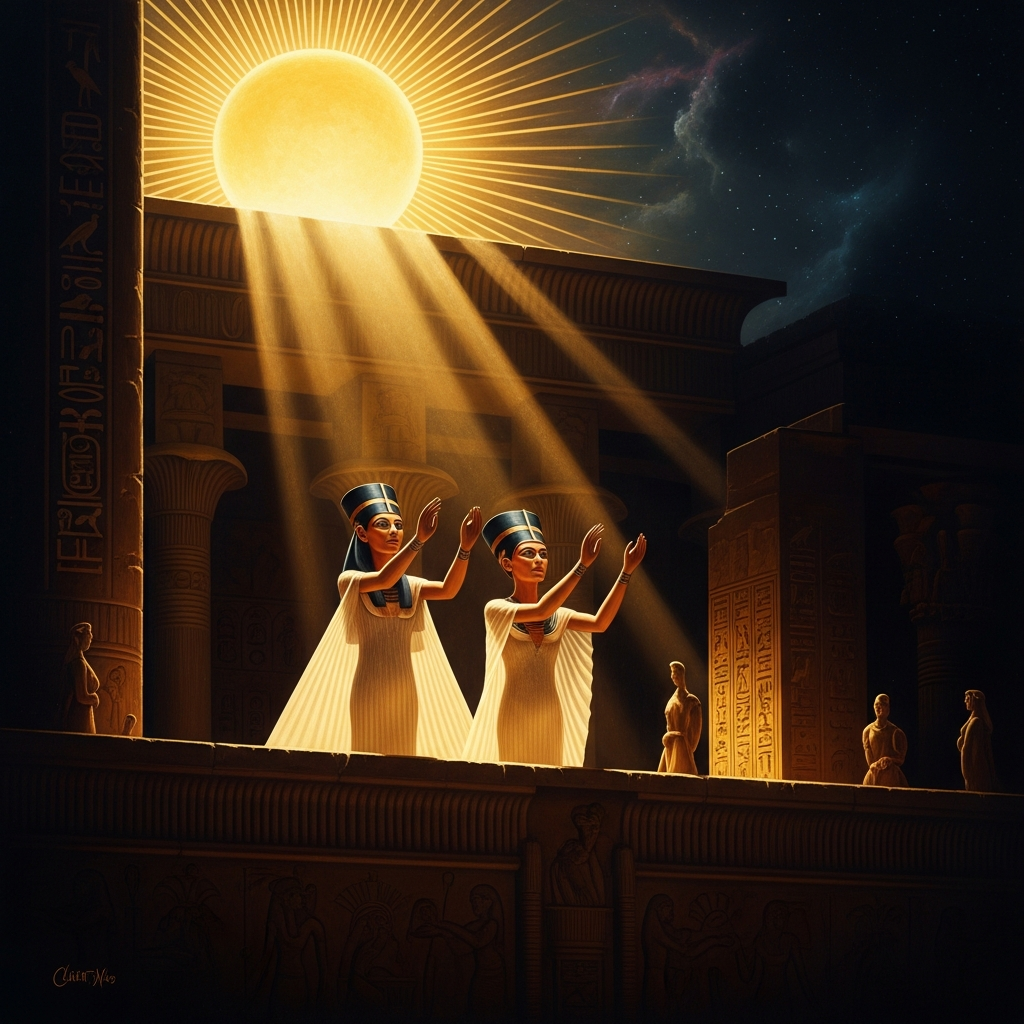
The city goes up fast. In three to five years — fast, for ancient construction on this scale — the palace, the temples, the residential quarters, the estates of the court officials who are compelled to follow the pharaoh to his new city are more or less complete. The temples are unlike any Egyptian temples before them: open to the sky rather than roofed, courts rather than inner sanctums, no dark inner chamber where the god’s image is kept and tended by priests. The Aten needs no statue. The Aten is already everywhere the light touches. You worship it by standing in it, arms raised in the dua gesture, face turned east.
Akhenaten and Nefertiti stand at the great window of appearances and show themselves to the court below. They are the mediators between humanity and the disk. The Aten’s rays in the official art end in human hands — the divine light reaches down to touch the ankh at the lips of the royal couple, and through them to the people. There is no other way to the god. The priests are gone. The temples are closed. The pharaoh and his queen are the only intermediaries.
The Great Hymn to the Aten is the text that survives from this period that makes the theological claim most explicitly.
It begins at dawn: How manifold are your works! They are hidden from the face of man. O sole god, like whom there is no other. It describes the sun rising and every creature waking — birds lifting their wings, animals running in the fields, boats sailing, fish in the river — and the sun setting and every creature sleeping, the world dark and vulnerable and cold until the disk returns. It describes the Aten making the Nile flood for Egypt and rain for foreign lands, making every face different from every other face, understanding the language of every nation, creating the child in the mother’s womb and breathing life into it.
You are in my heart, it says. There is no other who knows you except your son, Akhenaten.
This is the sentence that locates the entire revolution in one place: the pharaoh’s personal relationship with the sole god. There is no priestly hierarchy mediating this relationship. There is no mythological apparatus — no murder, no resurrection, no journey through the underworld, no weighing of hearts. There is a man standing in the light, claiming to know the light directly, and speaking for it.
Scholars who read the hymn alongside Psalm 104 of the Hebrew Bible find the structural parallels unsettling: both begin with the sun rising and creation waking; both describe the sun setting and creatures hiding in darkness; both culminate in the affirmation that the singular god is the source and sustainer of all life. Whether one borrowed from the other, or both drew on a shared ancient Near Eastern form, or the similarities are the natural convergence of similar theological projects — this is still contested. The resemblance is there.
Akhenaten reigns for seventeen years. Then he dies, or disappears from the record, the cause uncertain.
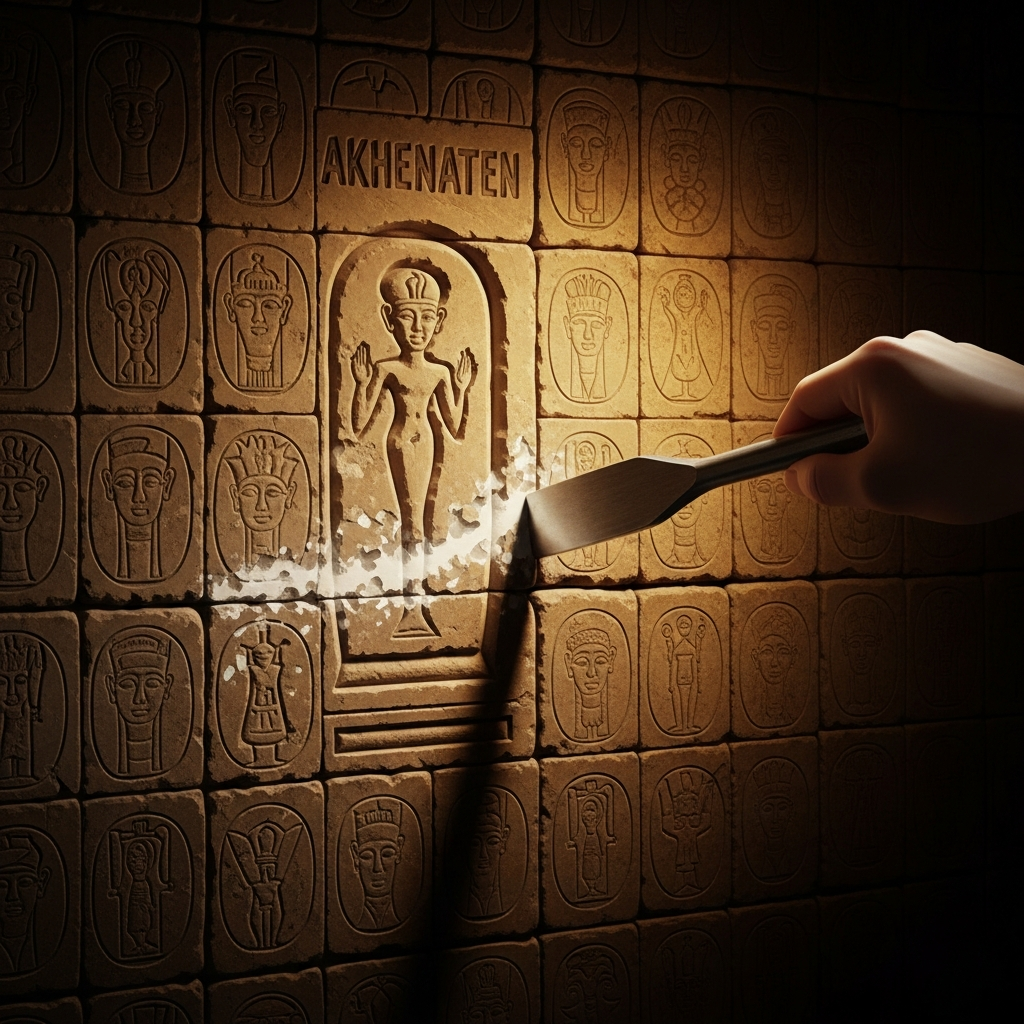
What follows is methodical and efficient. His successors — including the boy king Tutankhamun, who was born Tutankhaten and changed his name back in the second year of his reign — begin the restoration. The temples of Amun are reopened. The priests return. The workers who had chiseled the name of Amun from every surface are now dispatched to chisel the name of Akhenaten from every surface. The pharaoh who tried to end the gods is himself ended, not with violence — he has been dead long enough — but with stone and a chisel.
His images are smashed. His cartouches are cut out of temple walls and replaced with the names of earlier pharaohs, so that the building records show a continuous tradition that does not include him. His city is abandoned within a generation and stripped of its stone for use elsewhere. The memory of Akhenaten is so thoroughly expunged that later Egyptian king lists omit him entirely — he is the gap between Amenhotep III and Horemheb, a blank in the sequence, a pharaoh who did not, officially, exist.
He is recovered in the nineteenth century CE, from the ruins of his city, from the scattered fragments of the boundary stelae, from the Great Hymn inscribed in the tomb of his official Ay at Amarna. He is, it turns out, recoverable. The stone that was meant to erase him preserved him.
What the Amarna period shows — what it shows with more clarity than almost any other episode in religious history — is the relationship between monotheism and power. Akhenaten’s sole god required absolute royal authority to impose and required that authority to sustain itself. When the authority collapsed, so did the theology.
The monotheism that survived in the ancient world — the Hebrew strand, the root from which Judaism, Christianity, and Islam all grow — developed the opposite way: under persecution, in exile, in the minority condition that requires theology to sustain itself without state support. The Israelites developed the idea of the one God while they were the powerless ones, which is why the idea could survive the loss of power.
Akhenaten had the power. He used it absolutely. He lost it.
His hymn to the rising sun is still there in the limestone of Amarna, and it is still one of the most beautiful things a human being has ever said about light.
Scenes
Akhenaten and Nefertiti stand on the balcony of the great temple at Amarna, arms raised in the dua gesture of adoration, their elongated forms catching the full force of the rising sun
 Generating art…
 The city of Akhetaten rising from the empty limestone cliffs of Middle Egypt — a city conceived whole and built in perhaps three years, the palace and the open-air temple facing east, the royal road running north to south, the whole settlement oriented toward the horizon where the Aten rises between two cliffs
 Generating art…
 A chisel at work on a temple wall at Karnak, cutting away the cartouche of Akhenaten from the stone, cutting away the face from every image of the pharaoh who tried to end the gods
 Generating art…
 Echoes Across Traditions
Entities
- Akhenaten
- Aten
- Nefertiti
- Amun
- Tutankhamun
Sources
- Miriam Lichtheim, *Ancient Egyptian Literature, Volume II: The New Kingdom* (University of California Press, 1976) — standard translation of the Great Hymn
- Jan Assmann, *Moses the Egyptian: The Memory of Egypt in Western Monotheism* (Harvard University Press, 1997)
- Donald Redford, *Akhenaten: The Heretic King* (Princeton University Press, 1984)
- Erik Hornung, *Akhenaten and the Religion of Light* (Cornell University Press, 1999)
- James Allen, *The Art of Medicine in Ancient Egypt* (Metropolitan Museum of Art, 2005)