Benzaiten and the Dragon King
552 CE — the tradition records a specific date during the reign of Emperor Kinmei · Enoshima island, Sagami Bay, Japan
Contents
Benzaiten — the only female deity among the Seven Lucky Gods, originally the Hindu Saraswati — descends to Enoshima island to suppress a five-headed dragon who has been devouring children. She does not fight him. She marries him instead, and the marriage transforms his nature. The theology of beauty as the most effective form of power.
- When
- 552 CE — the tradition records a specific date during the reign of Emperor Kinmei
- Where
- Enoshima island, Sagami Bay, Japan
He has been eating children for five hundred years.
The five-headed dragon who lives in the lake at the base of the Koshigoe hills in Sagami province is not a young evil. He is ancient, established, built into the landscape the way a river is built into its valley — by persistence, by the shaping of the terrain around his presence over long time. The province has adapted to him the way populations adapt to the things that kill them: with grief, with ritual, with the particular resignation of people who have been praying for five hundred years without result.
The children are the measure of it. Five-headed dragons in the Japanese tradition are not arbitrary in their hungers. They eat the young because the young are the future, and the future is what the dragon, who is very old, cannot have. This is not a satisfying explanation to the families. It is the explanation the monks offer when they run out of other explanations.
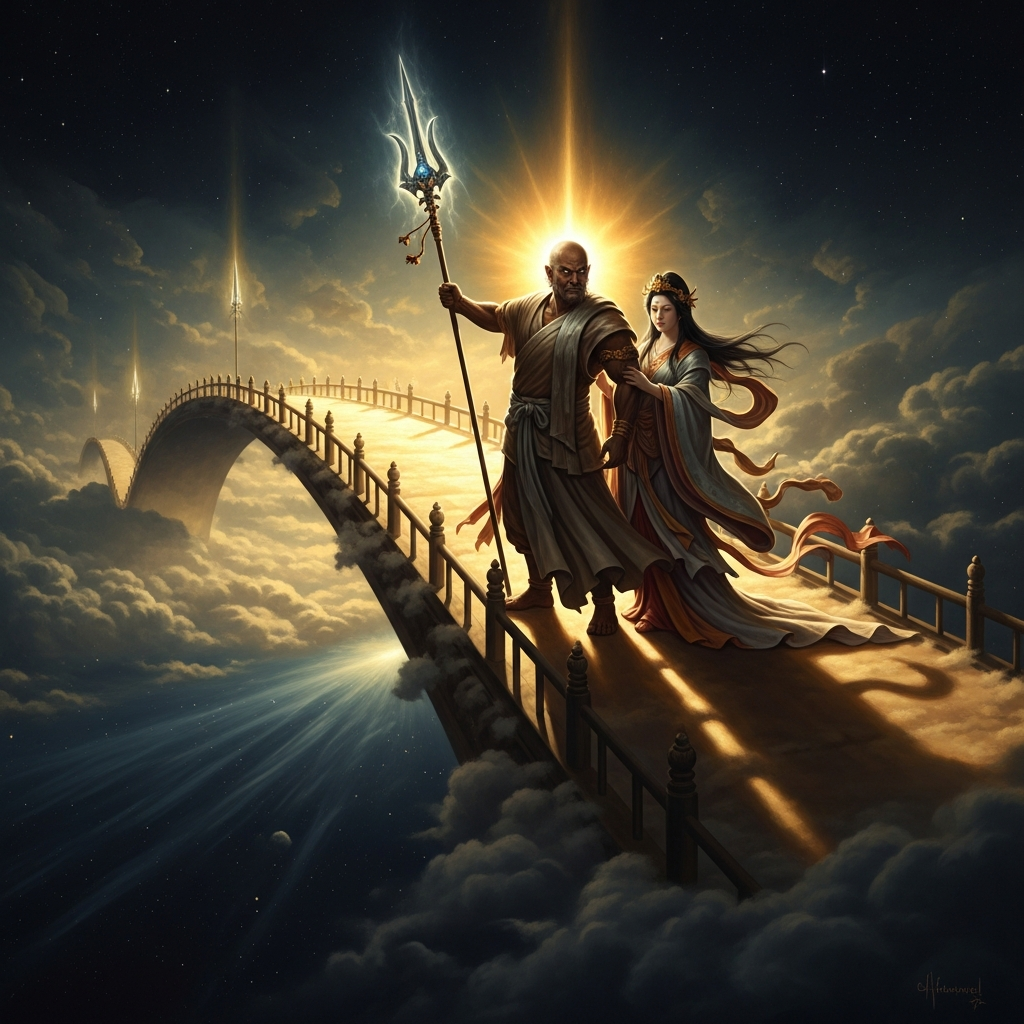
In the fifth year of the reign of Emperor Kinmei — the record is specific, which is unusual for mythological events, and the specificity suggests that something happened in Sagami Bay in 552 CE that people felt they needed to date — a golden cloud descends from the direction of the northeast.
Benzaiten arrives the way she always arrives: with the biwa.
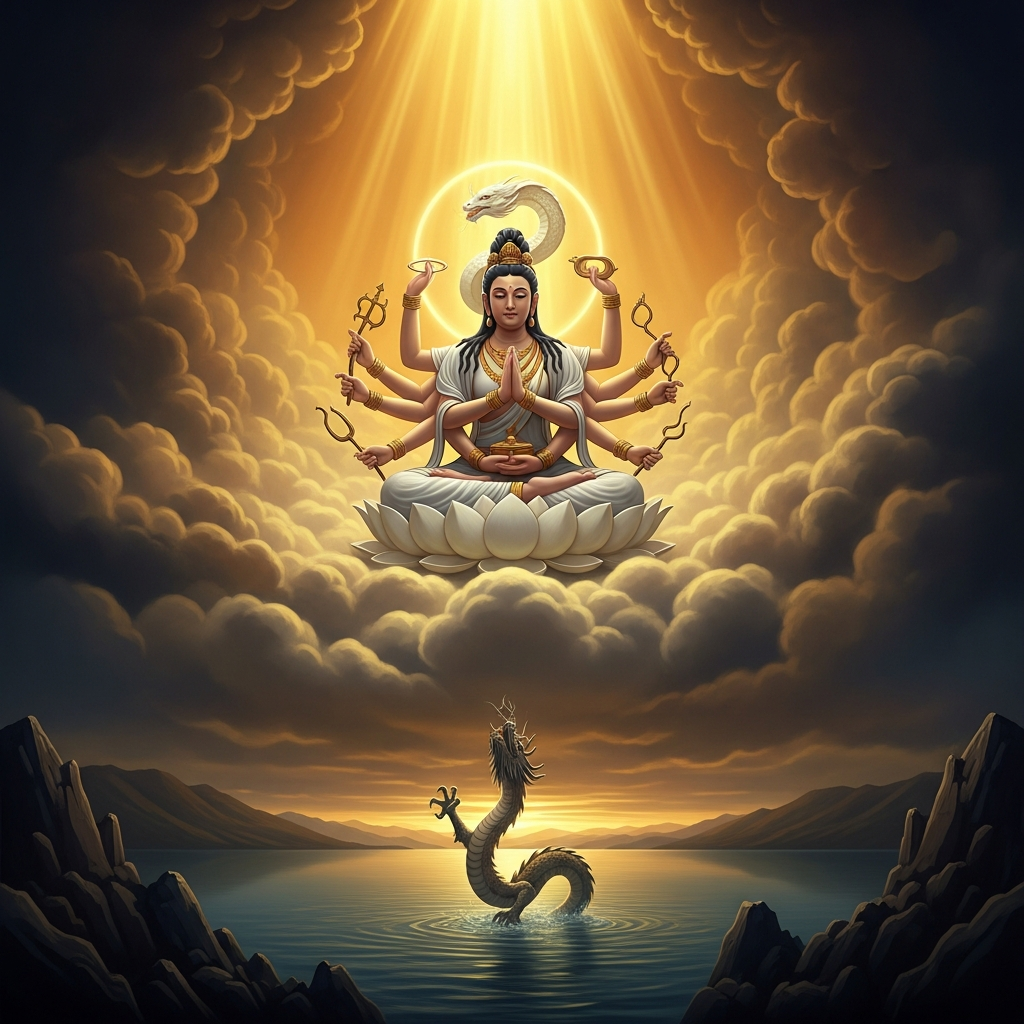
She is the goddess of everything that flows — water, music, time, eloquence, the river of sacred speech that runs between what is thought and what is said. She is Saraswati’s Japanese daughter, though the lineage is more complicated than that: she crossed from India into China with Buddhism, accumulated Chinese water-goddess attributes, crossed into Japan in the sixth century as Benten, the radiant one of the sea, and has been sorting out who she is in the Japanese landscape ever since. By the time of the Enoshima descent she has eight arms in her full manifestation — the biwa in the primary hands, the bow and arrow, the sword, the rope, the wish-fulfilling jewel, the key, the wheel of the dharma, the ritual vase — and the white serpent who is her messenger and her emblem coiled in her hair.
She does not arrive armed. Or rather: she arrives with all her arms, but the biwa is in her hands, and this choice is her argument before she has spoken a word.
The golden cloud descends over the bay and an island rises from the sea to meet it — a tongue of rock and stone that the bay pushes up from its floor, the Enoshima, which will be a pilgrimage site for the next fourteen centuries. She steps from the cloud to the island. The lake trembles. The dragon rises.
He has five heads.
This is not a metaphor, though everything about the five-headed dragon is also a metaphor. Five heads mean five hungers, five attentions pulling in five directions simultaneously, five sets of senses all reporting different things, five different estimates of the situation. A five-headed dragon is not simply dangerous in proportion to its heads. It is dangerous in the specific way that multiplied desire is dangerous: it cannot be satisfied because satisfaction requires an agreement among all five heads about what satisfaction would be, and they do not agree.
He rises from the lake and sees the goddess on the island.
The five heads focus.
This is the mechanism. This is what Benzaiten understood when the gods sent her rather than a warrior: the dragon’s problem is not evil in the theological sense, not the opposition of good and righteousness that a sword can address. His problem is dissipation — five hungers, five attentions, centuries of consuming without being consumed. What he lacks is not suppression. He lacks an object adequate to his attention. He has never encountered one.
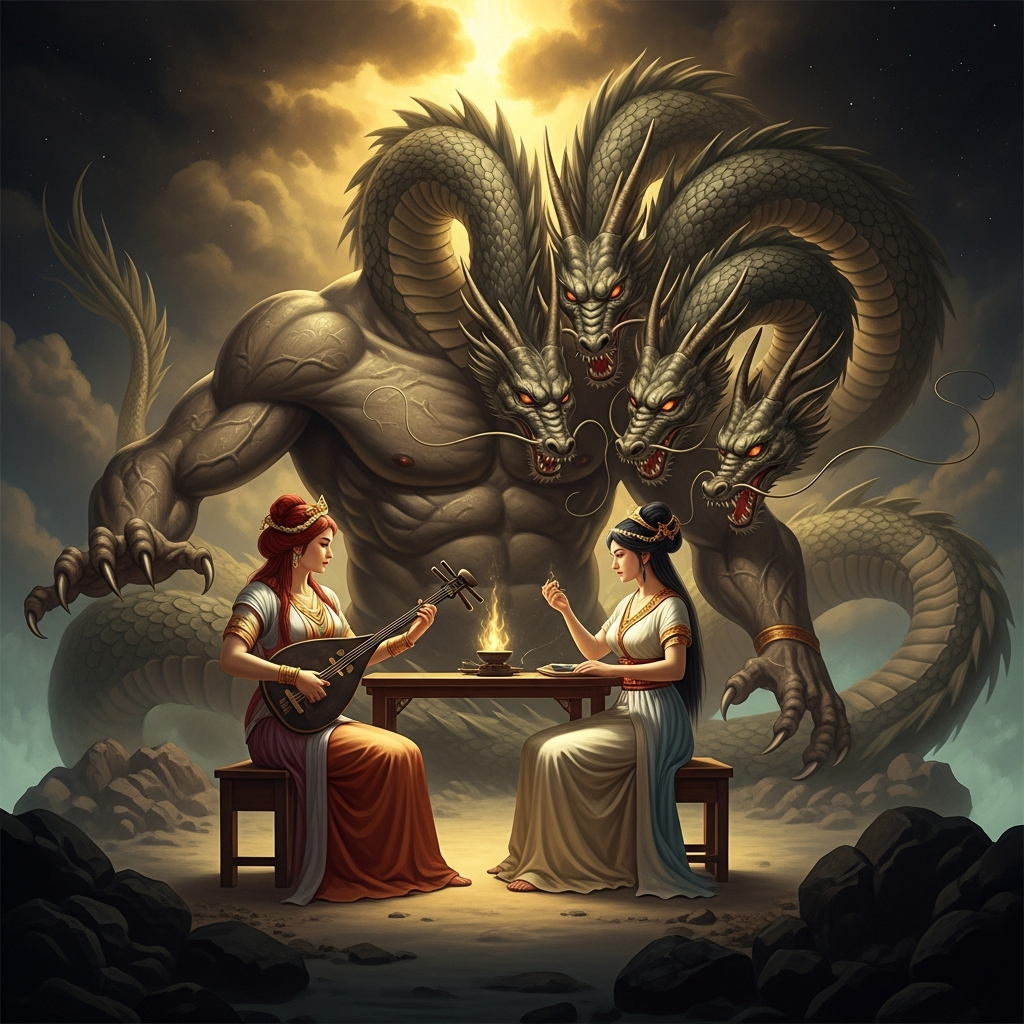
She plays the biwa.
The instrument is the one the goddess of sacred speech carries because speech at its most potent is music — not words but the tonal structure beneath words, the vibration that the body receives before the mind translates it into meaning. The biwa is a short-necked lute with four strings and a sound that in the Japanese tradition is associated with impermanence, with the falling of things, with the specific beauty of what does not last. Heike Monogatari, the great war chronicle, opens with the sound of the Gion Shrine bell and is said to have been composed to biwa accompaniment.
She plays.
Five heads attend.
What follows is recorded in the tradition as a negotiation, because the people who recorded it needed a category and negotiation was the closest available. But a negotiation has terms, and what happens between Benzaiten and the five-headed dragon of Sagami does not have terms in any form that can be reviewed. It has music. It has the dragon’s five heads drawn toward a single point for the first time in five hundred years, which is the first peace he has known, and the peace is the argument she makes, and the argument is persuasive.
He lowers his heads, one after another, until all five are level with the goddess on the island.
He proposes marriage.
She accepts.
This is the moment that the later tradition both dwells on and moves past quickly, because it is the moment where the theology becomes uncomfortable. The goddess of beauty and music and sacred speech — the deity invoked for eloquence and artistic achievement and the flowing intelligence of things — accepts the proposal of a monster who has been eating children for five centuries.
The discomfort is the point.
What Benzaiten knows that the tradition around her sometimes forgets is that power has two modes and only one of them is creative. The mode of opposition produces martyrs and ruins. The mode of attraction — of beauty, of music, of the thing that draws another thing toward itself by being worth approaching — produces transformation. She does not marry the dragon despite what he has done. She marries the dragon because of what she is, which is the thing that can hold his five attentions simultaneously without being consumed, which is what a god is for.
The dragon eats no more children.
He does not stop because he is imprisoned or defeated or frightened. He stops because he has found an object adequate to his attention, and the object has married him, and he is — this is the word the tradition eventually uses — converted. The energy that spent five centuries in consumption turns toward something else. What he becomes in the marriage is not recorded. The shrines at Enoshima are dedicated to Benzaiten. The dragon’s role in the subsequent theology is as her companion, her consort, the water power she rides when she manifests over the sea.
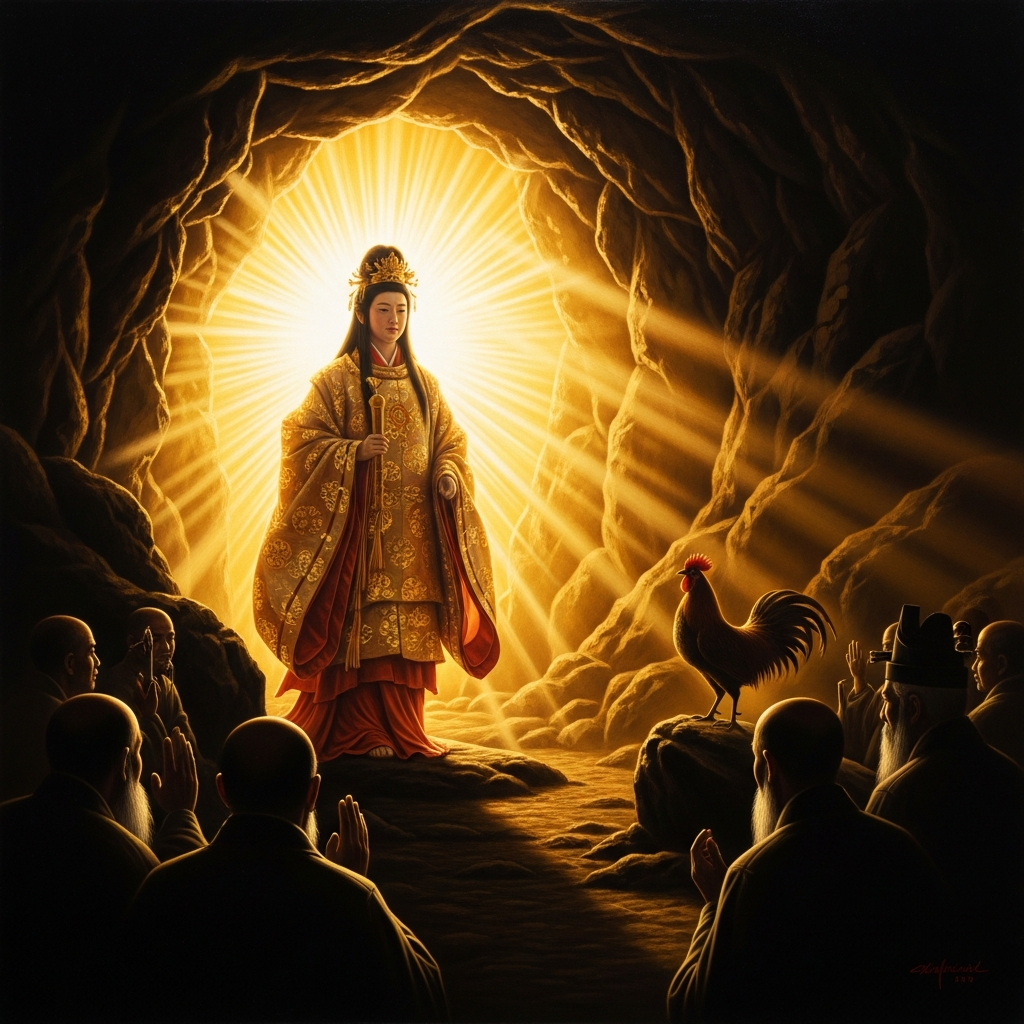
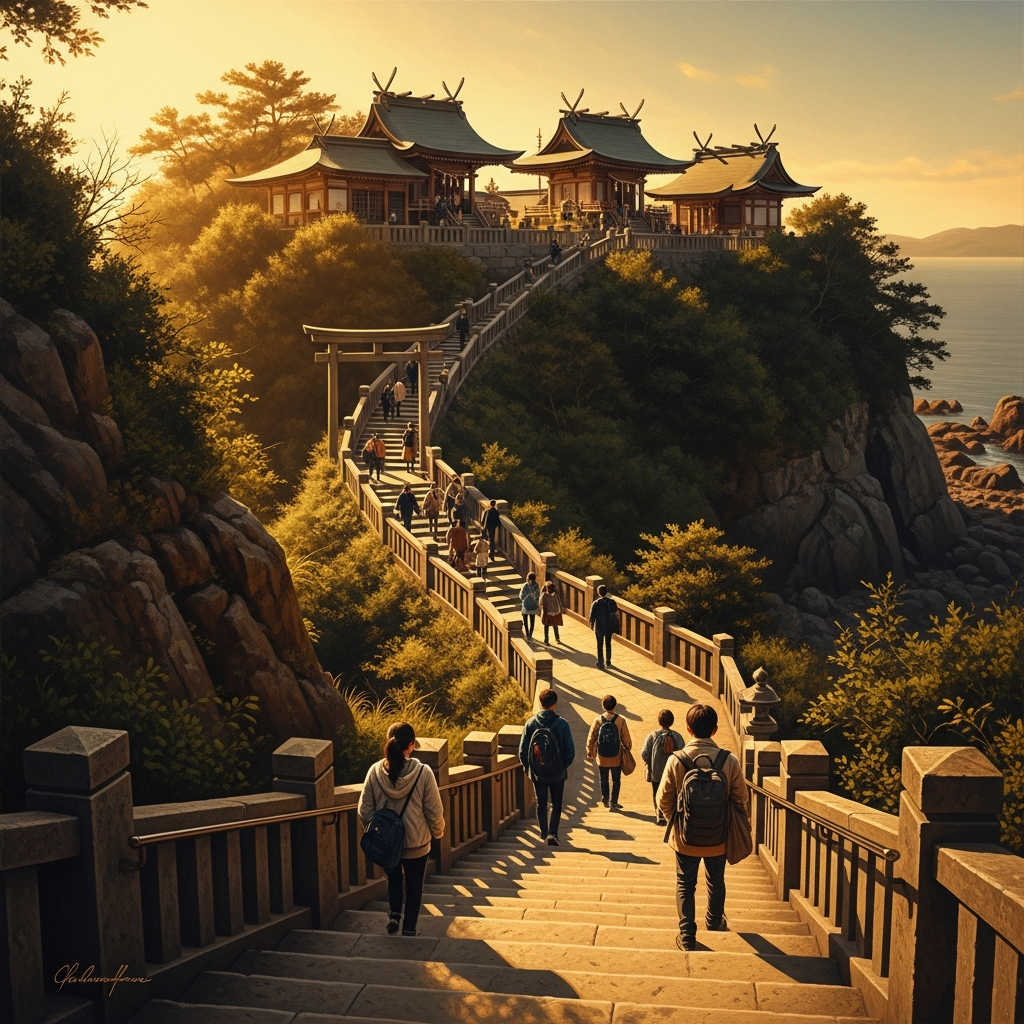
The Enoshima-jinja stands today at the end of a causeway in Kanagawa Prefecture, approximately an hour from Tokyo by train. Three shrines occupy the island’s spine: the Hetsunomiya at the base, the Nakatsunomiya in the middle, and the Okitsunomiya at the top, near the cave where Benzaiten is said to have resided during the negotiations. The cave goes deep into the island’s rock. At its end, depending on which source you trust, there is either a small statue of the naked Benzaiten or simply the dark.
Pilgrims have been making the climb for fourteen centuries. They come for luck — she is one of the Seven Lucky Gods, the Shichifukujin who sail into harbor on New Year aboard a treasure ship, each carrying a different gift, and Benzaiten carries eloquence, artistic talent, wisdom, the capacity to flow around obstacles. Lovers come to Enoshima to leave prayers, though there is a tradition that couples who visit the shrine together will be separated — the goddess, being married, takes a proprietary view of the matter.
She appears most often in Japan as a small, graceful figure with a biwa and two arms, which is the portable version. The eight-armed manifestation — the one that arrived at Enoshima in the golden cloud — is rarer and stranger, and the shrines that show it tend to be the older ones, the ones where the image was made before the artists fully understood what they were depicting.
The Seven Lucky Gods arrived in Japan over several centuries, drawn from three traditions: Daikoku and Ebisu from Shinto, Hotei and Fukurokuju and Jurojin from Buddhism and Daoism, Bishamonten from Hindu Vaishnava practice via Buddhism, and Benzaiten — the only woman — from Hindu Saraswati via Buddhism via the Japanese synthesis. They became collectively popular in the Muromachi period (1336–1573) and have been part of New Year iconography since at least the Edo period.
Why seven? The number in East Asian cosmology aligns with the seven stars of the Big Dipper, the seven days of the Buddhist week, the seven notes of the scale. Seven is the number of completeness in a different arithmetic than the Western one.
Benzaiten is the only one who is also a dragon’s wife. The other six are luck in its more straightforward registers: wealth, health, longevity, contentment, military protection, honest labor. Benzaiten is beauty and music and the intelligence of flowing things, which are forms of luck in a more complicated key. She is what happens when the thing that devouring cannot satisfy encounters the thing it was always hungry for.
The dragon stopped devouring. The children of Sagami grew up.
This is what the theology of beauty claims: that the beautiful thing does not merely please the one who encounters it. It changes what the encounter was for. The five heads, which spent five hundred years in disagreement, found their point of convergence in a goddess with a biwa.
That is what music is for. That is what she is for.
Scenes
A golden cloud descends on the bay of Sagami in 552 CE
 Generating art…
 At the shrine on the newly risen island, Benzaiten faces the five-headed dragon
 Generating art…
 The Enoshima-jinja shrine in the golden light of afternoon
 Generating art…
 Echoes Across Traditions
Entities
- Benzaiten
- Ryujin
- Enoshima
- Five-Headed Dragon
- Seven Lucky Gods
Sources
- Donald L. Philippi (trans.), *Kojiki* (University of Tokyo Press, 1968)
- Royall Tyler, *Japanese Tales* (Pantheon Fairy Tale and Folklore Library, 1987)
- Joseph Kitagawa, *Religion in Japanese History* (Columbia University Press, 1966)
- Carmen Blacker, *The Catalpa Bow: A Study of Shamanistic Practices in Japan* (Allen and Unwin, 1975)
- Alicia Matsunaga, *The Buddhist Philosophy of Assimilation: The Historical Development of the Honji-Suijaku Theory* (Sophia University Press, 1969)