Kali on the Battlefield
Mythic Time · Devi Mahatmya, Markandeya Purana ~6th century CE; elaborated in the Kalika Purana · The demon battlefield — the killing ground that cannot be contained, that spreads until it has no edge
Contents
Durga creates Kali from her third eye to fight the demon generals Chanda and Munda. Kali springs forth black-skinned and wild-haired, devouring armies so fast that every drop of demon blood that touches the ground births a thousand new demons. She cannot stop killing. Only Shiva, lying down in her path, arrests her — and when she realizes she has stepped on her husband, her tongue comes out in the gesture that defines her forever.
- When
- Mythic Time · Devi Mahatmya, Markandeya Purana ~6th century CE; elaborated in the Kalika Purana
- Where
- The demon battlefield — the killing ground that cannot be contained, that spreads until it has no edge
Durga is winning the war when the problem begins.
The demon army is vast — generals whose names the texts list in columns: Chikshura, Chamara, the armored thousands under the banner of Shumbha and Nishumbha, who have usurped heaven in a later telling of the same recurring story. Durga fights them the way she always fights — methodically, without anger, the divine immune system at work. She is winning. The demon lines are breaking.
Then Chanda and Munda ride forward.
They are the generals’ generals — the two who command when the generals have fallen, the last reserve of a collapsing army. They are brave in the way desperate creatures are brave, which is different from courage and more dangerous. They charge the goddess’s lion with everything they have.
Durga’s brow furrows.
The crease between her eyes deepens. The third eye — the one Shiva carries in the center of his forehead, the seat of cosmic fire and also of cosmic wrath — gathers into itself all of Durga’s anger at the sheer persistence of what should already be defeated.
And from the crease, from the vertical line of fury compressed between the goddess’s brows, something erupts.
She is black.
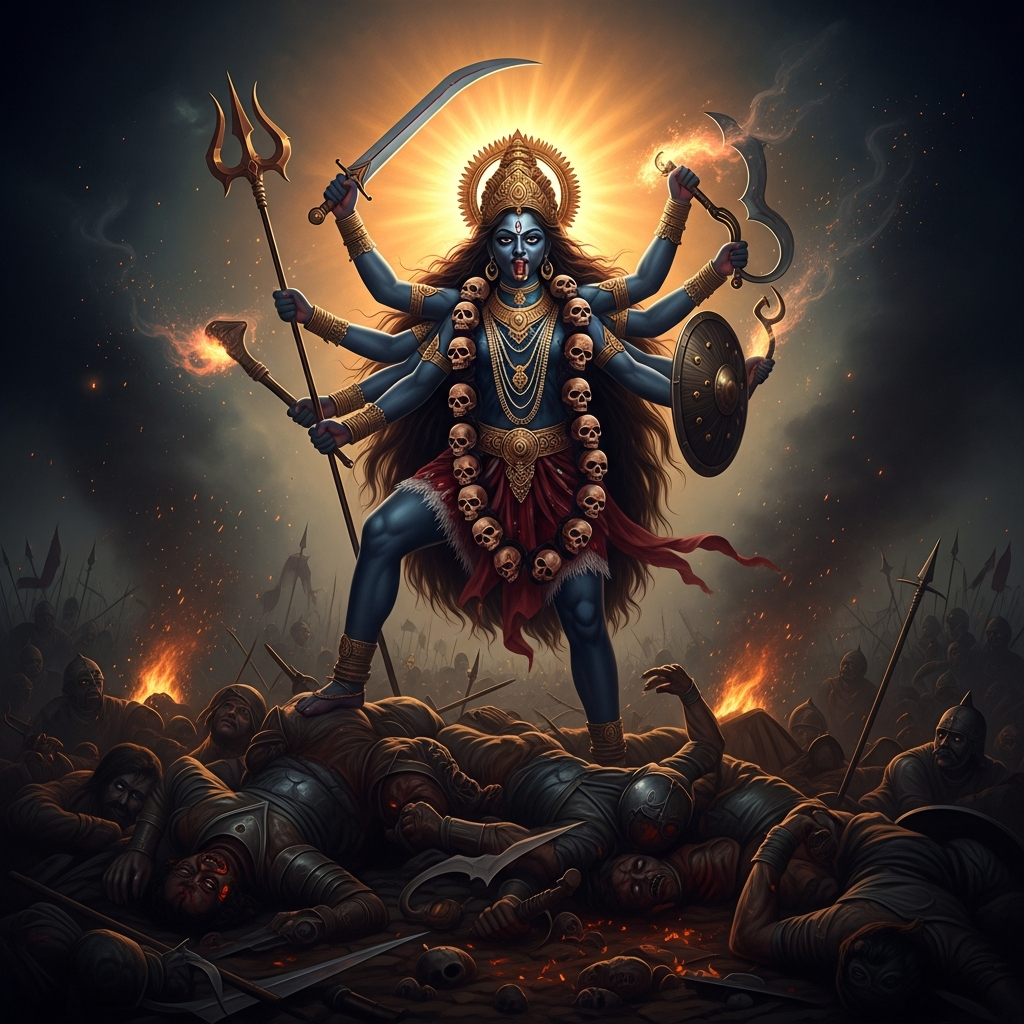
Not dark brown, not the blue-black of a storm cloud or the blue of Vishnu’s skin — but absolute black, the color of a closed eye, of the space between stars, of what exists before the lamp is lit. Her hair is wild and unbound, the way a widow’s hair goes unbound, the way the hair of mourning women goes unbound at the burning ground. She is laughing with her mouth open and her tongue extended, bright red against the black of her face, and around her neck is a garland of severed heads — freshly severed, the texts are specific about this, the blood still running.
She wears a skirt of severed arms.
She carries a skull-topped staff and a sword, and she is making a sound that is not a war-cry exactly — it is the sound a thing makes when it has been held inside a body too long and finally released.
She lands on the battlefield and begins.
Chanda dies before he finishes his charge. Munda dies a moment later. The texts say she puts both their heads in a bag and presents them to Durga — Chanda and Munda, mother, your generals — which is where she gets one of her permanent names: Chamunda, she who slew Chanda and Munda.
Durga accepts the heads. She looks at Kali. Kali looks back.
There is a recognition between them that the texts do not quite explain. Kali is Durga’s anger made autonomous — the warrior function taken past the point where the warrior function can govern itself. She is what happens when divine fury is no longer serving a purpose but has become the purpose.
Then Raktabija enters the field.
His name means blood-seed. His boon — and of course he has a boon; all the great demons have boons — is this: every drop of his blood that falls to the earth immediately generates a fully formed demon, an exact replica, fully armed. If he bleeds a hundred drops, there are a hundred new Raktabijas. If he bleeds a thousand drops, there are a thousand.
The Devi Mahatmya describes what happens when the gods’ weapons find him. Every sword cut produces clones from the wound. Every arrow that passes through him sends a spray of blood-seeds arcing across the field, and each seed hits the earth and stands up and reaches for a sword. The army regenerates faster than it can be killed. The demon has turned the act of killing him into a method of reproduction, and the gods are helpless because their weapons are the very mechanism of his multiplication.
Durga understands the problem immediately.
She calls Kali.
Kali spreads her tongue across the field.
This is the solution, and it is as strange as the problem. She crouches over the battlefield and extends her tongue — an impossible tongue, a cosmic tongue, a tongue that the images render the size of a river delta — and she drinks. Every drop of Raktabija’s blood that falls, she catches before it reaches the ground. Every sword wound, she puts her mouth over and drinks the blood before a single seed can land.
Raktabija bleeds and bleeds and shrinks as he bleeds, the copies of him disappearing because the blood that made them is being consumed before it can make them. He is diminishing. The army is diminishing. The field is emptying.
This is what divine transgression looks like. Kali does not kill cleanly. She consumes. She puts her mouth on the wound and drinks the wound down. In a tradition with strict rules about bodily purity and the contamination of blood, the goddess who saves the cosmos does so by violating every one of them — openly, systematically, with evident relish.
Raktabija collapses. The army is gone.
And Kali cannot stop.
The killing is over and she is still killing.
There is nothing left to kill on the field except the bodies of the demons she has already killed, and she is dancing on them — the wild hair flying, the tongue extended, the garland of heads swinging against her chest. The dance is Tandava, the same dance Shiva dances at the end of the cosmic age, and it is getting faster. She is beginning to lose the distinction between the field and the world. The destruction is threatening to spread.
The gods watch from the margins and understand that they have a new problem.
They made her from fury, and the fury accomplished what it was made to accomplish, and now the fury has no remaining object and it is looking for one. Kali does not have a switch. She does not have a state that is called not killing. She has a state called killing and she is in it.
They send for Shiva.
Shiva understands his wife’s anger better than any god because he married its creator and because he himself is the destroyer. He does the only thing that can be done. He goes to the killing ground and lies down among the bodies.
He lies in her path.
Her foot comes down on his chest.
She is still moving, still dancing the dance that will unmake the world if it does not stop — and her foot descends, and it lands on Shiva’s chest, and she feels the solidity of a body that is not a demon, and she looks down.
She sees her husband.
The tongue that has been catching blood and breathing fire — the tongue that is the image everyone carries of her, the red tongue against the black face — comes out. Not in hunger. Not in a war-cry. In the gesture of a woman who has just done something deeply inappropriate and knows it. The Sanskrit commentators call this lajja, shame or modesty. The gesture of a wife who has stepped on her husband is the gesture of sudden awareness that the rules of the household are different from the rules of the battlefield, and she is on the wrong ground in the wrong mode.
She stops.
The dance ends. The field is quiet. Shiva looks up at his wife from between the bodies. He is not angry. He is the destroyer himself; he has nothing to fear from destruction. He is, if anything, impressed.
He stands. She helps him up. The tongue comes in.
The image freezes there — the black goddess, tongue extended, one foot on Shiva’s prone chest, her garland swinging, the killing field behind her. It is the most reproduced image of Kali in the Hindu tradition. She stands on her husband; she does not bow over him.
The theology of this image is argued over in every generation of Shakta commentary. One reading: Shiva lies at Kali’s feet because she is supreme, because Shakti is the active force and Shiva without Shakti is a corpse. Another: the husband’s love is the one force that can arrest the goddess’s rage — not authority, not weaponry, but recognition, presence, the fact of being known. A third: the tongue is not shame but the moment of remembering, the god of destruction and the goddess of destruction meeting each other’s eyes on a killing ground and knowing that they are the same thing.
Kali’s devotees in Bengal — the poets of the Shakta tradition, Ramprasad Sen in the eighteenth century, the great Ramakrishna Paramahamsa in the nineteenth — address her as Ma, mother. They ask her for grace while standing between the garland of heads and the skirt of arms. They say: you are terrible, and you are my mother, and these are not in contradiction.
She is the face the goddess shows when the warrior function is taken to its absolute end — past control, past assignment, past the point where even the force that created her can recall her. Only love can stop her. Only the body of her husband, lying down in the wreckage she has made, can interrupt the dance.
That is the icon. She is caught at that interruption, forever.
Scenes
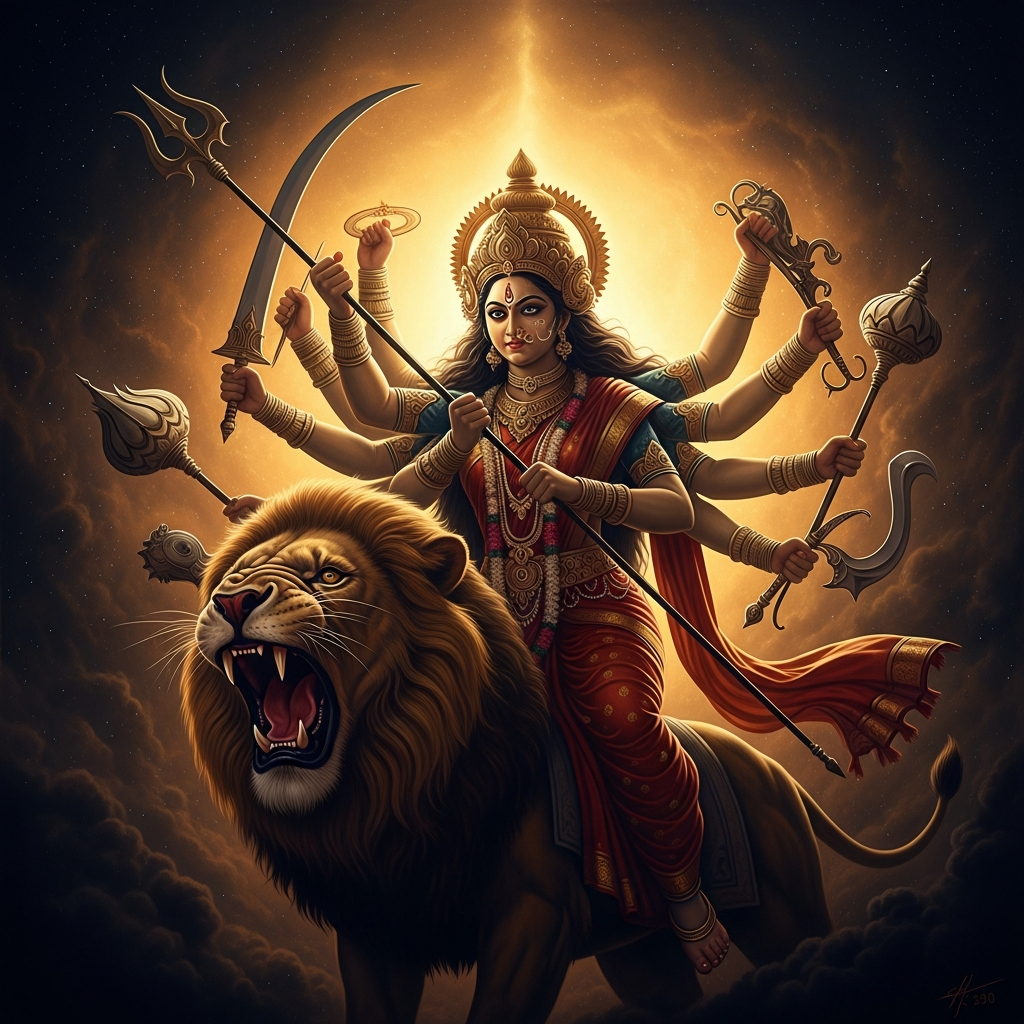
From Durga's furrowed brow — the third eye clenched with fury — Kali springs forth fully formed: black-skinned, wild-haired, her tongue already extended, a garland of freshly severed heads swinging as she lands
 Generating art…
 The demon Raktabija bleeds a thousand copies of himself onto the field
 Generating art…
 Shiva lies among the bodies on the killing ground
 Generating art…
 Echoes Across Traditions
Entities


Sources
- *Devi Mahatmya*, *Markandeya Purana* chapters 87-89 (Chanda-Munda episode) and chapter 88 (Raktabija), ~6th c. CE
- *Kalika Purana*, chapters 60-70
- David Kinsley, *The Sword and the Flute: Kali and Krsna, Dark Visions of the Terrible and the Sublime in Hindu Mythology* (1975)
- Rachel Fell McDermott, *Mother of My Heart, Daughter of My Dreams: Kali and Uma in the Devotional Poetry of Bengal* (2001)
- Wendy Doniger O'Flaherty, *Women, Androgynes, and Other Mythical Beasts* (1980)