Durga Slays Mahishasura
Mythic Time · Devi Mahatmya, Markandeya Purana ~6th century CE; festival of Navaratri observed each autumn · The cosmic battlefield between the heavens and the demon realm — the field where nine days become the axis of the year
Contents
The buffalo-demon Mahishasura has conquered heaven and the gods are helpless. They pool their divine fire into a single blazing point, and a goddess steps out — eighteen-armed, lion-mounted, the entire armory of heaven in her hands. Nine days she fights him as he shifts shape. On the tenth, she pins him under her foot and takes his final head.
- When
- Mythic Time · Devi Mahatmya, Markandeya Purana ~6th century CE; festival of Navaratri observed each autumn
- Where
- The cosmic battlefield between the heavens and the demon realm — the field where nine days become the axis of the year
Mahishasura earned his boon the long way.
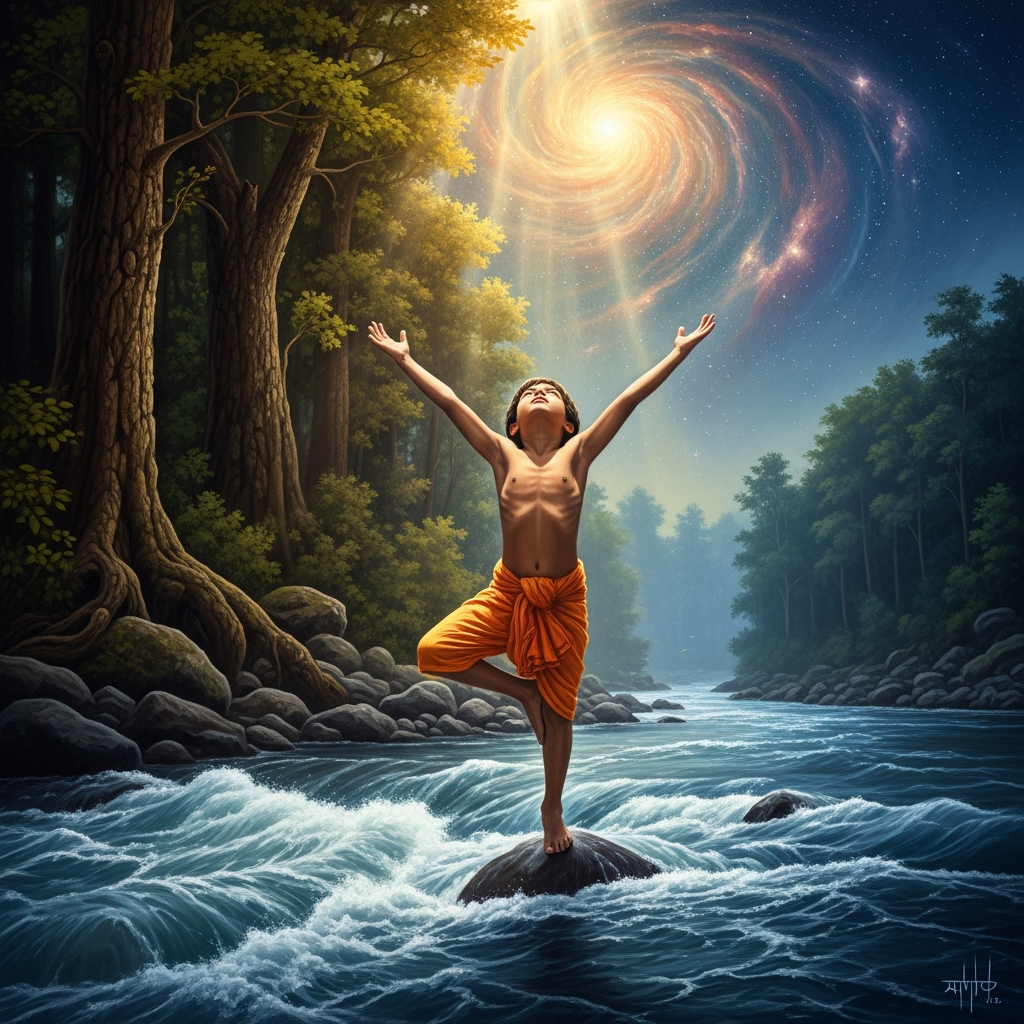
He stood on one leg for a thousand years. He held his breath in the cold waters of a mountain river until the river turned warm around him. He fasted until the fat burned away and the tendons showed and the crows gathered, and he held his attention on Brahma and did not blink. Brahma, who is bound by the cosmological rule that sufficient austerity must be answered, came down at last and asked what the demon wanted.
The buffalo-demon — half-bull, half-man, the head of an animal that knows how to lower its horns and the body of a creature that knows how to grip a sword — said: I want to be unkillable by any man or any god.
Brahma considered the wording. Demons always frame their boons in the categories they fear. They almost never think to fear the categories they have not noticed.
He granted it.
Mahishasura returned to the demon realm. He raised an army. He attacked heaven.
The gods fall.
Indra rides against him and is thrown from his elephant. Agni’s fire runs off the demon’s hide. Vayu cannot move him. Yama raises the staff of death and finds it useless against a creature whose boon explicitly excludes it. One by one the devas are unhorsed, scattered, driven from the city of Amaravati into the mountain forests below, where they sit in the dark and listen to Mahishasura issuing orders from Indra’s throne.
The cosmic order unravels. The sacrifices on earth go unanswered because the god who receives each sacrifice has been displaced. Rain falls in the wrong season. Rivers run toward the wrong sea. The whole tuning of the world drifts because something sits on the throne of heaven that should not be there and cannot be removed.
The gods go to Vishnu. They go to Shiva. They go to Brahma.
The three highest gods listen. They look at each other. They understand that the boon they gave cannot be broken by any of them, and cannot be broken by any being who currently exists, and that the cosmos therefore cannot be saved unless a being is created who does not yet exist.
So they make one.
It begins with anger.
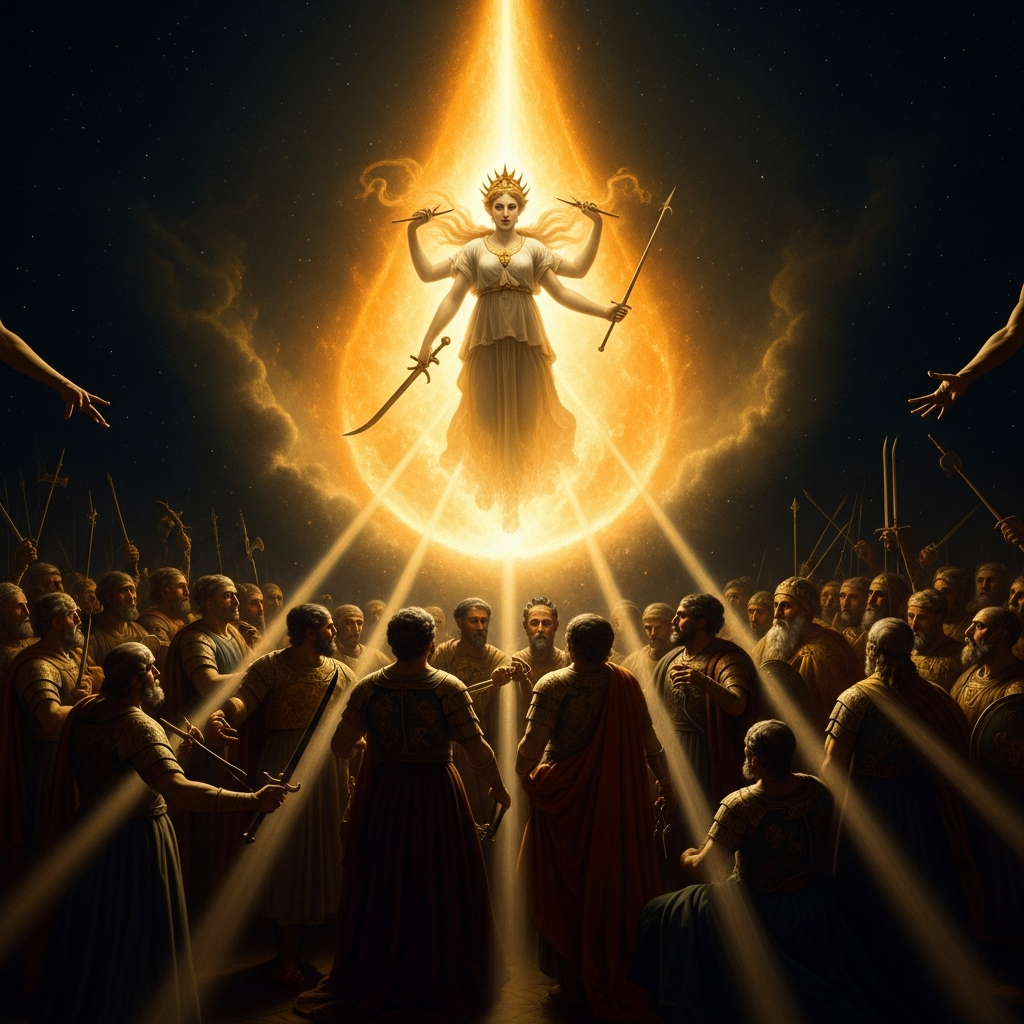
Vishnu’s anger rises first — a column of dark blue fire pouring from his face, the fury of a preserver whose cosmos is being destroyed. Shiva’s anger follows, white-hot and total, the destroyer’s flame released without direction. Brahma contributes his own. Indra, Agni, Vayu, Yama, Varuna — every deva in the displaced assembly adds their rage to the single point above them where the three primary fires are already meeting.
The light gathers. It does not disperse. The column of combined divine fury is taking a shape — arms, a waist, a face, a crown. The gods stand below and watch themselves being poured into a body that is not theirs, that is something new, something the cosmos has not contained before.
She steps out of the light.
She has eighteen arms. Each hand is empty for the span of a heartbeat, and then each god steps forward and places a weapon in it: Vishnu’s discus, Shiva’s trident, Indra’s thunderbolt, Vayu’s bow, Varuna’s conch, Yama’s staff, Agni’s spear. The gods give away their armory because they understand, finally, that they have made her to wield what they could not.
Her mount is a lion that steps forward from somewhere in the assembled light as though it has been waiting.
She does not announce herself. The texts give her the names: Durga, the impassable one. Mahadevi, the great goddess. Mahishasura-mardini, she who will slay Mahisha — a name given before the slaying, the way prophecies are given, because the event has already been settled.
She rides toward the throne.
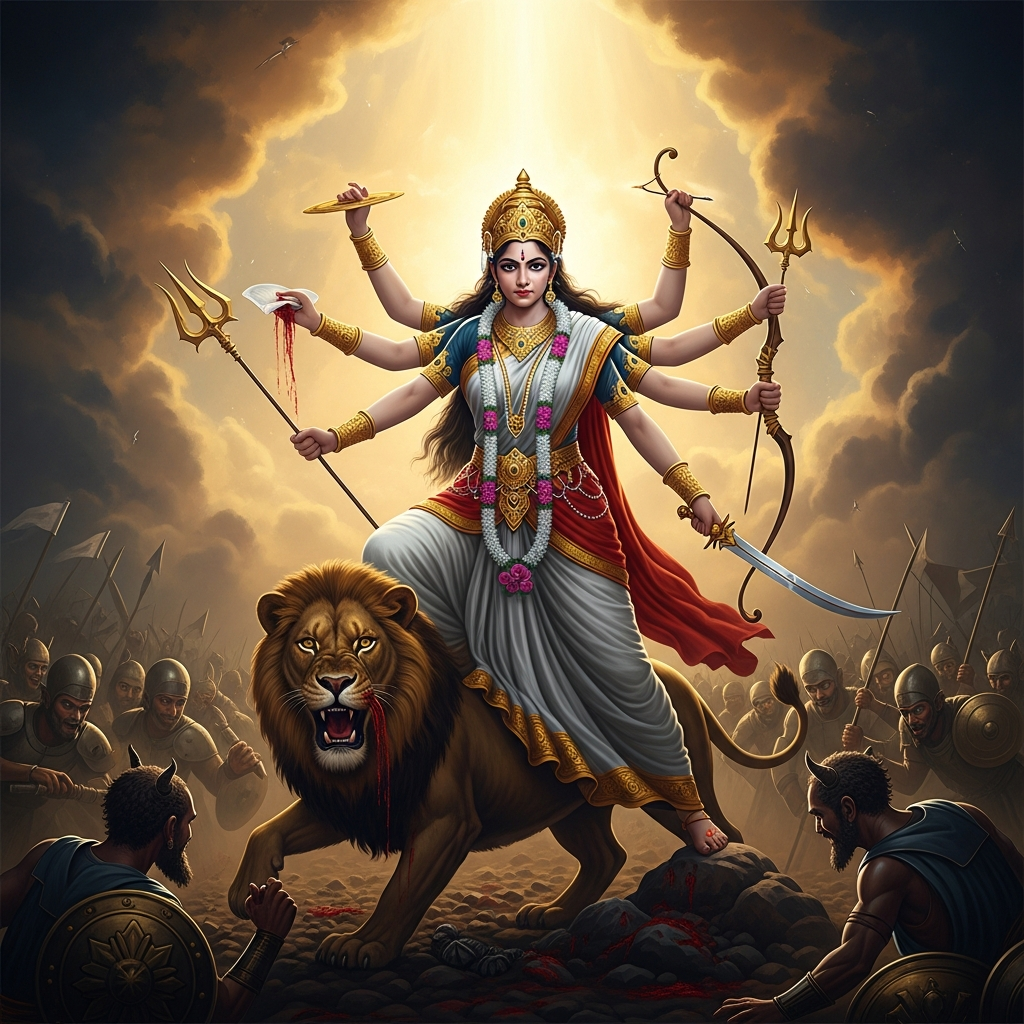
The battle runs for nine days.
This is what Navaratri — nine nights, the great autumn festival — preserves. Nine days of a goddess wearing down a creature who cannot be killed by any force the cosmos already contained. Mahishasura has an army whose names the text catalogs with the grim precision of a war record: Chikshura, Chamara, Udagra, Mahahanu, Durdhara, Durmukha, on through the hundred-named generals of the demon host.
She kills them all.
Her arms move without consulting each other. The discus leaves the index finger and returns. The bow draws and releases without pause. The trident impales three in a single thrust. The lion does its own work, tearing throats with the efficiency of a creature that has been doing this in every age. She does not fight in anger — the anger that built her was used up in building her. What remains is pure function: the cosmic correction, methodical and absolute.
But the boon holds. Mahishasura does not die.
He changes shape.
When she drives at him in his buffalo form, he becomes a lion — and her lion grapples his lion while she attacks the flanks. When she forces her blade toward his lion-throat, he becomes an elephant and charges. She severs the trunk and he reverts to man, and she draws her bow, and he becomes a buffalo again. Buffalo, lion, elephant, man — he cycles through his forms the way a drowning creature cycles through whatever it can reach.
Each transformation saves him a moment. Each moment costs him a wound. He is bleeding from every body he has inhabited. His armies are gone. He fights alone now, shape-shifting alone, and the shifting itself is exhausting him — the effort of becoming something else, again and again, not out of power but out of desperation.
This is the theology the text wants named. The demon’s strength is multiplicity, the claim that he cannot be caught in any single form. And multiplicity is precisely what destroys him — because the goddess does not change. She is the still axis around which his transformations spin, and every revolution costs him more than it saves.
On the ninth day he begins to slow.
She catches him between forms.
He is emerging from the buffalo toward the man — the head still horned, the shoulders still animal, the moment of structural weakness when one shape is dissolving and the other has not yet locked. She has been watching his rhythm. She knows this moment. Her lion crosses the ground in two strides and she is already moving.
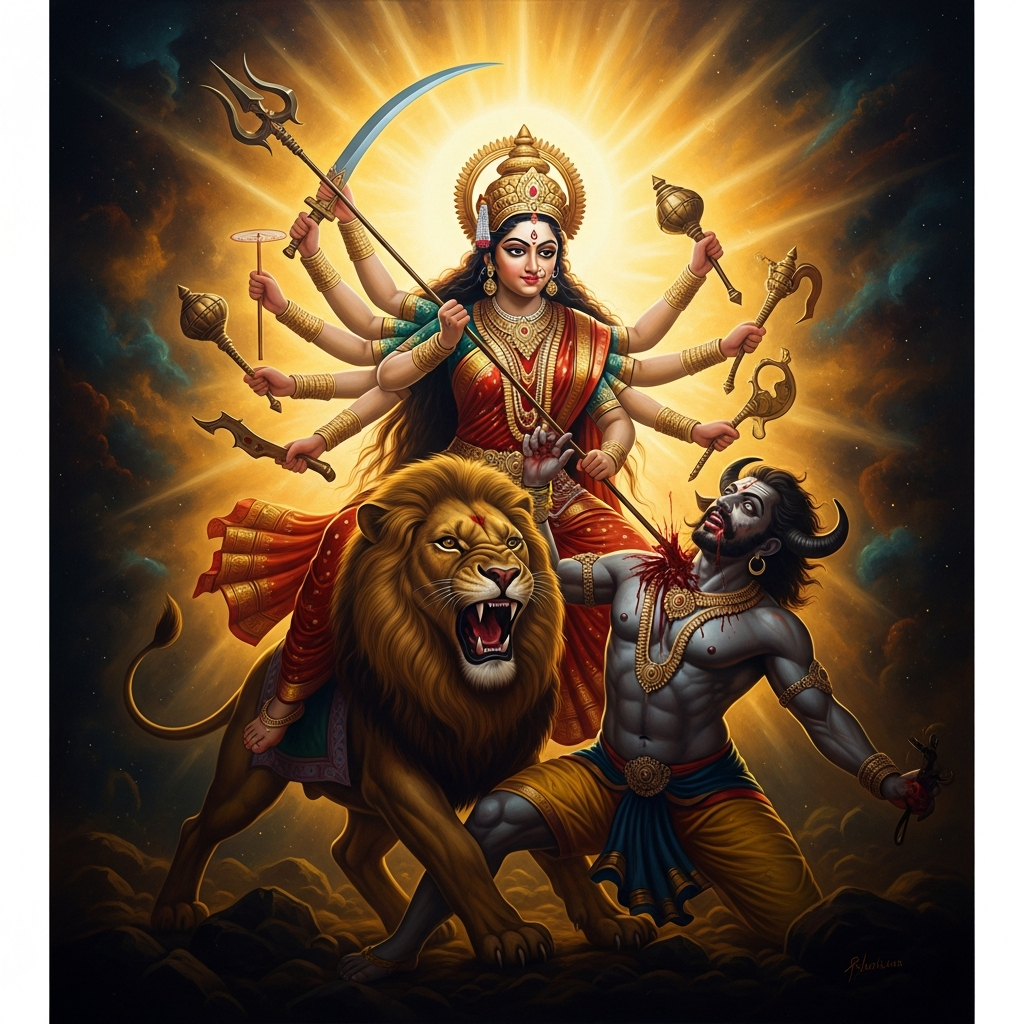
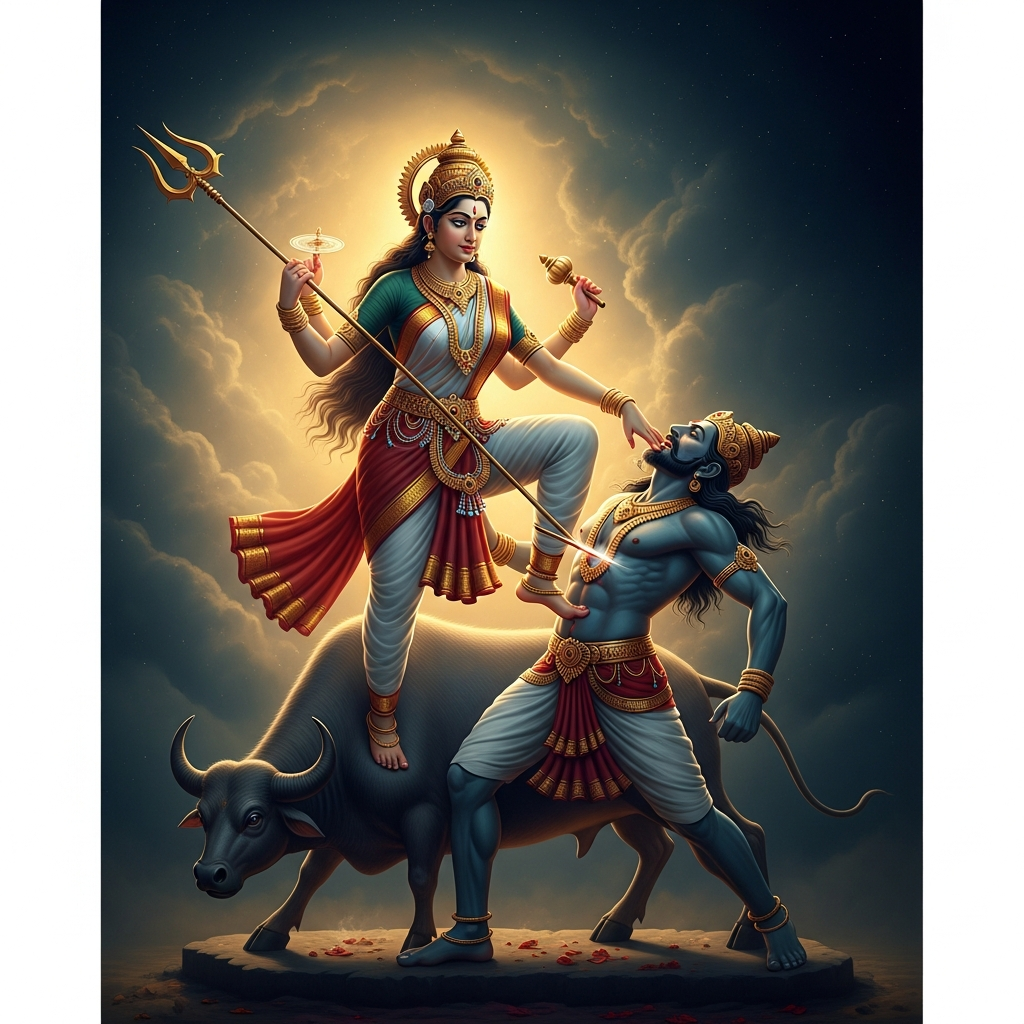
Her foot comes down on the buffalo-throat. Her trident enters the chest that is almost a man’s chest. Both strikes land in the same heartbeat.
Mahishasura stops.
The Devi Mahatmya describes the moment with a strange restraint. The demon looks up. He is no longer the creature who conquered heaven. He is a being meeting the force that was specifically manufactured to meet him, and there is in the encounter something that is not quite victory and not quite defeat — something older, like recognition. The cosmos made her in response to him. He is the reason she exists.
She does not gloat. The lion does not eat. The gods cheer from a respectful distance.
She places her foot on his throat. The image freezes there — the goddess astride the dying buffalo, weapons raised, the lion crouched at her side, the cosmos corrected. Sculptors from Mysore to Khajuraho to Bali will carve it for the next fifteen centuries.
The gods descend to thank her.
They expect her to dissolve back into the combined energies that made her — to return to the column of light the way a tool returns to its cabinet. She does not.
She remains.
Whatever she was before this moment — the texts argue about it, some saying she always existed and was only made visible now, others saying she was genuinely created from the gods’ combined fire — what she is now is Mahadevi, the supreme goddess, and the cosmos has just learned that it cannot be managed without her.
The gods bow. She accepts it.
She tells them, before she withdraws into the mountain, something the Devi Mahatmya records as a standing promise: Whenever the demonic rises again — whenever the cosmic order is broken by what the gods alone cannot correct — invoke me. I will return. The form will differ. The work will be the same.
The texts, looking forward, enumerate the forms she names: Kali when the killing cannot stop. Chandi when the world needs rage. Saraswati when knowledge fails. Lakshmi when fortune abandons the good. Each is her, in a different instrument, returning each time the cosmos needs what only the highest feminine force can provide.
The Devi Mahatmya — also called the Durga Saptashati, the seven hundred verses of Durga — is the primary scripture of Shakta Hinduism. It is read in its entirety during Navaratri in temples and homes across South Asia. On the tenth day, Vijaya Dashami, the day of victory, effigies of Mahishasura are burned and carried to rivers and the sea.
The text’s theological claim is not metaphor dressed as narrative. It is doctrine. The male gods cannot save the cosmos. Their combined energy must be crystallized into feminine form to do what they cannot. The goddess is not assistant or consort. She is supreme, and the supremacy was always there — the crisis only made it visible.
Mahishasura earned his boon the long way. He did not ask for the right thing. The boon that made him untouchable by men and gods created, by the terms of its own exclusion, the force that would undo him — because the cosmos, when it needs something that does not exist, manufactures it from whatever it has.
That is the goddess. That is what she is made of.
Scenes
The gods pour their combined fury into a single burning point above the assembly
 Generating art…
 Nine days on the battlefield
 Generating art…
 She catches Mahishasura mid-transformation, half-emerged from buffalo into man
 Generating art…
 Echoes Across Traditions
Entities
- Durga
- Mahishasura
- Mahadevi
- Indra
- Vishnu
- Shiva


Sources
- *Devi Mahatmya* (*Durga Saptashati*), *Markandeya Purana* chapters 81-93, ~6th c. CE
- Thomas B. Coburn, *Encountering the Goddess: A Translation of the Devi-Mahatmya and a Study of Its Interpretation* (1991)
- Cheever Mackenzie Brown, *The Triumph of the Goddess* (1990)
- David Kinsley, *Hindu Goddesses: Visions of the Divine Feminine in the Hindu Religious Tradition* (1986)
- Wendy Doniger, *Hindu Myths: A Sourcebook Translated from the Sanskrit* (1975)