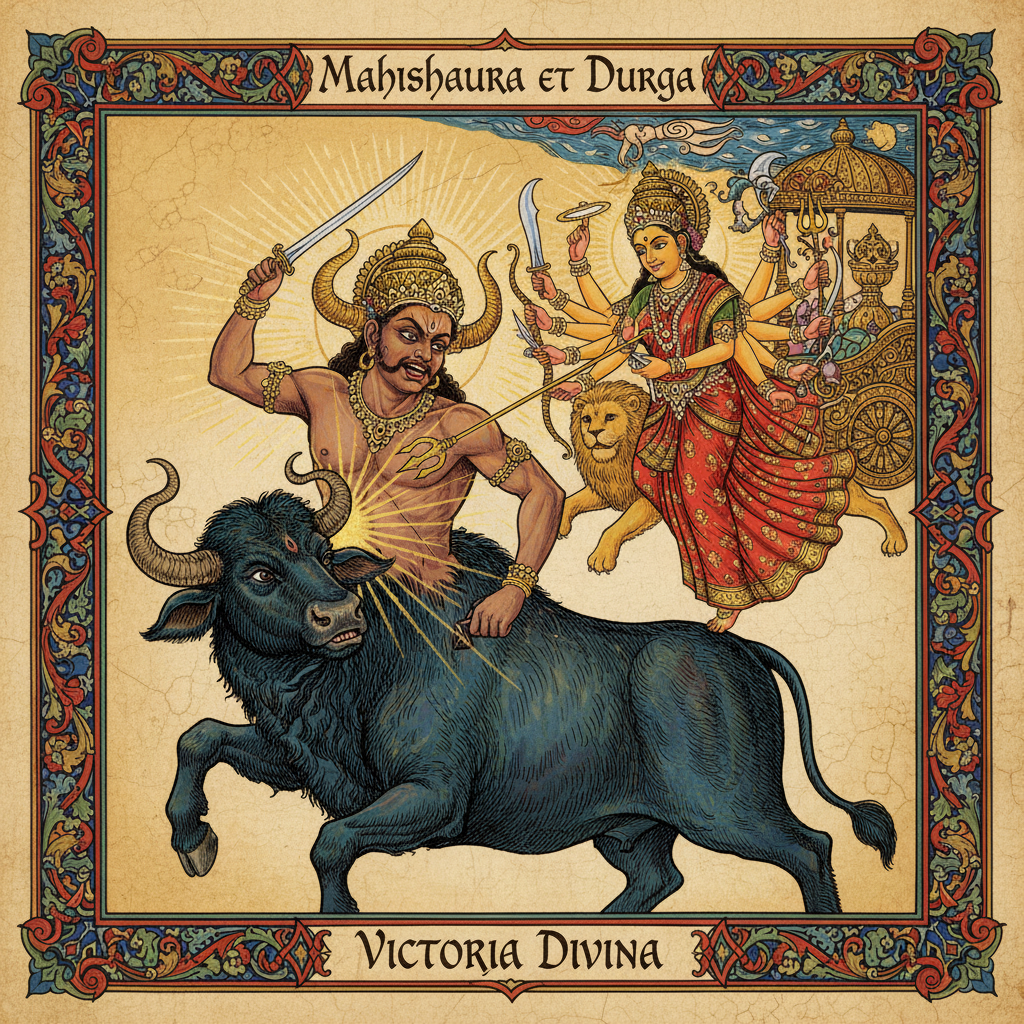
Combat Profile
Buffalo Ascendant
Mahishasura transforms into an invulnerable buffalo form granted by Brahma's boon, gaining immunity to weapons wielded by gods or men.
Hubris Incarnate
Each turn without taking damage from a female warrior increases Mahishasura's ATK by 10%, reflecting his arrogant belief that no woman can defeat him.
Mahishasura performed severe austerities and received a boon from Brahma: he could not be killed by any male being — god, demon, or human (Devi Mahatmya, Markandeya Purana). With this invincibility, he conquered the three worlds and drove the gods from heaven. The gods, unable to defeat him, combined their energies to create Durga — a female warrior goddess, the one category of being his boon did not protect him from (Devi Mahatmya). After a ferocious nine-day battle (commemorated during Navaratri), Durga killed Mahishasura by piercing him with her trident as he shifted between buffalo and human form (Devi Mahatmya 8.22-25).
The theological pattern: evil acquires what it believes is total protection, but divine wisdom exploits the one gap. This echoes Jael and Sisera (the mighty general killed by a woman with a tent peg — Judges 4:21), Judith and Holofernes (the invincible commander beheaded by a widow), and the broader Abrahamic principle that God chooses the weak and unexpected to shame the strong (1 Corinthians 1:27). Mahishasura’s boon reflects a deep Hindu theological insight: arrogance always has a blind spot, and the divine knows exactly where it is.
1 min read
Devi Mahatmya (Markandeya Purana)