The Golden Stool Descends
c. 1701 CE · Founding of the Ashanti Confederacy at Kumase · Kumase (Kumasi), capital of the Ashanti Confederacy, present-day Ghana
Contents
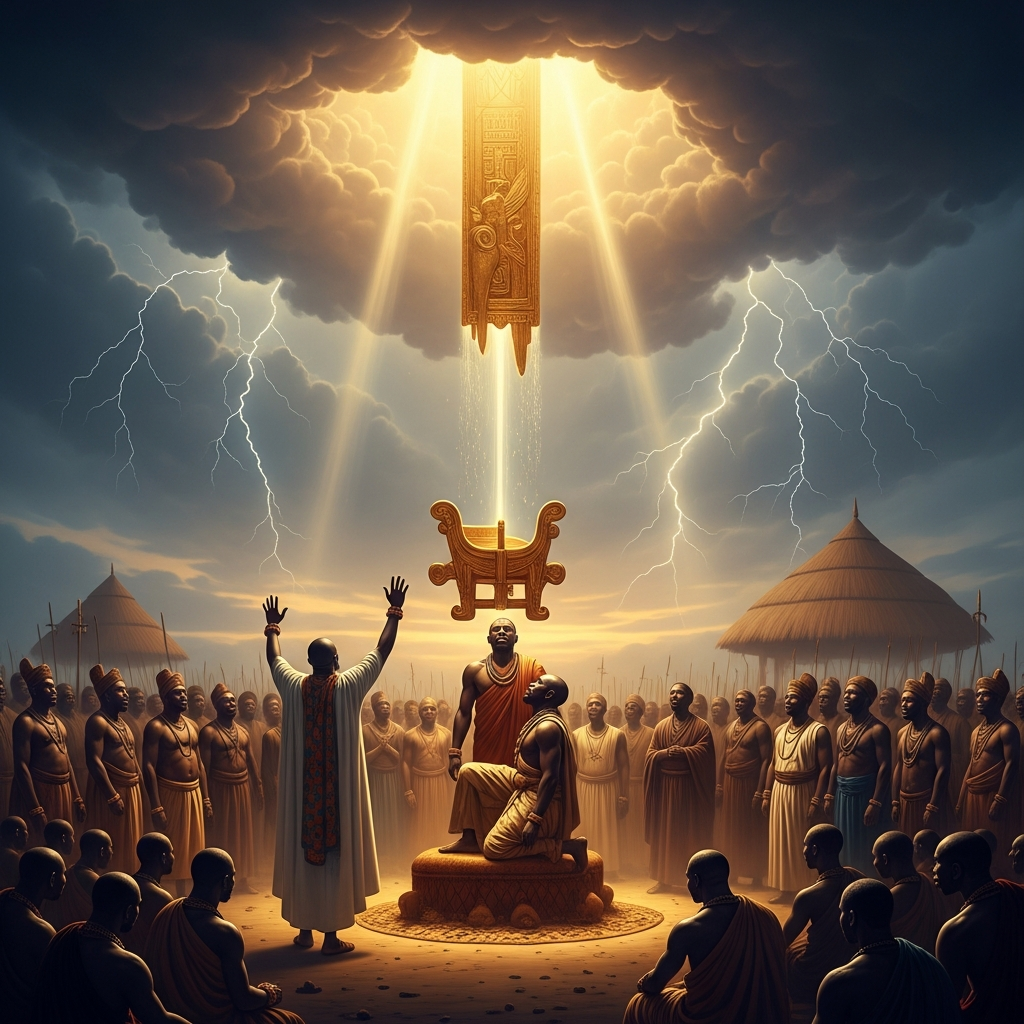
At Kumase the chiefs are gathered, the union still fragile. The priest Okomfo Anokye lifts his hands, the sky cracks, and a stool of beaten gold descends through the thunder onto Osei Tutu's knees.
- When
- c. 1701 CE · Founding of the Ashanti Confederacy at Kumase
- Where
- Kumase (Kumasi), capital of the Ashanti Confederacy, present-day Ghana
The chiefs of the Akan are tired of one another.
They have been at war for as long as anyone can remember. Mampong against Juaben. Bekwai against Kokofu. Each kingdom of the central forest holds its own dwa — its own carved wooden stool — and each stool holds the sunsum, the spirit, of one royal lineage. The stools do not love one another. The stools have spent generations watching their bearers march men into the fields to die. Now Osei Tutu, who has fought beside Denkyira and against Denkyira, who has lived as a hostage and learned the politics of his enemies from inside their court, has called the chiefs to Kumase under the great kuum tree from which the city takes its name. He is asking them to do what no Akan king has ever asked. He is asking them to be one people.
He cannot do it alone. He turns to the man at his right hand.
Komfo Anokye — Okomfo Anokye, the priest, the okomfo who walks between worlds — is not from Kumase. He is from Awukugua-Akuapem, brought into Osei Tutu’s confidence years ago because the boy-king saw what kind of fire was lit behind the priest’s eyes. Anokye is the greatest medicine man the Ashanti will ever produce. He has buried a sword at Kumase that no man will ever pull from the earth. He has planted three kuum trees and pronounced that the tree which thrives will mark the seat of the kingdom. He has done things the chiefs whisper about and refuse to name aloud. Now Osei Tutu asks him for the largest thing he has ever asked anyone for.
Make us one, the king says. Make us one in a way the gods cannot undo.
Anokye walks away into the forest for three days.
When he returns he says nothing about where he has been. He sets the day. He summons every paramount chief of every Akan state to Kumase, and he tells them to bring their stools — the wooden royal stools that hold each lineage’s soul. The chiefs come, suspicious, suspecting a trick. They sit in a wide circle in the courtyard before the king’s compound. The drummers do not drum. The horn-blowers do not blow. The day is hot and still. Anokye stands in the centre with his hands empty.
He begins to chant.
The language he uses is older than any of the chiefs in the circle, older than the kingdoms they rule, older than the Akan migration into the forest. Some of the elders later swear they heard fragments of the speech of Bono-Manso, where the Akan came from. Some swear they heard nothing they recognized at all. He chants for a long time. The sun moves across the sky. The chiefs grow restless. A few of them lean toward each other and begin to ask each other in low voices whether the priest has finally gone mad — whether they have come all this way to witness the breaking of a great mind.
Then Anokye lifts his arms.
The sky above Kumase, which has been clear all day, tears down the middle.
It is not cloud. It is not weather. It is something the language of weather cannot describe — a seam opening in the air itself, a line of darkness above the courtyard from which no rain falls but from which thunder spills like water from an overturned pot. The chiefs feel the thunder in their chests before they hear it in their ears. The horn-blowers drop their horns. The drummers fall to their knees. Anokye is still chanting, louder now, his voice carrying over a sound that should not allow any voice to carry.
And the stool comes down.
It descends slowly, turning in the air as it falls, gleaming gold against the open seam of the sky. It is not large. It is the shape of every Akan royal stool — the curved seat, the central pillar, the four legs — but it is made entirely of beaten gold, and it shines with a light that does not come from the sun. The chiefs cannot move. The wooden stools they carried in their hands feel suddenly small, suddenly cheap, suddenly like the things they actually are: carved pieces of wood from local trees.
The Golden Stool falls.
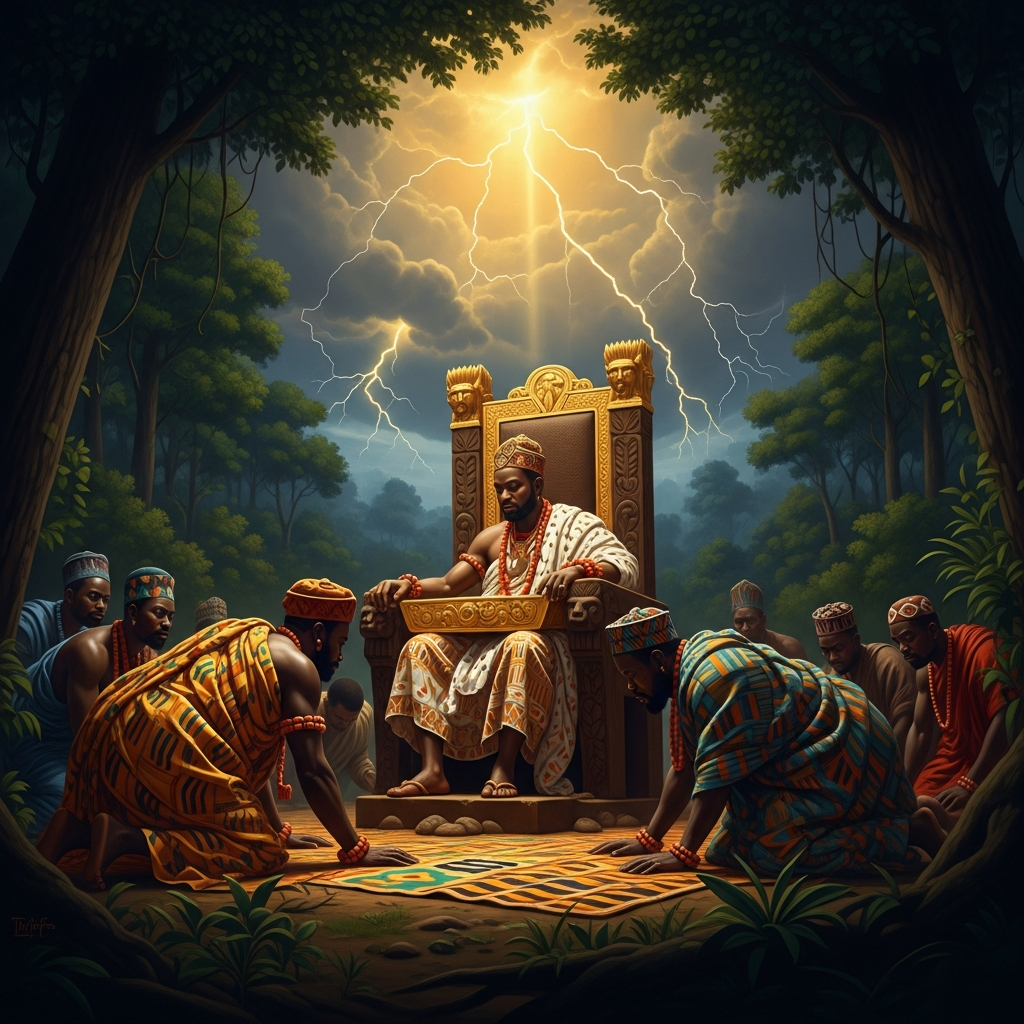
It falls slowly, slowly, the way a leaf falls in still air. It does not fall toward the ground. It falls toward Osei Tutu, who is sitting on his royal stool at the head of the circle, who has not moved since the chanting began, who is watching what is happening with the face of a man who knew exactly what his priest was going to do and is still surprised that he was right. The Golden Stool descends through the last few feet of air and comes to rest, lightly, perfectly, on Osei Tutu’s knees.
It does not touch the ground. It will never touch the ground.
Anokye stops chanting. The seam in the sky closes. The thunder rolls away over the forest like a thing called back to its kennel. The afternoon returns. The chiefs are still on their knees.
Anokye speaks.
This, he says, is the Sika Dwa Kofi. The Golden Stool, born on a Friday. It is not the king’s stool. It is not Osei Tutu’s stool. It is the sunsum of the Ashanti nation — every Ashanti who has ever lived, every Ashanti now living, every Ashanti yet to be born. Their souls are in this stool. To lose this stool is to lose them all.
The chiefs do not breathe.
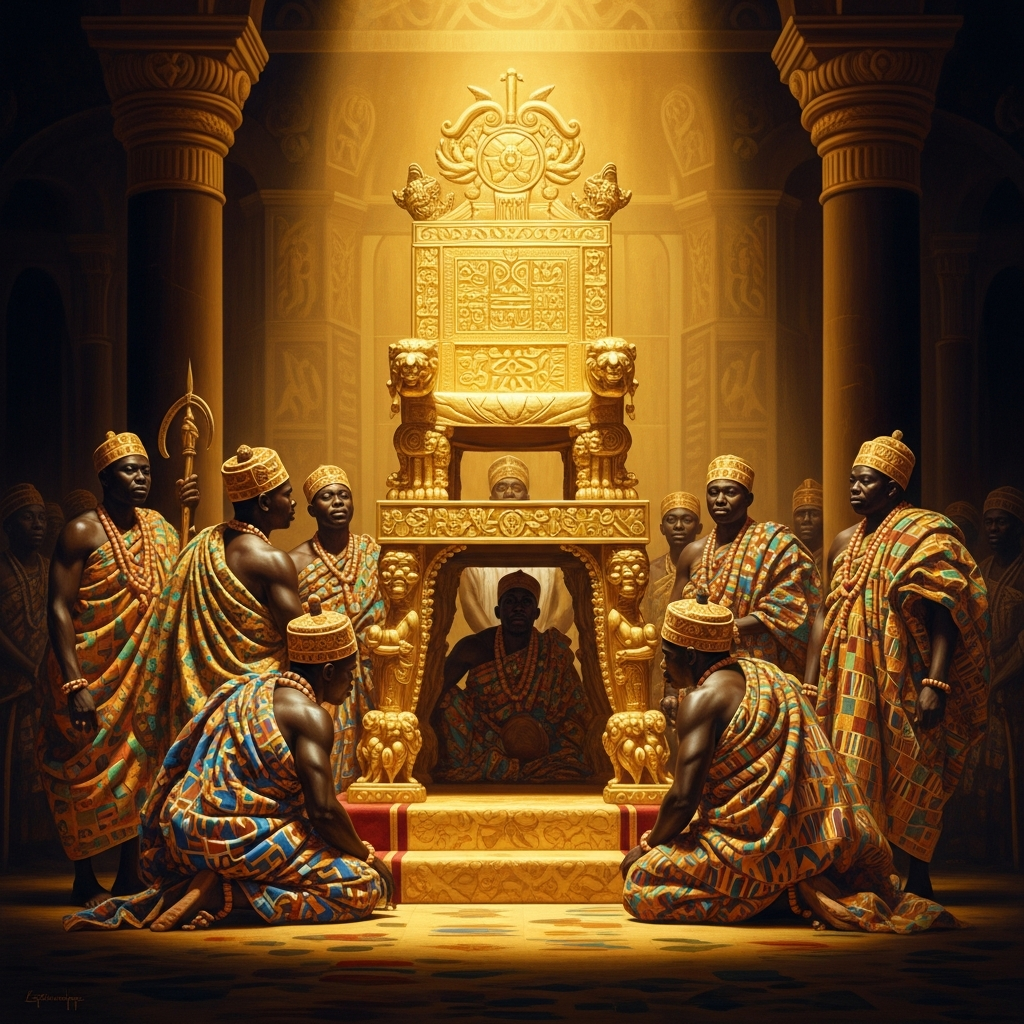
No one will sit on this stool, Anokye says. Not Osei Tutu. Not the king who comes after him. Not the king who comes after that. The stool will have its own palanquin. It will have its own sandals so that even when it is carried, it does not touch the bare earth. It will have its own attendants. It will live in its own room.
He lifts a knife. He cuts a small wound in his own arm and lets the blood fall onto the seat of the Golden Stool. He calls each chief forward. Each chief comes. Each one cuts himself and bleeds on the stool.
Now you are one, Anokye says, because the stool holds the blood of all of you. To attack one of you is to attack the stool. To attack the stool is to attack all of you.
Then he takes each chief’s wooden stool — the sunsum of their separate lineages — and buries them. He buries every old stool of every old kingdom in a single grave near the river. He buries the wars that came with them.
The Ashanti Confederacy is born.
For two hundred years it holds. The Ashanti push out from Kumase across the forest, eating their old enemies, building roads of beaten earth and a system of law. They become, by the eighteenth century, the dominant power of the Gold Coast — and through it all the Golden Stool sits in its room and never touches the ground, and no king sits on it, and the sunsum of the nation rides safely inside it.
Then the British come.
It is 1900. The Ashanti have already lost a war. Their king, Prempeh I, has been exiled to the Seychelles. The British governor of the Gold Coast, Sir Frederick Mitchell Hodgson, comes up to Kumase to receive what he believes is the last formal submission of a defeated people. He sits in the great courtyard. He looks around. He sees a stool placed beside him for the use of guests. He does not understand what stools mean here. He sits on it. Then he stands and he speaks to the gathered chiefs and he tells them — through his interpreter, in the comfortable voice of a man who has not understood a single thing he has been told about the country he is governing — that the Golden Stool, which he has heard so much about, must now be brought out and placed under him so that he may sit upon it as the representative of the Queen.
The chiefs in the courtyard go very still.
They are still in the way the old chiefs went still on the day Anokye opened the sky. They are still in the way men go still when they have just realized that the person speaking does not understand what he has asked for and that they are about to have to teach him at terrible cost.
Hodgson finishes his speech. He sits down. He waits.
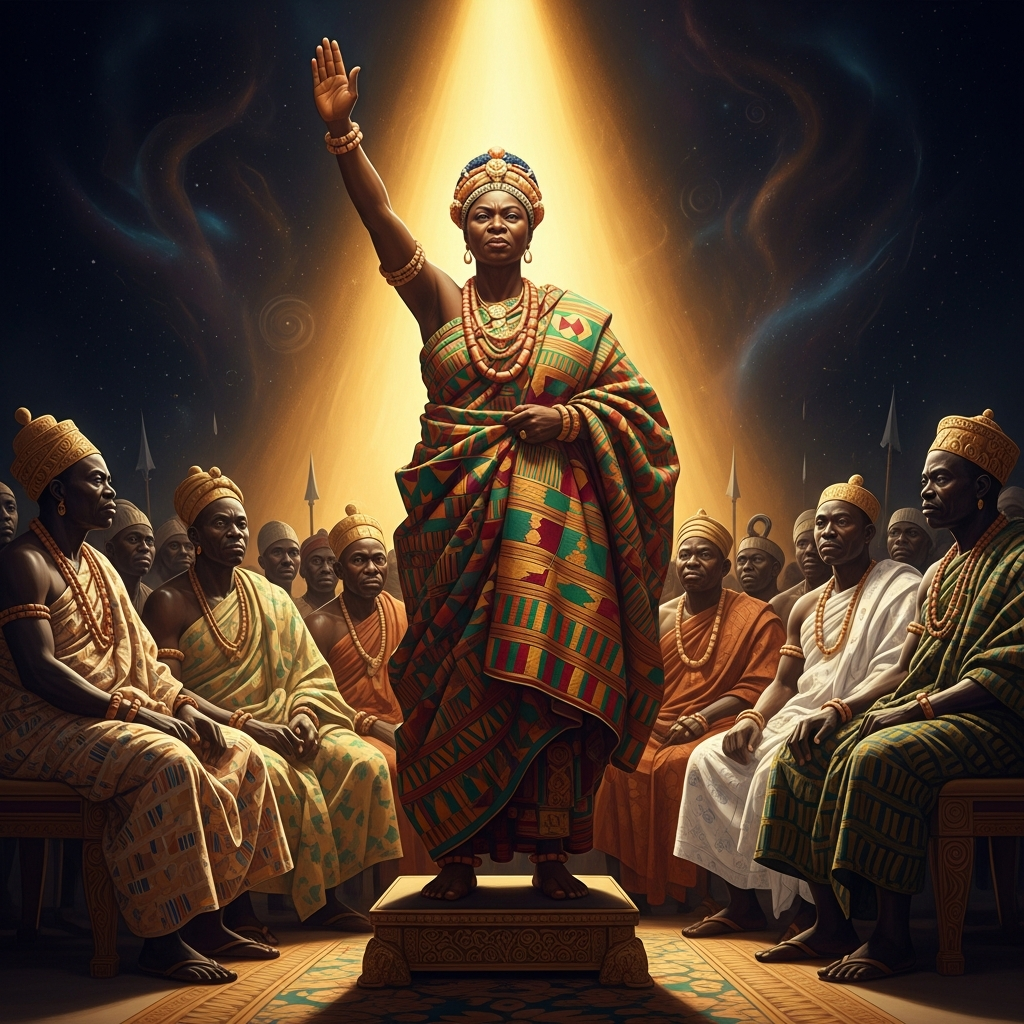
That night the queen mother of Ejisu, Yaa Asantewaa — sixty years old, small, sharp-eyed, the woman the king named regent before he was taken — rises in the secret council of chiefs and looks around the room. The chiefs are arguing. Some say to give the British what they want; the king is exiled, the people are tired, what is one stool against another generation of war. Yaa Asantewaa stands and lifts a rifle in both hands.
If you, the men of Ashanti, will not go forward, she says, then we, the women, will. I shall call upon my fellow women. We will fight. We will fight till the last of us falls in the battlefields.
The men go silent. Then they pick up their rifles too.
The War of the Golden Stool lasts months. The British besiege the fort at Kumase, and the Ashanti besiege the British inside it. People die on both sides. Yaa Asantewaa is eventually captured, exiled to the Seychelles where she dies in 1921, and the British declare victory. They march into Kumase, they search every house, they dig in every compound, they tear apart every shrine they can find.
They never find the Golden Stool.
The stool has been hidden by its priests, moved through the forest at night, kept by men and women who would die rather than give it up. Years later, in 1921, a group of road workers will accidentally dig up its hiding place and strip away some of its gold ornaments — and the Ashanti, when they find out, will track down those workers and put them on trial under their own law, and the British colonial authority will refuse to interfere because by then the British have understood, in the slow way conquerors understand, what the stool is.
The stool is brought back to Kumase. It is restored. It is placed on its palanquin. It is given its sandals. It is set in its own room. It does not touch the ground.
It still does not touch the ground.
The Asantehene of today — the king of the Ashanti, descended through three centuries of sunsum that the chiefs poured out of their veins onto its golden seat — lives in the palace at Manhyia. The stool lives there too. He does not sit on it. No king has ever sat on it. On great festival days it is carried out, lifted high, and carried back. It is older than the British Empire that demanded it. It is older than every government that has ruled this land since.
The seam in the sky closed long ago.
The thing that came through is still here.
Scenes
Okomfo Anokye stands beneath a torn sky above Kumase, arms raised, calling the soul of a nation down through cloud and lightning
Generating art… The stool comes to rest on Osei Tutu's knees
 Generating art…
 The Golden Stool is borne on its own special palanquin, never permitted to touch the earth, its own sandals carried beside it — the soul of a people who refuse to set themselves down
 Generating art…
 Two centuries later, Yaa Asantewaa rises in the council of chiefs and seizes a rifle
 Generating art…
 Echoes Across Traditions
Entities
- Osei Tutu
- Okomfo Anokye
- The Golden Stool (Sika Dwa Kofi)
- Yaa Asantewaa
Sources
- Ivor Wilks, *Asante in the Nineteenth Century: The Structure and Evolution of a Political Order* (1975)
- T.C. McCaskie, *State and Society in Pre-Colonial Asante* (1995)
- Adu Boahen, *Ghana: Evolution and Change in the Nineteenth and Twentieth Centuries* (1975)
- Agnes Akosua Aidoo, 'Asante Queen Mothers in Government and Politics in the Nineteenth Century,' *Journal of the Historical Society of Nigeria* 9.1 (1977)