Contents
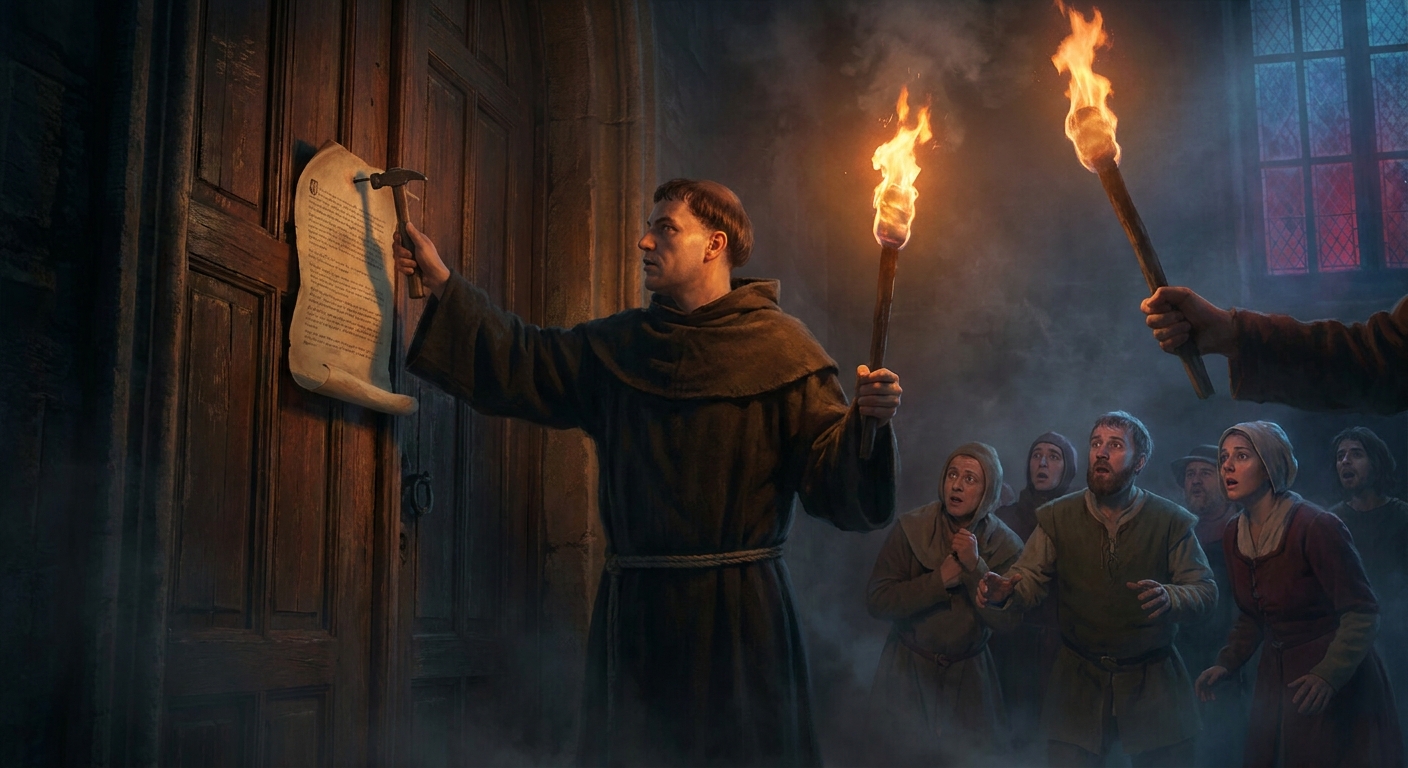
October 31, 1517. An Augustinian friar drives a nail into a church door and, without meaning to, splits Christendom in two.
- When
- October 31, 1517
- Where
- Wittenberg, Saxony
It is All Hallows’ Eve in Saxony, and the friar has a hammer.
Martin Luther is thirty-three years old. He is an Augustinian, a doctor of theology, a professor at the University of Wittenberg, a man who has spent years in a monastery cell terrified that no amount of penance will ever be enough. He knows, more intimately than most, what it costs to try to purchase your way into God’s mercy. He has done it himself — the confessions, the fasts, the pilgrimages, the crawling on his knees. None of it has worked. The terror does not lift.
What lifts it, eventually, is a sentence from the prophet Habakkuk, repeated by Paul in his letter to the Romans: the righteous shall live by faith. Not by deeds. Not by purchase. By faith alone.
This is the wound that is already open in him when Johann Tetzel arrives in the neighboring territories of Saxony, swinging his strongbox and his sermon.
Tetzel is good at his job.
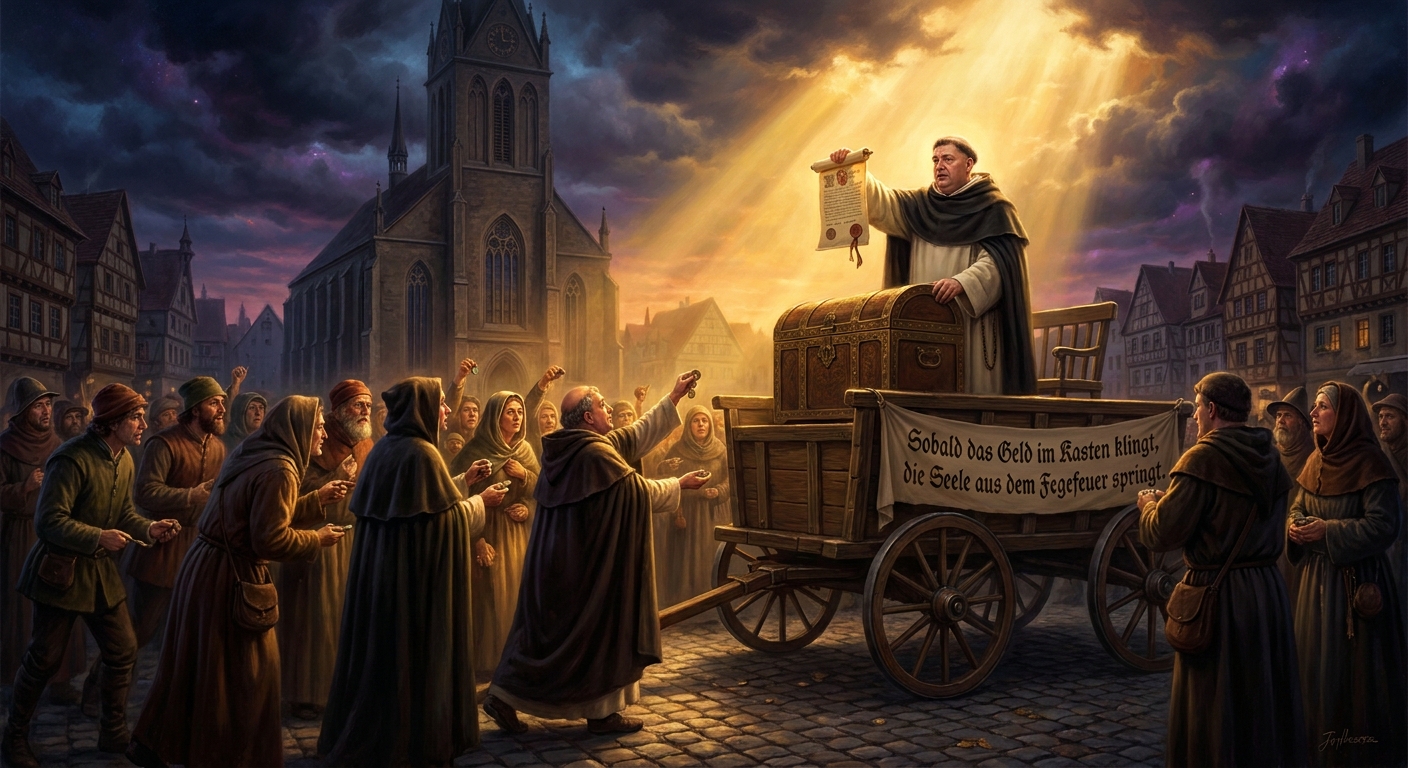
He rides into town with a brass chest, a papal bull, and a pitch so well-honed it sounds like mercy. The money goes to Rome, to the rebuilding of St. Peter’s Basilica — the greatest construction project in Christendom, hemorrhaging funds. The pitch is simple: buy a letter of indulgence and shorten the time your dead relatives spend suffering in purgatory. He has a line for the crowds, and the crowds remember it: As soon as the coin in the coffer rings, the soul from purgatory springs.
Luther’s parishioners are crossing into Tetzel’s territory and coming back waving their certificates. They stop confessing. Why confess when you’ve already paid? They show Luther the papers as if the papers are the thing.
He writes ninety-five responses.
He writes them in Latin, because they are academic propositions intended for academic debate — the standard form of scholastic argument. He is not writing a manifesto. He is not launching a movement. He is doing what a professor does when he believes a question has been settled incorrectly: he posts a challenge on the church door, which is Wittenberg’s public bulletin board, and invites colleagues to argue with him.
The theses are not gentle. Thesis 27 mocks Tetzel directly: They preach only human doctrines who say that as soon as the money clinks into the money chest, the soul flies out of purgatory. Thesis 32 goes further: those who believe their salvation is secured by indulgence letters will be damned along with their teachers. Thesis 86 asks a question that is almost impertinent in its plainness: if the pope has the power to free souls from purgatory, why does he not simply free them all, out of love, rather than for money?
He nails the document to the door — or he sends it by letter to Archbishop Albrecht of Mainz, who is personally profiting from Tetzel’s sales. The historical record is genuinely ambiguous. The nail may be legend. What is not legend is that within two weeks, someone translates the theses into German and hands them to a printer, and within two months, they are everywhere.
The Gutenberg press has been running for sixty years. This is the first time it changes the world in a season.
Rome is slow to understand what is happening.
Pope Leo X — a Medici, a man who once said the papacy was a gift from God to be enjoyed — initially dismisses Luther as a quarrelsome monk. A German matter. A theology squabble. He sends a cardinal to sort it out. The cardinal and Luther argue, and Luther refuses to recant, and the cardinal reports back that this is not a squabble.
Rome issues a papal bull in 1520: Exsurge Domine. Luther has sixty days to recant forty-one specific errors. Luther burns the bull in the public square at Wittenberg.
The excommunication follows in January 1521.
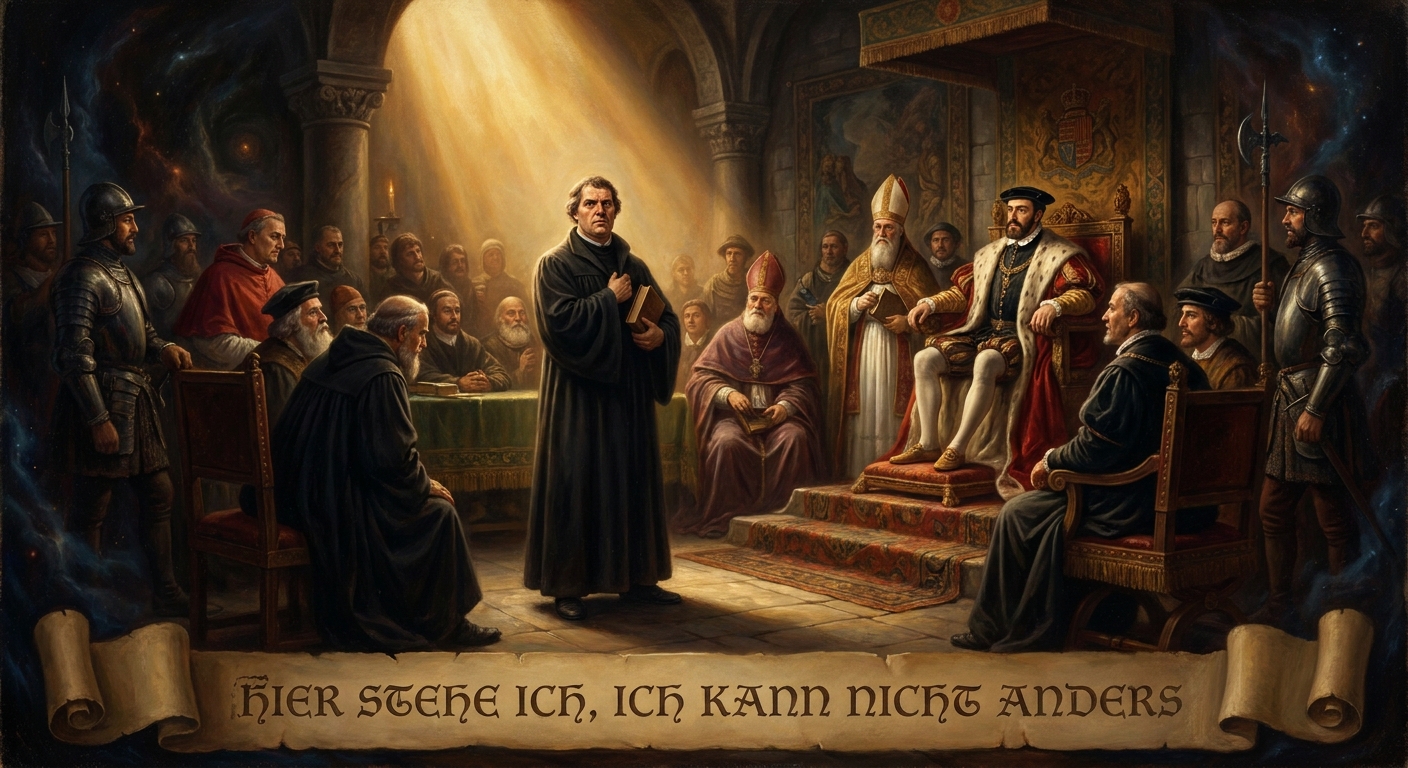
That spring, the Holy Roman Emperor Charles V summons Luther to the Diet of Worms — an imperial assembly, not a dietary one — and gives him one last chance to take it all back. Luther asks for a night to think. The next day he stands before the emperor and the princes and the papal legate and refuses: Unless I am convicted by scripture and plain reason — I do not accept the authority of popes and councils, for they have contradicted each other — my conscience is captive to the Word of God. I cannot and I will not recant anything, for to go against conscience is neither right nor safe. Here I stand. God help me.
The emperor declares him an outlaw. A friendly prince kidnaps him for his own protection and hides him in Wartburg Castle, where Luther translates the New Testament into German in eleven weeks.
The Bible is now in the language of the people. The people are now reading it themselves. The institution that controlled the reading of scripture has lost the monopoly.
By 1525 the Reformation has ceased to be Luther’s.
Thomas Müntzer leads peasant armies in the name of the same gospel Luther preached, and Luther denounces them and calls for their slaughter, and twenty thousand die. Zwingli in Zurich reads the same texts and disagrees with Luther on the Eucharist: Luther believes Christ is truly present in the bread; Zwingli believes it is symbol. They meet in Marburg in 1529 and fail to agree. Calvin will build a different system in Geneva. The Anabaptists will reject infant baptism entirely. The English will find their own path, for reasons that are partly theological and partly about Henry VIII’s need for an annulment.
Each of them is doing what Luther did: reading scripture and drawing conclusions, without the pope to tell them they are wrong.
Within a century, there are hundreds of Protestant denominations. Within four centuries, there are tens of thousands.
Luther did not intend to break the Church. He intended to reform it from within — the way Francis of Assisi had, the way Dominic had, the way every great reformer before him had. He was an Augustinian monk, not a revolutionary. He believed in the Church, just not in the Church’s right to sell grace.
The nail, or the letter, or whatever it was — it was a professor’s challenge, not a declaration of war.
But the press was running. The German was clear. The question was live: if a coin can spring a soul from purgatory, whose soul is the Church actually in the business of saving?
Christendom, which had survived the Black Death and the Crusades and the East-West Schism of 1054, does not survive the answer.
What breaks a thousand-year institution is not usually an army. It is a question the institution can no longer answer without exposing something it would rather not expose. Luther’s question was simple: does God’s grace cost money? The Church had been saying yes, in practice, for generations. Luther said no, in ninety-five propositions, in Latin, on a church door.
The printing press made it German. Germany made it European. Europe made it global. The fracture has never healed, and most of the Christianity alive in the world today — Baptist, Methodist, Presbyterian, Pentecostal, Anglican, Lutheran — traces its license to disagree back to the afternoon a frightened monk reached for a hammer in Wittenberg.
Scenes
Luther nails the Ninety-Five Theses to the door of Wittenberg Castle Church, October 31, 1517 — an academic disputation notice that becomes the spark of the Reformation
Generating art… Johann Tetzel works the crowds of Saxony with his famous pitch: 'As soon as the coin in the coffer rings, the soul from purgatory springs
 Generating art…
 Before the Diet of Worms, 1521, Luther refuses to recant: 'Here I stand
 Generating art…
 Echoes Across Traditions
Entities
- Martin Luther
- Johann Tetzel
- Pope Leo X
Sources
- Martin Luther, *Disputatio pro Declaratione Virtutis Indulgentiarum* (*Ninety-Five Theses*), 1517
- Roland Bainton, *Here I Stand: A Life of Martin Luther* (1950)
- Lyndal Roper, *Martin Luther: Renegade and Prophet* (2016)
- Heiko Oberman, *Luther: Man Between God and the Devil* (1989)