The Boat and the Shore
May 1966 · Geneva — and the years of exile that follow · Geneva, Switzerland — and the road of exile: France, the United States, Southeast Asia, Plum Village
Contents
A Vietnamese Zen monk and poet is traveling the world in 1966 with a peace proposal that neither side of the Vietnam War wants — exiled by his own country for refusing to choose between two armies — and in the Geneva hotel room where he meets Martin Luther King Jr., he is naming what he calls engaged Buddhism: the idea that washing dishes mindfully and stopping a war mindfully are the same practice.
- When
- May 1966 · Geneva — and the years of exile that follow
- Where
- Geneva, Switzerland — and the road of exile: France, the United States, Southeast Asia, Plum Village
He has a peace proposal.
It is not complicated. He has written it down in careful English, this Vietnamese monk who has been studying at Princeton and Columbia and who reads Tolstoy alongside the Pali suttas and who has been corresponding with Thomas Merton about what Christianity and Buddhism might teach each other about peace. The proposal is that both sides — the government of South Vietnam and the National Liberation Front — call a ceasefire, negotiate, and allow the Vietnamese people to determine their own future without the American military in the south and the North Vietnamese Army pressing south.
Neither side will accept it.
He already knows this. He is going to say it anyway.
He has been traveling since May.
Paris, London, New York, Washington — the monk in brown robes with the bowl-cut hair and the measured speech, carrying the peace proposal that no government wants and the photographs of the burning villages that every newspaper wants. His School of Youth for Social Service back in Vietnam has been rebuilding bombed-out villages for two years — teams of young monks and students who go to the site of the latest bombing and dig out the rubble and build back without asking which side’s bombs fell. Both sides have threatened the workers. Both sides have killed several of them.
He refuses to call the dead martyrs for either cause. He calls them dead. He calls the people who killed them wrong. He does not specify which army.
This is the position that gets him exiled.
He meets King in Geneva in May 1966.
The conversation is not recorded. What is recorded is its effect: King comes out of the hotel room and announces that he is now publicly opposed to the Vietnam War. This is a major shift. His advisors have been urging caution — the antiwar position will cost him the Johnson administration’s support for civil rights legislation. King has been calculating the cost. After two hours with the Vietnamese monk, he stops calculating.
He will give the Beyond Vietnam speech at Riverside Church in New York on April 4, 1967 — exactly one year before he is shot. The speech costs him what his advisors predicted: the editorial support of the New York Times, the backing of the Johnson White House, the goodwill of the mainstream civil rights coalition. He gives it anyway.
In January 1967, he writes to the Nobel Committee in Oslo: I do not personally know of anyone more worthy of this prize than this gentle monk from Vietnam. He details Nhat Hanh’s peace proposals, his refusal to take sides, his rebuilding work. Oslo does not award the prize that year — the Committee declares no suitable living candidate. The letter is preserved in King’s archives.
The exile begins informally in 1966 and becomes official the following year.
The government of South Vietnam revokes his right to return. The government of North Vietnam, which he has also criticized, will not invite him. He is, in the most literal sense, a man without a country — a Vietnamese citizen whom Vietnam will not receive. He settles in France. He continues writing. He continues the peace work from a distance, corresponding with prisoners on both sides, raising money for refugees, translating suttas, planting cabbages.
He founds Plum Village in the Dordogne in 1982. It becomes a monastery, a community, a meditation center — and the base from which he teaches what he has been teaching since the war years: that the breath and the bomb are connected, that the quality of attention you bring to the present moment is not separate from the quality of action you bring to the political moment.
He teaches this with extraordinary specificity. He does not say be mindful. He says: when you wash the dishes, wash the dishes. Not to get them clean. Wash them as an end in themselves. The monk who cannot wash dishes mindfully cannot do anything else mindfully either — not comfort a dying man, not negotiate a ceasefire, not look at the photograph of the burning village with the clear eyes that the village deserves.
Engaged Buddhism is not a program.
He is asked, in every country he visits, for the Buddhist equivalent of the social gospel — the doctrine, the platform, the five-point plan. He does not have one. He has the breath. He has the precepts. He has the teaching that inter-being — interbeing, his coined English word for the Madhyamaka insight that nothing exists independently — means that the cloud is in the paper, the logger is in the page, the war is in the temple bell and the temple bell is in the possibility of the war’s end.
He tells the story of the pirates who attack the boats of Vietnamese refugees in the Gulf of Thailand in the late 1970s. Hundreds of boats. Thousands of refugees. Boys who grew up in fishing villages and became pirates because the economic collapse and the war left them no other option. He says: if I had been born in that village, I would be a pirate. He is not forgiving the piracy. He is refusing to make the pirate into a category separate from himself.
This is what gets labeled engaged Buddhism. It is simply Buddhism.
He returns to Vietnam on January 12, 2005.
He has been in exile thirty-nine years. He is seventy-eight years old. He flies into Hanoi. There are Buddhist monks and nuns at the airport. He lands. He is received. He holds retreats. He meets with government officials. He pushes, quietly and with the same measured patience he brings to everything, for the release of imprisoned monks and the restoration of monastic property confiscated after reunification.
He is not received warmly by all. The government controls his schedule, monitors his meetings, restricts his access. He accepts the restrictions. He is inside the country. He holds retreats in Hanoi and Ho Chi Minh City and the mountains where the war was fought. He is in the country he left in 1966. The country is not what he left.
He returns to Plum Village. He does not stop going back.
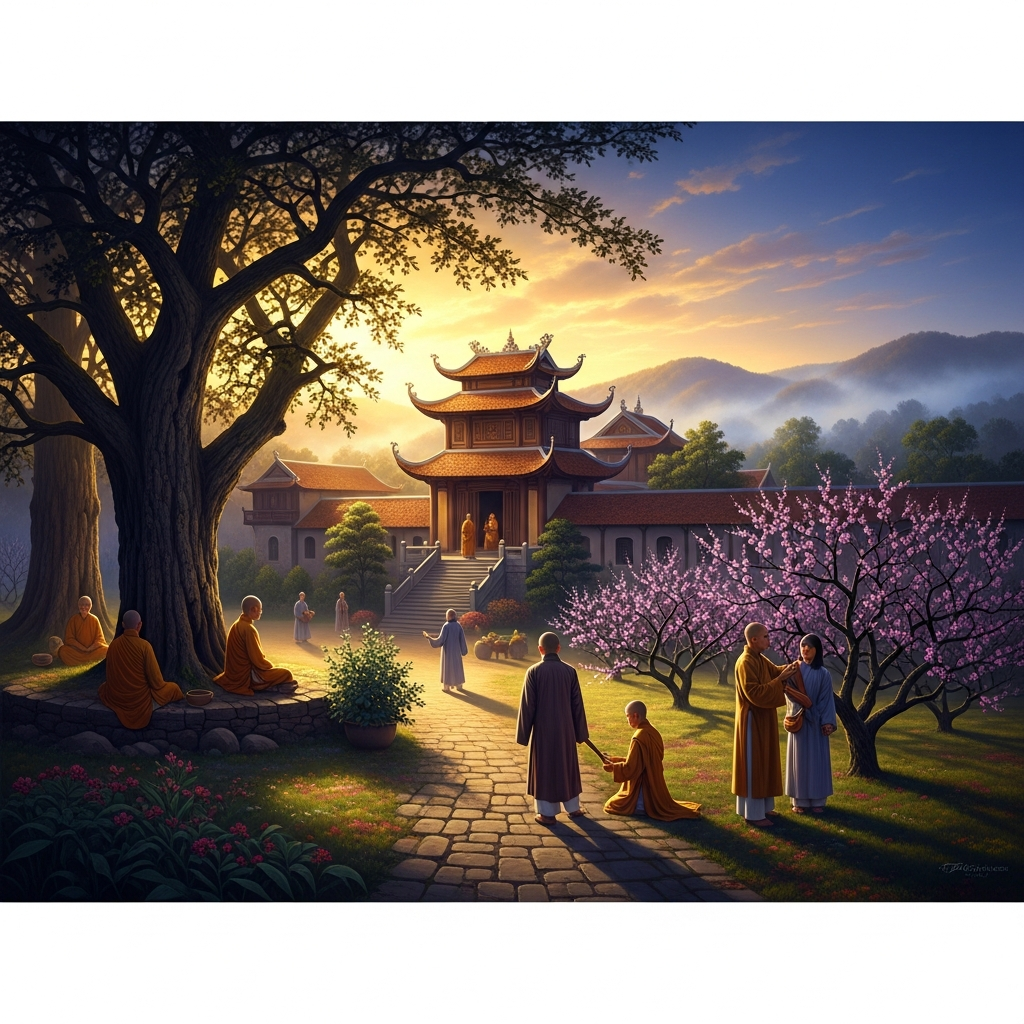
He suffers a severe stroke in 2014 that leaves him largely nonverbal. He returns to Vietnam in 2018 to die at his root temple, Tu Hieu Pagoda in Hue — the monastery where he was ordained at sixteen. He sits in the garden. He sits in the chapel. He looks at the monks who have come to practice what he spent sixty years naming.
He dies on January 22, 2022, at ninety-five. He is in Hue. He is home.
He coined the word interbeing because English did not have one. He meant it precisely: not that things are connected but that things have no independent existence to connect. The cloud is not connected to the rain; the cloud is the rain in a different moment. The monk is not connected to the soldier; they are the same conditions in different choices.
Engaged Buddhism is the practice of living inside that understanding without looking away from what it implies. The war is in the breath. The peace is also in the breath. The question is what you do with the eight seconds between them.
He washed the dishes for seventy-nine years. He meant every one of them.
Scenes
Geneva, May 1966 — Thich Nhat Hanh meets Martin Luther King Jr
Generating art… Plum Village, France — the monastery in exile Nhat Hanh founds in 1982, where the engaged Buddhism forged in wartime becomes a practice for peacetime
 Generating art…
 Vietnam, 1966 — the countryside on both sides of the war that Nhat Hanh's School of Youth for Social Service rebuilds village by village, refusing to favor either army
 Generating art…
 Echoes Across Traditions
Entities
- Thich Nhat Hanh
- Martin Luther King Jr.
- the School of Youth for Social Service
- Tiep Hien Order
- the 'lotus in a sea of fire'

Sources
- Thich Nhat Hanh, *Vietnam: Lotus in a Sea of Fire* (1967)
- Thich Nhat Hanh, *The Miracle of Mindfulness* (1975)
- Thich Nhat Hanh, *Being Peace* (1987)
- Martin Luther King Jr., letter to the Nobel Committee nominating Thich Nhat Hanh, January 25, 1967
- Sister Chan Khong, *Learning True Love: Practicing Buddhism in a Time of War* (1993)