
James Cone and the Theology of the Lynching Tree
1968-1969 CE — *Black Theology and Black Power* published 1969; *The Cross and the Lynching Tree* published 2011 · Adrian College, Michigan, and Union Theological Seminary, New York City
Contents
Two months after Martin Luther King Jr. is shot dead on a balcony in Memphis, a twenty-eight-year-old theology professor in Adrian, Michigan sits down at a small typewriter in a small apartment and writes a book in three months that says the thing American Christianity has been avoiding for three centuries: that if the Christian God is on the side of the oppressed, then the Christian God in America today is Black, because Black people are the oppressed, and that this is not metaphor but the central theological claim of the Gospel applied finally to its actual context.
- When
- 1968-1969 CE — *Black Theology and Black Power* published 1969; *The Cross and the Lynching Tree* published 2011
- Where
- Adrian College, Michigan, and Union Theological Seminary, New York City
The typewriter is in the corner of a small apartment in Adrian, Michigan.
The apartment is small because Adrian College does not pay much, and because James Cone is twenty-eight years old, and because in 1968 the institutional rewards for being a Black theologian in a white denominational college are not yet what they will become. Adrian is a Methodist school, mostly white, in southeast Michigan. He is the only Black faculty member in the religion department. He has a doctorate from Garrett Theological Seminary and Northwestern University. His dissertation was on Karl Barth.
It is summer. The windows are open. Outside, somewhere in the country, the radio is reporting on Eugene McCarthy and Bobby Kennedy and the burning of cities and what a Memphis hotel balcony looked like on the evening of April 4, when his teacher and his prophet — the man whose voice he could not now hear without weeping — was shot dead at thirty-nine.
He sits at the typewriter and he is furious.
This is the fact he will say later, repeatedly, when the book is famous. He was furious. The book was not written from a position of theological poise. It was written from a position of rage, refined into theological precision over ninety days because rage refined was, he had decided, what the situation required.
He types the first sentence. He keeps typing.
He has been taught the white tradition.
This is the second fact. James Cone is not an autodidact. He is one of the most thoroughly educated theologians of his generation. He has read Karl Barth in German and Paul Tillich in English and Reinhold Niebuhr’s Moral Man and Immoral Society and The Nature and Destiny of Man. He has read Bonhoeffer’s Letters and Papers from Prison. He has read Søren Kierkegaard. He has read Thomas Aquinas and Augustine and the Cappadocians.
He has noticed something. None of them — Barth, Tillich, Niebuhr, Bonhoeffer — wrote a single significant theological sentence about the lynching of Black people in America. Niebuhr lived in New York from 1928 onward. Niebuhr was, during the years when thousands of Black men were being hanged from trees across the South, the most influential Protestant theologian in the United States. Niebuhr wrote about the moral failings of liberalism, the necessity of irony in history, the use of force in resisting fascism. He wrote, in passing, about race. He did not write about the lynching tree.
This is not, to Cone, a minor omission. This is the omission. This is the fact that white theology, even the best of it, even the most courageous of it, even Bonhoeffer who was hanged for his resistance to Hitler, has somehow constructed an entire theological apparatus on top of the buried bodies of lynched Black men and women without noticing them. The corpse is under the floor. The theologians have been writing in the parlor. The theology, however brilliant, is incomplete.
He decides to write the book that names what is under the floor.
The thesis of Black Theology and Black Power is so direct that white theologians, when they first read it in 1969, will not know what to do with it.
The thesis is this: God is Black.
This is not, Cone insists, metaphor. He is not saying that God resembles Blackness or sympathizes with Blackness or has Black people in some special category of divine concern. He is saying something stronger and more uncomfortable. He is saying that the central theological claim of Christianity — that God identifies with the oppressed in history, that the cross is the moment where God enters human suffering not from above but from below, that incarnation means the divine takes on the specific flesh of a specific people in a specific place at a specific time — this claim, applied to the United States in 1969, requires that God be identified with the lynched and the segregated and the imprisoned, who are, in the United States in 1969, Black.
If God is not Black, the argument runs, then God is on the side of the lynchers. There is no neutral. There is no abstract universalism that floats above the question. The question — whose side is God on? — is the only theological question that matters in a society organized around racial hierarchy, and the answer, for a Christian, has to be: God is on the side of those the lynchers are killing.
Therefore: in 1969 America, God is Black.
The argument is shocking to white readers because they had not understood that this was the argument. They had read Cone as a sociologist, perhaps, or a polemicist, or a Black nationalist who had borrowed religious vocabulary. He is none of these. He is a systematic theologian. He has constructed his argument from Karl Barth — from the very German neo-orthodox tradition the white seminaries had taught him — and applied it more rigorously than his teachers had been willing to apply it.
If God in Christ takes the side of the suffering — and on this Barth had been clear — then in America, today, God in Christ takes the side of Black people. The conclusion follows from the premise. The white theologians had affirmed the premise. They had refused, for three hundred years, to draw the conclusion.
Cone draws it.
He writes the book in three months.
This is also a fact that has to be insisted on. He does not spend a decade on it. He does not workshop the chapters. He sits at the typewriter in Adrian in the summer of 1968 and writes through it. The first sentence of the published book: the time has come for white America to be silent and listen to black people. The opening paragraph announces, without preamble, that what follows is not a request for a seat at the theological table but a refusal of the table’s seating chart.
The book is published in 1969 by Seabury Press. The reviews are immediate and divided. Black readers — many of whom had been thinking these thoughts for years without theological permission — recognize themselves in it. White readers, including white liberal readers, including Niebuhr’s own students, are stunned. Some review it favorably and uneasily. Some review it as if it were an emotional outburst rather than a theological argument. A few — the more honest — admit that they do not know how to respond, because the response would require them to admit that the tradition they have been teaching has a hole in it the size of a continent.
Cone takes a position at Union Theological Seminary in New York the next year. He will teach there for forty-seven years, until his death in 2018. He will train two generations of Black liberation theologians, womanist theologians, queer theologians, disability theologians. He will become the most widely cited theologian in the African American tradition since W. E. B. Du Bois.
He will also write four more books before he is forty.
Forty-three years later, in 2011, he publishes the book that some readers — including Cone himself, in interviews near the end — will consider his masterpiece.
The Cross and the Lynching Tree is shorter than his early books. It is also harder. He has spent four decades preparing to write it. The argument is concentrated, almost compressed, into a single image that he refuses to let the reader leave.
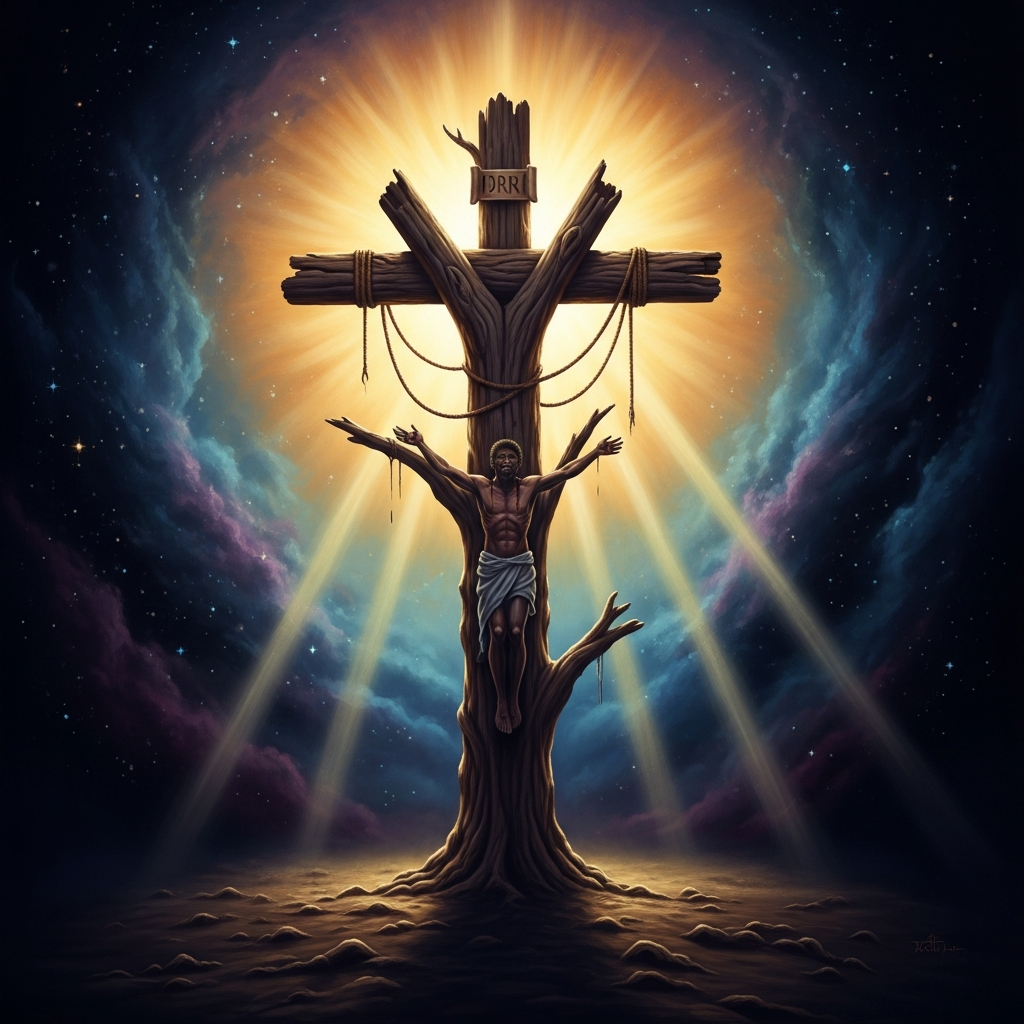
The image is this: the cross of Jesus is a lynching tree. The lynching tree is a cross.
The point is not that they are similar. The point is that they are the same. A man hanged from a tree by a mob, on the outside of the city, at the hands of the political authorities, abandoned by his disciples, mocked by the crowd, his body left as a warning to others — this is what happened to Jesus of Nazareth in Palestine in 30 CE, and this is what happened to thousands of Black men and women in the American South between 1880 and 1940. The crucifixion was a lynching. The lynchings were crucifixions. The same theology applies. The same God is present.
This is, Cone argues, why the spirituals had always known something the white theologians had missed. Were you there when they crucified my Lord? — the song was not asking whether the singer had been historically present in Palestine. It was asking whether the singer recognized that the cross is happening, again and again, in the singer’s own time, in the singer’s own town, on the trees the singer’s own children walk past in the morning. The spiritual is theology in the form of a question that requires the answer yes.
The white theological tradition could not have written this book, because it could not see the lynching tree. The Black theological tradition had been writing this book in song and sermon for two hundred years. Cone’s task was to translate it into the formal language of systematic theology so that the seminaries could no longer claim, with credibility, that the lynching tree is not a theological subject.
After Cone, the seminaries cannot make that claim with credibility.
He died at Union Theological Seminary on April 28, 2018.
Six days later, the Equal Justice Initiative opened the National Memorial for Peace and Justice in Montgomery, Alabama — the first lynching memorial in the United States, eight hundred steel monuments hanging from a structure that resembles, deliberately, the trees from which the lynched bodies hung. Cone had not lived to see it open. His students went. They stood under the hanging steel and they wept and they prayed.
The argument he had made forty-nine years earlier, in a small apartment in Adrian, Michigan — that the lynching tree is a theological subject, that it sits at the center of any honest American theology, that the cross of Jesus and the lynching tree are the same — had now been carved into a national monument in steel, in the city where Rosa Parks had refused to give up her seat and where Martin Luther King had pastored Dexter Avenue Baptist Church.
The argument was no longer marginal. It had become the country.
Cone had said, near the end of his life, that he wrote not to be respectable but to be honest. The honesty, in the end, outlasted the disrespectability. The grain had fallen. The fruit was still arriving.
Scenes
James Cone at his typewriter in Adrian, Michigan, summer 1968 — the manuscript of *Black Theology and Black Power* taking shape in three months of fury
Generating art… The image at the center of Cone's later theology: the cross and the lynching tree as the same symbol, the same God, the same suffering
 Generating art…
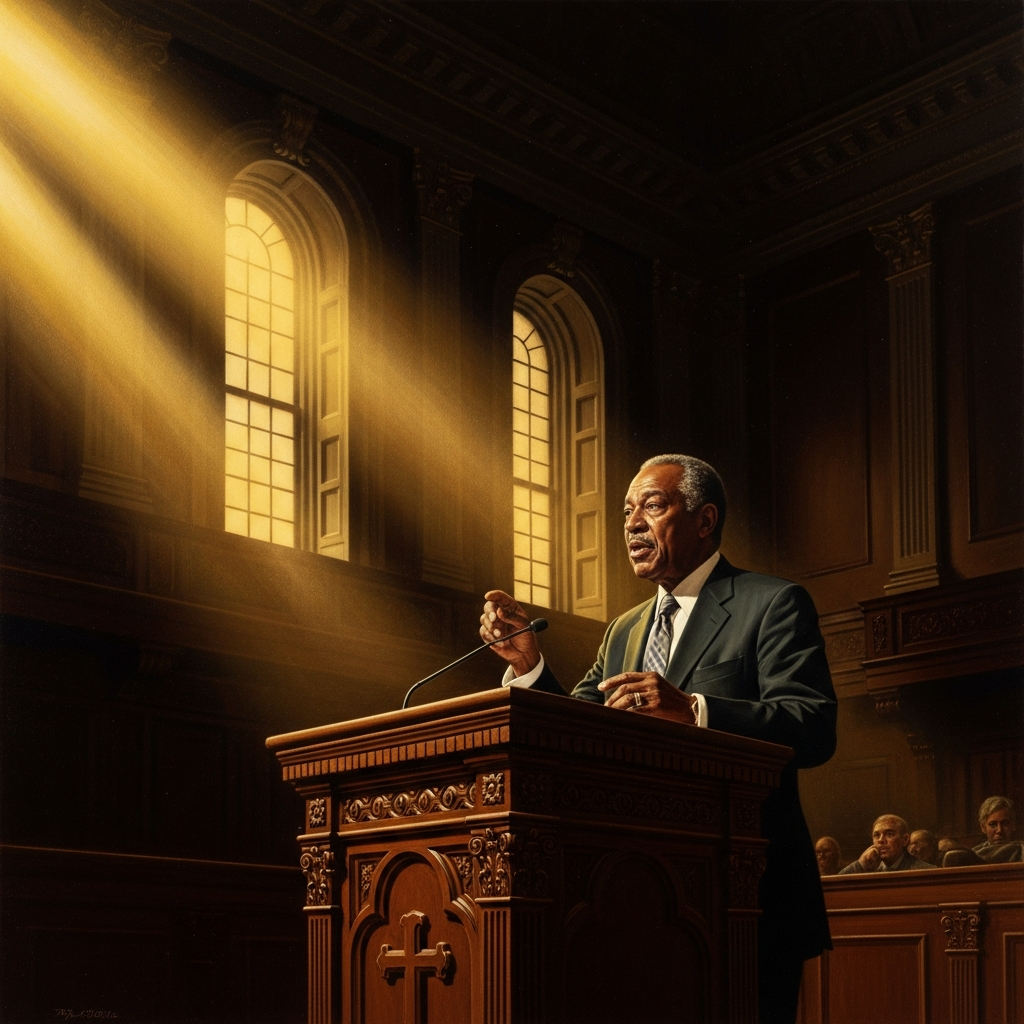
 Cone lecturing at Union Theological Seminary, where he taught for nearly fifty years and trained two generations of Black liberation theologians
 Generating art…
 Echoes Across Traditions
Entities
- James Hal Cone
- Martin Luther King Jr.
- Reinhold Niebuhr
- Albert Cleage Jr.
- Howard Thurman


Sources
- James H. Cone, *Black Theology and Black Power* (1969)
- James H. Cone, *A Black Theology of Liberation* (1970)
- James H. Cone, *The Spirituals and the Blues: An Interpretation* (1972)
- James H. Cone, *The Cross and the Lynching Tree* (2011)
- Kelly Brown Douglas, *The Black Christ* (1994)
- James H. Cone, *Said I Wasn't Gonna Tell Nobody: The Making of a Black Theologian* (2018, posthumous)