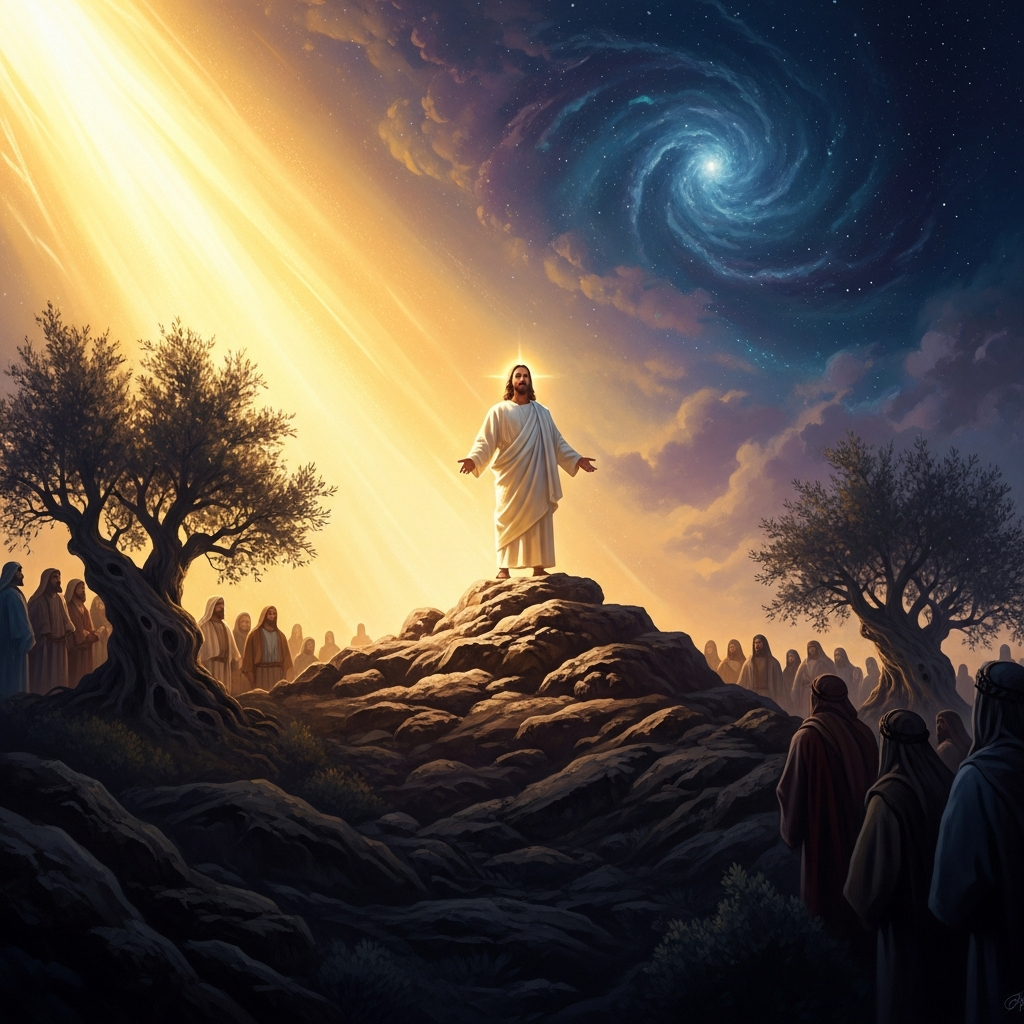
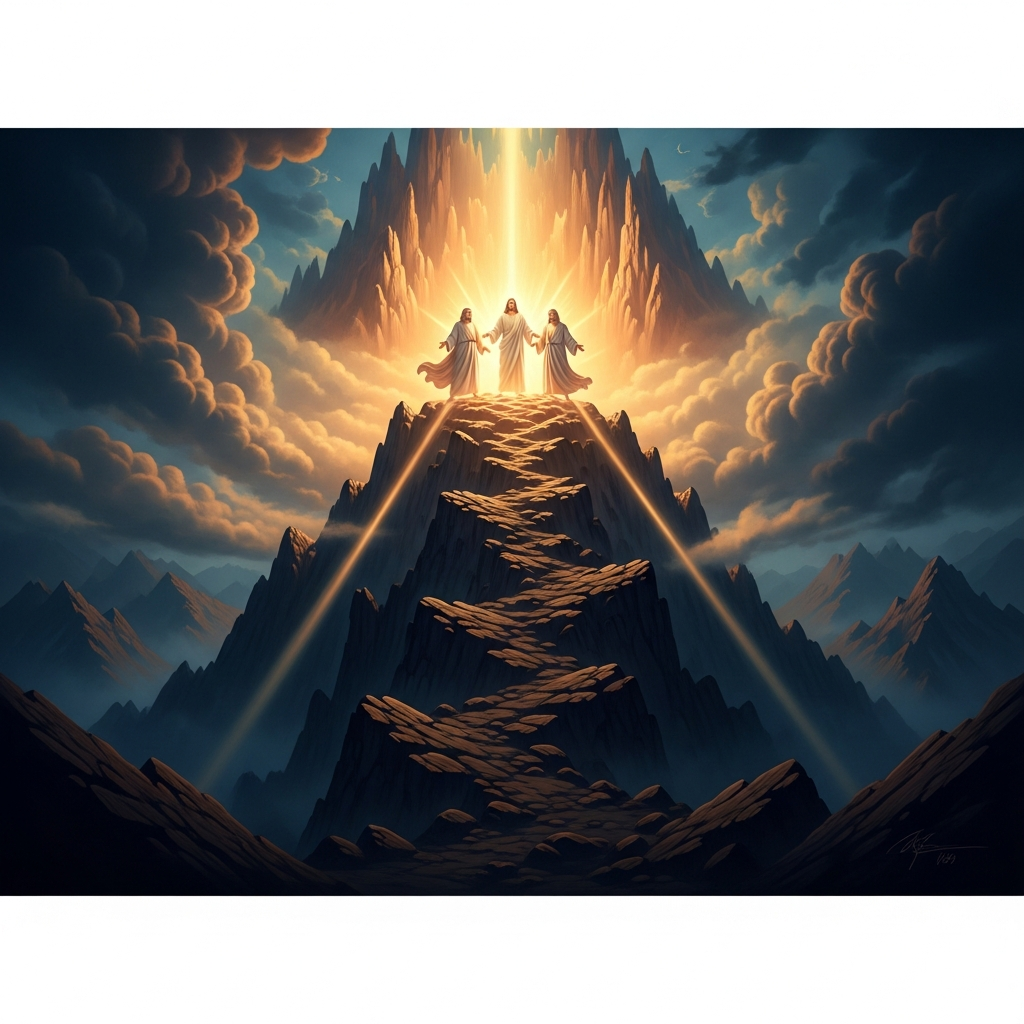
John of the Cross in the Toledo Closet
December 1577 - August 1578 · The Carmelite priory of Toledo, Spain
Contents
A small Carmelite friar is kidnapped by his own brothers in religion and locked for nine months in a six-by-ten-foot closet in Toledo. He is beaten weekly and starved. In the dark, with no paper, he composes the *Spiritual Canticle* line by line in his head — and escapes through a window with knotted bedsheets.
- When
- December 1577 - August 1578
- Where
- The Carmelite priory of Toledo, Spain
He is thirty-five and weighs almost nothing.
Juan de Yepes — Brother John of the Cross to the reformed Carmelites, fray Juanito to Teresa of Ávila who calls him affectionately my little Seneca — is a four-foot-eleven friar from a poor family in Old Castile. He has helped Teresa launch the Discalced reform. He has founded a friary at Duruelo with two other men, slept on straw, eaten bread soaked in oil, and walked barefoot across the meseta in winters that killed stronger men.
The Calced Carmelites — the older, looser, unreformed branch of the order — have decided he is a heretic. He is not. He is something worse, by their lights: he is a successful reformer, and his existence is making them look bad.
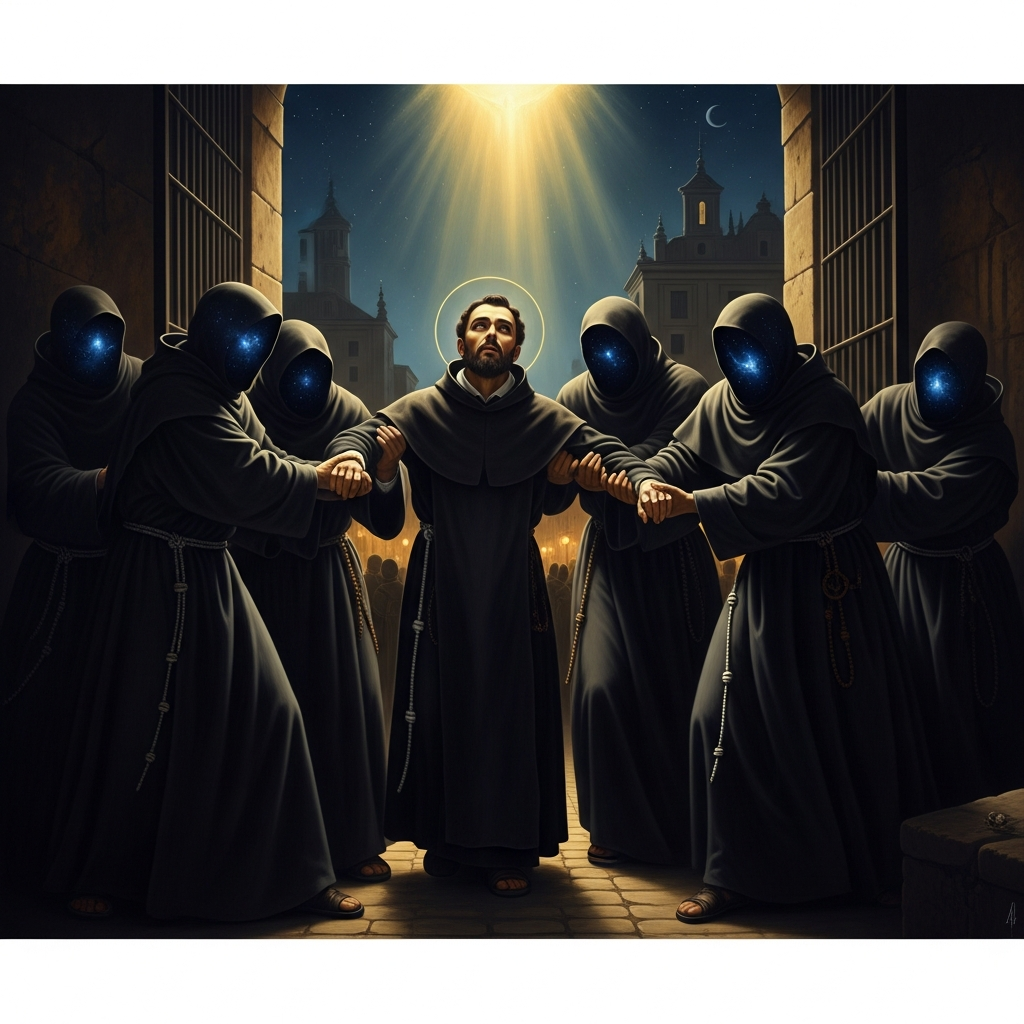
On the night of December 2, 1577, an armed band of Calced friars and lay enforcers breaks down the door of his small house in Ávila. They drag him out, blindfold him, and put him on a mule. They ride to Toledo.
The cell they put him in was originally a closet.
Six feet by ten. No window — only a slit, three fingers wide, set high in the outer wall, looking onto a corridor where a sliver of indirect light arrives for two hours a day. No bed. A board on the floor. A bucket. A wooden plate. The walls weep in winter. The summers in Toledo are infernal — the cell heats to a temperature in which a man cannot sleep, cannot pray, cannot do anything but lie still and breathe.
He is brought out three times a week and beaten.
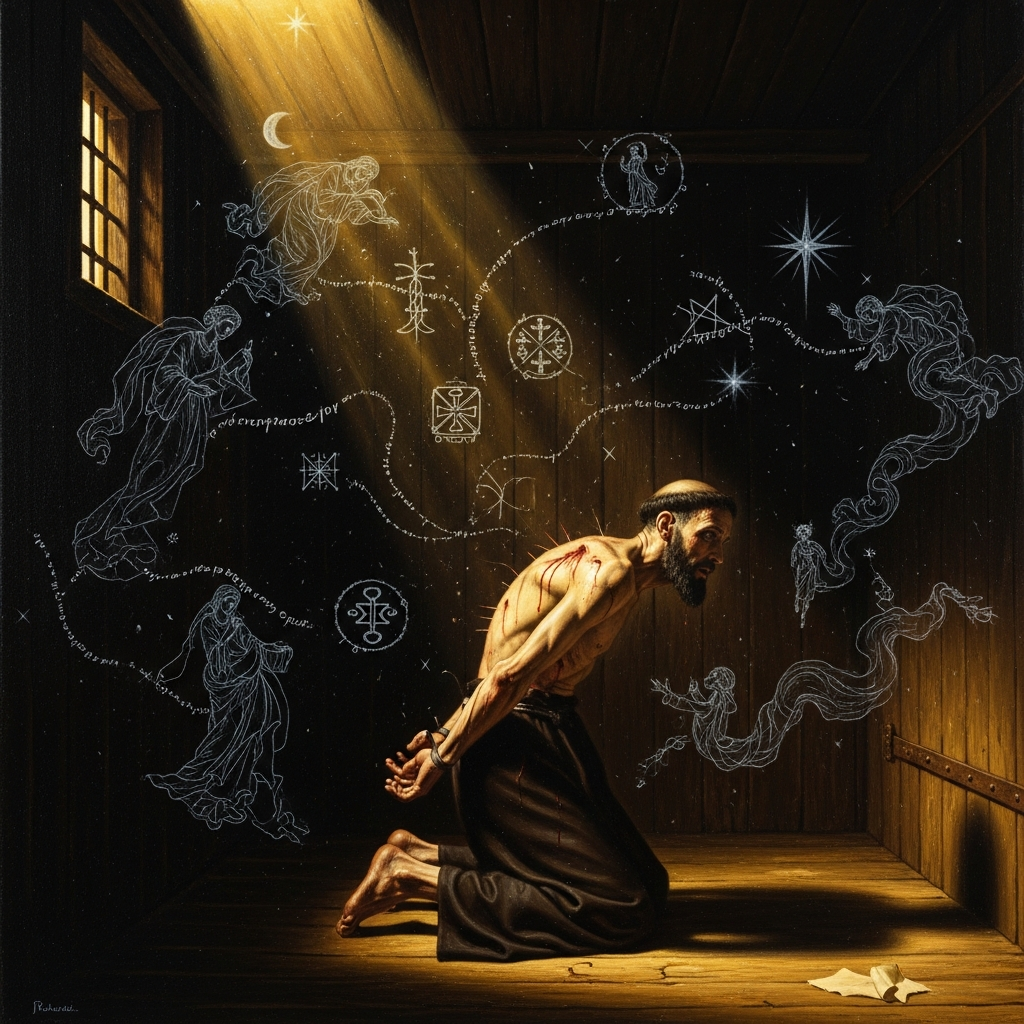
Not symbolically. The discipline of the order, applied to him by the entire community of Toledo Carmelites in turn — every friar takes the leather scourge and strikes him while he kneels in the refectory and the prior reads the formal accusation. They call him a contumacious rebel. They tell him to renounce the reform. They tell him Teresa has already abandoned him.
His back never heals. The lice get into the wounds. By summer, he cannot tell the smell of his own body from the smell of the cell.
He has nothing to read. He has nothing to write with. He is forty paces from the room where the friars eat the bread he is not given.
He composes poems in his head.
He has been a poet since he was a boy. He has read Garcilaso, the Cancionero of Castilian love-songs, the Song of Songs. He knows by heart entire psalms and entire Books of the Bible. In the closet — at first as a discipline to keep his mind from breaking, then as the thing his mind begins doing without permission — he begins to compose stanzas.
Adónde te escondiste, / Amado, y me dejaste con gemido? — Where have you hidden, Beloved, and left me to my groaning? He writes the Spiritual Canticle in nine months in the dark, line by line, holding each new stanza in memory until the next is built. It is a love poem in the voice of a bride searching the mountains for a bridegroom who has vanished. It is also, simultaneously, the soul looking for God in the dark of a Toledo closet. He cannot tell the two readings apart and does not try.
Around month four, a new jailer is assigned.
Brother Juan de Santa María — sympathetic, perhaps, or just less brutal than his predecessor — gives John a small lamp, sometimes paper, sometimes ink. John uses these the way a starving man uses food: too fast, with shaking hands. He writes down the Canticle stanzas he has been carrying. He writes some of the romances. He hides the paper in his habit during the daylight hours when the friars come for him.
The beatings continue. The food does not improve. Twice he develops dysentery and is sure he is dying. He dictates — to himself, in his head, since no one else is there — what he wants the brothers to know after he is dead. He writes nothing of the abuse. He writes only of the Beloved.
He understands, in the closet, what he will later call the dark night: the night of the senses, in which the consolations of religion are stripped away, and the night of the spirit, in which God himself seems to vanish, leaving the soul in a dark that is not absence but a presence too pure for the senses to register. He understands it because he is living it. He is not a theologian writing about deprivation. He is a man being deprived who happens to be a poet.
In August 1578, he plans the escape.
The cell is on the second floor. The slit in the wall is too narrow. But the cell connects, through an unused doorway behind the dirty laundry, to a passage that leads to a window above the Tagus. The window is high — a thirty-foot drop to a wall, then another drop to the street.
He pries the lock on the cell door over several nights with a small bent nail. He saves strips from his blanket and from his single tunic, knotting them into a thin rope. He prays — and this part is in the Vita — for a sign of permission, and dreams that the Virgin tells him to go.
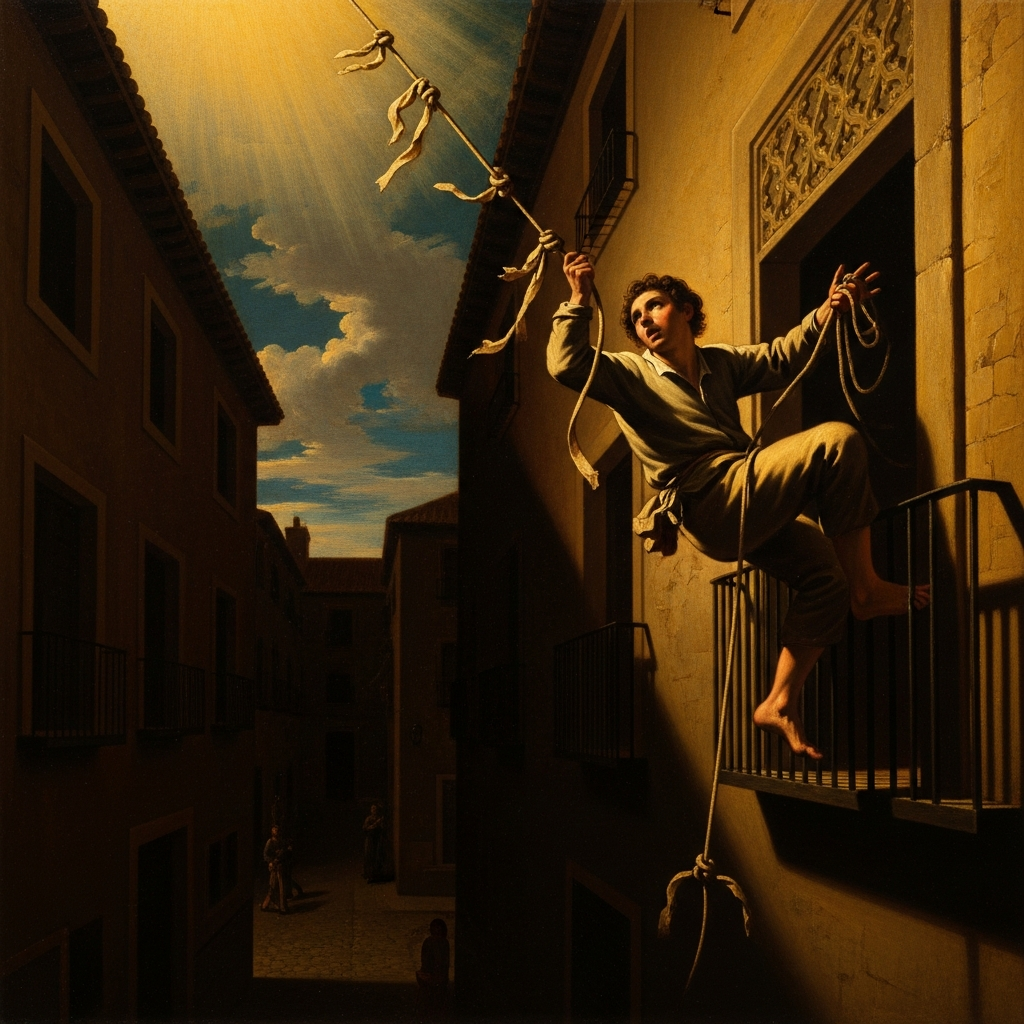
On the night of August 16, the eve of the Assumption, with the moon down and the Toledo streets silent, he opens the cell door, walks through the laundry passage, climbs to the window, ties the cloth-rope to the iron bar across it, and lowers himself.
The rope is too short. He drops the last several feet and hits the parapet of the wall. He climbs down the wall into a courtyard he does not recognize. It belongs to a convent of Franciscan nuns. He cannot find the gate. He sleeps a few hours behind a hedge. At dawn, a dog finds him.
He stumbles into the streets of Toledo barely able to walk. He is wearing only the remains of a tunic. His back is a wound that has been re-opened so many times it is no longer scarring. He has the Canticle in his head and on a few crumpled sheets of paper inside what is left of his habit.
He finds the house of a sympathetic woman — a friend of the reform — and collapses. He is hidden for days. The Calced friars search the city. They do not find him. He is moved, eventually, to a Discalced convent at Beas de Segura, where the nuns nurse him back to a body that will never be entirely whole again. Teresa, hearing he is alive, weeps and writes to him.
He recites the Canticle aloud to the Beas nuns. They write it down for him. The poem enters the world.
He lives twelve more years.
He writes the prose commentaries on his three great poems — the Ascent of Mount Carmel, the Dark Night, the Spiritual Canticle, the Living Flame of Love — explicating in plodding scholastic Castilian what the verses had said in fire. He becomes prior of various reformed houses. He is hated by some of his own faction now, too — the reform has its own politics, and John refuses to play them. In his last year, he is stripped of office, sent to a remote priory in Andalusia, and dies there of a leg infection on December 14, 1591, age forty-nine.
He is canonized in 1726. Declared a Doctor of the Church in 1926. The poems — eight short ones, perhaps thirty pages of verse total — are recognized as among the supreme achievements of Spanish literature, on a level with Cervantes and Lope.
The closet is still in Toledo, in what was once the Carmelite priory and is now a museum. You can stand in it. It is exactly the size he said it was. The slit in the wall is exactly where he said it was. The Tagus is below the window.
The poems describe a darkness that does not feel like darkness from the inside — a night more lovely than the dawn, night that united the lover with the Beloved, transforming the lover into the Beloved. The man who wrote them was, at the time, in a closet, being beaten by Christians for being a Christian, with lice in his back-wounds, composing in the dark because he had nothing to write on.
The dark night of the soul is not depression. It is not despair. It is the systematic stripping away of every consolation — sensory, emotional, intellectual, spiritual — until what is left is the bare contact with God that the consolations had been hiding. John mapped it because he was forced through it. The Toledo closet was the laboratory.
Mother Teresa’s letters, published in 2007, describe the same terrain in twentieth-century English — fifty years of darkness, of God’s silence, of going through the motions without the feelings that had once accompanied them. She had read John. She knew what was happening. She did not call it abandonment. She called it the night.
The Sufis had mapped a parallel topography five centuries earlier — fanā, the annihilation, the bi-khabar of unknowing. The Pseudo-Dionysius had written about the divine darkness in the sixth century. John brought it into Castilian and into the body of a small friar in a closet. He brought it into poetry that is so good it survives translation, which mystical poetry almost never does.
The deepest claim of the dark night is that the absence is the presence in a form the senses cannot register. You have to go through it. You cannot read your way around it. John went through it because they locked him in a closet, and he came out with the poems.
The closet is six by ten. The poems run for centuries.
Scenes
The kidnapping — December 2, 1577, Ávila, dragged out at night by his own order
 Generating art…
 The closet — nine months in the dark, weekly scourging, the *Spiritual Canticle* composed line by line in memory
 Generating art…
 The escape — knotting strips of cloth, lowering himself out a high window onto a Toledo street, August 1578
 Generating art…
 Echoes Across Traditions
Entities
- John of the Cross
- Teresa of Ávila
- the Beloved
- the Carmelite Calced friars
Sources
- John of the Cross, *Cántico Espiritual* (composed in prison, 1577-78)
- John of the Cross, *Noche Oscura del Alma* (composed shortly after escape)
- John of the Cross, *Subida del Monte Carmelo* (1578-85)
- Gerald Brenan, *St. John of the Cross: His Life and Poetry* (1973)
- Iain Matthew, *The Impact of God: Soundings from St. John of the Cross* (1995)
- Richard P. Hardy, *John of the Cross: Man and Mystic* (2004)