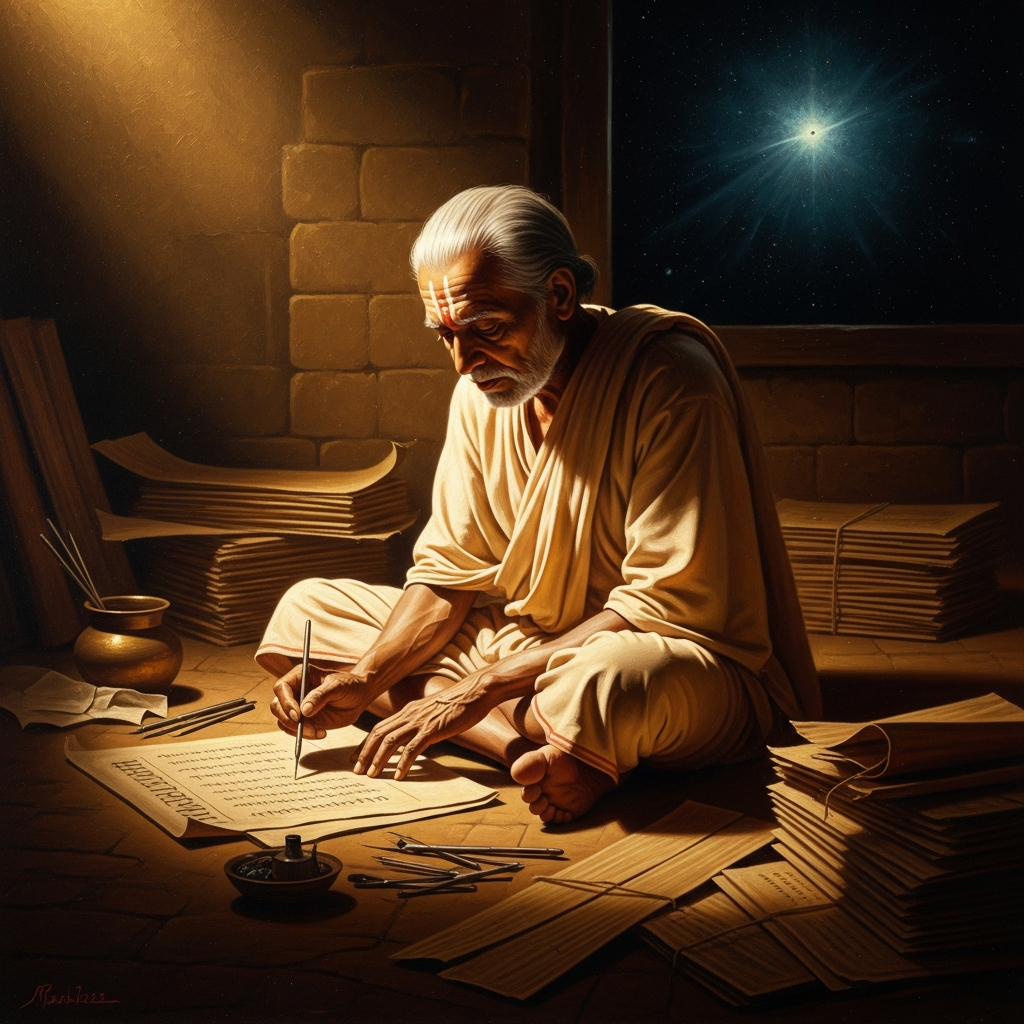
Tulsidas and the Poem That Became Scripture
1574-1577 CE (composition of the Ramcharitmanas); Tulsidas c. 1532-1623 · Varanasi and Ayodhya — the two cities of Rama's story and Tulsidas's vision
Contents
He is a Sanskrit scholar in Varanasi, a householder whose wife has just humiliated him for following her to her father's house when she expected him in the temple. The taunt is the inciting line: *if you loved Ram half as much as you love this body of mine, you would have been free already*. He leaves the marriage that night. He goes to Ayodhya. He sees Ram in vision. He is commanded to write the story in the language his neighbours actually speak — Awadhi, the dialect of north Indian villages, not the Sanskrit of the Brahmins. He writes for three years. The Brahmin scholars of Varanasi are furious. The poem is finished in 1577. It becomes, over the next four centuries, the most widely read and memorized text in north India — the *Ramcharitmanas*, the people's Ramayana, the Bible of Hindi-speaking Hinduism.
- When
- 1574-1577 CE (composition of the Ramcharitmanas); Tulsidas c. 1532-1623
- Where
- Varanasi and Ayodhya — the two cities of Rama's story and Tulsidas's vision
The river at midnight is wider than he thought it would be.
He swims the upper Ganges in monsoon flood with his clothes on his head, mistaking a floating corpse for a piece of driftwood and using it to push himself across — he will only realize this in the morning, when the body of the unknown dead man is no longer beneath his hand. He reaches the far bank. He climbs the wall of his father-in-law’s house in Rajapur. The compound is dark. He finds his wife’s window. The window is shuttered. He pulls himself up by what he assumes is a vine and which turns out, in the lightning, to be a snake.
She is awake. She has heard the noise. She comes to the window and sees her husband — Tulsidas, the Sanskrit scholar, the householder, the man who has just risked his life crossing a river he cannot swim and climbing a wall he cannot see — standing in the courtyard, soaked, shivering, holding his arms out to her.
She says one sentence.
The sentence is preserved in the biographical tradition with slight variations across the manuscripts but the meaning is constant. Have you no shame, she says. Coming through the night for this body of mine, this bag of flesh and bone? If you had loved Ram half as much as you love this — you would have been free already.
He stares at her.
The biographical tradition makes him stand there for a long minute. Some versions add the lightning a second time — illuminating his face, illuminating hers, the two of them frozen in the rain. Some versions add that he laughs, a single short laugh of absolute recognition. All versions agree on what he does next.
He turns around. He climbs back over the wall. He does not return to the marriage. He walks west toward Ayodhya in the wet night with no plan, no possessions, the clothes still wet from the river. He is somewhere between thirty and forty years old. The marriage has been the center of his life for fifteen years.
The marriage ends in a sentence.
The sentence is the inciting line of one of the great poems of Asia.
He walks for weeks. The biographies are vague about the route. He reaches Ayodhya, the legendary city of Ram’s birth — a town on the Sarayu River that is, in the sixteenth century, a small provincial center with a few minor temples and the persistent local memory that the Ramayana of Valmiki happened here. He sits down on the riverbank and begins to wait.
He waits years.
The texts give the period as a long indeterminate stretch — somewhere between several years and several decades — during which Tulsidas lives as a wandering ascetic in Ayodhya, in Chitrakoot, in the Mathura-Vrindavan region, occasionally back in Varanasi, never in one place long enough to be claimed by a school. He is reading. He is reciting Sanskrit. He has the Valmiki Ramayana by heart in the original. He has the Adhyatma Ramayana, a later devotional version. He has the Bhushundi Ramayana and the Ananda Ramayana and the various purana references to Ram. He is saturating himself.
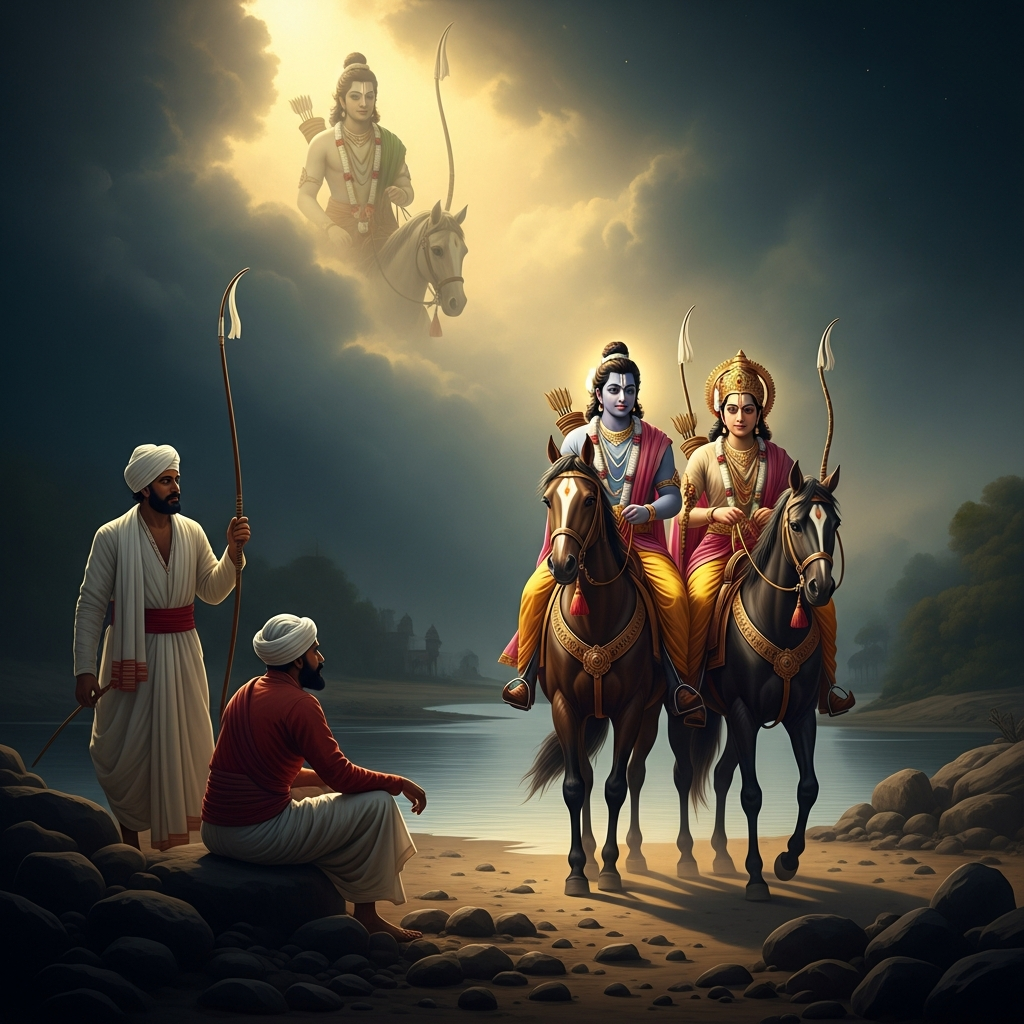
The vision arrives in Chitrakoot, where Ram had spent the central years of his forest exile. Tulsidas is preparing his sandalwood paste for morning worship. Two boys on horseback ride past — princely-looking, dark-skinned, the elder with a bow over his shoulder — and ask him for sandalwood paste for tilak. He gives it. They mark their foreheads. They ride away.
Hanuman, who has been watching from the trees in monkey form, comes down and asks Tulsidas if he knew who that was.
Tulsidas says he did not.
Hanuman tells him. Tulsidas runs after the riders. The road is empty.
This is the moment in the biographical tradition when Tulsidas understands that he has been seeing Ram and not recognizing Ram — and that the not-recognizing is itself the human condition the Ramayana exists to address. The vision returns to him repeatedly in the following years. Each return clarifies the project the wife’s sentence had set in motion fifteen years earlier.
He must write the story.
He must write the story in the language people speak.
He goes to Ayodhya in 1574.
The date is preserved in the prologue of the Ramcharitmanas itself — the second day of the bright half of the month of Chaitra, which is the traditional birthday of Ram. Tulsidas opens the manuscript on Ram’s birthday. He intends the symmetry.
The first decision is the language. Sanskrit is the language of scripture. Sanskrit is the language Valmiki used. Sanskrit is the language every Brahmin in Varanasi will tell him is the only acceptable language for the story. Tulsidas decides against Sanskrit.
He chooses Awadhi.
Awadhi is the dialect spoken in the area around Ayodhya — a north Indian village language related to Hindi and Bhojpuri, the language of the farmers and the artisans and the women who do not read. Awadhi has no literary prestige. No major religious text has been written in Awadhi. The decision to compose the Ram story in Awadhi is the decision to write for a constituency that does not currently have a Ram story available to it — a constituency that has been hearing the story orally for centuries from professional reciters working from Sanskrit and translating on the fly.
He decides to give the constituency the text directly.
He writes in doha and chaupai — couplet and quatrain forms native to north Indian oral tradition, the same forms Kabir had used a century earlier. The meter is built for memory. The lines are built to be sung. The poem is composed, from the first line, to be heard rather than read.
He writes for three years and three months.
The Brahmin establishment of Varanasi finds out.
The pandits are furious.
The position is institutional. If the Ram story can be written in Awadhi and read by anyone, the Brahmin monopoly on the sacred dissolves. The priests have been the gatekeepers of the Sanskrit text — the ones with the training to recite it, the ones the laity have to pay for the recitation. A vernacular Ram story removes the gate.
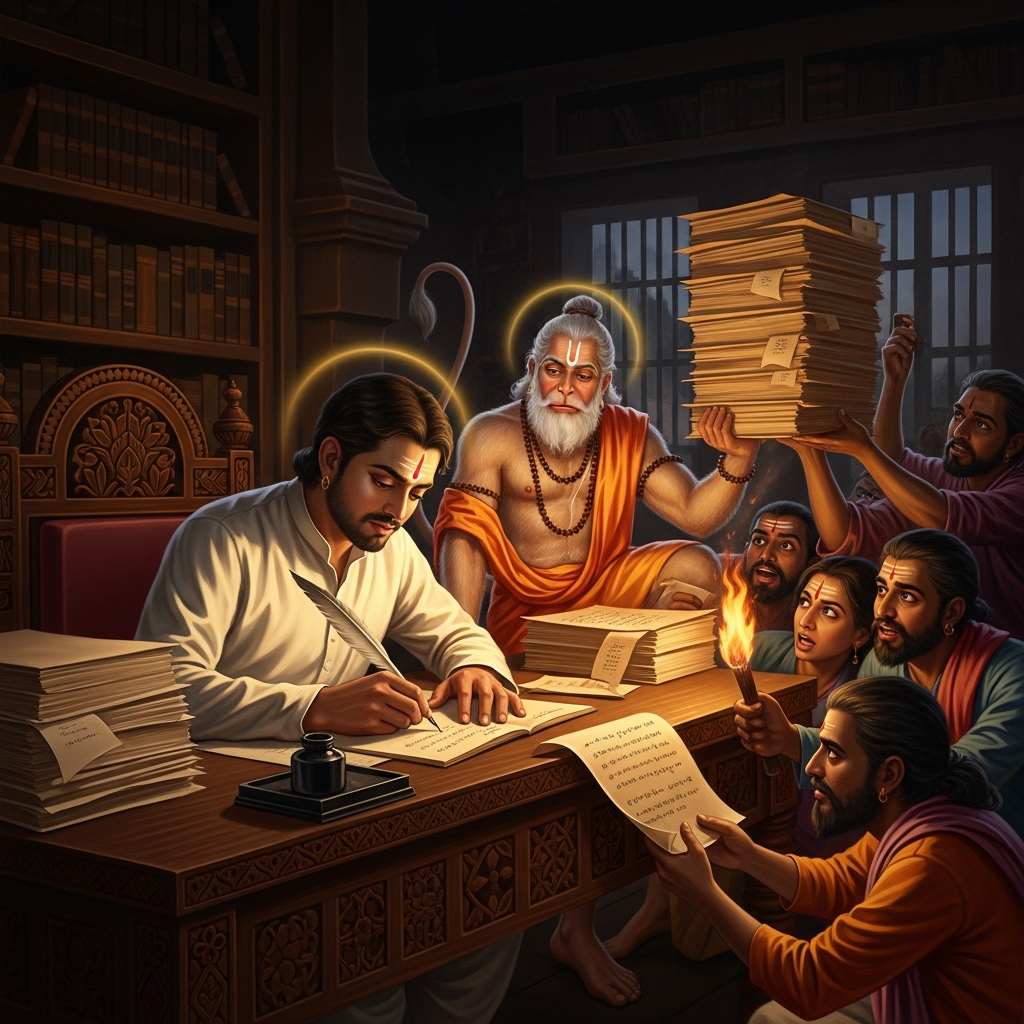
They send delegations. They demand that Tulsidas stop. They demand that he submit the manuscript for review. He refuses. The most aggressive of the pandits arrange for the manuscript to be stolen — they send two thieves to his hut, instructing them to bring back the work-in-progress so it can be destroyed.
The biographical tradition records that the thieves arrive at the hut at midnight and find two armed warriors — one dark-skinned with a bow, one fair-skinned with a sword — guarding Tulsidas as he sleeps. The warriors look at the thieves. The thieves drop their tools and flee. They go to Tulsidas the next morning and tell him what they have seen. Tulsidas understands without surprise. He gives the men food and sends them away.
He finishes the manuscript in 1577.
The pandits make one more attempt. They want the manuscript tested. The agreed test is theological combat by ordeal: the Ramcharitmanas will be placed in the inner sanctum of the Vishwanath Temple in Varanasi alongside the major Sanskrit scriptures — the Vedas, the Upanishads, the Bhagavata, the Sanskrit Ramayana — and the doors will be locked overnight. Whichever text is found on top of the pile in the morning will be the most sacred.
The doors are locked.
The doors are opened.
The Ramcharitmanas, in Awadhi, is on top of the pile.
The story is preserved by the followers of Tulsidas and is treated by the historians as legend, which it almost certainly is, but the institutional outcome it dramatizes is real: the Ramcharitmanas is accepted, the pandits subside, the text begins to circulate.
Within Tulsidas’s lifetime it spreads from Varanasi outward across the entire Hindi belt. By 1600 it has reached the courts. By 1700 it is being recited in temples from Punjab to Bihar. By 1800 it is one of the two or three most widely read religious texts in India. By the twentieth century it is the defining religious text of north Indian Hinduism — the basis of the Ram Lila dramatic festivals, the basis of the katha recitation tradition, the source of more proverbs in spoken Hindi than any other single text.
The poem is divided into seven books — kandas — following Valmiki’s structural template.
But the content is reshaped.
Tulsidas is not translating Valmiki. He is rewriting the story under the explicit theological assumption that Ram is not merely the perfect king of Valmiki’s poem but is parabrahman, the absolute, the supreme reality manifesting itself in human form for the redemption of the age. Sita is not merely Ram’s wife but is Adi Shakti, the primordial feminine power. Hanuman is not merely the loyal servant but is the very paradigm of the devotee — the soul that has chosen its God and has been remade by the choice.
The narrative emphasis shifts toward the devotional moments. The exile in the forest is expanded. The relationship of Ram and Hanuman is given more interior space than Valmiki gave it. The encounter with the boatman Kevat at the Ganges — a low-caste fisherman who agrees to row Ram across only after Ram allows him to wash Ram’s feet — becomes one of the central scenes of the poem. The boatman’s argument is the Bhakti argument: I have heard, Kevat says, that the dust of your feet turned a stone into a woman. If your feet do that to my boat I will be ruined. Let me wash them first.
Ram laughs and lets him.
The scene is not in Valmiki. The scene is the entire theology of Tulsidas in twelve lines: the divine condescends, the lowest accept the divine without prerequisite, the dust of the feet of grace transforms whatever it touches, the social order is upended in passing.
Tulsidas writes lines that millions of people in north India still know by heart four centuries later. Mangal bhavan amangal hari — abode of blessing, destroyer of sorrow. Ram naam manidip dharu jih dehri — place the lamp of Ram’s name on the threshold of the tongue. Hari anant hari katha ananta — Hari is endless, Hari’s story is endless.
The lines work the way scripture works. They are quoted at weddings. They are quoted at funerals. They are quoted by politicians making speeches and by farmers settling disputes. They are sung at the Ram Lila in October. They are recited at full length, twenty-four hours straight, during Akhand Path ceremonies at temples across the Gangetic plain.
He dies in 1623 at the age of approximately ninety-one, in Varanasi, at his house on the Tulsi Ghat that still bears his name.
The pandits who had tried to suppress him have been dead for decades. The text he wrote against their wishes is being copied in monasteries across north India. Within a century it will be the basis of an entire performative tradition — the Ram Lila, the cycle of Ramayana plays performed in towns and villages every autumn — that takes its script directly from Tulsidas, not from Valmiki.
The political consequences of the poem will run on for four centuries.
The Ram of the Ramcharitmanas — the moral, ideal, suffering king who refuses every shortcut and accepts every burden — becomes the central image of north Indian Hindu religiosity. Gandhi will appeal to Ram Rajya — the kingdom of Ram — as the political ideal of independent India. The image of Ram in the popular imagination, contested by twentieth and twenty-first century political movements that have used him for purposes Tulsidas would have found distressing, is everywhere the image Tulsidas put there.
The poet had no political project. The poet had a wife who said one cutting sentence and a vision that arrived years later in Chitrakoot and a manuscript he wrote in the language his neighbors could understand.
But the vernacular wins, every time. Tyndale, Luther, Honen, Dante, Tulsidas. The argument is the same: the sacred is for everyone or it is not sacred. The institutional resistance is the same. The institutional resistance loses, every time.
The pandits are forgotten. The poem is recited at this moment, somewhere in north India, by someone who does not know that he is reciting an act of revolt that succeeded.
That is the test the manuscript passed when the doors were locked overnight in the Vishwanath Temple. Not the legend. The verifiable historical test: does the text survive without institutional sponsorship? Does it survive when the priests turn against it? Does it survive in the mouths of people the priests do not consult?
Tulsidas’s poem passed the test in 1577 and is still passing it.
The wife, by the way, is not heard from again in the biographical record. Her sentence remains. The poem her sentence ignited continues to be spoken aloud, four hundred and fifty years later, in villages along the river she crossed to leave him.
Scenes
He has crossed a flooded river in the dark to reach her father's house, mistaking a corpse for a log and a snake for a rope
 Generating art…
 Years later in Ayodhya
 Generating art…
 He writes for three years and three months
 Generating art…
 Echoes Across Traditions
Entities
- Tulsidas
- Ratnavali
- Hanuman
- Valmiki
- The Brahmin Scholars of Varanasi

Sources
- Tulsidas, *Sri Ramacharitmanasa* (trans. R.C. Prasad, 1990; trans. Philip Lutgendorf, *The Epic of Ram*, Murty Classical Library, 7 vols. 2016-2025)
- Philip Lutgendorf, *The Life of a Text: Performing the Ramcharitmanas of Tulsidas* (1991)
- John Stratton Hawley, *A Storm of Songs: India and the Idea of the Bhakti Movement* (2015)
- Wendy Doniger, *The Hindus: An Alternative History* (2009)
- F.R. Allchin, *Tulsi Das — The Petition to Ram* (1966)
- Linda Hess, *Bodies of Song: Kabir Oral Traditions and Performative Worlds in North India* (2015) — for the broader Bhakti context