Ajahn Chah and the Snake That Was Always Going to Bite
c. 1960-1990 CE · Wat Nong Pah Pong, Ubon Ratchathani Province, northeastern Thailand
Contents
A student at Wat Nong Pah Pong is bitten by a snake and in considerable pain. Ajahn Chah, the Thai forest master, comes to see him. He asks the student a question that has no good answer. The space between the question and the answer contains the teaching about suffering that the student has been sitting with for three years and has not yet understood.
- When
- c. 1960-1990 CE
- Where
- Wat Nong Pah Pong, Ubon Ratchathani Province, northeastern Thailand
It is early morning at Wat Nong Pah Pong, which means early morning means four in the morning, because the forest monks rise at three for sitting meditation and are done with sitting by four-thirty, and then there is walking meditation on the paths between the trees in the dark before dawn.
The student — the accounts call him simply the student, or the monk, not naming him — is walking the path and he steps on the snake, or the snake is in the leaf litter beside the path and his foot comes too close and the snake bites him on the ankle in the dark. It is a pit viper; this is the forest of northeastern Thailand and the paths go through the same habitat as the snakes, and everyone who practices at the monastery long enough has a snake story. But being bitten is different from having a story about being bitten. The venom is in his ankle and his ankle is swelling and the pain is moving up his leg.
He is carried to his kuti. Someone sends for Ajahn Chah.
This is not obvious — there are people who know more about snakebite treatment than Ajahn Chah does, at least in the medical sense. But Ajahn Chah comes because a student is suffering and because the monastery he built runs on the understanding that suffering is the curriculum, not the interruption of the curriculum.
He sits beside the student on the floor of the kuti. The student’s leg is elevated. The swelling is serious. The student is not in mortal danger from this particular bite — the venom is hemotoxic but the dose was not enough to kill him — but he is in real pain, the kind that fills the field of attention and makes it difficult to think about anything else.
Ajahn Chah sits with him for a while without speaking.
Then he asks: does it hurt?
The student says: yes.
Ajahn Chah says: does it have to hurt?
This is the question that has no good answer.
If the student says no, he is claiming something he cannot make true — the pain is present, the swelling is present, the venom is in his blood and doing what venom does, and saying it does not have to hurt does not make it hurt less. If the student says yes, he is agreeing that his suffering is inevitable and necessary, which is exactly the position the Buddha’s first sermon argues against — the teaching on dukkha is not that pain exists but that the relationship to pain is the variable, that pain and suffering are not the same thing.
The student knows this. He has been sitting at Wat Nong Pah Pong for three years, memorizing the Pali formulas, sitting in meditation for hours each day, listening to Ajahn Chah give the same teaching in forty different forms. He knows what the right answer is supposed to be. He knows that the clinging to the pain as unbearable, the wishing it were not happening, the internal arguing with the fact of the snakebite — all of that is the additional layer that turns pain into suffering.
He knows this. The snake is in his ankle and knowing it does not help.
Ajahn Chah says: the snake was always going to bite you.
This is the second teaching in the same conversation, and it is the one that lands differently depending on whether you hear it as fatalism or as something else. As fatalism it is useless — the implication would be that the student’s pain is preordained and therefore beyond response. But Ajahn Chah does not teach fatalism. What he is pointing at is the conditional arising that runs through the entire Pali analysis of experience: this being, that arises; this not being, that ceases. The snake was in the path. The student was walking the path in the dark. The conditions were present. The bite was the result of conditions being present, not of anything being wrong, not of a universe that is supposed to protect practitioners from the physical world.
The student is looking at him.
Ajahn Chah says: now, where is the suffering?
The pain is in the ankle. The swelling is in the leg. These are physical events, and physical events happen in the body the way snakes happen in the forest — they are what they are, operating according to their own conditions. The suffering — the extra layer, the wishing it were not so, the arguing with the universe — is being produced right now by the student’s mind, and the student’s mind is something he has been training for three years, and the question of where the suffering is is the question of whether three years of training is available to him in this moment, in this kuti, with this ankle.
The student does not immediately achieve liberation. This is important — the story is not about a student who hears the teaching and the pain stops. The pain continues for several days. The leg heals. The student stays at the monastery.
What changes is subtler: there is a gap, however small, between the pain-event in the ankle and the additional construction of suffering that the mind builds around it. The gap is very small. But the gap is the practice — the space between the stimulus and the response, which is where Ajahn Chah spent thirty years of teaching pointing.
He taught by showing up where the students were in pain. He taught in kitchens and on paths and beside sick monks in kutis, because the doctrine is not about something else — not about a hypothetical future state or a theoretical liberation available only under ideal conditions. It is about this, here, with this swollen ankle, at four-thirty in the morning when the forest is waking up and the birds are beginning and the pain is real.
The snake is in the forest. The forest is the monastery. The monastery is the practice.
What Ajahn Chah understood that is hardest to transmit is that he was not teaching a method for avoiding suffering. He was teaching what it looks like when someone is in real pain and does not add to it, and he taught it by being that person in front of students who were suffering, so they could see the gap between pain and suffering in action, in someone else, before they could produce it in themselves. The snake was always going to bite someone. The question was only what happened in the kuti afterward.
Scenes
Wat Nong Pah Pong at dusk — forest monastery, teak trees, the sound of evening chanting from the sala
 Generating art…
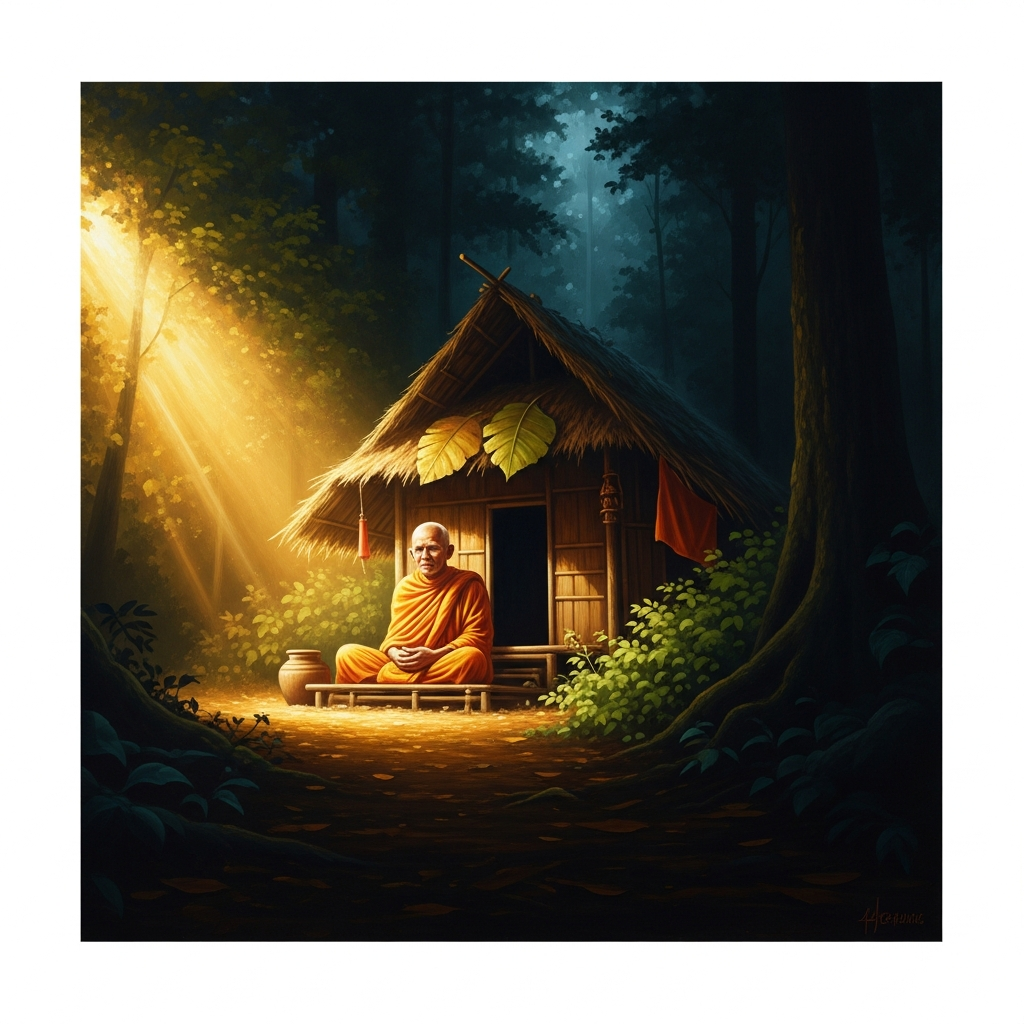
 A small forest kuti — a monk's hut on stilts — in the early morning
 Generating art…
 A circle of monks and Western practitioners in white robes seated on the ground around Ajahn Chah, who is speaking with his hands slightly open
 Generating art…
 Echoes Across Traditions
Entities
- Ajahn Chah
- Wat Nong Pah Pong
Sources
- Ajahn Chah, *Food for the Heart: The Collected Teachings of Ajahn Chah* (Wisdom Publications, 2002)
- Ajahn Chah, *Being Dharma: The Essence of the Buddha's Teachings* (Shambhala, 2001)
- Paul Breiter, *Venerable Father: A Life with Ajahn Chah* (Paraview Press, 2004)
- Bhikkhu Thanissaro, *The Wings to Awakening: An Anthology from the Pali Canon* (Dhamma Dana Publications, 1996)
- Jack Kornfield, *Living Dharma: Teachings and Meditation Instructions from Twelve Theravada Masters* (Shambhala, 1996)