Testament of Solomon
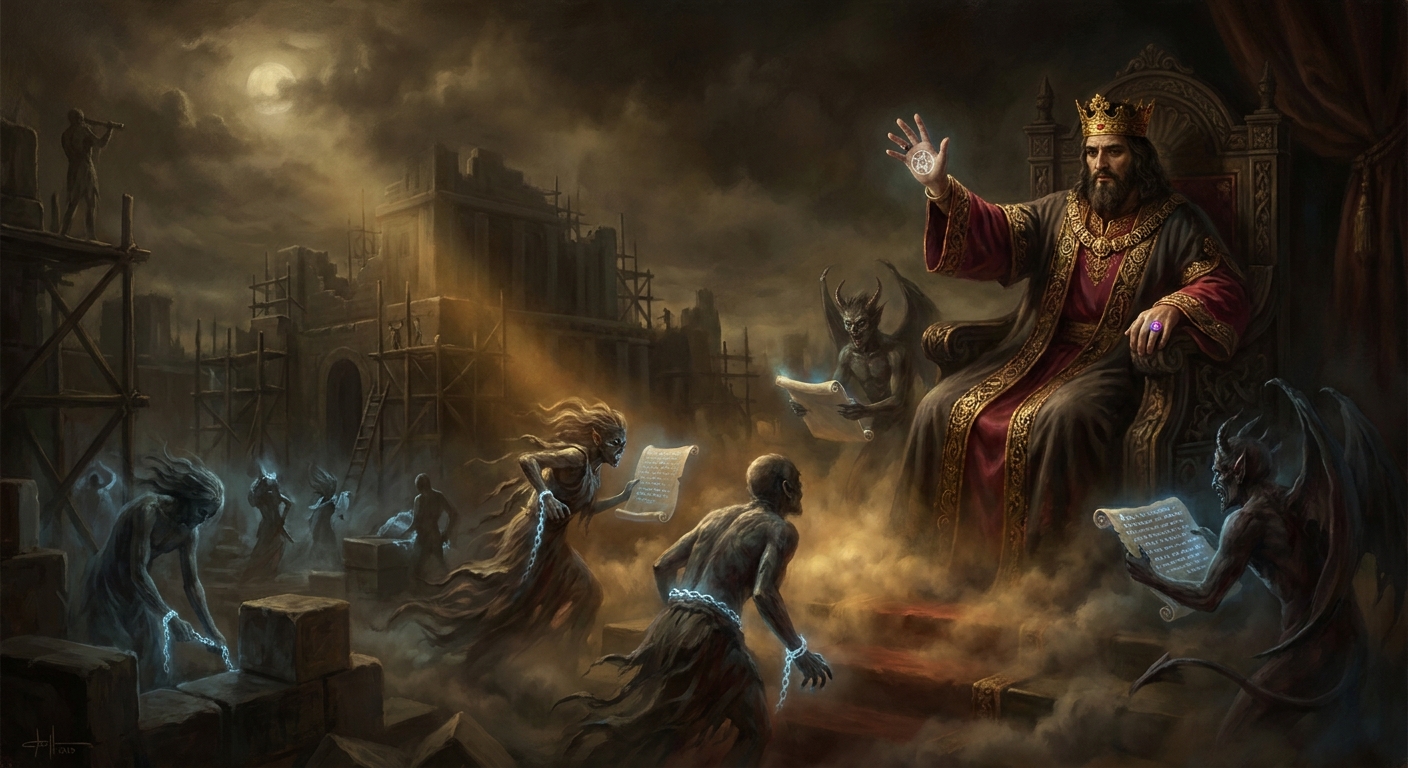
King Solomon receives a magic ring from the archangel Michael, uses it to summon and interrogate 36 demons one by one, forces them to reveal their names and weaknesses, and puts them to work building the Temple. The foundation text of all Western ceremonial magic.
| Aspect | Detail |
|---|---|
| Written | ~1st-3rd century AD (composite, with possible earlier oral traditions) |
| Language | Greek |
| Attributed to | King Solomon (pseudepigraphical) |
| Genre | Pseudepigraphical testament / demonological catalog / wisdom text |
| Canon status | NEVER canonical in any Christian or Jewish tradition. But its influence on magical practice, folklore, and art is immense |
| Connection to Tobit | The demon Asmodeus appears in both Tobit and the Testament of Solomon — the only demon named in both “biblical” and pseudepigraphical literature |
A demon named Ornias is harassing a boy working on the Temple construction, sucking his thumb and draining his life force. Solomon prays to God, and the archangel Michael delivers a magic ring engraved with a pentalpha (five-pointed star / pentagram). Solomon uses the ring to summon Ornias and then commands Ornias to bring other demons before him.
One by one, 36 demons appear. Each is interrogated:
- What is your name?
- What is your function? (what suffering do you cause?)
- What angel or power thwarts you? (what is your counter-force?)
Solomon then binds each demon to labor on the Temple.
Notable demons include:
| Demon | Function | Thwarted By |
|---|---|---|
| Ornias | Strangles boys, drains life | The archangel Ouriel |
| Beelzeboul | Prince of demons; causes worship of false gods | ”The Almighty God” |
| Asmodeus | Plots against newlyweds; causes madness | Smoke of a fish’s liver and gall (same as in Tobit!) + the angel Raphael |
| Lix Tetrax | Causes fires and fevers | ”The only one that can send me away is the one that the whole firmament serves” |
| The Seven Sisters | Deception, strife, battle, jealousy, power, error, “the worst” | Specific prayers and angelic names |
| Ephippas | Wind demon | Bound to carry a pillar through the air for the Temple |
Solomon eventually falls because he desires a Shunammite woman whose god demands sacrifice. He offers five grasshoppers to her god, loses the ring’s power, and becomes a servant to idols — fulfilling 1 Kings 11:1-8.
Testament of Solomon 1:5-7 — The ring arrives:
“And Michael the archangel gave me a ring with a seal engraved upon it, and said to me: ‘Solomon, son of David, take this gift which the Lord God has sent you, the highest Sabaoth. With it you shall lock up all the demons of the earth, male and female; and with their help you shall build up Jerusalem.’”
Testament of Solomon 5:1-5 — Asmodeus interrogated:
“I asked him: ‘What is your name?’ He answered: ‘I am called Asmodeus among mortals, and my business is to plot against the newly wedded, so that they may not know one another. I sever them utterly by many calamities… my star is bright in heaven, and men call it the evening star.’”
- Magic and demonology — The text treats magic rings and demon-binding as God-given powers, which mainstream Judaism and Christianity rejected
- Pseudepigraphical — Clearly not written by Solomon
- No theological content — It reads more as a catalog of demons than a spiritual teaching
- Late composition — Written centuries after the canonical period
| Tradition | Significance |
|---|---|
| Christian (Protestant) | Not canonical, not read. But the “Solomon as exorcist” tradition influenced the Gospel exorcism narratives. Jesus is accused of casting out demons “by Beelzebul” (Matt 12:27) — the same demon Solomon interrogates |
| Catholic | Not canonical. The tradition of Solomon’s ring was known to medieval Catholics but treated as legend, not scripture |
| Jewish | Solomon as demon-binder appears in the Talmud (Gittin 68a-b), where Solomon captures Asmodeus using a chain inscribed with the divine name. The Testament and the Talmud share a common oral tradition |
| Masonic | Directly relevant. The construction of Solomon’s Temple is the central Masonic allegory. The idea that Solomon commanded supernatural forces to build the Temple resonates with Masonic symbolism of the Temple as cosmic architecture. The pentalpha (pentagram) on the ring appears in some Masonic traditions |
| Esoteric | The foundational text. The Ars Goetia (part of the Lesser Key of Solomon, ~17th century), the most influential grimoire in Western magic, claims to be Solomon’s system of demon-binding. The 72 demons of the Goetia descend from the 36 of the Testament. Every subsequent “Solomonic” grimoire traces back to this tradition |
| Ethiopian Orthodox | Not canonical, but the Solomon tradition is deeply embedded in Ethiopian culture through the Kebra Nagast (Glory of Kings), which traces the Ethiopian royal line to Solomon and the Queen of Sheba |