Combat Profile
Suspension of Fate
Temporarily halts all causality and progression in a localized space, allowing only the caster to act freely within the frozen moment.
Inverted Wisdom
Perceives truth through reversed perspective; all conventional knowledge becomes unreliable while hidden insights become crystalline.
Total immobility; the Hanged Man cannot act, and his wisdom comes at the cost of agency
“For whosoever will save his life shall lose it: and whosoever will lose his life for my sake shall find it.” — Matthew 16:25
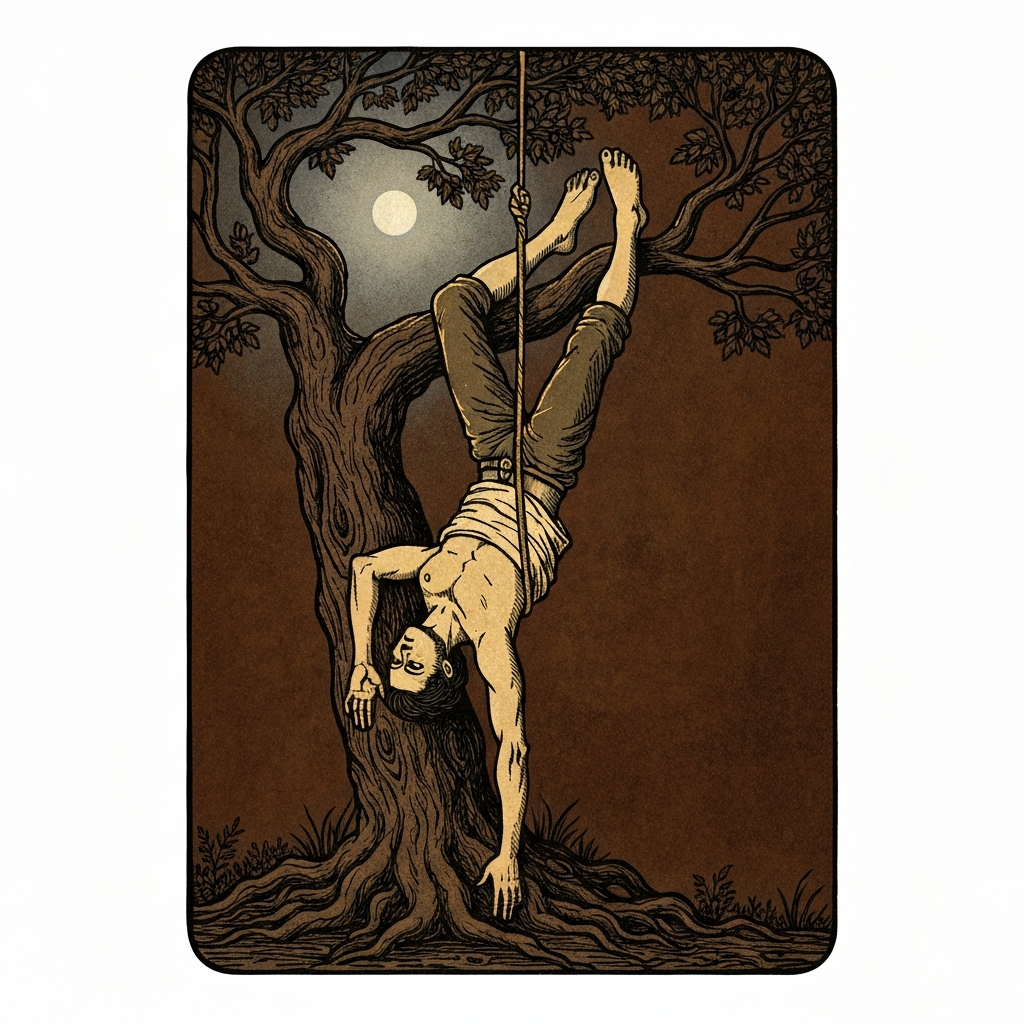
Lore: A man hangs upside down from a living tree (shaped like the Hebrew letter Tav or a Tau cross), suspended by one foot. His other leg crosses behind the first, forming a figure-four — the same shape as the Emperor’s seated pose, but inverted. His face is serene, even radiant. A golden halo surrounds his head. He has chosen this. He is not a victim; he is a voluntary sacrifice. Hanging inverted reverses everything: what was above is now below, what was important becomes trivial, what was invisible becomes clear. The Hebrew letter Mem means “water” — the Hanged Man is submerged in the unconscious, suspended in the amniotic fluid of transformation. He cannot move, but he can see.
Biblical Parallel: Christ on the Cross — the voluntary sacrifice of God Himself, arms spread, suspended between heaven and earth (Matthew 27:32-56). Peter, who tradition says was crucified upside down because he felt unworthy to die in the same manner as Christ (Church tradition; Acts of Peter). Odin hanging on Yggdrasil for nine days and nights to gain the runes — “I hung on that windy tree, wounded with my own spear, myself to myself” (Havamal 138-139). Isaac bound on the altar (Genesis 22:1-14) — the willing sacrifice that God Himself provided.
1 min read
The Chariot (VII) -- action vs. surrender; The Emperor (IV), who would never permit such vulnerability
Rider-Waite-Smith deck; Norse mythology (Odin); Golden Dawn