Contents
A nine-year-old Oglala boy falls into a twelve-day illness and travels in his spirit to the six grandfathers who show him the tree of life at the center of the hoop of the world — the most detailed vision account in Plains Indian literature.
- When
- 1863 CE — Oglala Lakota, the generation before the Battle of Little Bighorn
- Where
- The Oglala camps near the Black Hills; the spirit geography of the six directions
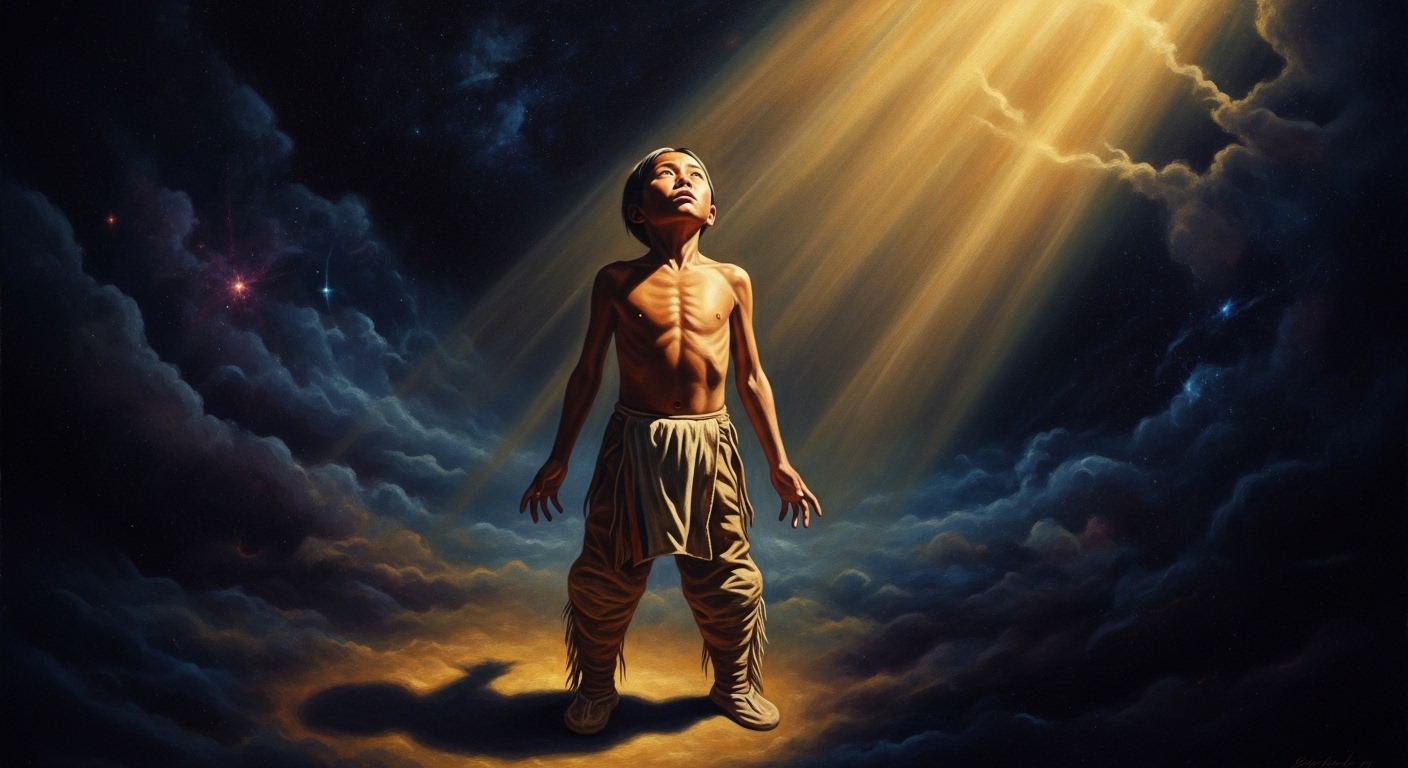
He is nine years old when his legs swell and his arms go stiff.
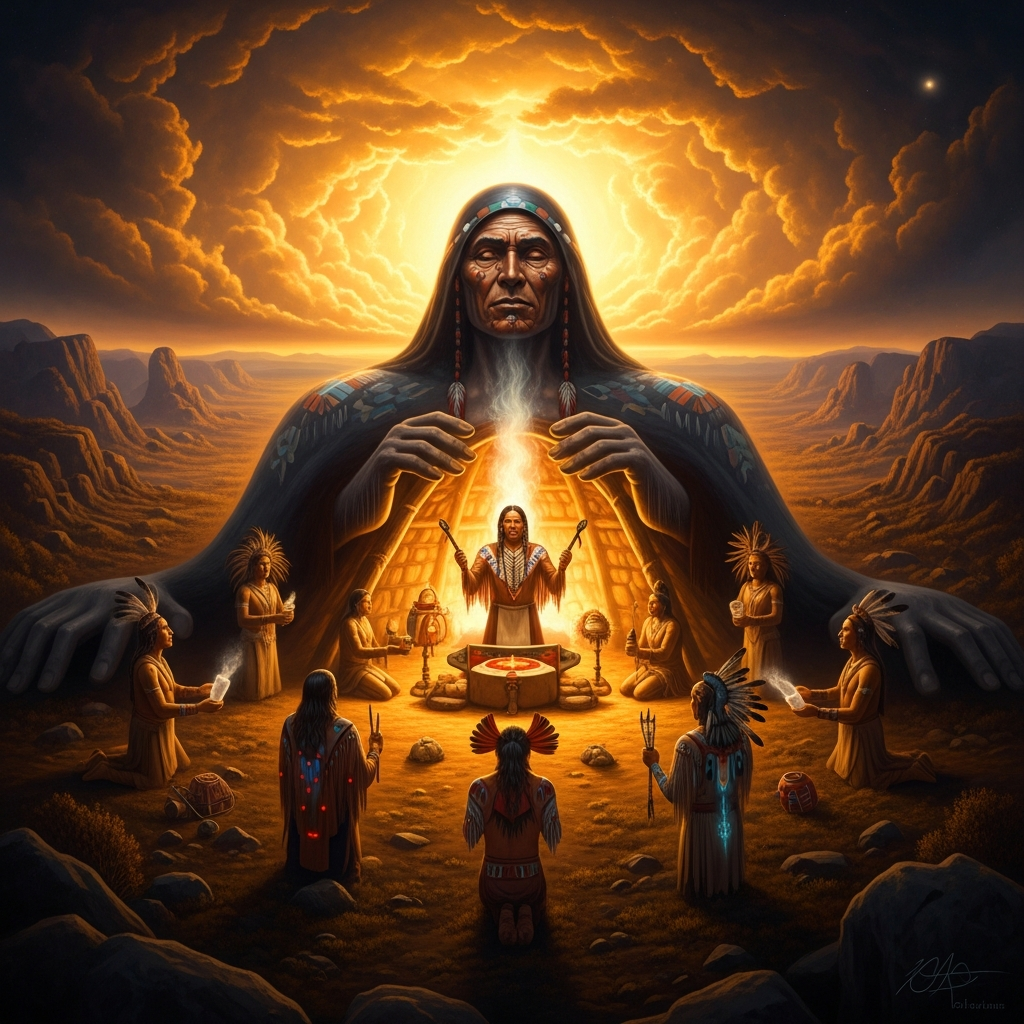
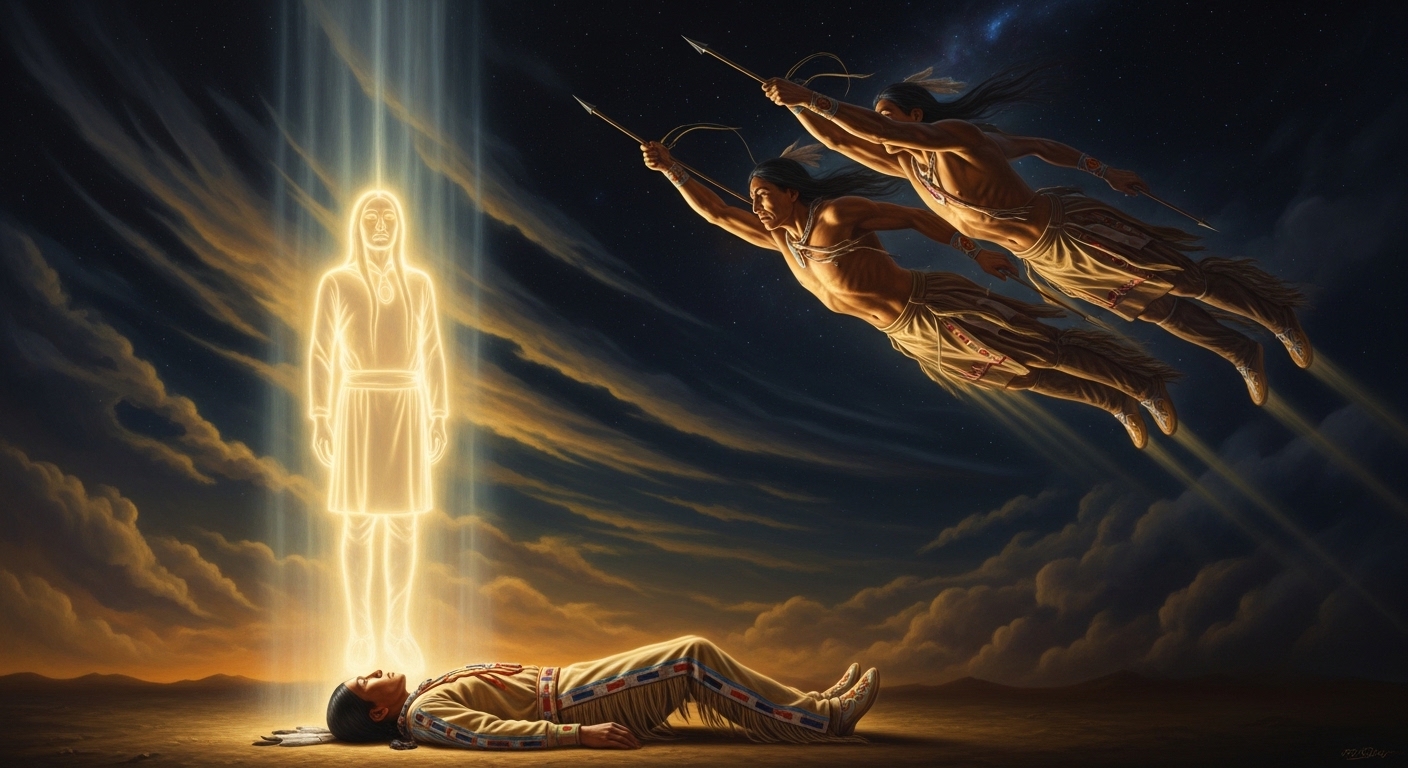
For twelve days Black Elk lies in the tipi and does not move. His parents think he is dying. The medicine man comes and does what he can, but the boy does not return to himself, does not eat or speak or open his eyes. His body is in the tipi but the boy himself is somewhere else entirely.
He hears voices calling from above.
He rises — his spirit rises, his body stays — and two men come down from the clouds like arrows. They tell him the grandfathers are calling for him. He follows them upward through the clouds into a place that is structured like the sky and like the world at once, a geography of the six sacred directions: west, north, east, south, above, below.
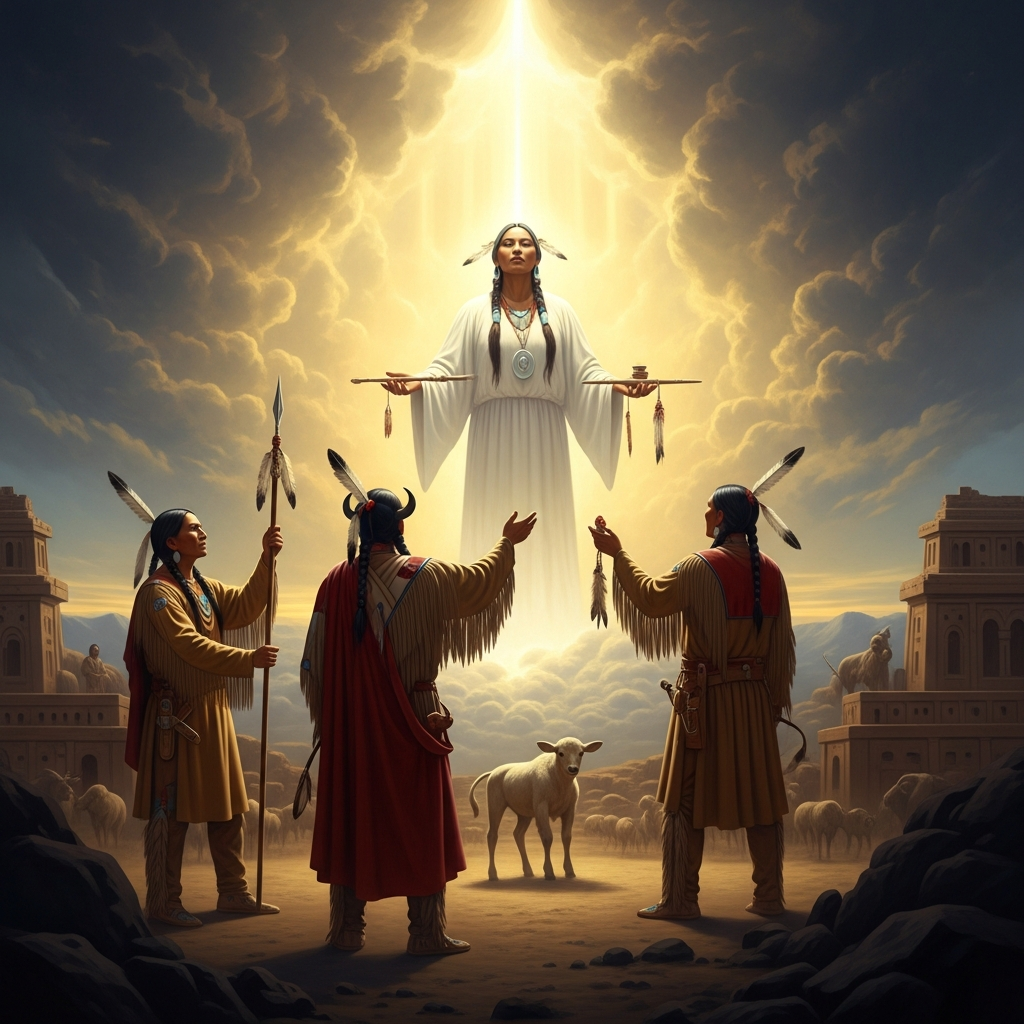
Six old men are seated in a row. They are very old — older than anything with a beginning — and their faces are kind with the specific kindness of those who have seen everything and are not frightened. Black Elk understands that these are not ordinary elders. They are the powers of the world given the shape of old men so that a nine-year-old can look at them without being destroyed.
The first grandfather gives him a wooden cup of water — the power of life — and a bow. The second grandfather gives him an herb of purification and a white wing of the goose. The third grandfather shows him a pipe and a nation of animals. The fourth grandfather gives him a flowering stick and the morning star. The fifth grandfather becomes a spotted eagle. The sixth grandfather — who is the earth itself, who is the land of the Lakota — looks at him and says: My boy, I have sent for you, and you have come.
Then the vision opens.
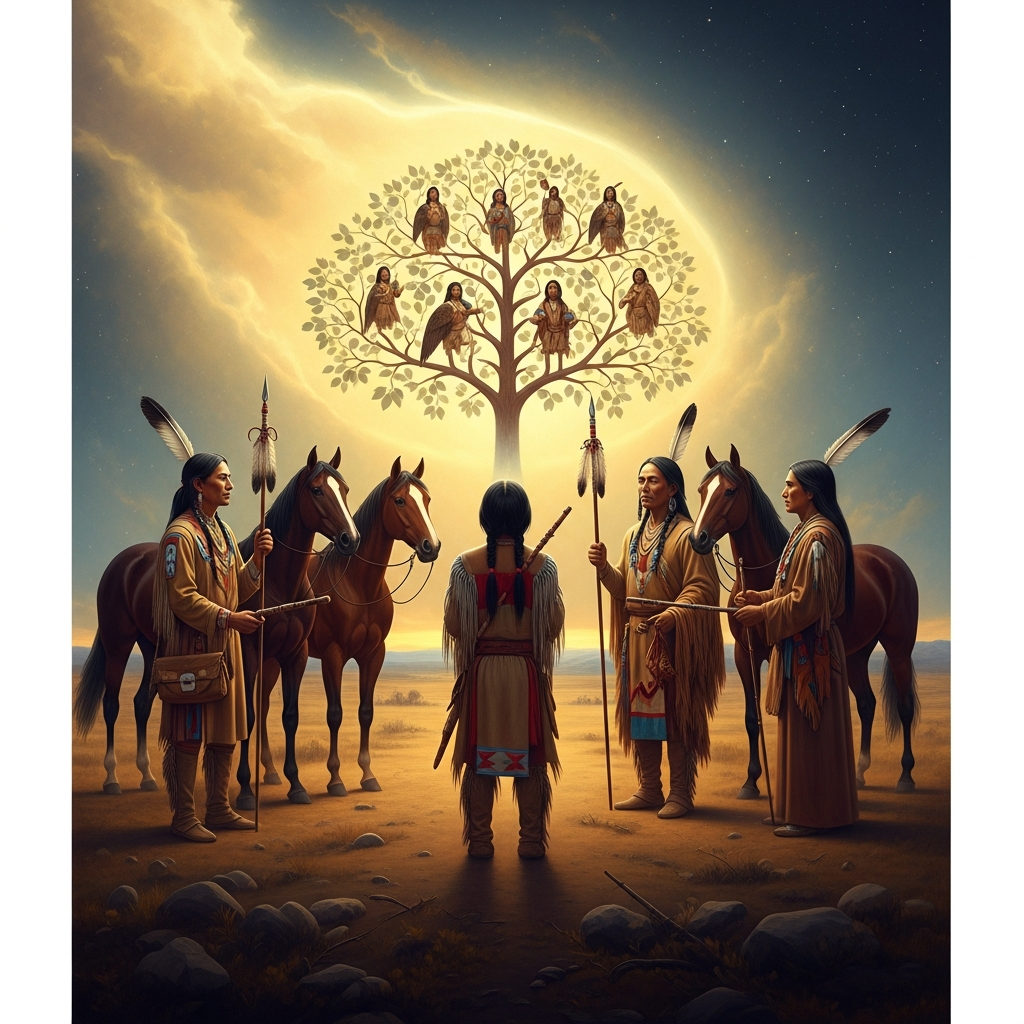
He sees the whole world from above — the black hills, the plains rolling to every horizon, the rivers. He sees his people in the hoop of the nation, and the tree of life at the center of the hoop, and the tree is flowering and full of birds. He sees the four directions send their horse nations: the sorrels of the west, the whites of the north, the bays of the east, the blacks of the south. He is given a bay horse and made to lead them. He sees the enemies driven away. He sees the tree cut down, the hoop broken, the people scattered.
He sees the hoop reunited.
He sees the tree bloom again at the center of a nation that has survived its own destruction — the flowering tree as the image of everything that matters, the tree that every ceremony is reaching toward, the tree that the Sun Dance pole represents, the tree whose roots go to Wakan Tanka and whose branches shelter every people who have ever lived in balance with the earth.
He returns to his body at the end of twelve days.
His parents say he sat up and was hungry. He was nine years old. He told no one the vision — not for years. He was afraid to speak it. He watched the world move toward the disaster the grandfathers had shown him: the taking of the Black Hills in 1874, the battle at Little Bighorn in 1876, the killing at Wounded Knee in 1890 where he was present with a red stick, trying to do what the grandfathers had told him to do.
He did not speak the vision fully until he was sixty-seven, seated with a Nebraskan poet named Neihardt in a tent on Pine Ridge Reservation in 1931.
The tree that was shown to a nine-year-old boy has been flowering in the hands of readers ever since.
Scenes

Echoes Across Traditions
Entities
- Black Elk (Hehaka Sapa)
- the Six Grandfathers
- the bay horses of the four directions
- the flowering tree
- the sacred hoop
Sources
- John G. Neihardt, *Black Elk Speaks* (University of Nebraska Press, 1932/2000)
- Raymond DeMallie, ed., *The Sixth Grandfather: Black Elk's Teachings Given to John G. Neihardt* (University of Nebraska Press, 1984)
- Michael F. Steltenkamp, *Black Elk: Holy Man of the Oglala* (University of Oklahoma Press, 1993)
- Clyde Holler, *Black Elk's Religion* (Syracuse University Press, 1995)