Contents
The exiled Roman general Coriolanus marches on Rome with a Volscian army — and only his mother Veturia, walking out to meet him with his wife and children, can turn him back.
- When
- Traditional date c. 488 BCE — the early Roman Republic
- Where
- The Volscian camp at the fifth milestone outside Rome
He has every reason.
Gaius Marcius — the man who will be called Coriolanus for his capture of the Volscian city of Corioli, one of Rome’s greatest military achievements — has been driven into exile by the people he fought for his whole life. The charge: his contempt for the plebeians, his opposition to grain distribution during famine, his arrogance before the tribunes of the people who hold the legal power to exile him. The charge is not entirely wrong. He is arrogant. He holds the common people in contempt. He is also the best soldier Rome has.
He goes to the Volscians — Rome’s neighbors and enemies, the people he spent years defeating — and offers his services. Their leader Attius Tullius receives him. They give him command of their armies.
The Volscian army advances on Rome. It takes the Roman colonies one by one. The Roman Senate sends three embassies. Coriolanus dismisses all three. The priests go out in their sacred robes. He dismisses them. Nothing from the Roman side of the argument is effective because his argument against Rome is correct: they drove him out, and every Roman who appears before him is a representative of the unjust city.
Then the women come.
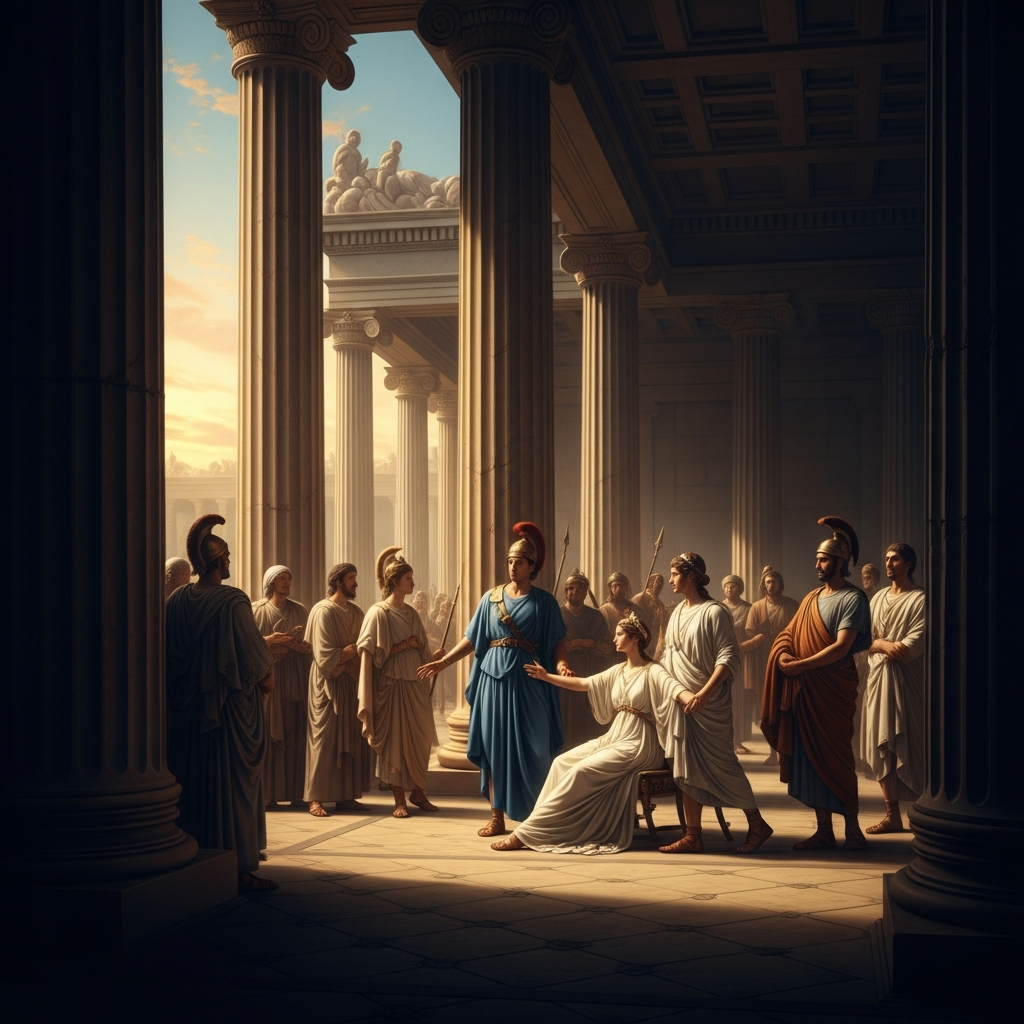
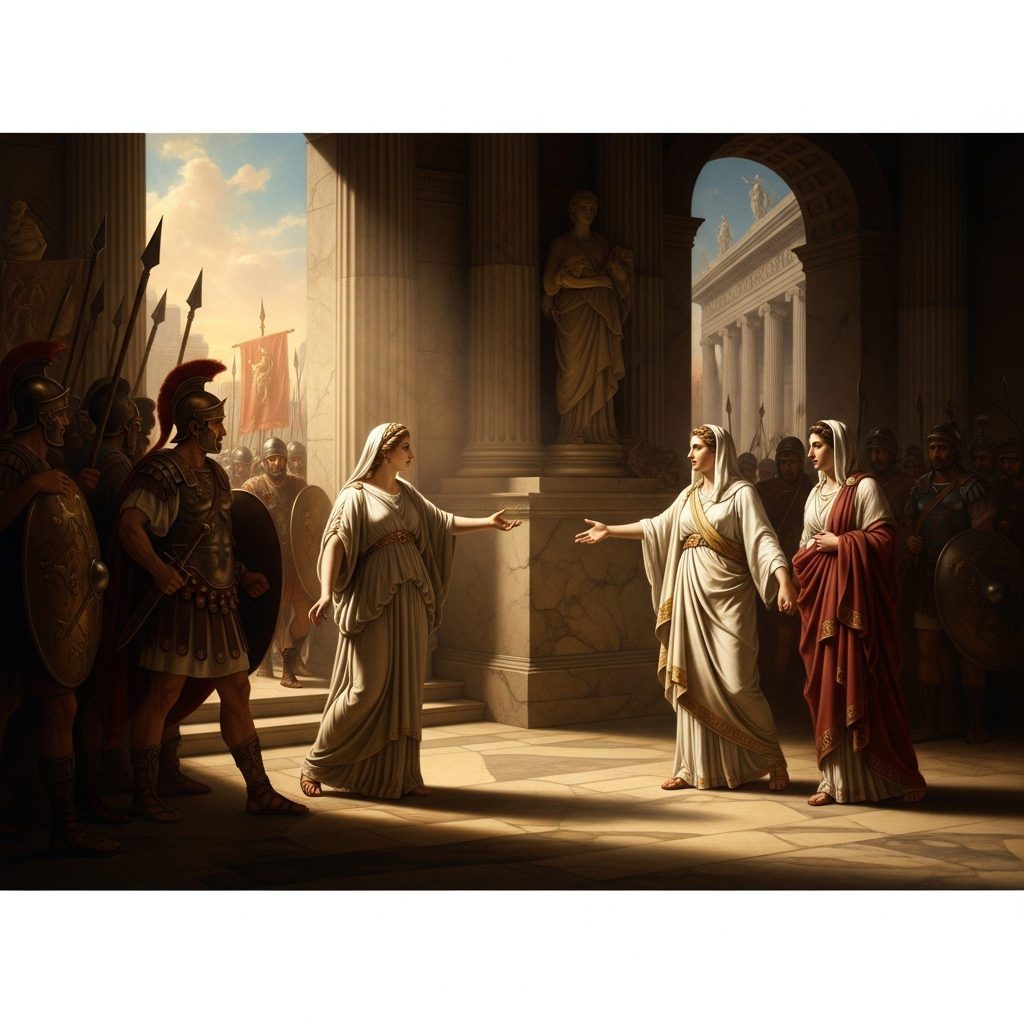
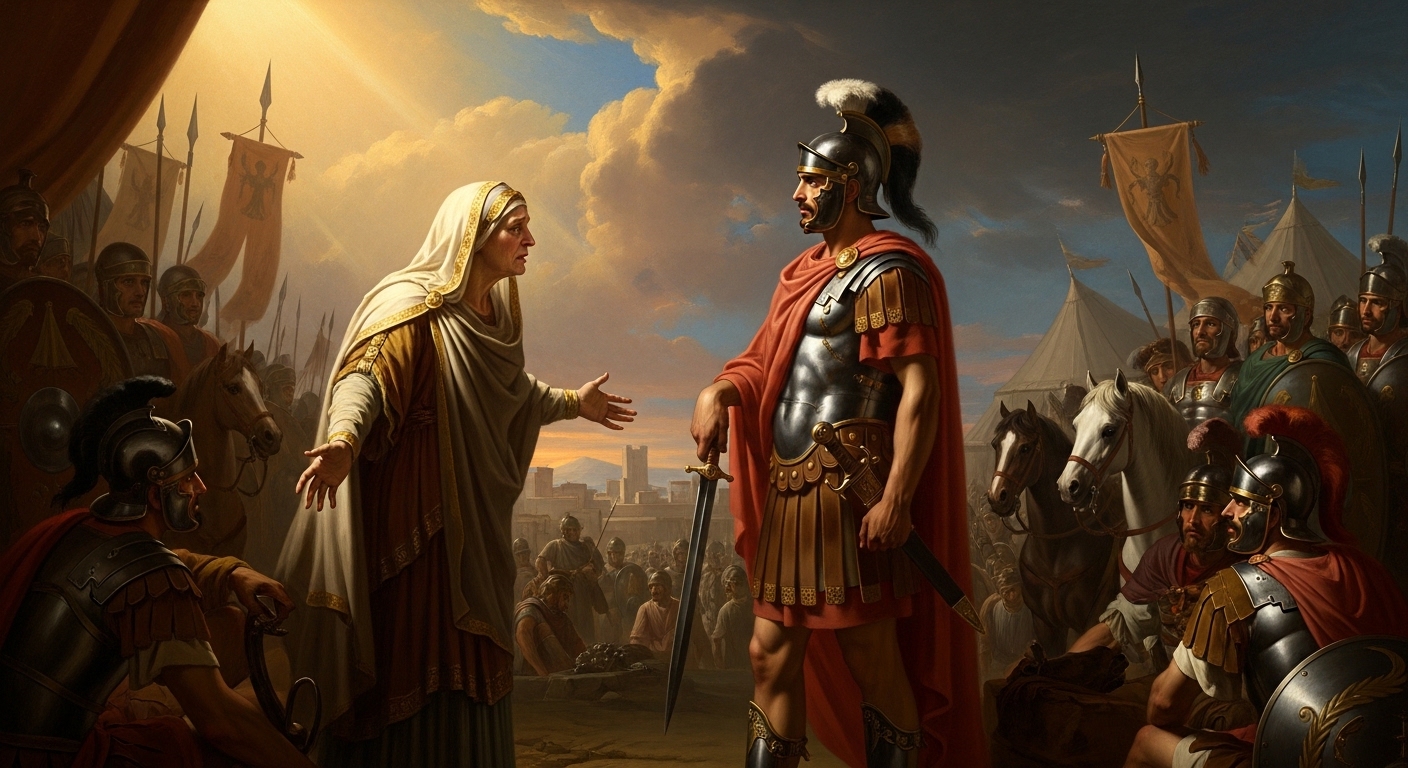
Veturia, his mother, walks out of Rome ahead of a group of Roman matrons.
Plutarch is precise about the details: she has come against Coriolanus’s wife Volumnia’s wishes. She leads. She has brought Volumnia and the children as her arguments, but Veturia herself is the argument. She walks into the Volscian camp to the place where her son is reviewing troops.
He sees her coming.
He makes the gesture of going to meet her, which is the Roman son’s gesture of respect to the Roman mother — the man who commands an army stands up for his mother when she approaches. He makes this gesture and then he does not know what to do with the moment, because the gesture that filial piety requires and the gesture that military command requires are opposed. He is about to destroy Rome. His mother is in the city he is about to destroy.
She speaks first.
She asks: before I touch you, tell me — am I your mother or a captive? Has your exile made me Rome’s enemy or yours? She tells him she sees her body standing in Rome while he camps outside it with weapons drawn. She says she cannot bear to live until Rome falls and she cannot bear to see the son she raised destroy the city she loves. She says: if you attack Rome you will first trample on the body of her who bore you.
Plutarch records the scene with the detail that makes it devastating: Coriolanus holds her in silence for a long time.
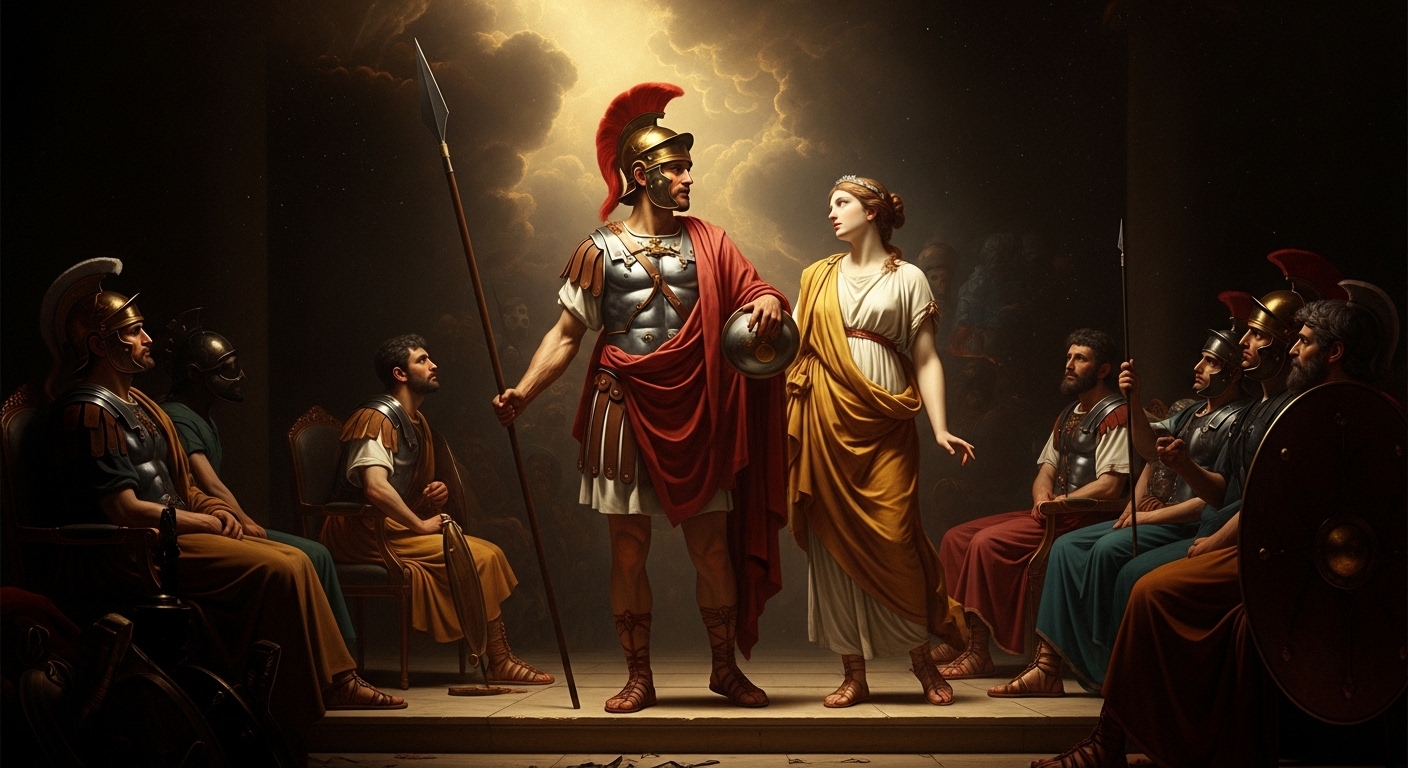
He does not answer. He does not try to argue back. He presses his mother’s hands. He presses his wife’s hands. He speaks to the children. Then he turns away, and when he speaks, it is the most famous line of his story: Mother, you have won a great victory for Rome, and a ruin for your son.
He withdraws the army.
The women return to Rome as heroes. The Senate votes them extraordinary honors: a new temple built at their request, the right to receive certain reverences from men. The place where Veturia met Coriolanus is marked as a sacred site. Fortune — the goddess Fortuna — is worshipped there under a specific dedication: Fortuna of Women (Fortuna Muliebris), the fortune that the women won for Rome by doing what the priests and senators and ambassadors could not do.
Coriolanus’s fate varies by source.
Livy says the Volscians killed him when he withdrew the army — charging him with betrayal of their cause. Plutarch says he died in exile among the Volscians, old and bitter, a famous saying attributed to him: that old age is the most miserable of exiles.
Both versions preserve the same truth: Coriolanus wins the theological point and loses everything else. He was right that Rome mistreated him. He was right that the Volscians honored him more. He was right about the injustice. Veturia simply showed him that being right about the injustice does not license the destruction of the city where your mother lives.
This is pietas — the Roman concept that cannot be exactly translated. It is not merely piety or even duty. It is the whole network of obligations to family, city, and gods that constitutes a Roman person’s existence. You cannot have pietas and destroy Rome. Coriolanus chooses pietas. He pays for it with everything else.
Scenes

Echoes Across Traditions
Entities
- Coriolanus (Gaius Marcius)
- Veturia
- Volumnia
- the Volscians
- the Roman Senate
Sources
- Livy, *Ab Urbe Condita* II.40 (c. 27-25 BCE)
- Plutarch, *Life of Coriolanus* 31-36 (c. 75 CE)
- Dionysius of Halicarnassus, *Roman Antiquities* VIII.39-54 (c. 7 BCE)
- Shakespeare, *Coriolanus* (c. 1608)