Contents
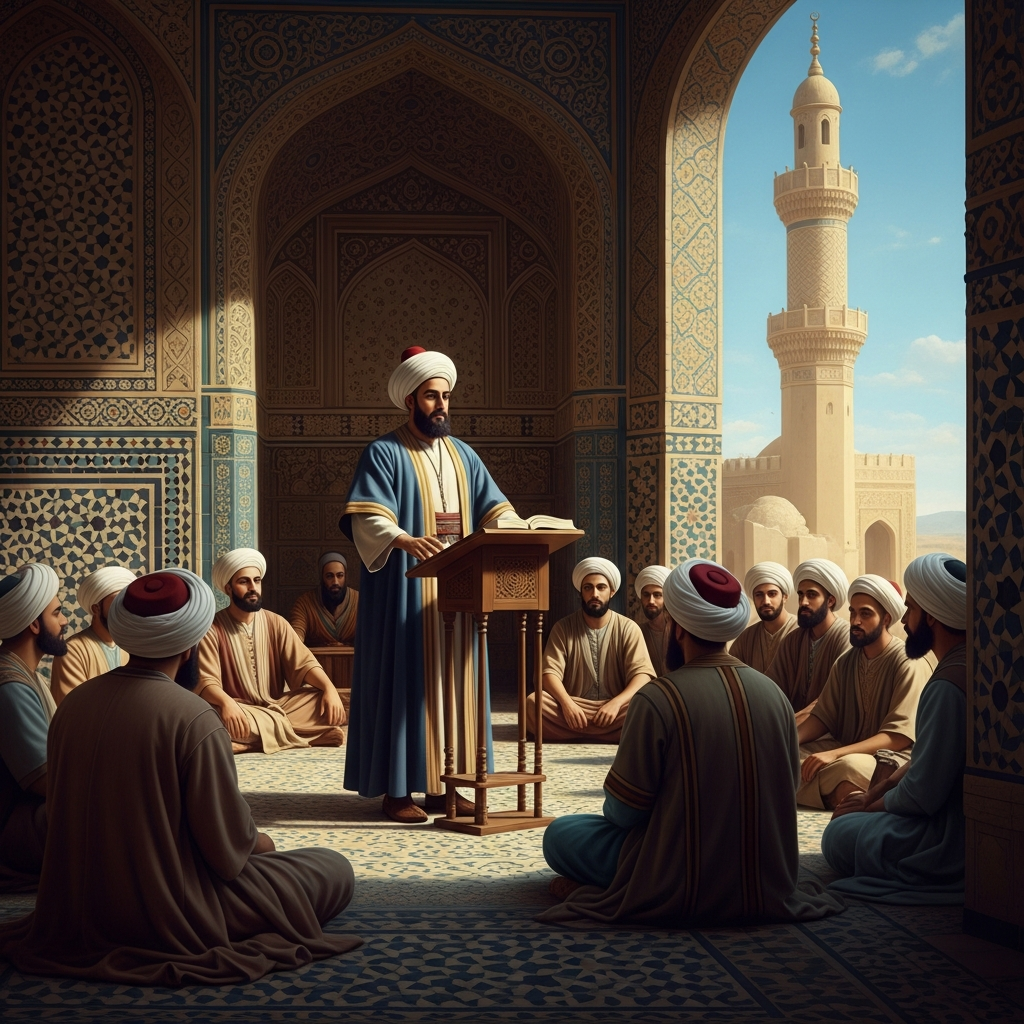
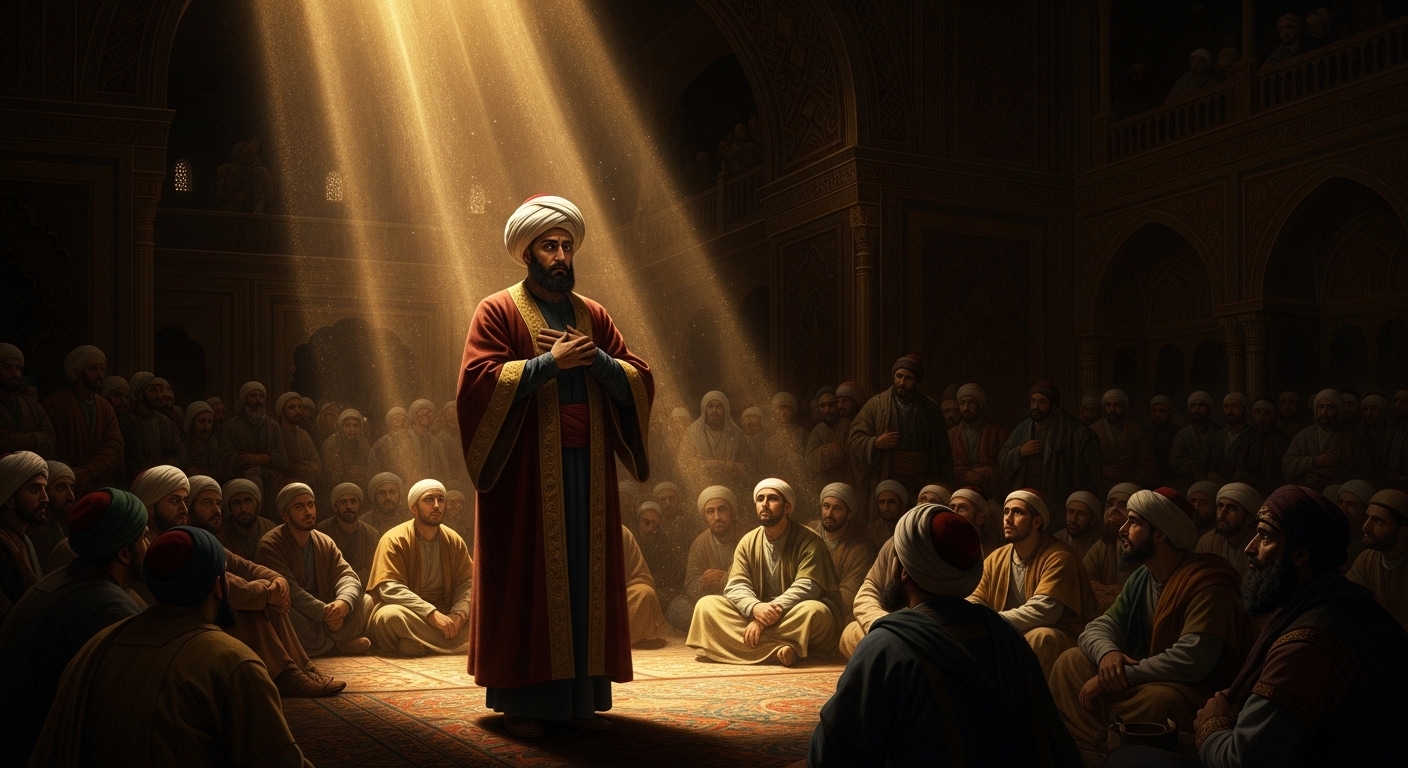
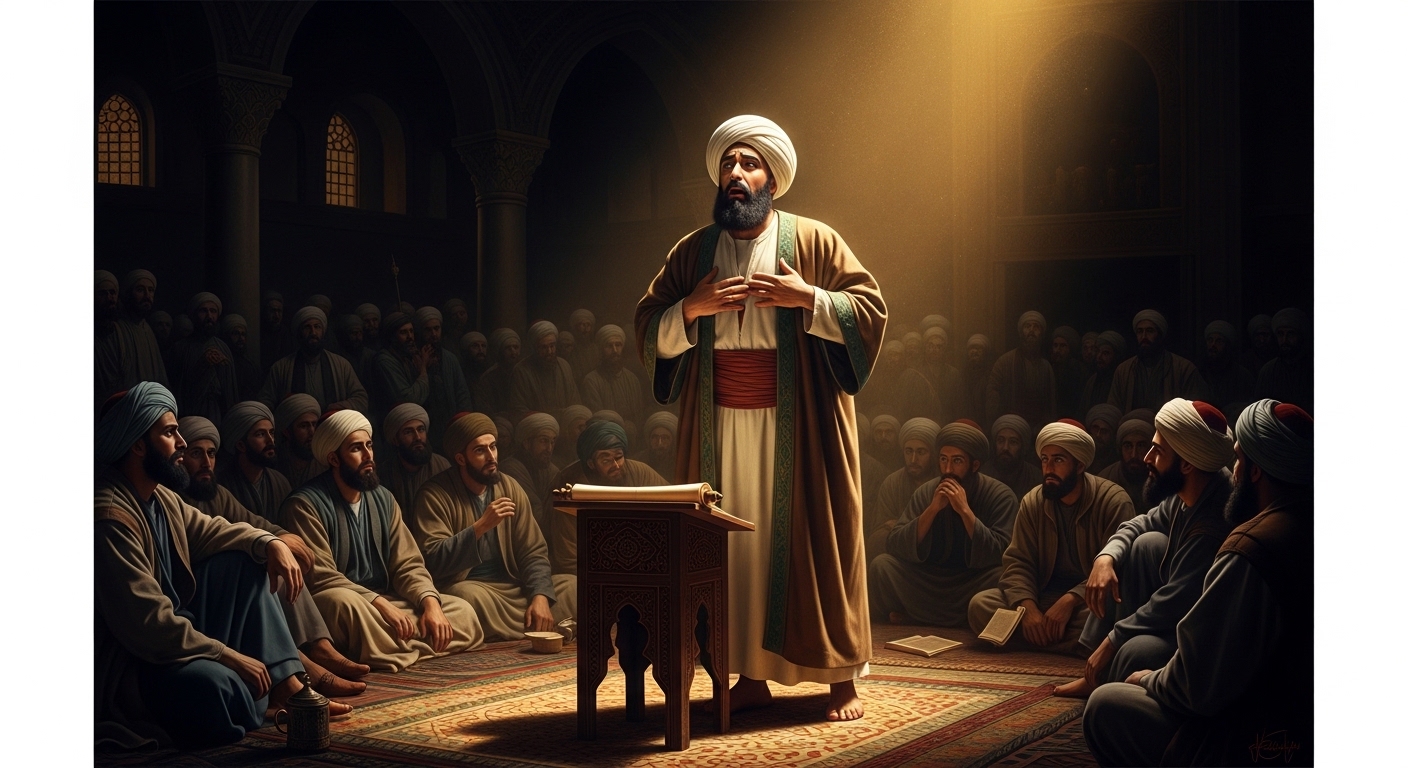
In 1095, the most brilliant Islamic scholar of his generation stands before his three hundred students in the Nizamiyya madrasa of Baghdad and finds that he can no longer speak — not because of physical illness but because the gap between what he teaches and what he actually knows has become unbearable.
- When
- 1095 CE — Baghdad, the Abbasid Caliphate
- Where
- Baghdad, Iraq — specifically the Nizamiyya madrasa, the premier Islamic university of its age
The throat closes.
It is the most precise description he gives in his autobiography: something in his throat stops him. He opens his mouth to lecture, and the words do not come. He tries again. Nothing. The three hundred students are waiting. He is the most prestigious teacher in the Islamic world. He cannot speak.
He does not have laryngitis. He has a recognition.
The year is 1095. Al-Ghazālī is thirty-seven years old. He has been teaching at the Nizamiyya madrasa in Baghdad for four years, appointed by the great Seljuk vizier Nizam al-Mulk — who was assassinated the same year, adding political instability to Al-Ghazālī’s already precarious interior situation. He is the author of multiple works in philosophy, jurisprudence, and theological polemic. He has demolished the philosopher Avicenna’s arguments in one book and the Ismaili theologians’ arguments in another. He is, by every measure, at the top of his profession.
And he knows — this is the recognition that stops his throat — that he does not believe what he is teaching.
Not that he believes it is false. It is worse than that. He believes it is all correct and none of it has touched the thing that matters. He has mastered Islamic knowledge as a scholar masters a subject: competently, comprehensively, accurately. He has never been consumed by it. He has never been changed by it. He knows the doctrine of divine love. He has never loved God. He knows the doctrine of death as the soul’s liberation. He is terrified of death.
He describes this in Deliverance from Error with a clinical precision that reads like a case history.
The crisis is epistemological before it is spiritual. He realizes that the foundation of his certainty — the logical proofs for the existence of God, the demonstrations of prophetic authority, the systematic derivation of Islamic law from its sources — does not provide the certitude he has been claiming it provides. The proofs are valid. The demonstrations are correct. But the certitude that comes from following the proofs is not the same as the certitude that comes from direct experience. He distinguishes them with the image of taste: you can correctly describe every physical and chemical property of honey without knowing what honey tastes like. His entire religious knowledge is the description. He has never tasted.
The Sufi mystics whom he had always considered peripheral figures — the ecstatics, the weeping ascetics, the practitioners of interior silence — have something he does not have. They know by dhawq, by taste, by direct experience. His argument demolishes other arguments. Their experience is impervious to argument because it is not constructed from argument.
He leaves Baghdad by subterfuge, disguising his departure as a short journey, because he knows he will be compelled to return if he announces his intention. He leaves his salary, his students, his position, most of his wealth. He keeps only enough to live on.
He goes first to Damascus. He spends time in the Great Mosque, in the minaret, alone. He goes to Jerusalem. He visits Hebron, the tomb of Abraham. He performs the hajj twice. He visits Medina. He returns to his hometown of Tus and continues the interior work.
The work is learning, gradually, to taste.
He writes about this process later: the Sufi practices — the night prayers, the dhikr, the fasting, the deliberate examination of the heart’s motions — were not new to him as intellectual knowledge. He had taught them. What was new was doing them without the scholar’s distance, without the ability to critique the method while performing it. He had to do them as a practitioner, not as a teacher of practitioners.
After eleven years, he goes back.
The throat opens.
He teaches from a different place — from inside the experience, not above it. The Ihya Ulum al-Din, the book he writes after the return, is what a scholar sounds like when the knowledge has moved from the head to the place where the throat was closed.
Scenes
Echoes Across Traditions
Entities
- Al-Ghazālī
- Nizam al-Mulk (his patron, recently assassinated)
- the three hundred students of the Nizamiyya
Sources
- Al-Ghazālī, *Al-Munqidh min al-Dalal* (Deliverance from Error), c. 1108
- W. M. Watt, *The Faith and Practice of al-Ghazali* (Allen & Unwin, 1953)
- Eric Ormsby, *Ghazali: The Revival of Islam* (Oneworld, 2008)
- Farouk Mitha, *Al-Ghazali and the Ismailis: A Debate on Reason and Authority in Medieval Islam* (Tauris, 2001)