Contents
In Mecca in 1201, Ibn ʿArabī begins receiving the Futuhat al-Makkiyya — the Meccan Revelations — a thirty-seven-volume work that unfolds the doctrine of wahdat al-wujud, the Unity of Being: not pantheism, not monotheism in the ordinary sense, but the claim that there is only one existence and everything that appears to exist participates in it.
- When
- 1201–1240 CE — Mecca and Damascus
- Where
- Mecca and Damascus — the two poles of Ibn ʿArabī's mature life
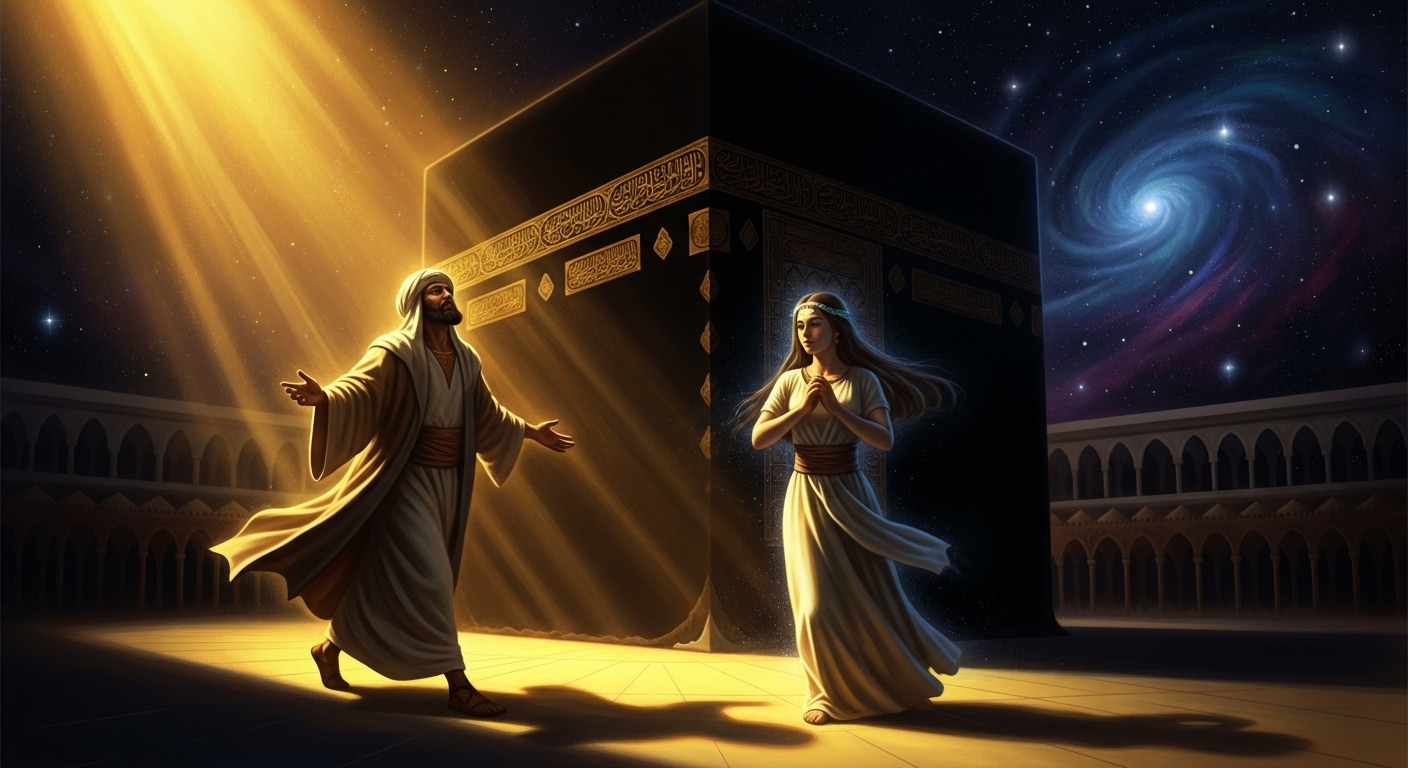
He is circumambulating the Kaaba when a young woman appears.
Ibn ʿArabī is in Mecca on his first hajj, in 1201. He is thirty-six years old, an Andalusian scholar who has been traveling through North Africa since his mid-twenties, absorbing the teachings of Sufi masters across the Maghreb and Egypt. He is already known as a scholar of unusual breadth and depth. And now, circling the House of God in the center of the Islamic world, he encounters — or sees, or imagines — a young Persian woman of extraordinary spiritual radiance.
She speaks to him. Her words concern the secrets hidden in the tawaf — the circumambulation. She represents, in the symbolic grammar that runs through everything he subsequently writes, the Sophia, the divine wisdom that reveals herself to those who have prepared to receive her. She becomes the addressee of some of his most celebrated love poetry.
He begins, in Mecca, to receive the Futuhat al-Makkiyya — the Meccan Revelations.
The doctrine of wahdat al-wujud — which his followers elaborate as the interpretation of his work, though the phrase itself does not appear in his own texts — begins from a simple logical observation.
Wujud is the Arabic word for existence, being. There is only one wujud. God is the only being that exists of itself, through itself, without derivation from anything else. Everything else that appears to exist — every creature, every moment, every particle of matter — exists only through participation in the one wujud. The creatures do not have their own independent existence. They are modes, manifestations, self-disclosures of the one Existence.
This is not pantheism in the sense that God and the world are identical. The stone is not God. But the stone’s existence — the fact that the stone is rather than is not — is God’s existence experienced in the mode of stone. The being of the stone is the divine Being, attenuated, limited, expressed in that particular register.
The implication for the mystic is the one the tradition finds most dangerous and most liberating.
If there is only one Being, then the distance between the human being and God is not ontological. You cannot be farther from God than the stone is farther from light. The distance is perceptual. The mystic’s task is not to approach God — the approaching implies a distance that does not fundamentally exist — but to recognize that the distance never existed. To see through the appearance of separation to the underlying unity that is always the case.
This recognition — kashf, unveiling — is not an achievement in the ordinary sense. You cannot earn it by doing more. You can remove the obstacles to it, which are the false beliefs about the self’s separateness that the ego maintains as its fundamental project. But the recognition, when it comes, is the recognition of something that was always already the case, not the production of something new.
Ibn ʿArabī describes this with the image of the mirror. The mirror reflects the face. The face is not in the mirror — the mirror’s contribution is the polished surface, not the image. The image is entirely the face. The mystic’s heart is the mirror; the divine is the face. The cleaner the mirror, the more accurately it reflects. The dirtiest mirror still reflects something, because even the most obscured heart exists through the divine existence.
The Meccan Revelations he receives continue for decades.
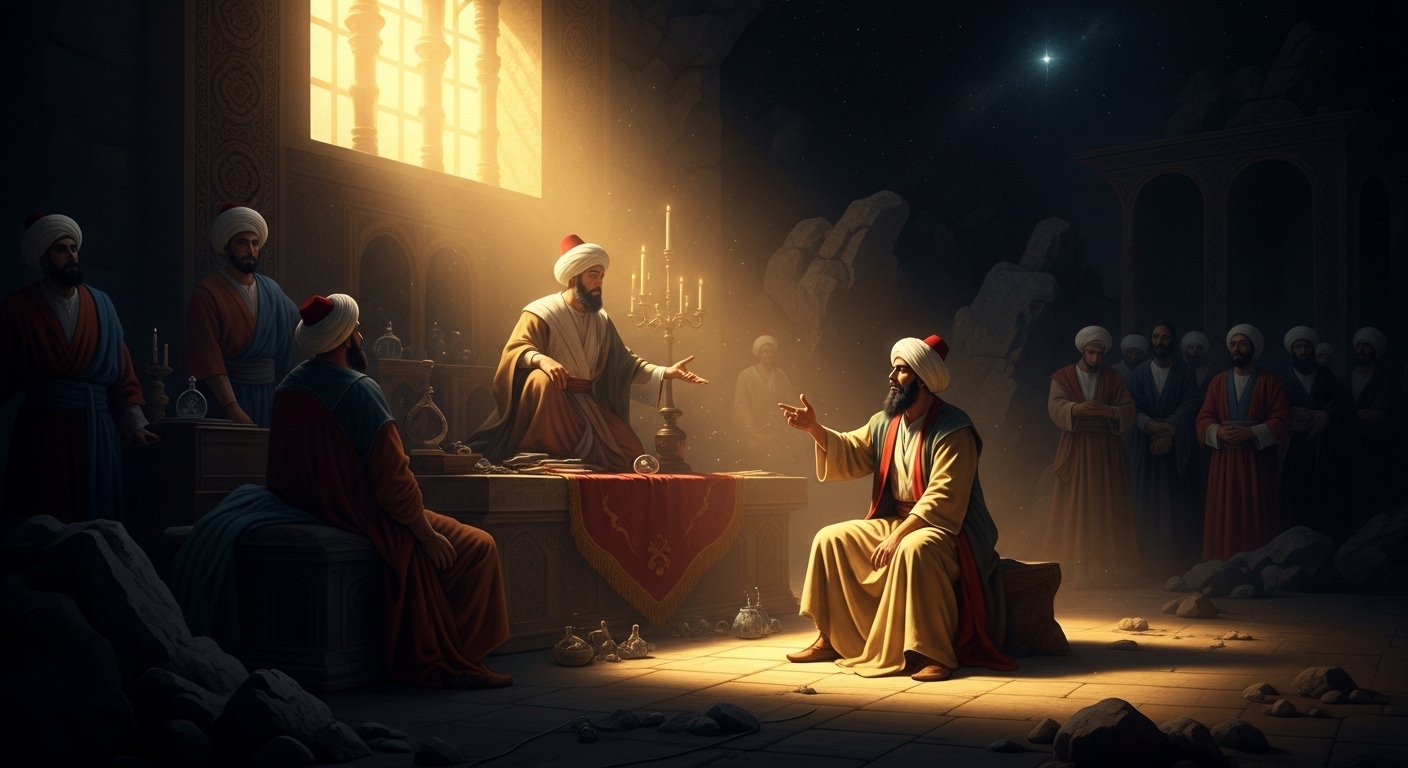
He eventually settles in Damascus, where the Ayyubid governor offers him protection. He spends his final thirty years there, writing, teaching, and dictating. He dies in 1240 at the age of seventy-five, having produced what scholars estimate at 350 works, of which approximately 100 have survived.
The controversy begins before his death and has never ended. Scholars in every generation since have accused him of pantheism, heresy, and theological confusion. Scholars in every generation have also produced defenses and commentaries. The tradition splits on him in a way that no other Sufi figure produces.
This split is itself evidence that he found something that could not be contained in the existing framework.
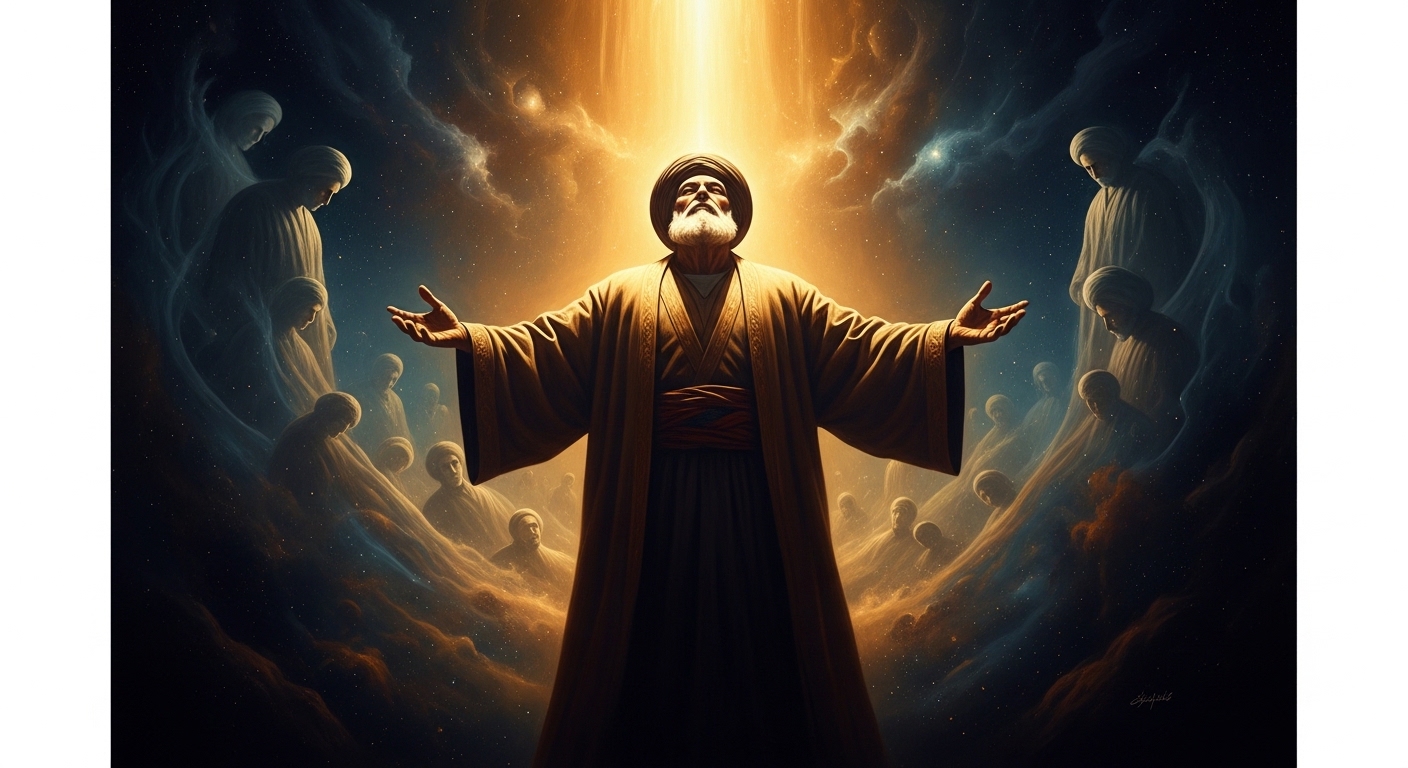
There is only one existence. The debate about what this means is the existence’s own self-examination.
Scenes
Echoes Across Traditions
Entities
- Ibn ʿArabī
- the young Persian woman who appeared to him at the Kaaba
Sources
- Ibn ʿArabī, *Futuhat al-Makkiyya* (Meccan Revelations), composed 1201–1240
- William Chittick, *The Sufi Path of Knowledge: Ibn al-Arabi's Metaphysics of Imagination* (SUNY, 1989)
- Henry Corbin, *Alone with the Alone: Creative Imagination in the Sufism of Ibn Arabi* (Princeton, 1969)
- Toshihiko Izutsu, *Sufism and Taoism* (California, 1983)