Crying for a Vision: The Hanbleceyapi
Lakota tradition; Black Elk's vision c. 1872 CE; recorded by John G. Neihardt, *Black Elk Speaks* (1932) · The Black Hills of South Dakota; the spirit world that overlays the physical landscape
Contents
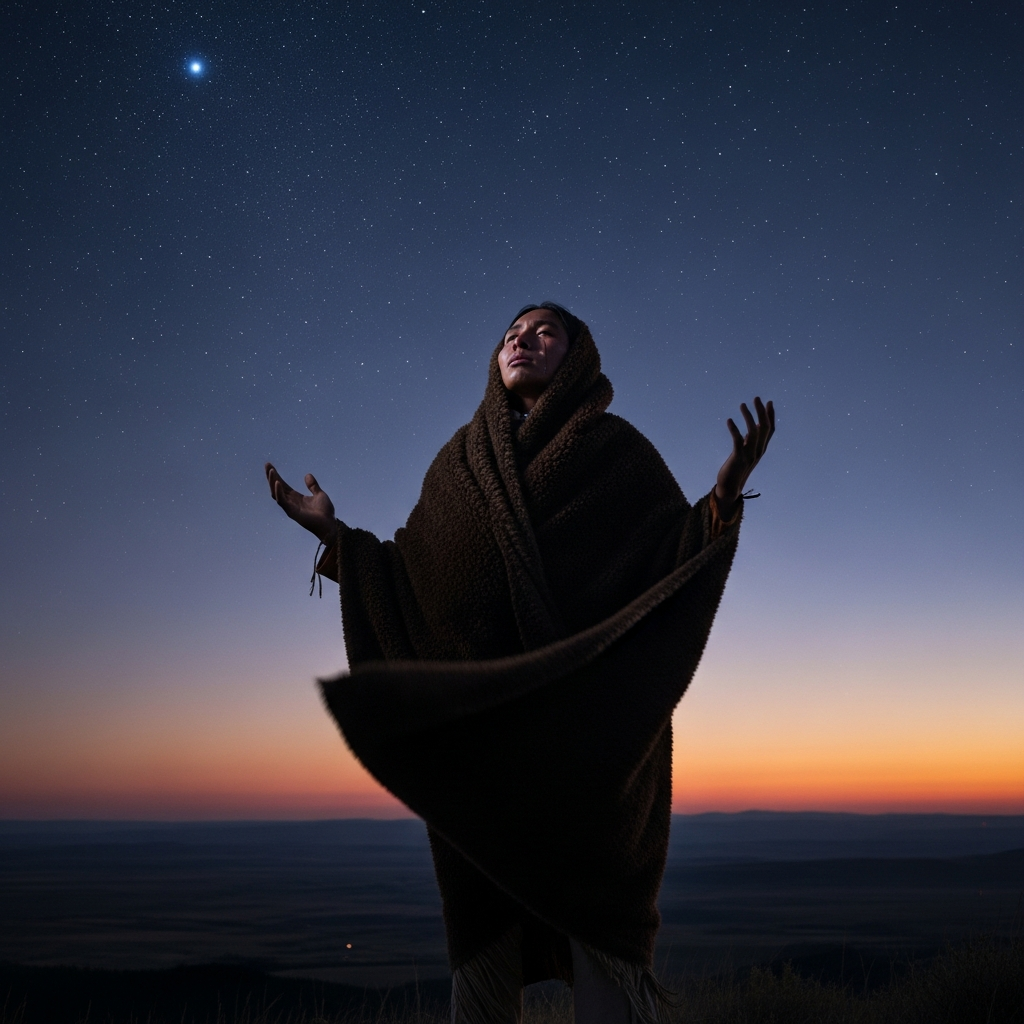
The Lakota vision quest — Hanbleceyapi, 'crying for a vision' — is a ritual of complete surrender: the seeker goes alone to a hilltop for four days without food or water, wrapped in a buffalo robe, and cries. Not metaphorically. He cries out loud, to the spirits, asking for a vision that will tell him who he is and what he must do. The vision comes, or it does not. Black Elk's vision at the age of nine is the most famous account of what comes.
- When
- Lakota tradition; Black Elk's vision c. 1872 CE; recorded by John G. Neihardt, *Black Elk Speaks* (1932)
- Where
- The Black Hills of South Dakota; the spirit world that overlays the physical landscape
He is nine years old when the vision comes.
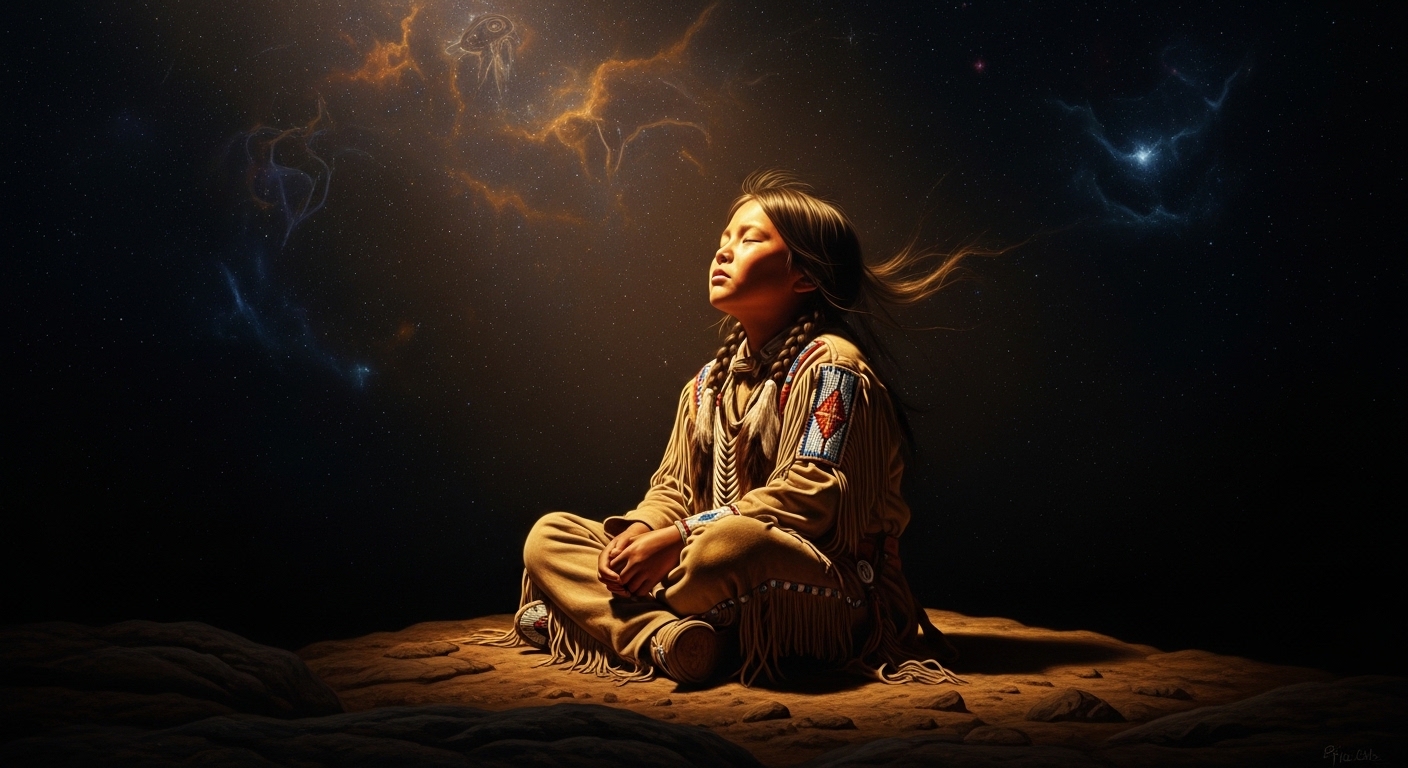
He has not gone to the hilltop. He has not prepared in the formal way. He is simply lying in his bed, sick with an illness that has lasted twelve days, when the sky opens and the two men appear, flying headfirst like arrows from the clouds, each carrying a spear and a song. They tell him to come.
He rises — his body stays lying in the bed, but he rises — and follows them into the cloud.
What follows is the Great Vision of Black Elk, Oglala Lakota, and it is the most extensively documented Indigenous American spiritual vision in the literary record, preserved first in John Neihardt’s transcription and then expanded in Raymond DeMallie’s scholarly edition. It is a vision that lasts, in its own time, for twelve days. It is a vision that shows Black Elk not only his own destiny but the shape of his people’s fate across the century to come.
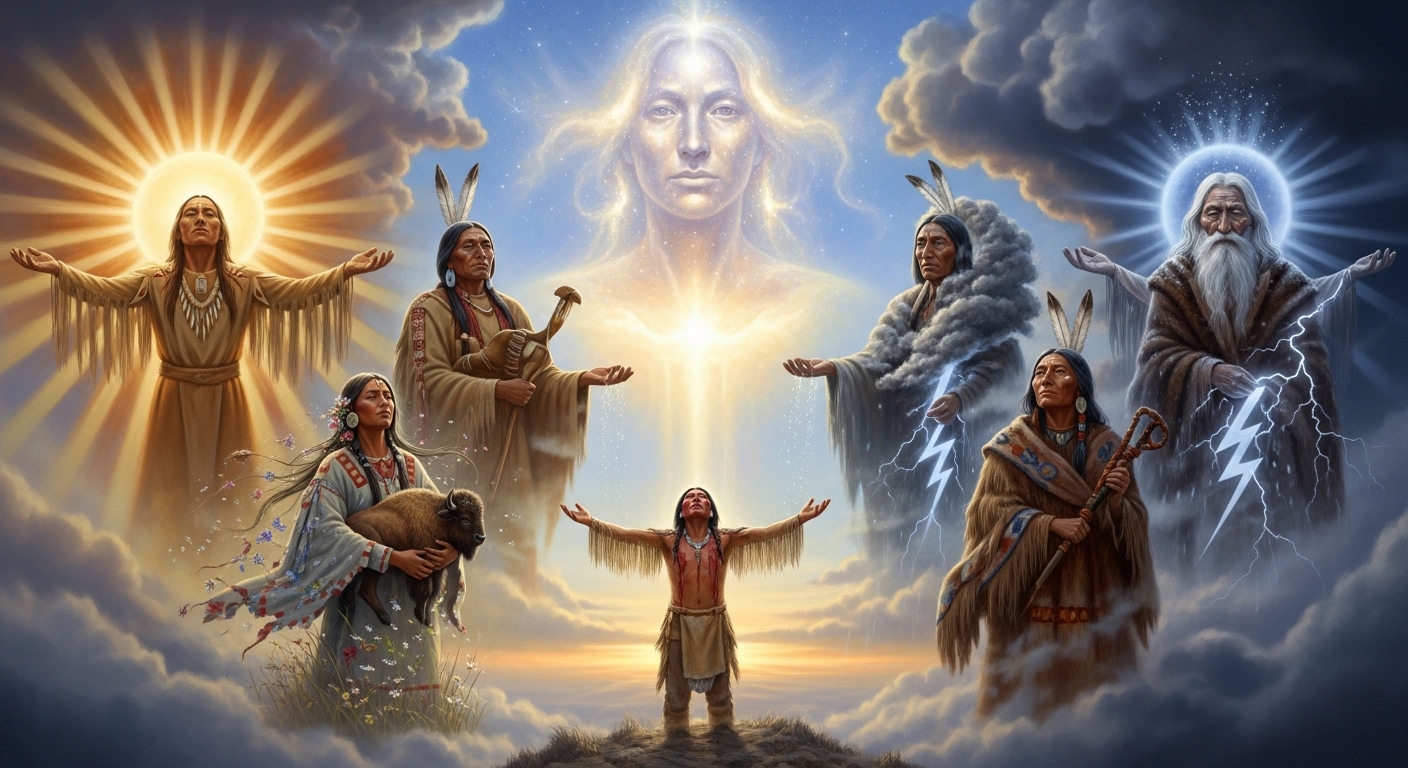
The Six Grandfathers are waiting for him.
They are the Powers of the World in their personified form.
The First Grandfather gives Black Elk a wooden cup full of water, the living power of the sky, and in the cup he sees the faces of all living things drinking. He gives him a bow and arrow. The Second Grandfather — the power of the north — gives him a white wing, the power of healing, and an herb. The Third Grandfather gives him a peace pipe. The Fourth gives him a red stick, the Flowering Tree. The Fifth is the spirit of the sky itself, a giant made of all sky-colors. The Sixth Grandfather has the face of a man, and then the face changes, and Black Elk realizes he is looking at himself — an old man.
He is given a task. He is shown his people’s nation as a great hoop, the sacred hoop that holds all the people together, and he is shown it breaking. He is taken through four ascents — four generations of his people — and shown the flowering tree at the center and the tree dying and the people scattered and the tree flowering again, all of this in the context of a world that is larger than any human political event.
He is nine years old. He receives all of this.
Then he wakes up in his bed. His mother is by him. His fever has broken.
He tells no one what he has seen.
This is the Hanbleceyapi in its formal, adult version.
A man who feels the calling goes to his spiritual elder — the holy man, the medicine person who knows the protocol — and asks to go on the hill. The preparation takes days: purification in the sweat lodge, prayer, the offering of the pipe, the ceremony that asks the spirits to receive the seeker. Then the man goes.
He is taken to a hilltop or a high place in the open country. He is left there with his pipe and his buffalo robe and nothing else. The elder and the helpers leave. He is alone.
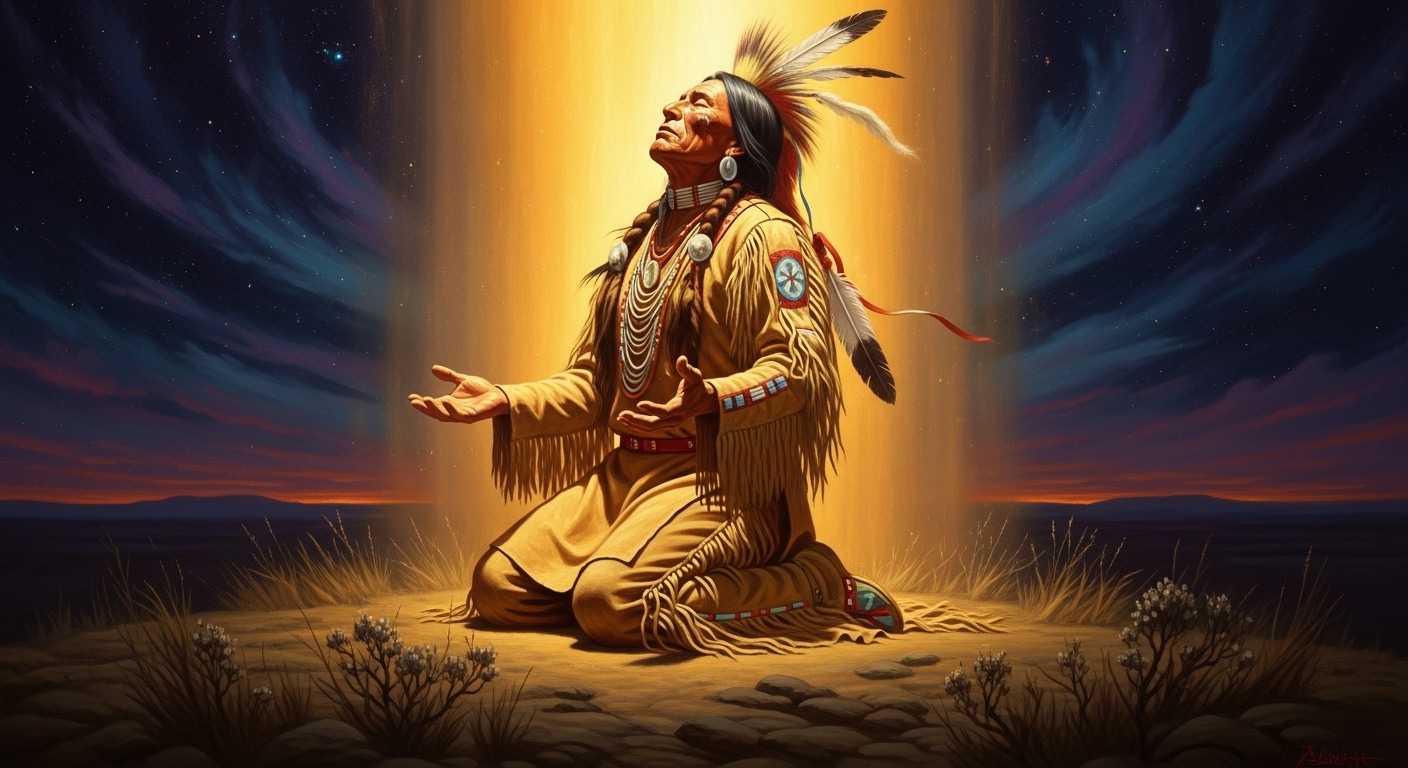
He stays for four days and four nights. No food. No water. He does not sleep if he can avoid it — or he sleeps with one part of his mind still watching. He cries. This is not a euphemism: the word Hanbleceyapi means literally ‘crying for a vision,’ and the crying is literal. He calls out to the spirits of the four directions, to the Thunder Beings, to the earth and sky, to his ancestors and his relatives in the spirit world. He makes himself completely available to whatever will come.
The vision comes, or it does not.
When a vision comes, it comes through the whole body.
This is the sensory reality of visionary experience that the Lakota tradition insists on: not a thought, not a symbol to be interpreted at a distance, but an encounter. The spirit beings arrive and they are present in the full sense. They speak and the seeker hears the words. They touch him and he feels the touch. The vision takes him somewhere and he goes there — his body is on the hilltop; his being is somewhere else entirely.
Black Elk’s vision came in childhood without the formal preparation, which the tradition understands as the spirits choosing the moment rather than the person choosing it. But the content was identical to what a prepared adult would seek: instruction, relationship, a commission that bound the recipient to a life of service.
The commission is the part that matters.
This is what separates the Hanbleceyapi from a merely interesting experience: the vision gives the seeker something to do. It does not deliver private consolation or personal assurance. It delivers purpose. The seeker returns from the hilltop knowing what he is for. And the knowing is a burden, because purpose is a burden — it requires living accordingly, which is harder than either having no purpose or having a purpose you choose yourself.
Black Elk carried his vision for thirty years before speaking it.
He carried it through the Battle of the Little Bighorn, which he witnessed as a boy. He carried it through the Ghost Dance movement, which he participated in with hope. He carried it through Wounded Knee — the massacre of 1890, where hundreds of Lakota men, women, and children were killed by the 7th Cavalry at the edge of a frozen creek. After Wounded Knee, he wrote, his great vision died with the sacred hoop of his people.
He carried it anyway.
He carried it through the years of the reservation, through the suppression of Lakota ceremony, through the period when the Hanbleceyapi and the sweat lodge and the Sun Dance were illegal under U.S. law. He carried it into old age, when he was a Catholic catechist who spoke openly about his faith in both traditions. He spoke it finally to Neihardt in 1930, on the side of Harney Peak in the Black Hills, because he was old and the vision was still in him and it had not been lived to its completion.
On the peak, he wept.
He prayed in Lakota — a prayer that Neihardt recorded and that DeMallie later published in the original language. He asked the Grandfathers whether the tree might yet flower. He said he knew he was a pitiful old man and that his people were broken. He asked anyway.
It rained. A small cloud came from the west and brought rain to the dry peak and then moved on. Black Elk took this as the answer.
The Hanbleceyapi continues.
The ceremony was revived in the second half of the twentieth century along with the Sun Dance and the sweat lodge, after the American Indian Movement and the Red Power era created space for the reclamation of suppressed practices. Young Lakota men and women go to the hilltop now as they have always gone: alone, without food or water, with the pipe and the robe and four days of open sky.
The vision comes, or it does not.
When it comes, it arrives in the same way it has always arrived: not as a metaphor, not as a psychological event to be interpreted later, but as a presence. The spirits are there. The Grandfathers speak. The tree is shown, flowering or broken or both at once, the hoop intact or shattered, the people scattered or gathered — and the seeker is given, if the spirits choose, some portion of understanding about what they are supposed to do in the world with the life they have been given.
They return from the hill. They go back to the elder and speak what they have seen, and the elder interprets it, and the interpretation becomes the direction of a life.
The Black Hills are still there — still visible on the horizon from the Lakota homeland, still sacred, still disputed, still the place where Black Elk wept on a peak and a small cloud came from the west.
The crying is still real.
That is the whole of the practice, and the whole of the teaching: go to the open place, give up everything that insulates you from direct contact with what is real, and cry. Not because the crying guarantees that something will come. But because the willingness to cry out — without armor, without mediation, without the protection of institution or text or tradition — is the only frequency on which certain things can be heard.
Scenes
Echoes Across Traditions
Entities
- Black Elk
- The Six Grandfathers
- The Bay Horse
- The Tree of Life
- The People
Sources
- John G. Neihardt, *Black Elk Speaks*, 1932
- Joseph Epes Brown, *The Sacred Pipe: Black Elk's Account of the Seven Rites of the Oglala Sioux*, 1953
- Raymond J. DeMallie, ed., *The Sixth Grandfather: Black Elk's Teachings Given to John G. Neihardt*, 1984
- Vine Deloria Jr., introduction to the 1979 edition of *Black Elk Speaks*
- Ella Deloria, *Speaking of Indians*, 1944
- Nick Estes, *Our History Is the Future: Standing Rock Versus the Dakota Access Pipeline*, 2019