Contents
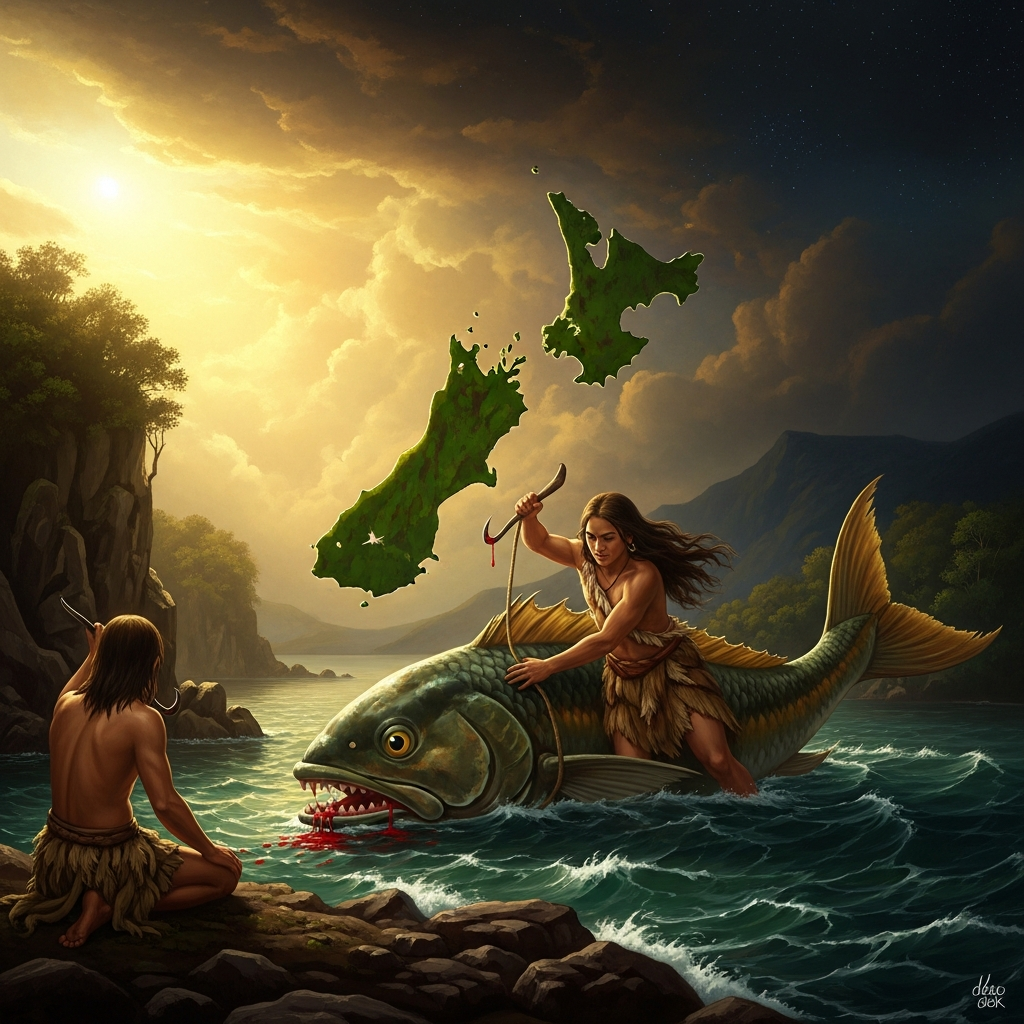
Using his grandmother's jawbone as a fishhook and his own blood as bait, the demigod Māui hauls Te Ika-a-Māui — the great fish of Māui — up from the deep ocean floor, and it becomes the North Island of New Zealand.
- When
- mythic time — the shaping of the world
- Where
- The deep ocean south of Hawaiki — the ancestral homeland
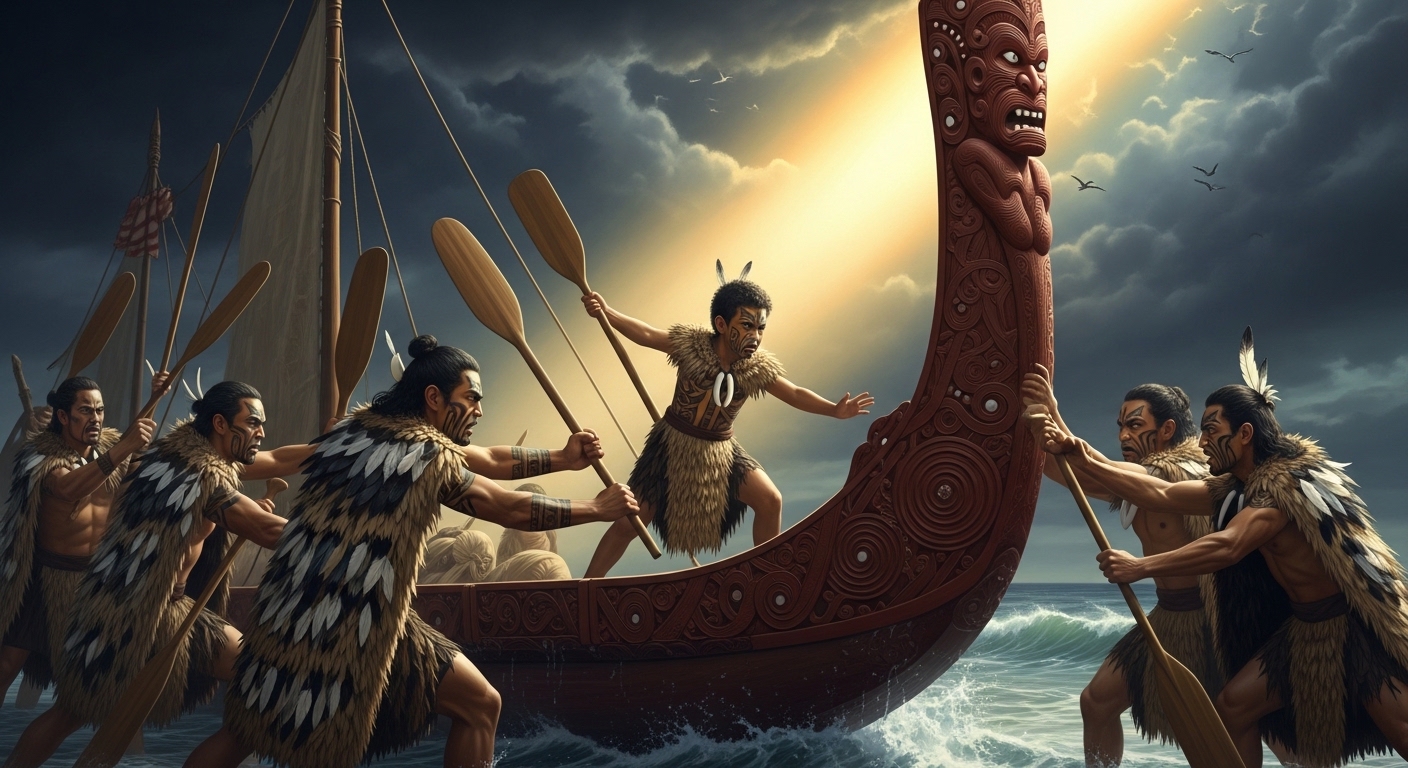
Māui’s brothers do not want him on the canoe.
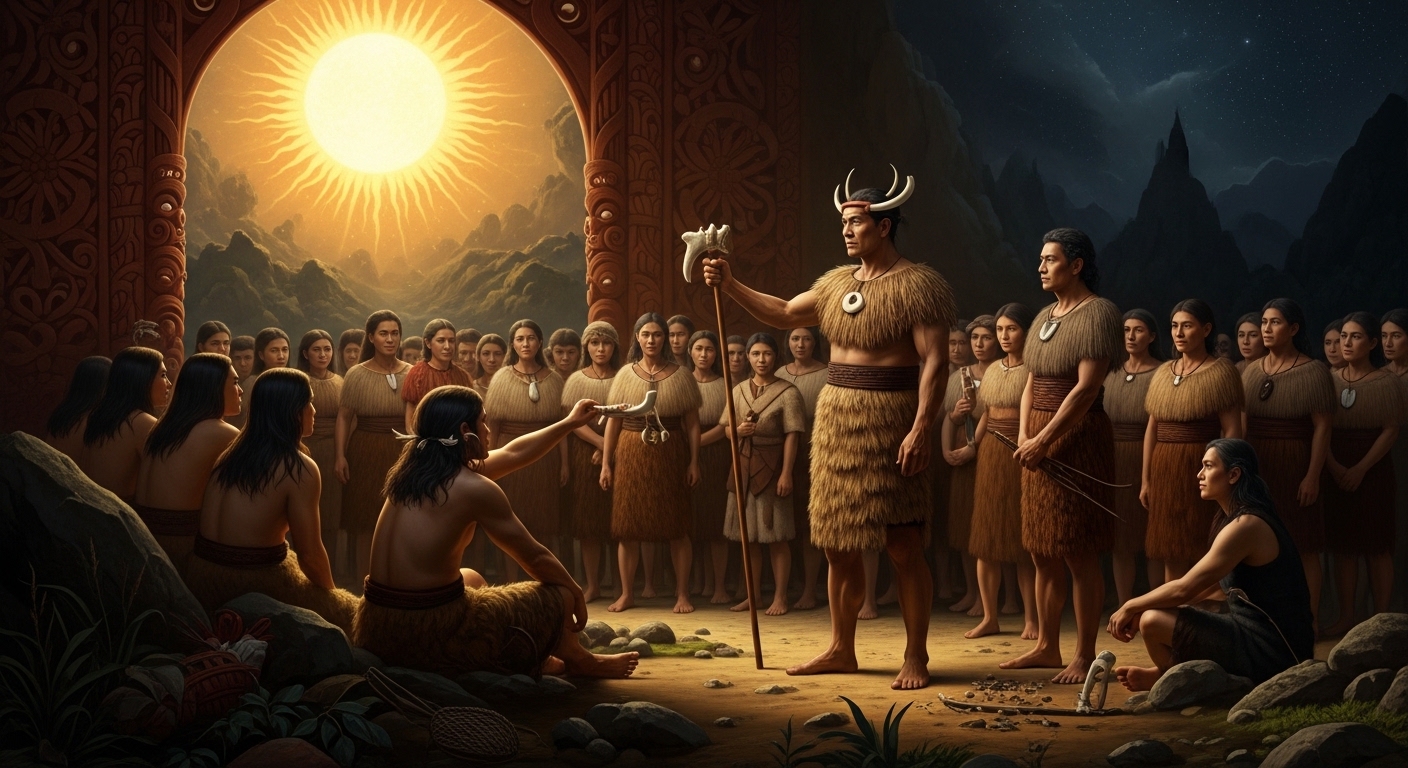
He is the youngest. He is the one who was born premature and cast into the sea in his mother’s topknot — who survived, who was raised by his ancestor Tama-nui-ki-te-rangi, who returned to the family already strange and already powerful. His brothers have watched him slow the sun. They know what he is. They still do not want him on the canoe, because men who do impossible things make ordinary men nervous.
He hides in the canoe beneath the floorboards.
When they are far enough out that turning back would be unreasonable, he reveals himself. His brothers argue, then accept the inevitable. They paddle further, far past the fishing grounds they know, far past the edge of the charts any navigator has described, into deep water above a place Māui says is there.
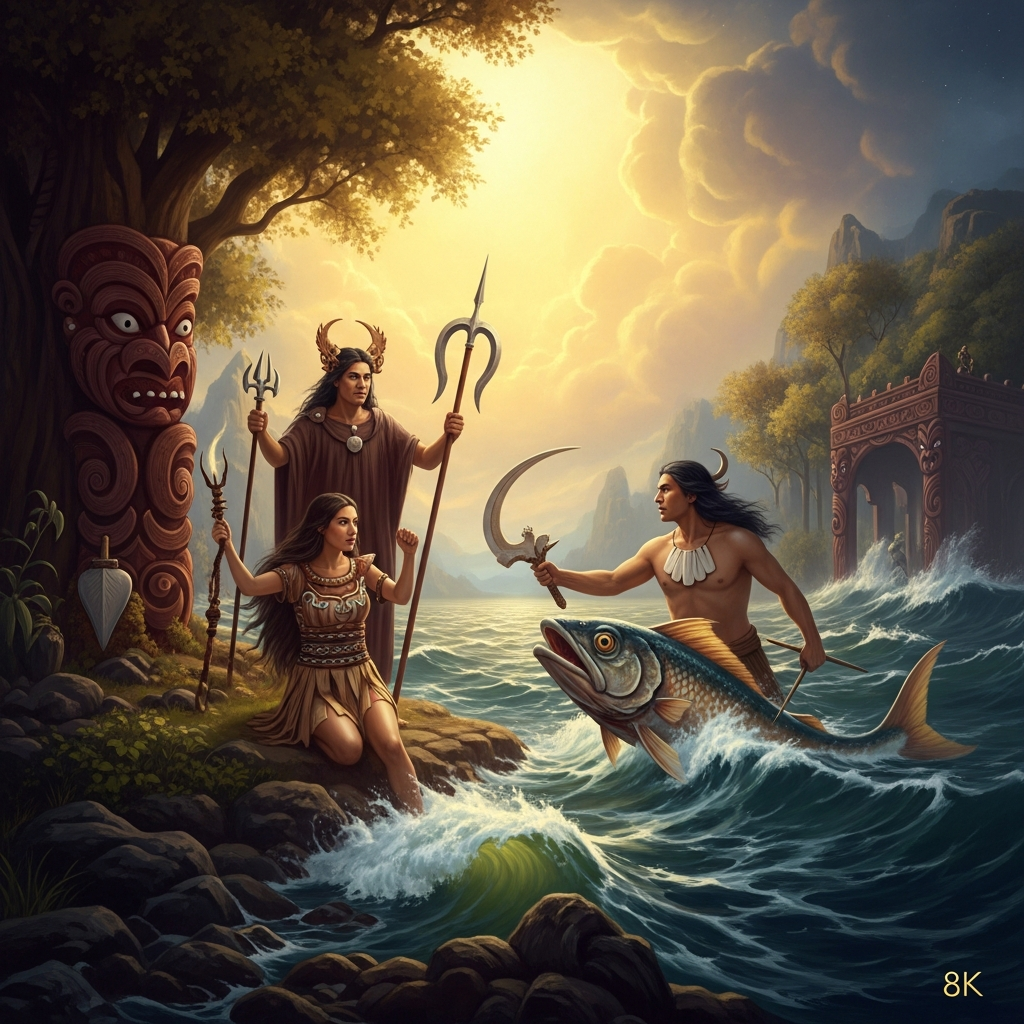
He brings no fishing equipment. Instead he pulls out his grandmother Muriranga-whenua’s jawbone — the same instrument he used against the sun — and asks his brothers for some bait. They refuse. He strikes his own nose with the jawbone and lets the blood drip onto the carved hook.
He lowers the line into water of unknown depth.
For a long time, nothing. Then the line tightens. Not with the pull of a fish — with something else, something that feels like the ocean floor itself deciding to move. Māui leans back and hauls. His brothers watch the sea change color, green going dark, dark going black, black going the color of something enormous rising toward the light.
Te Ika-a-Māui breaks the surface.
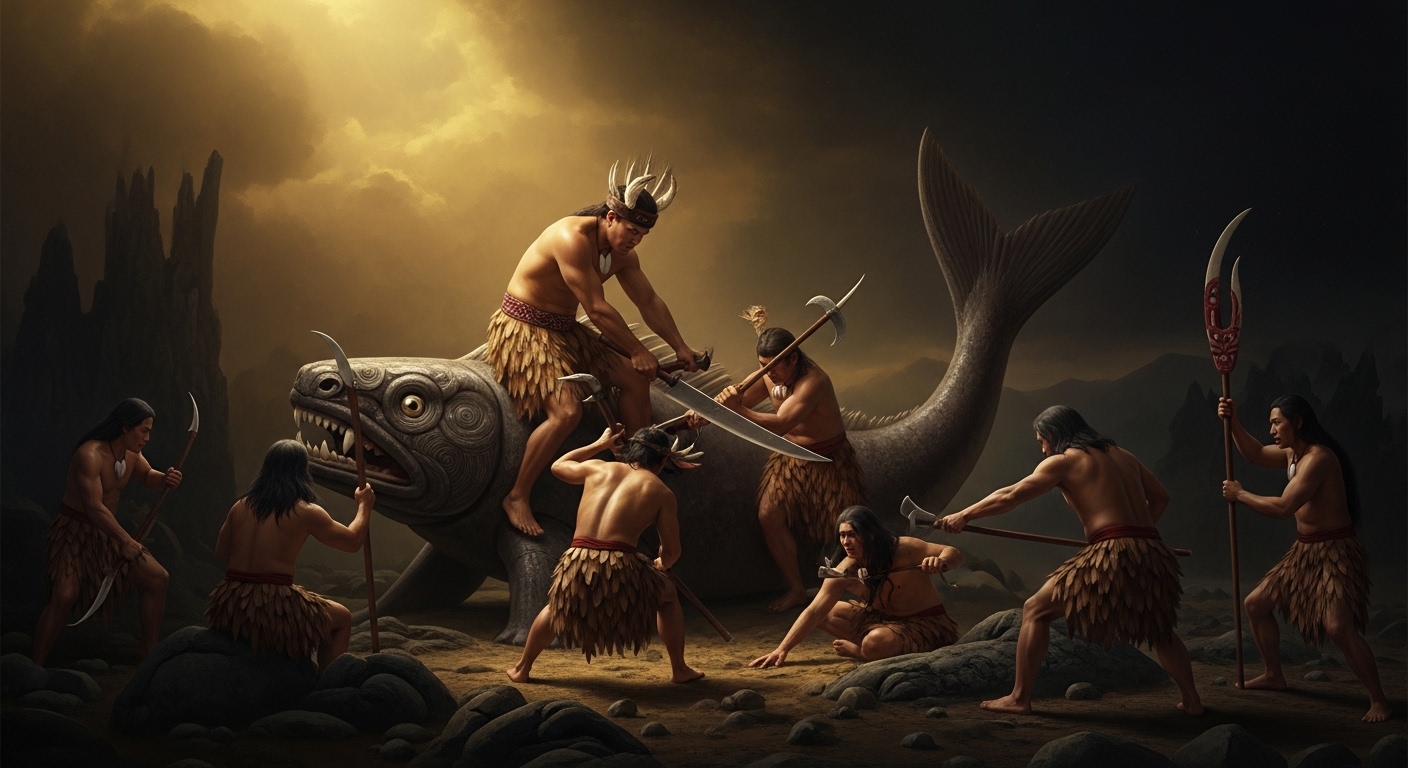
It is not a fish in any familiar sense. It is a landmass — a great flat-backed creature whose ridgeline forms a spine from one end to the other, whose movements make rivers, whose breathing makes valleys. It is still alive when it comes up. Māui leaves his brothers with it and goes to find a priest to properly dedicate it before it can be divided, before anyone can claim pieces of it or begin cutting.
His brothers do not wait.
The moment Māui’s back is turned, they begin hacking. This is the error — cutting a living thing without ceremony, without asking the atua, without the words that would still the creature before the knives go in. Te Ika-a-Māui reacts the way any living thing reacts to an unexpected blade: it thrashes. It heaves and buckles and bends. Mountains rise where the fish’s back arches. Valleys sink where the body folds. Rivers pour from wounds. The smooth flat land that could have been is lost forever, and in its place is the rugged, spectacular, exhausting terrain that is the North Island of New Zealand — a fish whose death no one managed properly, still moving under the feet of everyone who has ever lived there.
Māui returns to find the ceremony too late to perform.
He does not punish his brothers. He stands at the canoe’s edge and looks at what the North Island has become: a wild, broken, beautiful thing, hills stacked against hills, harbors cutting inland, great volcanic shapes pushing skyward. A fish that fought back.
He is not entirely disappointed. The world has never been exactly what he intended — it has always been what the world decided to make of his interference. The North Island, ruined and magnificent, is no different. It is Māui’s work. It is also its own.
Scenes
Echoes Across Traditions
Entities
- Māui-tīkitiki-a-Tāranga
- Te Ika-a-Māui (the North Island)
- Māui's brothers
Sources
- Sir George Grey, *Polynesian Mythology* (1855)
- Elsdon Best, *Maori Mythology* (1924)
- Te Ara — The Encyclopedia of New Zealand, 'Māui' entry
- Margaret Orbell, *The Illustrated Encyclopedia of Māori Myth and Legend* (1995)