The Naga Fireballs of the Mekong
End of Buddhist Lent (Awk Phansa), full moon of the 11th lunar month; tradition documented from at least the 19th century CE · The Mekong River at Nong Khai, Thailand, and Vientiane, Laos
Contents
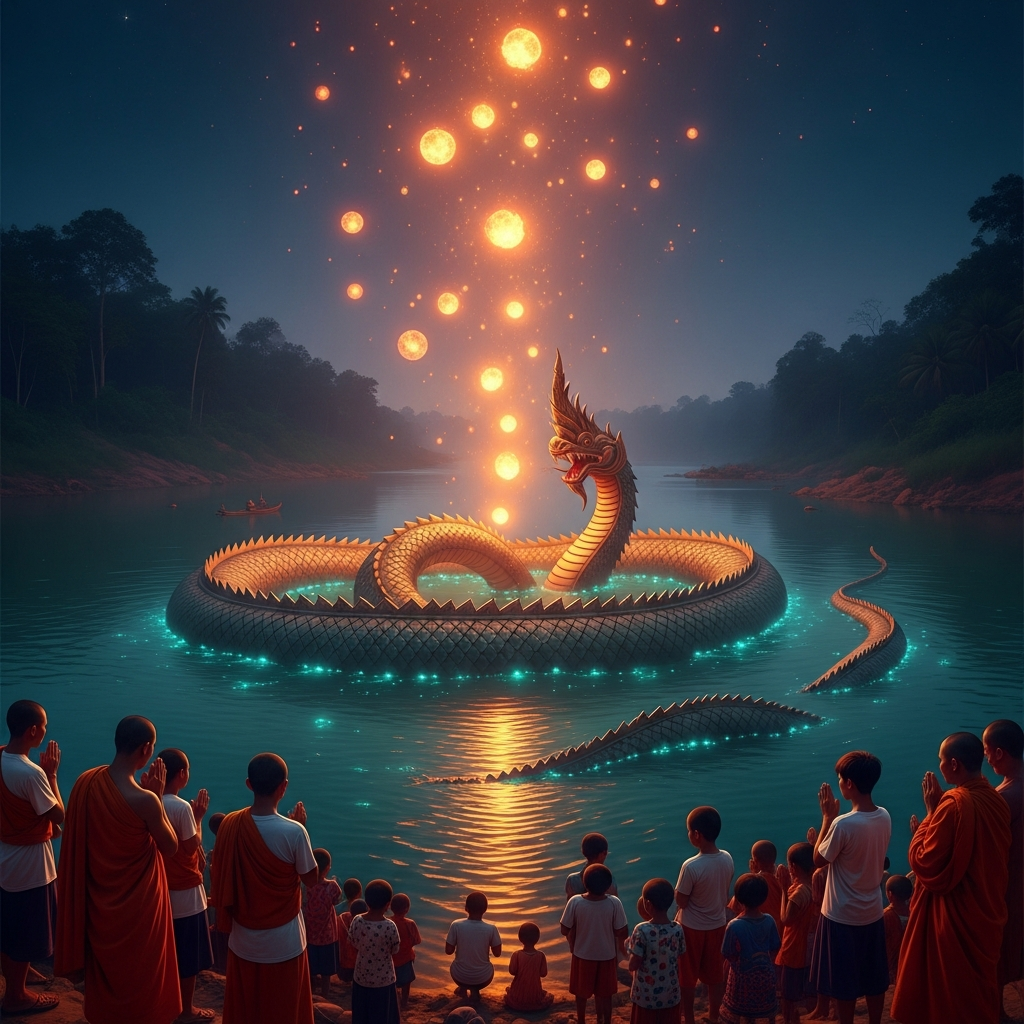
Every year at the end of Buddhist Lent, glowing balls of light rise silently from the Mekong River and float into the sky — explained by locals as the breath of the great Naga Phaya Naga who lives in the river's depths, celebrating the Buddha's return from heaven. The fireballs are real. Their explanation is the myth.
- When
- End of Buddhist Lent (Awk Phansa), full moon of the 11th lunar month; tradition documented from at least the 19th century CE
- Where
- The Mekong River at Nong Khai, Thailand, and Vientiane, Laos
On the night of the full moon at the end of Buddhist Lent, the river breathes.
The Mekong is wide here at Nong Khai — wide enough that Vientiane on the Lao bank seems in another country, because it is. The river runs fast in October, full from the monsoon, carrying the silt of the mountains downstream to the delta. On this particular night, the banks on both sides are crowded: monks and laypeople standing at the water’s edge, some having been here since before sunset, all of them watching the river.
They are waiting for the Naga.
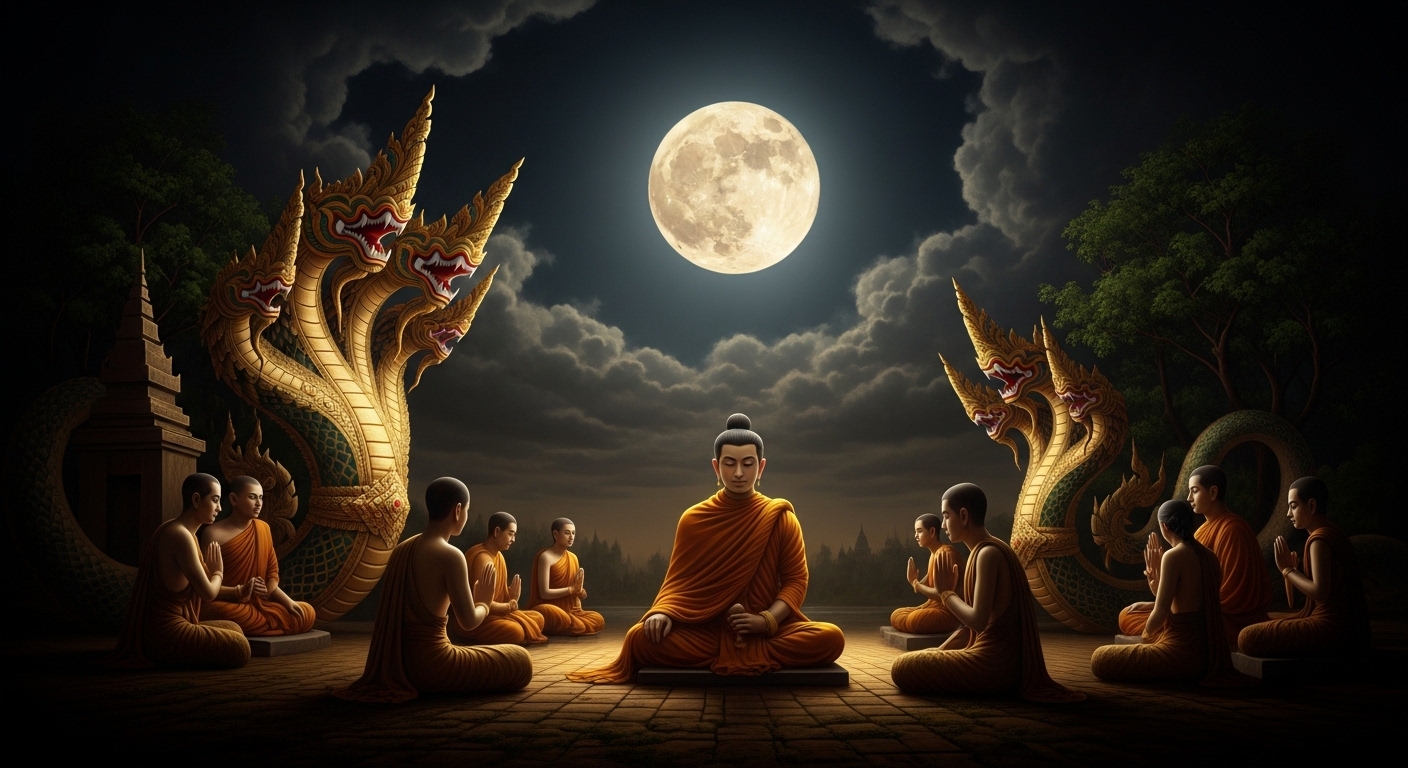
The full moon of the eleventh lunar month is Awk Phansa — the end of the Buddhist Rains Retreat, the three months when monks stay in their monasteries and the world holds a kind of collective breath. It is the night, in the Thai and Lao Buddhist calendar, when the Buddha returns from Tavatimsa heaven where he has been preaching the Dhamma to his mother. He descends from heaven on a crystal staircase, flanked by Indra on his right and Brahma on his left. The world is lit with celebration: gods and humans and all the beings in the six realms marking his return.
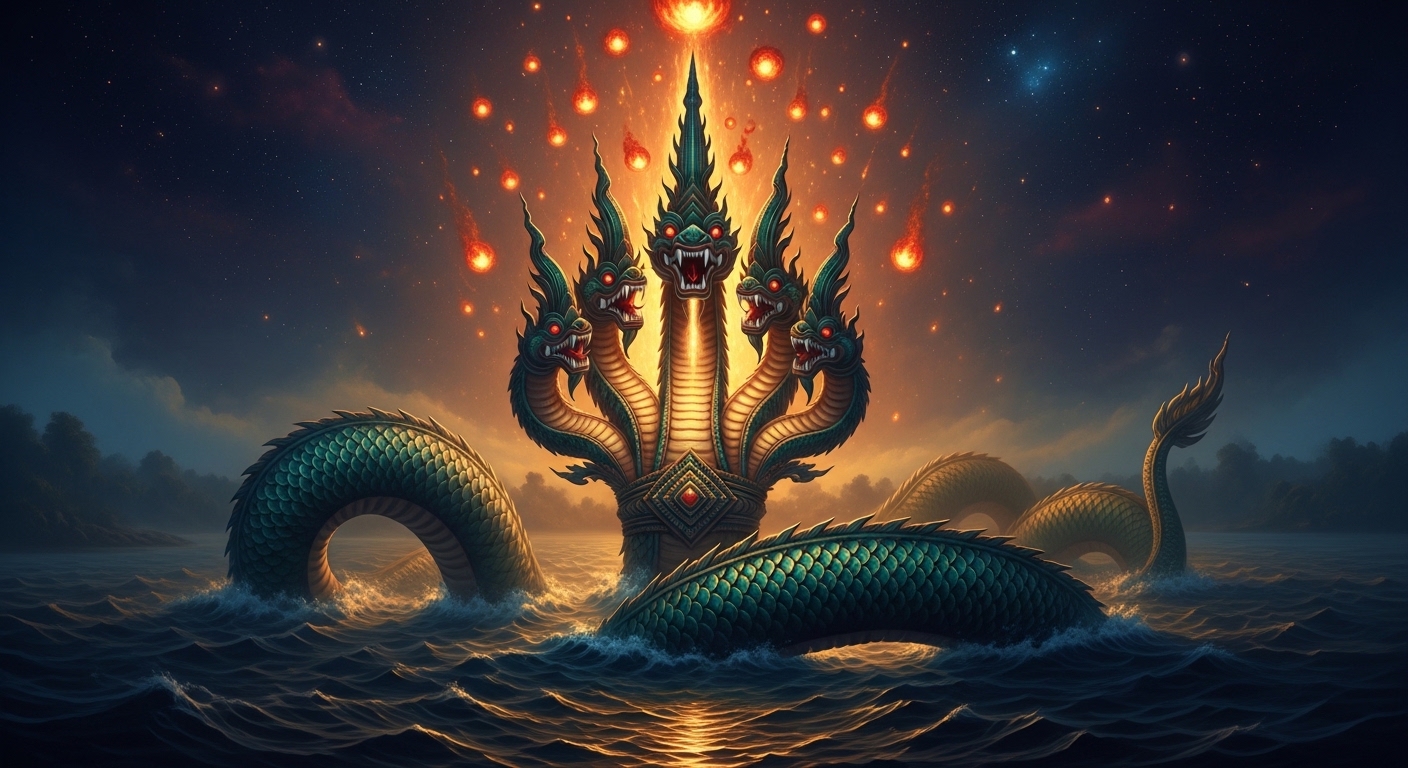
And in the river, Phaya Naga — the great serpent king who has always inhabited the Mekong’s depths — rises to celebrate with them.
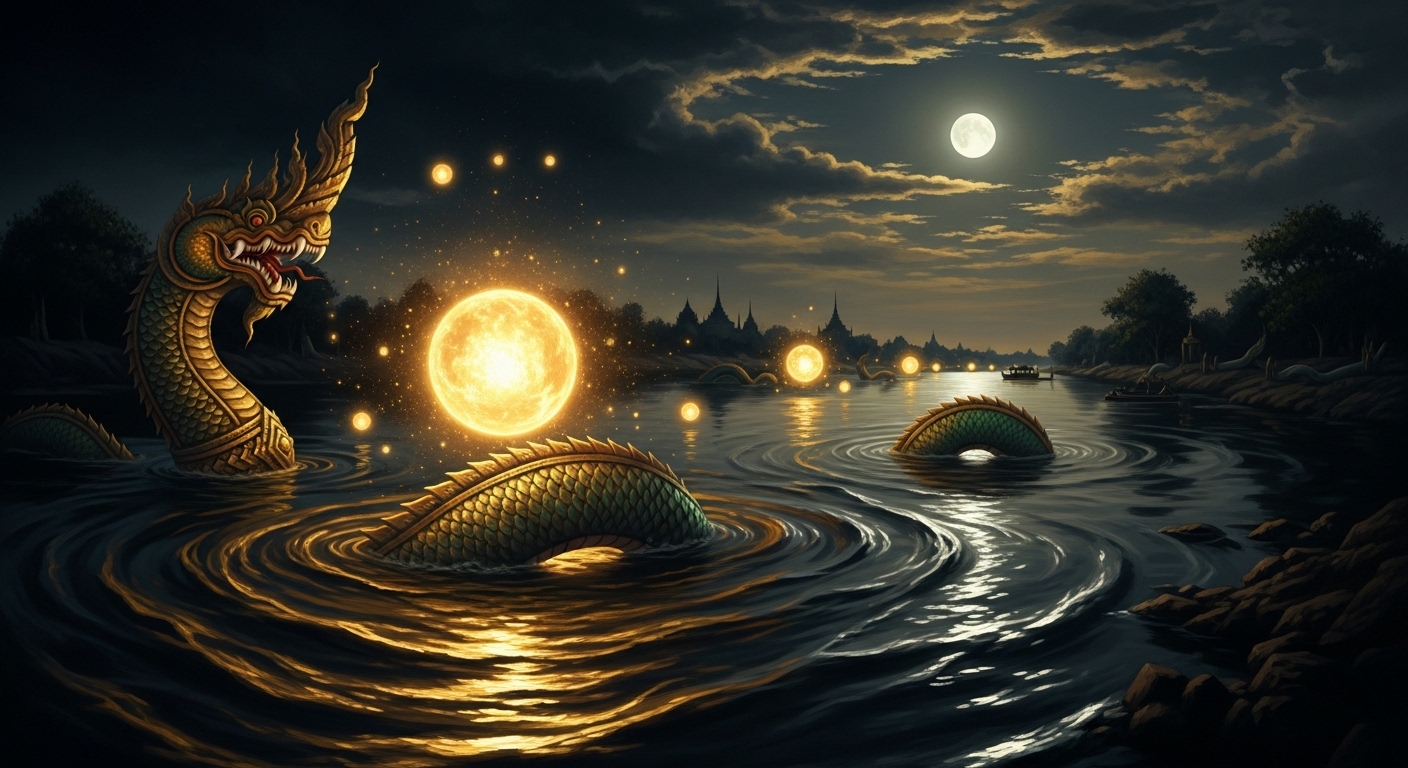
He does not rise physically. He rises in the way that a river spirit rises: through the release of his breath, the exhalation of his joy at the Buddha’s return. The breath rises through the water column, through the dark fast current, through the brown opacity of the monsoon-swollen river, and it breaks the surface as light.
The fireballs.
They are small — the size of a coconut, or a football, or a fist, depending on who you ask and which year. They are pink or red or orange. They rise silently from the surface of the water without smoke, without the sound of combustion, without the flickering of ordinary fire. They rise slowly at first and then faster, rising perhaps thirty meters into the air before fading — hundreds of them, or thousands, rising all along the stretch of the river from Nong Khai to Phon Phisai, on both banks, across the political boundary that the Mekong marks between Thailand and Laos.
The crowds cheer. The monks chant. The fireworks that humans set off in celebration are flashy and loud, but everyone knows the difference between the human fireworks and the Naga fireballs. The human fireworks have sounds. The Naga fireballs are silent.
Scientists have proposed explanations: methane from the river sediment, igniting as it rises through warm shallow-water conditions; plasma generated by geomagnetic activity along the river’s course; hoaxes involving submerged flares. The debates continue. The phenomenon has been documented by multiple independent observers across many decades. The exact mechanism remains genuinely disputed.
The people at the riverbank are not waiting for an explanation.
The myth is not trying to explain the fireballs scientifically. The myth is trying to explain why the fireballs matter.
Phaya Naga is not a metaphor for methane. He is the consciousness of the river — the quality of aliveness that a river has when it is understood as a being rather than a resource, when it is addressed rather than merely used. The Mekong has been a living entity in the religious imagination of the peoples along its banks for as long as those peoples have been there: it gives food, it floods, it retreats, it carries the dead downstream, it connects the high mountains to the sea. It is not neutral.
The Naga tradition names the river’s personality. It says: there is a being in there, and it has preferences, and on certain nights, under the right conditions, it expresses itself. The expression is not threatening. The fireballs are not omens of disaster. They are the Naga’s celebration of the Buddha’s return — which means they are the river celebrating the same thing the people on its banks are celebrating, which means the celebration is not divided between the human world and the natural world but shared across the boundary.
This is what mythological thinking can do that scientific thinking cannot: it can make the fireballs a gesture of participation rather than a phenomenon to be explained. The Naga is not causing the lights; the Naga is expressing something through the lights, the way a person expresses joy by lighting candles on a festival night.
The festival of Awk Phansa at Nong Khai draws hundreds of thousands of visitors now. Hotels fill months in advance. The government promotes it as ecotourism. Thai and Lao authorities manage the border crossing so that families can watch from both banks simultaneously.
And on the night of the full moon, the river still does what it has always done.
The fireballs rise. They rise silently from the brown water, pink and round and without smoke. The monks who have been in retreat for three months stand at the river’s edge and watch with the same attention they give to the dawn chanting. The children who have grown up watching this from their grandparents’ shoulders describe the exact color in the same words their grandparents used. The television cameras attempt to capture it and succeed technically and fail at everything else — the way cameras always fail at the thing that matters, which is the quality of silence on the riverbank when the lights appear and ten thousand people, for a moment, stop making noise.
Phaya Naga breathes.
The Buddha returns.
The river celebrates.
The year turns.
Scenes
Echoes Across Traditions
Entities
- Phaya Naga (the Naga king)
- the Buddha
- the monks who witness
- the river itself
Sources
- Patrice Lawergren, 'The Naga Fireballs of the Mekong,' *Journal of Scientific Exploration* 17.2 (2003)
- Charles Keyes, *The Golden Peninsula: Culture and Adaptation in Mainland Southeast Asia* (1977)
- Phra Ratchawutthikhan (Ratchaburi), *Tamnan Naga Khong Mae Nam Khong* (The Legend of the Mekong Naga) (1978, Thai)
- Donald Swearer, *The Buddhist World of Southeast Asia* (2nd ed., 2010)
- Santi Pakdeekham, 'Naga in the Mekong Region,' in *Sacred Rivers* ed. J. Kelly (2019)