Oisín in the Land of the Young
circa 200 BCE — 200 CE mythic time; the medieval literary tradition places it in early Christian Ireland · Tír na nÓg — the Otherworld isle beneath or beyond the western sea; and the plains of Ireland
Contents
A fairy woman rides to the Fianna on a white horse and invites the warrior-poet Oisín to the Land of the Young, where three hundred years pass like a single afternoon — until homesickness breaks the spell and three centuries of age crash down all at once.
- When
- circa 200 BCE — 200 CE mythic time; the medieval literary tradition places it in early Christian Ireland
- Where
- Tír na nÓg — the Otherworld isle beneath or beyond the western sea; and the plains of Ireland
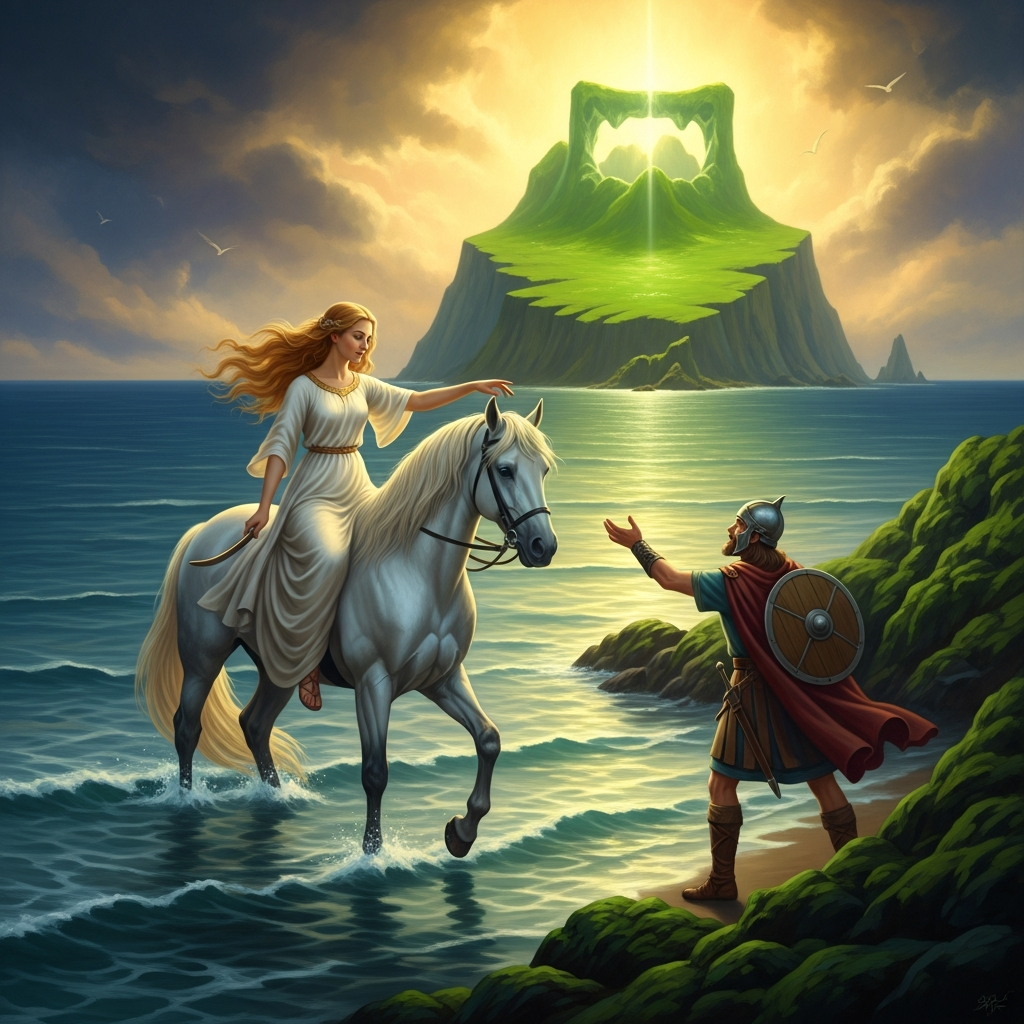
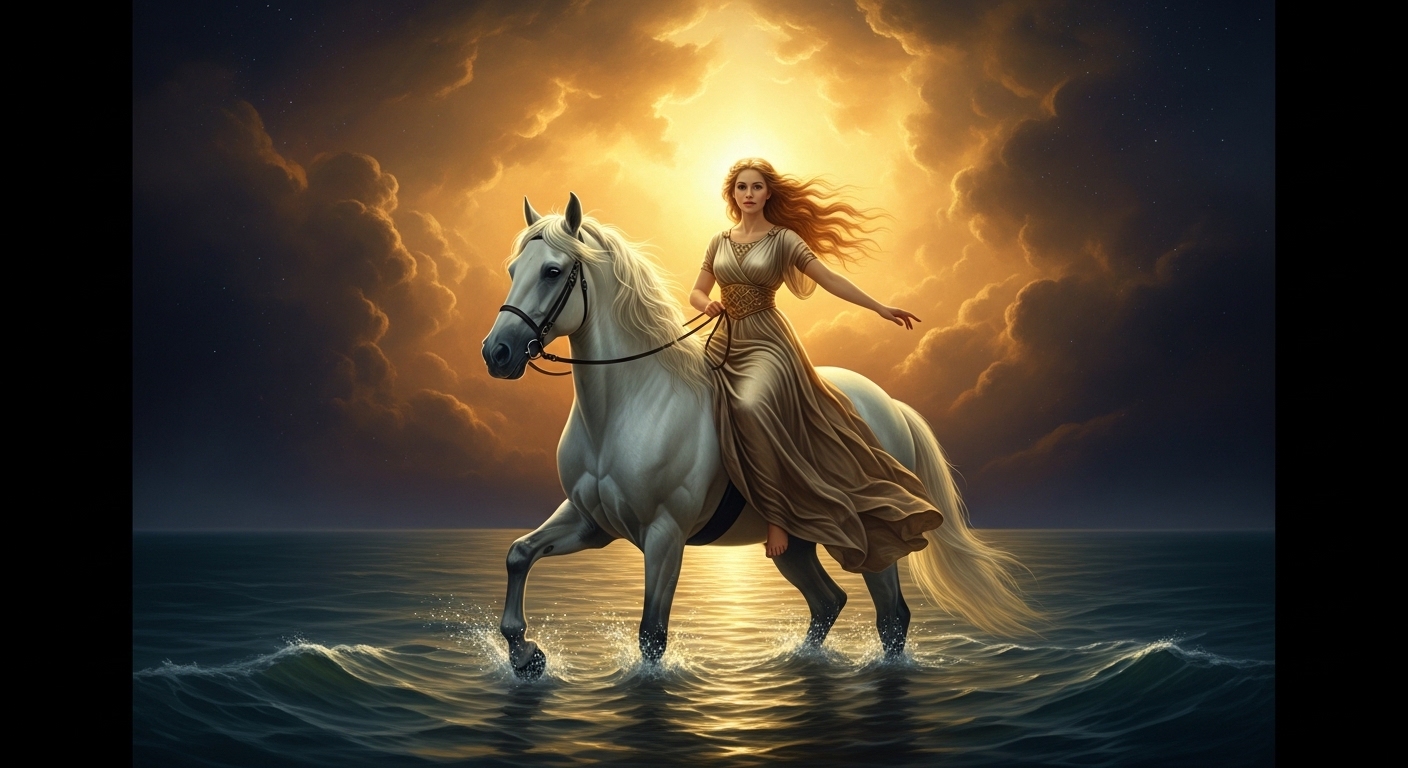
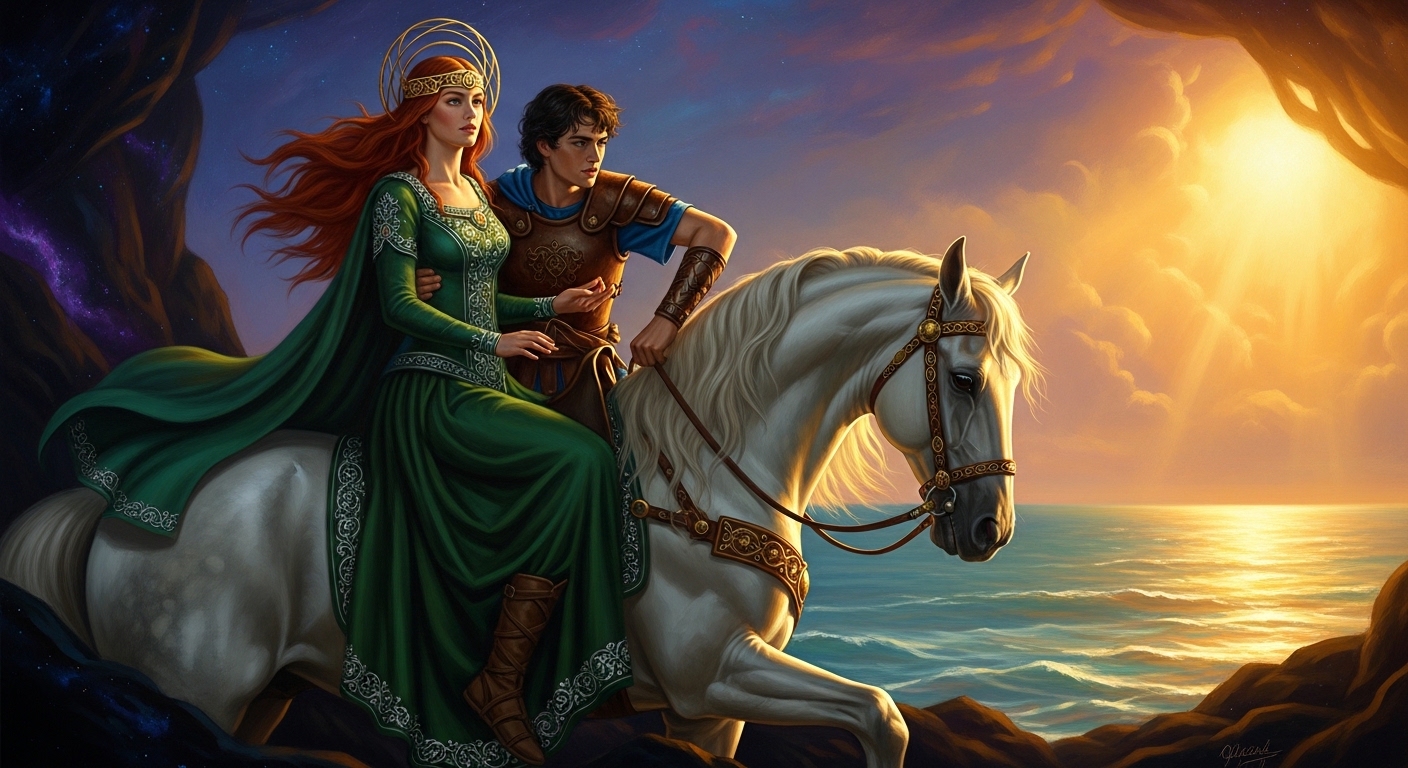
She rides out of the western sea on a white horse whose hooves barely touch the surface of the water.
Niamh of the Golden Hair — daughter of Manannán Mac Lir, lord of the Otherworld sea — comes to the Fianna’s hunting camp on a horse that is the color of cloud, mane and tail braided with gold, eyes the color of the water it walks on. The Fianna stop what they are doing. Even Fionn puts down the hound he is petting.
She has come for Oisín, poet of the Fianna, Fionn’s son.
She tells him what she offers: Tír na nÓg, the Land of the Young, where there is no sickness, no age, no death, no sorrow. Honey and wine. Music every night. And herself, Niamh, as his companion. She has watched him from the Otherworld for a long time. She has chosen him because she heard his poetry and his poetry is the finest in the world.
Oisín is a warrior and the son of a warrior and a member of the most famous war-band in Ireland. He is also a poet, which means he already lives in two registers simultaneously. He looks at his father, who says nothing, and at the white horse, which waits, and at Niamh, who watches him with patience.
He climbs up behind her. The horse turns back toward the sea.
His father watches the horse walk back across the water until it is gone.
In Tír na nÓg there is exactly what Niamh promised. Beauty. Music. No dying. Oisín writes poetry and fights the battles that the Otherworld requires of its warriors and sleeps beside Niamh in a palace that makes Tara look like a roundhouse. He has three children. He is, by every measure available in the Land of the Young, happy.
Three years pass. He becomes homesick.
This is the pivot that all the beauty cannot prevent. Not unhappiness — simple longing. He misses the sound of the Fianna’s hounds in the morning. He misses the particular quality of Irish rain. He misses his father.
Niamh lets him go with one instruction: do not dismount. Do not let your feet touch the ground of Ireland. If you touch the ground, you cannot come back.
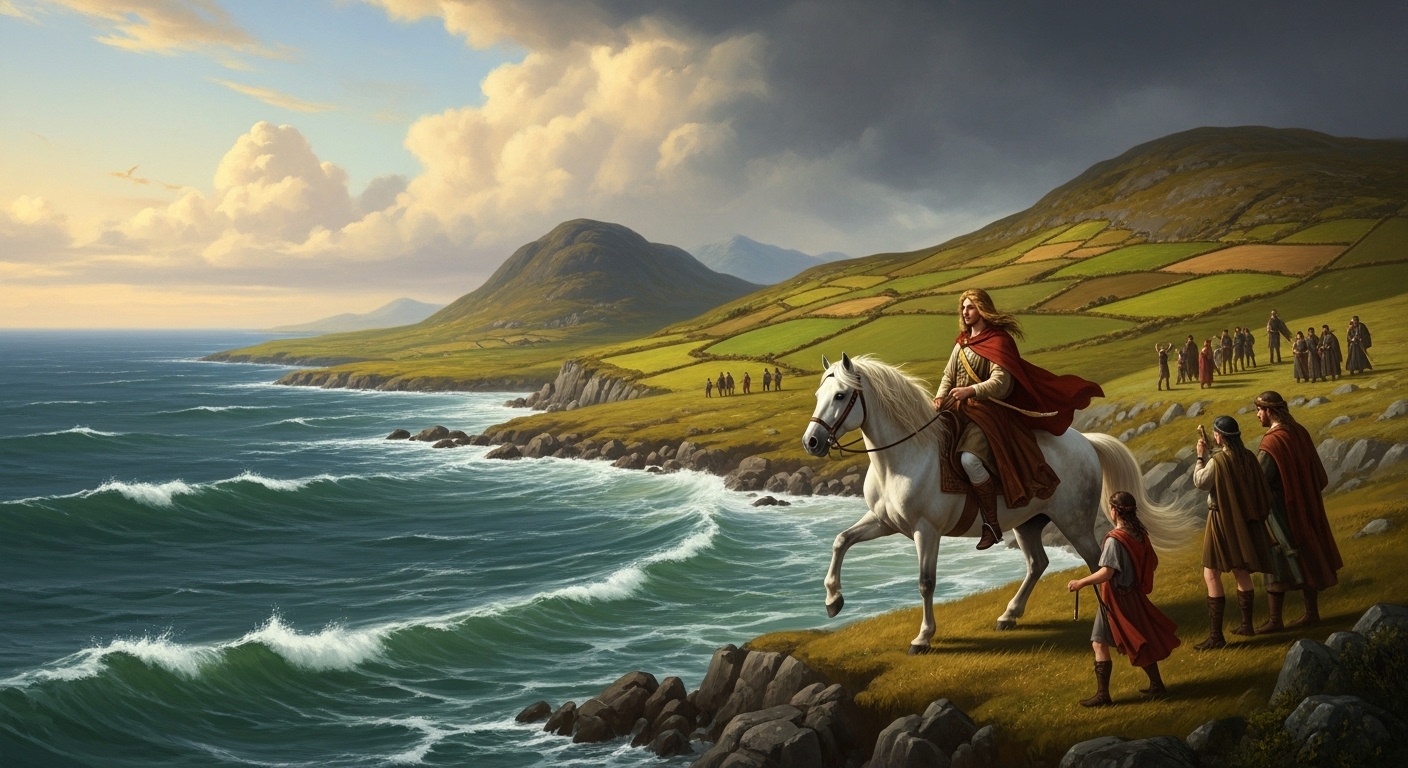
He rides the white horse across the sea. He crosses the Irish coast and the horse carries him across a landscape he doesn’t recognize — smaller hills, different-shaped fields, smaller men. He passes a group of workers trying to move a boulder and something in him moves before he thinks. He leans down to help them shift the stone.
The girth breaks. He falls.
The moment his feet touch the Irish soil, three hundred years arrive. Not a metaphor: the accumulated years of a normal human life, three centuries of them, landing simultaneously. The white horse turns and gallops back toward the sea without him. The workers scatter from the ancient thing writhing on the ground, the white-bearded ancient man who was a young warrior a moment ago and is now collapsing into himself like a building that has been waiting for permission to fall.
He survives it, after a fashion. Patrick finds him — the bishop who is reorganizing Irish religion and writing down its myths while transforming them — and in the late medieval texts, Oisín and Patrick have long debates. Oisín refuses to apologize for the Fianna. He describes the feasts and the hunts and the companionship of men who were better than the monks and clergy Patrick prefers. Patrick listens and writes it all down.
The old man’s voice is the only part of him that age cannot fully reach. The poetry, the particular weight of witness that comes from having been in two worlds — the poetry survives.
Fionn has been dead for three hundred years. The horse is gone. The Otherworld is closed to him now. He dictates the Fianna’s deeds to the bishop’s scribes and the scribes write them down and in this way the warrior-poet of the Fianna outlasts everyone, including himself.
Scenes
Echoes Across Traditions
Entities
- Oisín
- Niamh of the Golden Hair
- Fionn Mac Cumhaill
- Patrick (Saint)
- The Fianna
Sources
- Standish Hayes O'Grady, ed. and trans., *Silva Gadelica* (Williams and Norgate, 1892)
- Nora Chadwick, *The Celts* (Penguin, 1970)
- Dáithí Ó hÓgáin, *Myth, Legend and Romance: An Encyclopaedia of the Irish Folk Tradition* (Prentice Hall, 1990)